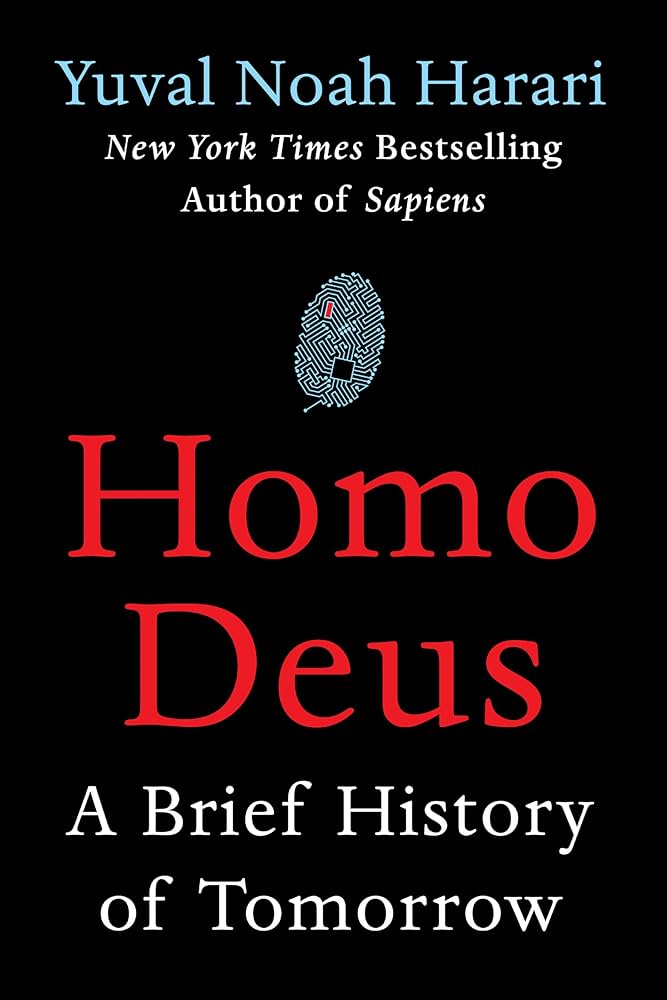
Homo Deus – Yuval Noah Harari
Detailed Description of the Book
Homo Deus: A Brief History of Tomorrow looks forward, asking what happens after humanity has largely tamed famine, plague, and large-scale war. Harari argues that the next great human projects are likely to be immortality (life extension), happiness (bio-chemical and psychological control), and divinity (god-like powers through technology).
The book examines how data, algorithms, biotechnology, artificial intelligence, and surveillance capitalism may reshape:
-
Human agency and free will
-
Democracy and equality
-
Employment and dignity of labour
-
Ethics, responsibility, and meaning
-
Power relations between states, corporations, and individuals
Harari introduces the idea of Dataism—a worldview where data flows and algorithms become the ultimate authority, potentially replacing human judgment, democratic choice, and moral reasoning. A central warning of the book is the emergence of a “useless class”—people rendered economically irrelevant by automation, leading to deep inequality and political instability.
The following extracts may be used in OPSC answer writing:
“The most important question in the 21st century will be what to do with all the useless people.”→ GS-3 / Essay: Automation, future of work, inequality, social security
“Those who control the data control the future.”→ GS-2 Governance / Essay: Data governance, digital sovereignty, surveillance capitalism
“In the 21st century, the most important struggle will be for control of information.”→ GS-2 / Essay: Information power, cyber security, misinformation
“Algorithms may soon know us better than we know ourselves.”→ GS-4 Ethics / GS-2: Privacy, autonomy, behavioural manipulation
“Free will is just a myth invented by humans.”→ GS-4 / Essay: Ethical debate on determinism, AI decision-making
“If we are not careful, equality may be the first casualty of technological progress.”→ GS-3 / GS-4: Tech-driven inequality, inclusive innovation
“Technology is never deterministic; it is shaped by human choices.”→ GS-4 Ethics / GS-2: Responsible governance of AI and biotech
“Humanism is under threat.”→ GS-4 / Essay: Decline of human-centric ethics, rise of algorithmic authority
“In the future, power will be concentrated in the hands of those who own algorithms.”→ GS-2 Governance / Essay: Big Tech power, regulation, antitrust
“The biggest revolution of the 21st century may be the fusion of biotechnology and information technology.”→ GS-3 / Essay: Bioethics, genetic engineering, AI–biotech convergence
“What humans fear most is not extinction, but irrelevance.”→ Essay / GS-4: Dignity of labour, psychological impact of automation
“Once technology can shape human desires, politics will become obsolete.”→ GS-2 / Essay: Threats to democracy, manipulation vs consent
(Use as a cautionary argument.)
“The danger is not that machines will rebel against us, but that we will become irrelevant to them.”→ GS-3 / GS-4: AI governance, human oversight
“The real problem is not intelligent machines, but obedient humans.”→ GS-4 Ethics / Essay: Moral agency, critical thinking, ethical resistance
PDF File:
No PDF attached
Subject:
← Back to Chapter