
Pre-Historic Period
Ancient History

Ancient history can be divided into different periods according to the tools used by people then.
- Palaeolithic Period (Old Stone Age): 500,000 BCE – 10,000 BCE
- Mesolithic Period (Late Stone Age): 10,000 BCE – 6000 BCE
- Neolithic Period (New Stone Age): 6000 BCE – 1000 BCE
- Chalcolithic Period (Stone Copper Age): 3000 BCE – 500 BCE
- Iron Age: 1500 BCE – 200 BCE
STONE AGE
Robert Bruce Foote is the archaeologist who discovered the first palaeolithic tool in India, the Pallavaram hand axe. The contribution of Sir Mortimer Wheeler is equally significant for prehistoric culture. Earliest period of stone age is developed in the Pleistocene period or the Ice Age.
Some of famous sites of old stone age in India are as follows:
- Shivalik Hills in North India
- Bhimbhetka in Madhya Pradesh
- Adamgarh Hills in Narmada valley
- Soan valley and Potwar Plateau in North west
- Kurnool in Andhra Pradesh
On the basis of geological age, the type and technology of stone tools, and subsistence base, the Indian stone age is classified primarily into three types:
- Palaeolithic age (old stone age): Period – 500,000 – 10,000 BCE
- Mesolithic age (late stone age): Period – 10,000 – 6000 BCE
- Neolithic age (new stone age): Period – 6000 – 1000 BCE
1. Palaeolithic Period
- Belonged to the ‘Negrito’ race. Lived in the open air, river valleys, caves and rock
- shelters.
- They were food gatherers and lived on hunting.
- There was no knowledge of houses, pottery, and agriculture.
- Humans used unpolished, rough stones like hand axes, choppers, blades, burins
- and scrapers.
- Palaeolithic men are also called ‘Quartzite’ men in India as the stone tools were made of a hard rock called quartzite
Lower Palaeolithic Age: up to 100,000 BC:
- It covers the greater part of the Ice Age.
- Use of Chopping tools as Hand axes, cleavers etc
- Hunters and food gatherers; tools used were hand axes, choppers and cleavers.
- Tools were rough and heavy.
- This age is represented by Soanian Culture now in Pakistan.
- One of the earliest lower Palaeolithic sites is Bori in Maharashtra.
- Limestone was also used to make tools.
- Major sites of lower Palaeolithic age
- Soan valley (in present Pakistan)
- Sites in the Thar Desert
- Kashmir
- North of the Cauvery River
- Belan valley, Singrauli Basin in UP
- Didwani in Rajasthan
Middle Palaeolithic Age: 100,000 BC – 40,000 BC
- This age was also called as ‘Age of Flakes’.
- Tools used were flakes, blades, pointers, scrapers and borers.
- The tools were smaller, lighter and thinner.
- There was a decrease in the use of hand axes with respect to other tools.
- They had no house to live in, lived under rocks, in caves and hollow tree trunks.
- Important middle Palaeolithic age sites
- Belan valley in UP
- Luni valley (Rajasthan)
- Son and Narmada rivers
- Bhimbetka- Recent discovery - India’s Only Known Fossil Dickinsonia
- Tungabhadra river valleys
- Potwar Plateau (between Indus & Jhelum)
- Sanghao cave (near Peshawar, Pakistan)
Upper Palaeolithic Age: 40,000 BC – 10,000 BC
- It coincided with the last phase of the ice age when the climate became
- comparatively warmer and less humid.
- Emergence of Homo sapiens.
- Innovation in tools and technology. A lot of bone tools, including needles,
- harpoons, parallel-sided blades, fishing tools and burin tools.
- Rock paintings and carvings have been found in Bhimbetka reflects art and rituals
- Characteristic features of upper palaeolithic art: Red and Green colours
- Animals Depicted are: Bisons, elephants, tigers, boars, rhinoceros, etc.
- Major sites of Upper Palaeolithic age
- Bhimbhetka (South of Bhopal) – hand axes and cleavers, blades, scrapers and a few burins have been found here.
- Belan valley (UP )
- Son valley (UP & MP )
- Chota Nagpur plateau (Bihar)
- Bone tools have been found only at cave sites of Kurnool and Muchchatla Chintamani
- Gavi in Andhra Pradesh.
2. Mesolithic Period (Middle Stone Age) (10,000- 4000 B.C)
- People of this age lived on hunting, fishing and food gathering initially but later on they also domesticated animals and cultivated plants, thereby paving the way for
- agriculture.
- The first animal to be domesticated was the wild ancestor of the dog. Sheep and goats were the most common domesticated animals.
- The Mesolithic people lived in semi-permanent settlements along with occupying caves and open grounds.
- The people of this era believed in life after death and hence they buried the dead with food items and other goods.
- The characteristic tools of this era were microliths – the miniature stone tools, both of geometrical and non-geometrical shapes.
- The Mesolithic men started to wear clothes made of animal skin.
- They were art lovers and initiated rock art. The subject matter of these paintings was mostly wild animals and hunting scenes, dancing and food collection and No snakes are depicted in.
Mesolithic Paintings
- These rock paintings give an idea about the development of religious practices and also reflect the division of labour on the basis of gender.
- The first human colonization of the Ganga Plains happened during this period.
Important Mesolithic Sites
- Bagor in Rajasthan is one of the biggest and best-documented Mesolithic sites in India. Bagor is on river Kothari where microliths along with animal bones and shells have been excavated.
- Adamgarhin MP provides the earliest evidence for the domestication of animals.
- Langhnajin Gujarat and Biharanpurin West Bengal are also important Mesolithic
- sites.
- Mesolithic rock art sites: Bhimbetka caves (Madhya Pradesh), Kharwar, Jaora and Kathotia (M.P), Sundargarh and Sambalpur (Odisha), EzhuthuGuha (Kerala).
- Microliths have also been found in some valleys of River Tapi, Sabarmati, Narmada, and Mahi.
- Bones of wild animals (rhinoceros, blackbuck, etc.) have been excavated from Langhnaj.
3. Neolithic Period (New Stone Age) (6,000 – 1,000 B.C)
Tools and Weapons:
- The people used microlithic blades in addition to tools made of polished stones.
- They also used tools and weapons made of bones – such as needles, scrapers, borers, arrowheads, etc.
Agriculture:
- The people of the Neolithic age cultivated land and grew fruits and corn like ragi and horse gram (kulati).
- They also domesticated cattle, sheep and goats.
Pottery:
- The pottery of this period was classified under greyware, black-burnished ware, and mat impressed ware.
- In the initial stages of the Neolithic age, handmade pottery was made but later on, foot wheels were used to make pots.
- Ochre-coloured Pottery (OCP) used by Neolithic people
Housing and Settled Life:
- The people of Neolithic age lived in rectangular or circular houses which were made of mud and reeds.
- Invention of Fire
- Neolithic men also knew how to make boats and could spin cotton, wool and weave cloth.
Important Neolithic Sites
Mehargarh (Pakistan):
- Earliest evidence of agriculture-based life; Human Burrials; Terracota of animals;
- Animal remains- Sheep, goat, deer, antilope etc.
- Mehargarh is earliest Neolithic site, where people lived in houses built of sun-dried bricks and cultivated crops like cotton and wheat.
- Mehrgarh (known as the Breadbasket of Baluchistan, a province of Pakistan)
- Saraikhola(Pakistan): Pit dwelling, hand-made polished pottery
- Burzahom(Kashmir): Pit Dwelling, man and dog Burial (Custom of pet burial)
- Gufkraal in Jammu and Kashmir: Pit dwelling, stone tools, and graveyards located within households.
- Koldihwa and Mahagara (lying south of Allahabad): This site provides evidence of circular huts along with crude handmade pottery. There is also evidence of rice, which is the oldest evidence of rice, not only in India but anywhere in the world.
- Chirand (Bihar): Husk of paddy; The Neolithic men used tools and weapons made of bones (especially made of Antlers).
- Durgadevi in Balasore district (Odisha): the emergence of urbanisation at Durgadevi around 400 BCE to 200 BCE.
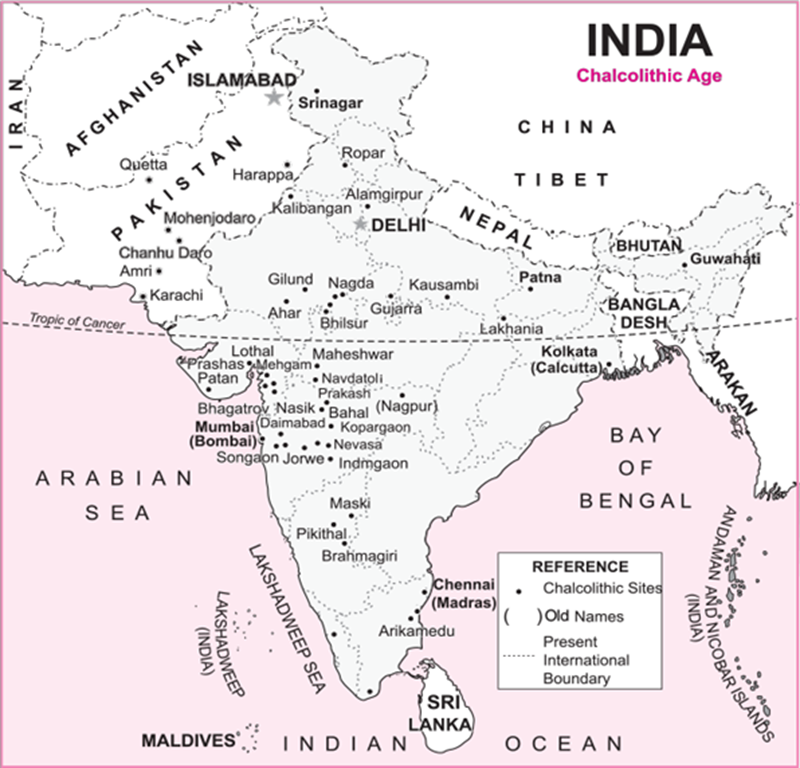
4. CHALCOLITHIC PERIOD (STONE COPPER AGE): 3000 BCE –500 BCE
The Chalcolithic Age marked the emergence of the use of metal along with stone tools. The first metal to be used was copper. The chalcolithic age largely applied to the pre-Harappan phase, but in many parts of the country, it appears after the end of the bronze Harappan culture.
Agriculture & cattle rearing:
- Animals: Domesticated animals such as cows, sheep, goats, pig and buffaloes and hunted deer.
- Crops: They produced wheat and rice, they also cultivated bajra, pulses such as lentil (masur), black gram, green gram, and grass pea.
- Cotton was produced in the black cotton soil of the Deccan and ragi, bajra and several millets were cultivated in the lower Deccan.
- In the eastern regions lived mainly on fish and rice, which is still a popular diet in that part of the country.
Pottery:
- Black and red pottery majorly found.
- The ochre-coloured pottery was also popular.
- The potter’s wheel was used.
Paintings:
- Painting with white linear designs was done.
Rural settlements:
- Primarily Rural settlement unlike Harappan (Urban settlement).
- Rural settlements and were not acquainted with burnt bricks.
Script:
- Did not know the use of writing.
Society:
- Beginnings of social inequalities in Chalcolithic societies.
- Chiefs were lived in rectangular houses, other people in round huts.
- Infant Mortality very high, can be evident from burials in western Maharashtra.
Economy:
- The chalcolithic economy is considered as a village economy.
- The beginning of social inequalities, as chiefs lived in rectangular houses while the commoners lived in round huts.
Art and Craft:
- The chalcolithic people were expert in Copper work.
- Also know art of copper smelting and were good stone workers as well.
- They knew spinning and weaving and were well acquainted with the art of manufacturing cloth.
Worship:
- Small clay images of earth goddesses have been found from the chalcolithic Sites.
- They venerated the Mother Goddess.
- In Malwa and Rajasthan, stylised bull terracotta show that the bull served as a religious cult.
Jewellery:
- Fond of ornaments and decoration.
- Women wore ornaments of shell and bone.
- They manufactured beads of semi-precious stones such as carnelian, steatite, and quartz crystal.
Important Chalcolithic Sites
- Ahar (Banas valley, South Eastern Rajasthan): The people of this region practiced smelting and metallurgy, supplied copper tools to other contemporary
- communities. Rice was cultivated here.
- Gilund (Banas valley, Rajasthan): Stone blade industry was discovered here.
- Daimabad (Ahmednagar, Maharashtra): The largest Jorweculture site in Godavari valley. It is famous for recovery of bronze goods such as bronze rhinoceros, elephant, two wheeled chariot with a rider and a buffalo.
- Malwa (Madhya Pradesh): The settlements of Malwa culture are mostly located on the Narmada and its tributaries. It provides evidence of the richest chalcolithic ceramics, and also spindle whorls.
- Kayatha (Madya Pradesh): The settlement of Kayatha culture was mostly located on the Chambal River and its tributaries. Houses had mud-plastered floors,
- pre-Harappan elements in pottery along with copper objects with sharp cutting
- edges were found.
- Chirand, Senuar, Sonpur (Bihar), Mahishdal (West Bengal): These are the prominent chalcolithic sites in these states.
- Songaon, Inamgaon and Nasik (Maharashtra): Large mud houses with ovens and circular pit houses have been discovered here.
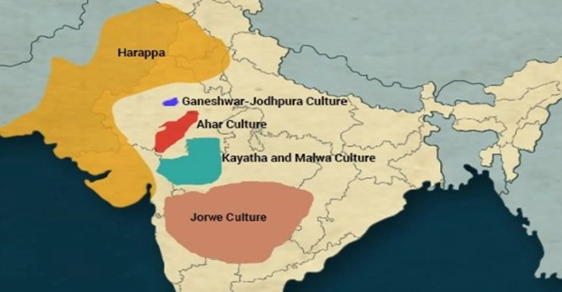
Chalcolithic Cultures on Basis of Their Geographical Location
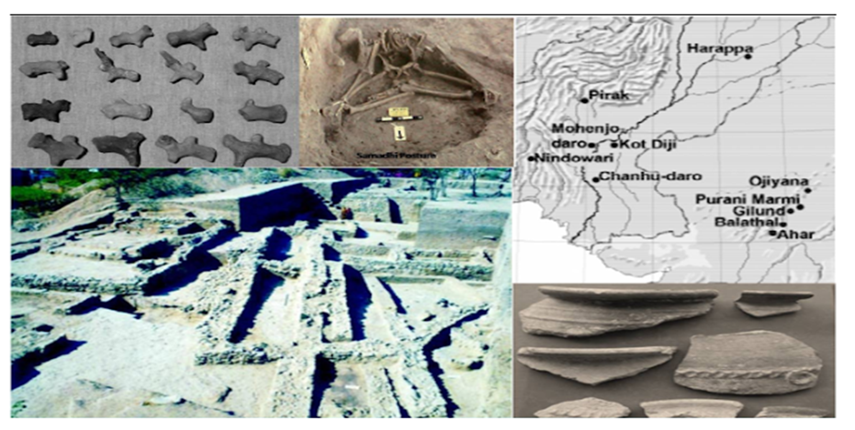
Ahar Culture
- The Ahar culture, also known as the Banas culture.
- Major excavated sites are Ahar, Balathal, Gilund, Ojiyana in Rajasthan.
- Ahar culture had a rich ceramic tradition consisting of Red ware, Black and Red ware, and Grey ware.
- Shapes include dishes, dish on stands, and globular.
- Radio carbon dating suggest a time period of 2025 BC-1270 BC for the Chalcolithic Phase.
Kayatha Culture
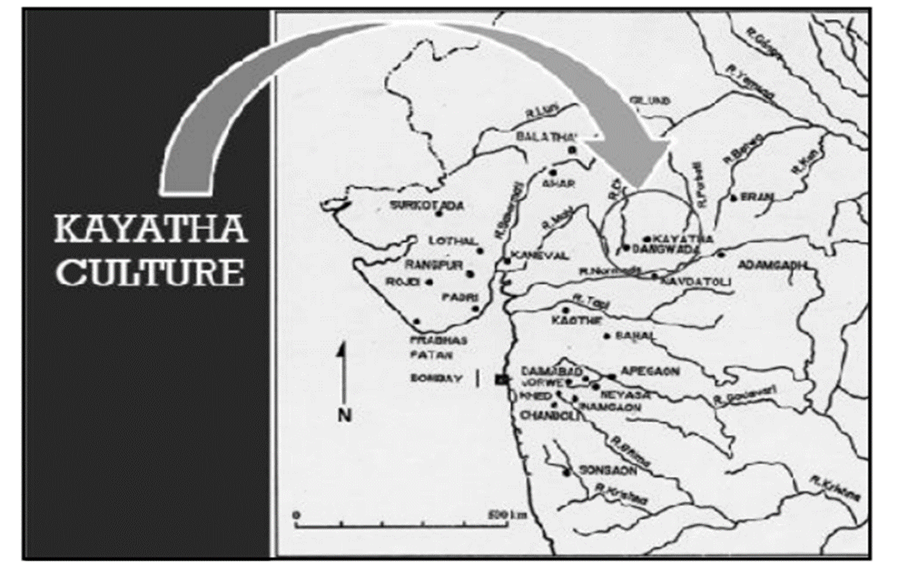
- Named after the site Kayatha, in Madhya Pradesh
- Radiocarbon dates suggest a period of 2000 to 1800 BC
- Ceramics include Kayatha ware, bowls, storage jars, and basins
- Similarities with pre-Harappan sites
- People lived in small huts with well-rammed floors and walls
- Mixed economy: subsistence farming, stock raising, and hunting-fishing
- Grew barley and wheat, domesticated animals included cattle and sheep/goat
- Horse found at Kayatha
- End of culture due to an earthquake
Malwa Culture
- Predominant chalcolithic culture of central India, with distribution of sites in Malwa region
- Radiocarbon dates place culture in 1900-1400 BC
- Sites mostly found on the banks of the rivers and tributaries.
- Subsistence based farming of wheat, barley, jawar, rice, legumes, oilseeds, and fruits
- Material culture includes Malwa ware, painted patterns in dark brown, also other ceramic types
- Religious beliefs confirmed from evidence like terracotta female and bull figurines
- Decline of the Malwa culture placed around 1400 BC, coinciding with that of Ahar culture
Jorwe Culture
- Most important characteristic of chalcolithic culture of Maharashtra
- Named after site of Jorwe in Ahmadnagar district, Gujarat
- Discovered in 1950
- Large centers found in Prakash in the Tapi valley, Daimabad in the Pravara-Godavari valley, and Inamgaon in the Bhima valley
- Early Jorwe houses – rectangular, while late Jorwe ones circular
- Many Jorwe sites are classified as villages.
- Subsistence dry-farming with stock-raising and hunting and fishing as primary activities
- Crops grown include barley, wheat, jowar, rice, ragi, green pea, grass pea, lentil, and green and black gram
- Mode of disposal of the dead involved child burials in urns laid in pits and chopping off portion below ankles in adult burials
- Many settlements deserted at end of 2nd millennium BC for climatic deterioration
Ochre Coloured Pottery Culture
- Named after a ceramic type which is extremely rolled and fragile with a wash of red ochre which is easily washed off
- Led a sedentary existence, similar to many early farming communities of this period
- Domesticated animals like cattle and evidence of cultivated crops like rice and barley provide information on their subsistence practices
- Found in Rajasthan, Punjab, Haryana, and western Uttar Pradesh
- Chronological span ranges from 2600 to 900 BC
Painted Grew Ware Culture
- Painted Grey Ware is a fine, smooth, even-colored grey pottery with a thin fabric.
- It was made out of high-quality clay, and forming a small percentage of the total pottery assemblage.
- PGW culture dates from 1100-500 BCE, with a wide geographical distribution.
- Apart from the plains, it has been found in hilly regions such as Kumaon and Garhwal.
- Structural remains at PGW levels consist mainly of mud huts.
- Unbaked and baked bricks were found at Hastinapura, whereas Jakhera represents a proto-urban stage of this culture.
- The PGW sites indicate a subsistence base that included cultivation of rice, wheat, and barley, alongwith animal husbandry.
5. IRON AGE: 1500 BCE – 200 BCE
- Iron age began about 1300 BC. Wheeler thought that knowledge of iron introduced by Achaemenids in 500 BC. Iron age is recognised as Late Harappan culture. Early Iron Age is associated with Megalithic Culture. Also, the transition period from Janapadas to Mahajanpadas
- Age is associated with Painted Grey ware (PGW)- [1300-300 BCE] and Northen Black Polished Ware [700-200].
- Irrigated rice cultivation was unique to this age
- Major Dravidian languages developed during this age
- Earliest Iron age south Indian sites: Hallur, Karnataka, Adichanallur.
- Iron sites in India:
- Pirak (Pakistan- Transition of Post Harappan phase)
- Mundigak (Afghanistan)
- Dharwar (Karnataka)
- Hallur (Karnataka)
- Ataranjikhera (Uttar Pradesh)
- Eran (Central India)
- Mahurjhari (Near Nagpur- large bead manufacturing site)
For more related content, explore the links below:
- Pocket Notes -Quick, exam-focused notes for fast and effective revision.
- Current Affairs -Daily updates on important national and international events.
- Free Materials - Access high-quality study resources at no cost.
- Book Summaries - Understand key books quickly without reading them fully.
- OAS Prism - In-depth analysis to strengthen conceptual clarity and perspective.
- Study Materials - Well-structured resources covering the complete syllabus.

PDF File:
No PDF attached
Subject: Ancient History
← Back to Chapter