
Harappan and Mauryan Architecture
Art and Culture

Architecture is the finest expression of human creativity right from the age of Harappan civilization to the British rule in India.
Harappan Art and Architecture

The Indus Valley or the Harappan civilization flourished during the Bronze Age i.e. 2500-2000 B.C. and is ranked among the four widely known civilizations of the Old World. Extensive excavation work undertaken during the post-Independence period identified hundreds of sites belonging to the Harappan civilization.
Features:
- Towns were laid out in a rectangular grid pattern.
- Roads ran in north-south and east-west direction and cut each other at right angles.
- Harappans used Burnt mud bricks for construction.
- Prevalence of public baths (E.g: Great Bath).
- Presence of advanced drainage system.
- Importance given to both personal and public hygiene.
Harappan Forts:
- These are the oldest forts in Indian sub-continent.
- The Upper town in Harappan cities was generally fortified, in Kalibangan and Surkotada even lower town was fortified.
- At Chanhudaro, fortification was absent completely.
- Lower portion of walls of forts built using stones and sun dried bricks and upper portion of walls of forts built using burnt bricks.
- Forts provided safety from flash floods, wild animals and robbers.
Important sites and their findings:
- Harappa (Pakistan): Two rows of six granaries with big platform, stone symbol of lingam and yoni, mother goddess figure, wheat and barley in wooden mortar, copper scale and mirror, sculpture of dog chasing a deer in bronze metal, nude dancing girl of stone and a red sandstone male torso.
- Mohenjo-daro (Pakistan): Great Bath, Great granary, post cremation burial, sculpture of bearded priest.
- Dholavira (Gujarat): Giant water reservoir, unique water harvesting system, stadium, dams and embankments.
- Lothal (Gujarat): Also known as Manchester of Indus valley civilization; Dockyard, double burial, rice husk, fire altars, painted jar, modern day chess, terracotta figure of horse and ship.
- Ropar (Haryana): Dog buried with human oval pit burials.
- Balathal and Kalibangan: Bangle factory, toy carts, bones of camel, decorated bricks and lower town.
- Surkatoda (Gujarat): First actual remains of horse bones.
- Banawali (Haryana): Toy plough, barley grains, oval shaped settlement; it is the only city with radial streets.
- Alamgirpur (Uttar Pradesh): Impression of a cloth on a trough.
Mauryan Art and Architecture
Megasthenes, the great Greek ethnographer and author of the work ‘Indika’, was considerably impressed by the Mauryan art. He gave a topographical account of Pataliputra, the capital of the Mauryan Empire, and described it as “the greatest city in India”, having the shape of a parallelogram and girdled with a wooden wall.
- Megasthenes described that most of the houses in the cities were made of wood and the royal palace at Pataliputra itself was made of timber. The art of polishing of wood reached its perfection during the Mauryan period but rocks and stones were not in much use.
Forts:
- Megasthenes inform us that the city of Pataliputra was surrounded by a wooden palisade.
- Wooden fort surrounded by a 60-feet deep and 200-yard ditch to prevent enemy forces from coming close to walls of the fort.
Palaces:
- In whole of ancient history, palaces built only during Mauryan age.
- Wood was the principal building material. Chandragupta Maurya built a palace with wood in his capital Pataliputra.
- According to Megasthenes, Mauryan palace had a massive central pillared hall and it was more beautiful than that of palaces at Susa and Ecbatana (located in Iran).
- Ashoka’s palace at Kumrahar had a high central pillar and was a three-storey wooden structure.
Pillars:
- The pillars were usually made of chunar sandstone and comprised of Long shaft formed the base, capital, abacus on which animal figure was placed.
- Best example include Laurya Nandangarh pillar in Champaran.
Independently erected pillars of Ashoka:
- The shaft of Ashokan pillars was generally monolithic.
- Four lion capital of Sarnath pillar was adopted as national emblem of India.
- Ashoka mostly used Prakrit as a medium in the pillar inscriptions.
EXAMPLE:
- Single Lion capital: Vaishali, Sanchi, Laurya Nandangarh pillar.
- Four lions sitting back to back: Sanchi and Sarnath pillars.
- Bull capital: Second Ramapurva pillar.
- Elephant capital: Sankisa pillar, Uttar Pradesh.
Ashokan pillars and Persian pillars:
- Both pillars are made of stone, had a shaft and bell-shaped portion, abacus and capital.
- Shaft of Ashokan pillars was generally monolithic whereas Persian pillars made of stone pieces joined together.
- Shaft of Ashokan pillars tapered from bottom to top whereas Persian pillars was cylindrical.
- Bell shaped structure used only at top in Ashokan pillars whereas in Persian pillars bell-shaped structures were present at both top and bottom.
Pillar Edicts and Inscriptions:
- 7 pillar edicts of Ashoka discovered in Topra (Delhi), Meerut, Kausambhi, Rampurva, Champaran, and Mehrauli.
- Pillar Edict I: Asoka’s idea of people protection.
- Pillar Edict II: Dhamma having greatest number of virtues, compassion, liberality, honesty, and purity.
- Pillar Edict III: Removes sins such as cruelty, rage etc.
- Pillar Edict IV: Addresses the responsibilities of Rajukas.
- Pillar Edict V: List of animals and birds which are prohibited for slaughtering on certain days.
- Pillar Edict VI: Dhamma policy of Ashoka.
- Pillar Edict VII: Ashoka contribution to Dhamma policy.
Minor Pillar Inscriptions:
- Rummindei Pillar: It documents Asoka’s visit to Lumbini and its exemption from taxation.
- Nigalisagar Pillar (Nepal): Extension of height of Konakamana stupa to twice its original size.
Major Pillar Inscriptions:
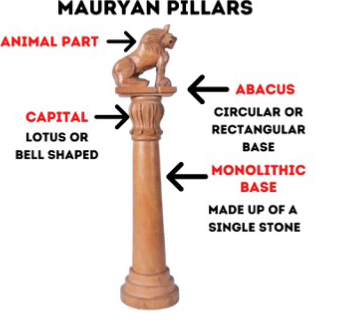
- Sarnath Lion Capital: Erected by Ashoka to commemorate Dhammachakra Pravartana.
- Single lion on Vaishali Pillar (Bihar): It has no inscription.
- Uttar Pradesh’s Sankissa Pillar.
- Lauriya-Nandangarh, Bihar.
- Lauriya-Araraj, Bihar.
- Uttar Pradesh’s Allahabad pillar.
Stupa Architecture:
- Stupas were burial mounds prevalent in India since Vedic period.
- Core of stupa was made of unburnt brick while outer surface was made by using burnt bricks.
- Medhi and toran decorated by wooden sculptures.
- According to Avadana Sutta, ten original stupas opened up by Ashoka and distributed their relics among 84,000 stupas built by him.
- Sanchi stupa (Madhya Pradesh) is the most famous of the Ashokan stupas.
- Piprahwa Stupa (Uttar Pradesh) is the oldest one.
- Stupas built after death of Buddha: Rajagriha, Vaishali, Kapilavastu, Ramagrama, Vethapida, Pava, Kushinagar and Pippalivana.
- Stupa at Bairat, Rajasthan: Grand stupa with a circular mound and a circumambulatory path.
Sanchi Stupa:

- Also known as Mahastupa, it was originally built by Ashoka with bricks but it was destroyed by Pushyamitra Shunga.
- The stupa was enlarged to twice of its original size by addition of more layers to its anda by Agnimitra.
- Ornamented gateways known as toranas were added during post-Mauryan age.
- The stupa was discovered by General Herbert Taylor in 1818 AD.
- The monuments at Sanchi were included in UNESCO’s list of World heritage sites in 1989.
Amaravati Stupa:
- Amaravati Stupa built in second or first century B.C. was probably similar to the one at Sanchi, but got transformed from a Hinayana shrine to a Mahayana shrine in the later centuries.
- The diameter of the dome of the stupa at ground level was about 48.76 metres and its height was about 30 metres.
- Amaravati stupa had free-standing columns surmounted by lions near the gateways. The dome was covered with sculptured panels.
Gandhara stupas:
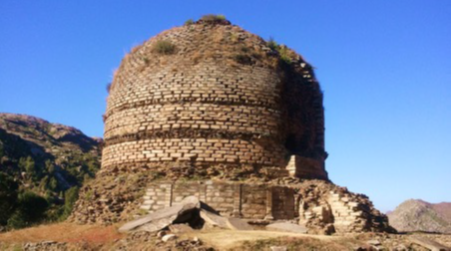
- The Gandhara stupas are a further development over the stupas at Sanchi and Bharhut. In Gandhara stupas the base, dome and the hemisphere dome are sculpted.
- The stupa tapers upward to form a tower like structure. The stupas of Nagarjunakonda were very large, having brick walls at the base forming wheel and spokes, which were filled with earth.
- The ‘Maha Chaitya’ of Nagarjunakonda has a base in the form of a ‘Swastika’.
Cave Architecture:
- During Mauryan period, caves were generally used as viharas by Jain and Buddhist monks. They were marked by a highly polished finish of interior walls and decorative gateways.
Barabar caves:
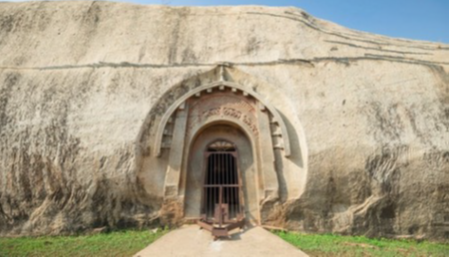
- These caves were cut during the reign of Ashoka donated to monks of Ajivika sect.
- There are four caves in Barabar hill which are Lomas Rishi cave, Sudama cave, karna chaupar cave and Visvakarma cave.
- The caves are simple rectangular halls cut into the hill + Level of ornamentation is very low and walls of caves have glossy finish.
Nagarjuni caves:
- These caves were cut under the patronage of Ashoka’s grandson Dasaratha.
- The caves located in Nagarjuni hill are Gopi Cave (Gopi-ka-kubha), Bahayak Cave (Vadithi-ka-kubha) and Vedantika Cave (Vapiya-ka-kubha).
- The caves divided into two chambers: Front hall for gathering of worshippers and back chamber used by monks for their residence and worship.
For more related content, explore the links below:
- Pocket Notes -Quick, exam-focused notes for fast and effective revision.
- Current Affairs -Daily updates on important national and international events.
- Free Materials - Access high-quality study resources at no cost.
- Book Summaries - Understand key books quickly without reading them fully.
- OAS Prism - In-depth analysis to strengthen conceptual clarity and perspective.

PDF File:
No PDF attached
Subject: Art and Culture
← Back to Chapter