A deep-analysis note on criminalization of politics, the JPC deliberations, and what it means for Indian federalism
Study OAS prism | 1 August 2026
The Governance Crisis That Prompted This Bill
India has long lived with the paradox of democracy: elected representatives facing serious criminal charges continue to hold — and exercise — the highest executive offices in the land. As of the 2024 general elections, the Association for Democratic Reforms (ADR) documented that approximately 46 per cent of the newly elected Lok Sabha MPs had declared criminal cases against them. Of these, nearly 31 per cent faced charges that courts classify as serious — offences carrying potential sentences of five years or more, including murder, kidnapping, and corruption. At the state level, the figures are even more troubling: 47 per cent of sitting ministers across India's states and Union Territories had pending criminal cases according to ADR's 2025 collation.
The political system absorbed this data with collective indifference — until two cases, in quick succession, exposed the sheer institutional emptiness of the status quo.
|
Case |
What Happened |
Significance |
|
Arvind Kejriwal (2024) |
Delhi CM arrested by ED on 21 March 2024 in the liquor policy case. Remained CM for nearly five months in custody. SC imposed restrictions on him signing files but left resignation entirely to his discretion. |
First sitting Chief Minister to govern from jail. Exposed that Articles 75 and 164 contain no mechanism to remove a minister on grounds of arrest — only conviction triggers disqualification under the Representation of the People Act, 1951. |
|
V. Senthil Balaji (2023–24) |
Tamil Nadu Electricity Minister arrested by ED in June 2023. Remained a minister while in judicial custody. SC ultimately told him to choose between office and freedom. |
Highlighted the absurdity: a minister in jail exercising power over a key portfolio. No constitutional provision existed to force his removal short of a Supreme Court order. |
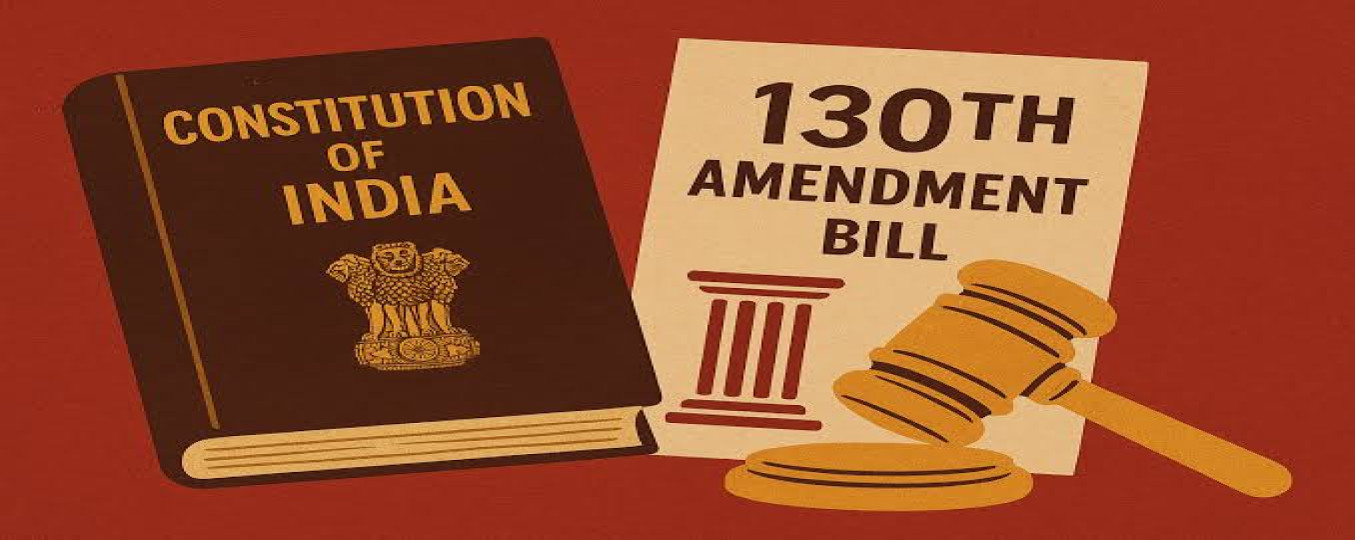
Against this backdrop, the Union Government introduced the Constitution (130th Amendment) Bill on 20 August 2025 in Lok Sabha during the Monsoon Session. Home Minister Amit Shah stated that the Bill sought to "uphold constitutional morality and governance by ensuring that individuals facing serious criminal allegations do not retain ministerial power."
What the Bill Actually Proposes
The Bill amends three constitutional articles and extends its operation to two related statutes covering Union Territories and Jammu & Kashmir.
|
Article |
Existing Provision |
Amendment Introduced |
|
Article 75 — Union Ministers |
Ministers hold office during the pleasure of the President. No arrest-related removal clause. |
Adds clause 5A: PM/Minister arrested for offence carrying 5+ year sentence and held for 30 consecutive days is removed by President on PM's advice; automatic cessation on Day 31 if no action taken. |
|
Article 164 — State Ministers |
Ministers hold office during the pleasure of the Governor. No arrest-related removal clause. |
Adds clause 4A: CM/Minister arrested for 30 consecutive days under same conditions removed by Governor on CM's advice; CM must resign on Day 31 or office ceases automatically. |
|
Article 239AA — Delhi |
Delhi Ministers under Lieutenant Governor. No arrest-specific clause. |
Adds clause 5A extending identical 30-day arrest-triggered removal to Delhi's Council of Ministers under LG. |
|
Companion Legislation |
Government of Union Territories Act, 1963; J&K Reorganisation Act, 2019. |
Parallel provisions introduced to cover other UTs and J&K — these are the companion bills referred to the same JPC. |
Operational Detail: When Does the 30-Day Clock Start?
The 30-day period runs from the date of judicial custody — not from the date of arrest by the investigating agency. Bail within 30 days stops the removal process. If released and re-arrested, a fresh 30-day period begins. Critically, re-appointment after release is explicitly permitted, meaning the Bill does not permanently bar a minister who is later acquitted or granted bail.
The Constitutional Architecture of Ministerial Accountability
The Doctrine of Pleasure: Articles 75 and 164
The Constitution deliberately chose to vest ministerial tenure in the "pleasure of the President" (Article 75) or "pleasure of the Governor" (Article 164) — not in a fixed term, not in parliamentary confidence alone. This design has a purpose: it preserves the executive's internal discipline while ensuring that the PM/CM advises such removal, thereby keeping the President and Governor ceremonially removed from factional politics. The 130th Amendment Bill does not abolish this doctrine; rather, it conditions ministerial tenure on a new automatic trigger — arrest and prolonged detention — overlaid on the existing pleasure-based removal.
The Existing Disqualification Framework
Under Section 8 of the Representation of the People Act, 1951, a legislator is disqualified from membership of Parliament or State Legislature only on conviction for specific offences — not on mere arrest or charge. This conviction-first standard was an explicit choice: it protects elected representatives from political persecution through false cases while providing a remedy once guilt is established. The 130th Amendment represents a partial departure from this framework by treating prolonged detention — which precedes conviction — as sufficient for removal from executive office (though not from legislative membership).
Four Constitutional Fault Lines in the Bill
Fault Line I: Presumption of Innocence and Article 21
The most fundamental objection is constitutional: removal from executive office on the basis of arrest, not conviction, erodes the right to be presumed innocent until proven guilty — a principle the Supreme Court has embedded within Article 21's guarantee of personal liberty. In Maneka Gandhi v. Union of India (1978), the Court held that any restriction on personal liberty must be just, fair, and reasonable. Critics argue that stripping a PM or CM of office merely because an investigation agency has placed them in custody — without any judicial determination of guilt — fails the Maneka Gandhi test. The risk is compounded by Special Laws such as the PMLA (Prevention of Money Laundering Act), where Section 45 makes bail practically impossible to obtain, making 30-day detention almost a certainty once an arrest is made under this statute.
Fault Line II: Separation of Powers — Investigative Agencies Removing Governments
The Bill's critics, including PRS Legislative Research in its formal analysis, have flagged a structural irony: if the 30-day removal clock is triggered by an arrest, then the agency that makes the arrest — the Enforcement Directorate, CBI, or state police — effectively holds the key to removing an elected government. A 2023 Indian Express investigation found that over 90 per cent of political figures investigated by the ED since 2014 belonged to opposition parties. This data point does not establish malice, but it does establish that allowing executive removal by arrest hands the governing party — through its control of investigating agencies — an unprecedented constitutional instrument against its political opponents.
Fault Line III: Federalism Under Pressure
The federal dimension is equally serious. If the Union government instructs the CBI or ED to arrest an opposition Chief Minister on a charge (even a politically motivated one), and the CM cannot secure bail within 30 days, the elected government of that state faces automatic collapse under the very Constitution that was meant to protect their autonomy. PRS notes this may violate the basic structure of the Constitution established in Kesavananda Bharati v. State of Kerala (1973), which protects the federal character of the polity as non-negotiable. The Bill's defenders respond that state-level agencies could symmetrically arrest Union ministers — but critics note the practical asymmetry: the Centre controls far more powerful investigative machinery.
Fault Line IV: Parliamentary Democracy — Who Has the Right to Remove the PM?
Under the Westminster model that India's Constitution adopts, the Prime Minister can only be removed by a vote of no-confidence in the Lok Sabha. This exclusive right of Parliament to remove the executive is a cornerstone of parliamentary democracy. The 130th Amendment proposes a bypass: a police arrest, sustained for 30 days, achieves what no-confidence motion requires a majority to accomplish. PRS's analysis flags this as a potential violation of parliamentary democracy as a basic structure element. This concern was echoed by several opposition members in JPC deliberations, though the draft report's fate remains uncertain after its deferment.
The JPC Deliberations: Status as on 1 August 2026
The Bill was referred to a 30-member Joint Parliamentary Committee immediately after its introduction — 20 members from Lok Sabha, 10 from Rajya Sabha. The Committee held nine formal sessions between December 2025 and May 2026 and examined witnesses from across India's legal and academic establishment.
|
Parameter |
Details |
|
JPC Chairperson |
Aparajita Sarangi, BJP, Member of Parliament from Bhubaneswar (Odisha) |
|
Composition |
30 members: 20 Lok Sabha + 10 Rajya Sabha |
|
Bills Under Examination |
(i) Constitution (130th Amendment) Bill, 2025; (ii) J&K Reorganisation (Amendment) Bill, 2025; (iii) Government of Union Territories (Amendment) Bill, 2025 |
|
Witnesses Examined |
Ministry of Home Affairs; Ministry of Law & Justice; Law Commission of India; National Law Universities (Delhi, Odisha, Hyderabad, Bengaluru); Association for Democratic Reforms (ADR); People's Union for Civil Liberties (PUCL); Vidhi Centre for Legal Policy; state governments of MP, Rajasthan, Haryana, Telangana, Chhattisgarh, Punjab |
|
Draft Report |
Circulated to members; contained five recommendations. Committee voted on only two before deferring. Full adoption deferred on 17 July 2026. |
|
Reason for Deferral |
JPC Chairperson stated: "The joint parliamentary committee unanimously said that we needed more consultations with stakeholders." Opposition members (Supriya Sule/NCP-SP, Asaduddin Owaisi/AIMIM) had filed dissent notes but withdrew them after the deferral decision. |
|
Known Draft Recommendations |
(i) Replace automatic removal with suspension during legal proceedings; (ii) Automatic restoration to office on acquittal or lapse of prosecution within a specified timeframe; (iii) Clear statutory definition of "serious criminal offence" (the 5-year threshold should be codified). |
|
Current Status |
Parliament's Monsoon Session 2026 ongoing (July 20–August 13). Government aims to table the final JPC report and introduce the Bill for a two-thirds special majority vote before the session ends. |
Judicial Landmarks That Define This Debate
|
Case |
Year |
Significance for This Debate |
|
Manoj Narula v. Union of India |
2014 |
SC held there is no constitutional bar on appointing persons with criminal antecedents as ministers. However, it urged the PM and CMs to exercise "constitutional morality" while making appointments. The Government cites this case as evidence that self-regulation has failed — hence the need for a formal amendment. |
|
Maneka Gandhi v. Union of India |
1978 |
Established that restrictions on personal liberty under Article 21 must be just, fair, and reasonable. Critics argue that removal from constitutional office on the basis of arrest (not conviction) fails this test — the procedure is neither just nor reasonable when the arrest itself may be politically motivated. |
|
Kesavananda Bharati v. State of Kerala |
1973 |
Established the "basic structure" doctrine: Parliament cannot amend the Constitution to destroy its essential features. PRS analysis identifies parliamentary democracy, federalism, separation of powers, and rule of law as basic structure elements potentially threatened by this Bill — making it constitutionally vulnerable to judicial review. |
|
Public Interest Foundation v. Union of India |
2018 |
A 5-judge Constitution Bench held that Parliament has exclusive authority to legislate on disqualification of elected members. The Court directed political parties to publish criminal antecedents of candidates but declined to add a judicially-crafted bar. This ruling strengthened the legislative route — which is what the 130th Amendment pursues — but the separation of powers concern remains. |
The Law Commission's Position
The Law Commission, in its report chaired by Justice A.P. Shah (commonly known as the 244th Report on Electoral Disqualifications), recommended disqualification at the stage of framing of charges by a court — not at arrest. The Commission argued that framing of charges involves judicial scrutiny and is therefore more defensible than a police arrest. The Commission recommended the disqualification to last until acquittal or a maximum of six years, and that trials involving sitting legislators be mandated to conclude within one year. The 130th Amendment departs from this safer standard by triggering removal at the arrest and detention stage — before any court has applied its mind to the charges.
Odisha Perspective
Aparajita Sarangi: An Odisha MP at the Heart of This Reform
The most direct Odisha link to the 130th Amendment Bill is the person leading its parliamentary scrutiny. Aparajita Sarangi, BJP Member of Parliament from Bhubaneswar, was appointed Chairperson of the 30-member Joint Parliamentary Committee. This makes her — and by extension Odisha — the institutional custodian of one of the most consequential constitutional reform exercises in recent memory. The JPC also held one of its consultation rounds in Odisha, making the state a site of legislative deliberation on this Bill. The National Law University, Odisha (NLUO, Cuttack) was among the four NLUs invited to present expert testimony to the Committee, alongside NLU Delhi, NLU Hyderabad, and NLU Bengaluru.
Odisha's Own Data: The Problem is Real
The criminalization of politics that this Bill seeks to address is sharply visible in Odisha's own legislative numbers. As per ADR's analysis of the 2024 Odisha Assembly election affidavits, 58 per cent of elected MLAs (85 out of 147) have declared criminal cases against them. Of these, 45 per cent (66 out of 147) face serious criminal charges — placing Odisha fourth in the country behind Andhra Pradesh (56%), Telangana (50%), and Bihar (49%). Seven Odisha MLAs face murder charges; 24 face attempt-to-murder charges; one faces rape charges; and 16 face charges involving crimes against women. These numbers make it difficult for any Odisha political party to argue abstractly against measures targeting the criminal-political nexus.
Odisha's Institutional Framework for Accountability
Odisha has its own institutional architecture for executive accountability that would interact with the 130th Amendment. The Odisha Lokpal and Lokayuktas Act, 1995, established the Odisha Lokayukta at Cuttack — an independent authority empowered to investigate complaints of corruption and maladministration against public servants, including ministers. The Odisha Lokayukta's jurisdiction partially overlaps with what the 130th Amendment seeks to achieve: removing from power those who abuse their positions. The state also applies the Prevention of Corruption Act, 1988 and its 2018 amendment, which increases penalties for bribery. If the 130th Amendment is enacted and an Odisha minister faces arrest under the PC Act for charges carrying a 5-year sentence, the Bill's provisions would kick in automatically — potentially far faster than the Lokayukta process.
Way Forward: Accountability Without Overreach
The governance pathology is real. The constitutional risk is also real. The way forward must honour both. Several measures, drawn from Law Commission recommendations, judicial precedents, and the JPC's own draft thinking, offer a more defensible architecture:
- Adopt the Suspension Model, Not Automatic Removal. Suspend the minister's active exercise of powers upon arrest, rather than removing them from office. This prevents governance from jail without destroying the presumption of innocence. Restoration happens automatically on bail or acquittal. This is closer to the UK and Canadian practice, and is what the JPC draft reportedly recommends.
- Anchor the Trigger to Charge Framing, Not Arrest. Follow the Law Commission's 244th Report recommendation: link disqualification to the court's framing of charges — not to the investigating agency's decision to arrest. Framing of charges involves judicial scrutiny and is therefore constitutionally more defensible under Article 21.
- Independent Judicial Oversight Before Removal Kicks In. Introduce a mandatory 7-day judicial review by the concerned High Court before any removal under this provision takes effect. This prevents instant weaponization and ensures a court — not an investigating agency — has the final say on whether the removal criteria are met.
- Fast-Track Courts for Cases Involving Elected Representatives. The Supreme Court has repeatedly called for dedicated tribunals to conclude cases against politicians within one year of charge framing. Without speedy trials, even the most well-designed removal provision becomes an instrument of indefinite destabilisation.
- Strengthen Internal Party Democracy. Mandatory primary elections and transparent candidate selection within parties would reduce the entry of candidates with serious criminal antecedents in the first place — addressing the root cause rather than its symptoms.
Mains Practice Question
The Constitution (130th Amendment) Bill, 2025, proposes automatic removal of the Prime Minister, Chief Ministers, and Ministers upon 30 consecutive days of arrest for offences carrying sentences of five years or more. While proponents argue it is necessary to prevent "governance from jail" and uphold constitutional morality, critics contend that it violates the presumption of innocence, threatens federalism, and could allow investigative agencies to destabilize elected governments. In this context, critically examine:
(a) the constitutional provisions and doctrines engaged by this Bill;
(b) the potential for its misuse against opposition governments; and
(c) a balanced way forward that addresses criminalization of politics without compromising fundamental rights and the federal structure. (250 words)
StudyOAS | Odisha's Most Trusted OPSC Preparation Platform | studyoas.in