
SAMARTH Portal & Model Own Source Revenue Rules
Panchayati Raj Fiscal Autonomy | 73rd Amendment | 16th Finance Commission | July 2026
Study OAS Prism| 29 July 2026
The Constitutional Promise and the Fiscal Reality
The 73rd Constitutional Amendment (1992), operationalised from April 24, 1993, was among independent India's most ambitious experiments in democratic decentralisation. It inserted Part IX (Articles 243 to 243-O) into the Constitution, establishing Panchayati Raj Institutions (PRIs) as the constitutional third tier of government. The 11th Schedule enumerated 29 subjects — from agriculture and social forestry to health and technical education — for potential devolution. Article 243-G authorised panchayats to prepare plans for economic development and social justice. Article 243-H explicitly empowered them to levy taxes, duties, tolls, and fees. On paper, India's gram panchayats became fiscal entities with constitutional standing.
Three decades later, the fiscal reality contradicts that aspiration in stark numerical terms. National data for 2017–22 reveals that the average gram panchayat generated only 2.27 lakh from own sources over five years — approximately 45,000 per year. Own Source Revenue (OSR) per capita stood at a national average of ?59. Of the 5,118.98 crore in total OSR collected by 2.25 lakh gram panchayats during this period, over 90% of panchayat income still derived from central and state government transfers. Eight major states — including Bihar, Jharkhand, and Uttar Pradesh — have enacted no OSR framework whatsoever in thirty-three years since the Amendment. The constitutional power granted by Article 243-H exists on paper; in practice, it is almost entirely dormant.
|
State |
Total OSR (2017–22) |
Remarks |
|---|---|---|
|
Gujarat |
829.75 crore |
Highest (absolute) |
|
Kerala |
802.95 crore |
High; strong ULB tradition |
|
Andhra Pradesh |
791.93 crore |
High |
|
Karnataka |
627.56 crore |
Above average |
|
West Bengal |
435.17 crore |
Average |
|
Goa / Puducherry |
Smaller totals |
1,635 / ?757 per capita — highest |
|
National Average |
59 per capita |
2.27 lakh per GP over 5 years |
Source: Ministry of Panchayati Raj data (2017–22); Business Standard. Covers 2.25 lakh gram panchayats and 86.95 crore rural population.
Why Panchayats Cannot Finance Themselves: Three Structural Obstacles
The Mandate-Resource Mismatch: Functions Without Fiscal Powers
The 73rd Amendment required states to devolve the "3Fs" — Funds, Functions, and Functionaries. In practice, most states transferred functions without corresponding financial authority. Gram panchayats implement MGNREGS, PM Awas Yojana, Jal Jeevan Mission, and Swachh Bharat Mission as agencies of higher-level governments — not as autonomous fiscal entities planning their own budgets. The 5th State Finance Commission of Odisha, like its counterparts across states, recommended OSR enhancement but received only partial implementation. When panchayats have no genuine expenditure autonomy, the taxing power under Article 243-H has no political constituency to support it.
The Property Tax Aversion: Electoral Calculus vs. Constitutional Duty
Property tax is the constitutionally mandated, most stable, and administratively feasible own revenue source for gram panchayats. Yet elected sarpanchs and panches are unwilling to issue demand notices to the very voters who elected them. Even the SVAMITVA scheme — which assigned digital property cards to rural households across approximately 67 lakh properties nationwide — has not produced automated tax collection, because the political act of imposing a tax on a neighbour remains the missing link. The 16th Finance Commission (2026–31) confronted this head-on by making 1,200 per household annually the OSR benchmark to qualify for performance-linked grants — conditioning access to ?87,048 crore on actual revenue mobilisation.
The Technical Vacuum: No Capacity for Bankable Projects
Converting a village pond, a community hall, or a common wasteland into a revenue-generating PPP project requires feasibility studies, investor agreement structuring, financial modelling, competitive bidding, and RFP preparation. None of these competencies exist at the gram panchayat level. In Odisha, CAG audit data (FY 2020-21) found that 35% of Additional Block Development Officer posts and 48% of technical assistant positions in PRI cadres were vacant. Without this infrastructure, even a politically willing panchayat cannot build a bankable project from a community asset — the gap is not constitutional but administrative.
The July 2026 Launch: Three Instruments, One Objective
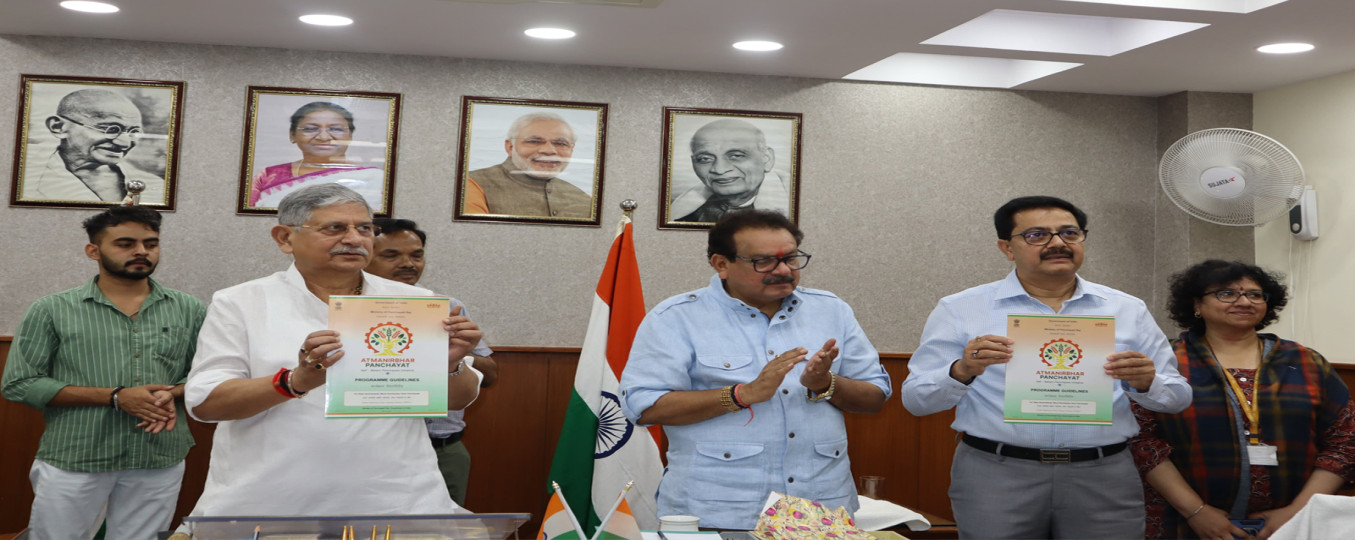
On July 27–28, 2026, Union Minister Rajiv Ranjan Singh (Ministry of Panchayati Raj and Fisheries, Animal Husbandry & Dairying) launched three interlocking initiatives at Krishi Bhawan, New Delhi. Taken together, they constitute the most comprehensive policy package for panchayat fiscal self-reliance since the 73rd Amendment itself — targeting revenue generation, digital infrastructure, and legal standardisation simultaneously.
|
Initiative |
Objective |
Parameters |
|---|---|---|
|
Atmanirbhar Panchayat Programme |
Convert idle community assets into sustainable, bankable, revenue-generating projects |
350 projects / 4 yrs; GP min OSR 50 lakh; PPP, CSR, NABARD/HUDCO finance |
|
SAMARTH Panchayat Portal |
Digitise the complete OSR lifecycle — registration, demand, payment, and monitoring |
Operational in 2 states; 51+ lakh taxpayers; 95 cr demand; 27+ cr collected |
|
Model OSR Rules |
Provide a standardised advisory framework for panchayat revenue law nationwide |
Covers property tax, user charges, fees, non-tax revenues; state-adaptable |
Atmanirbhar Panchayat Programme: Asset Monetisation at Scale
The programme targets the conversion of idle community assets — ponds, wasteland, buildings, agricultural markets, common areas — into revenue-generating, bankable projects. Four financing models are available: Build-Operate-Transfer (BOT), Build-Own-Operate (BOO), Corporate Social Responsibility (CSR) funding, and institutional credit through NABARD and HUDCO. A dedicated technical agency provides end-to-end support: feasibility studies, investor agreements, competitive bidding, and financial closure. The scale is deliberate rather than ambitious: 350 projects over four years, with per-state caps of 10 proposals in Year 1 and 20 annually thereafter, prioritising quality over proliferation. Gram Sabha approval is mandatory; additional scoring is awarded for endorsement from the previous sarpanch and opposition representatives — an embedded governance accountability mechanism.
Eligibility criteria reflect a focus on already-capable panchayats: gram panchayats must demonstrate a minimum of 50 lakh annual OSR for three consecutive years; block panchayats must show 1 crore. Special category states have relaxed thresholds of 10 lakh and 20 lakh respectively. Real-world models already documented include a vegetable market in Andhra Pradesh generating ?68 lakh annually, a pre-wedding tourism site in Uttarakhand earning 15–20 lakh per year, and ambulance service leasing producing ?50,000 per year in smaller panchayats.
SAMARTH Panchayat Portal: The Digital Revenue Management Backbone
SAMARTH is a unified national platform managing the complete OSR lifecycle: taxpayer registration, automated demand generation, online payment processing, collection reporting, and real-time monitoring. It replaces the fragmented, paper-based revenue systems that most panchayats currently operate — or fail to operate. As of launch, SAMARTH is functional in Chhattisgarh and Himachal Pradesh, where it has registered over 51 lakh taxpayers, generated 95 crore in demand notices, and collected over 27 crore. The platform is now being extended to Maharashtra, Mizoram, Assam, Haryana, West Bengal, and Uttar Pradesh. The Ministry received the Gold Award at the National Awards for e-Governance 2026 for this initiative.
Model OSR Rules: A National Template Panchayat Revenue Law
The Model OSR Rules provide states with a ready-made legislative template covering property tax, user charges, service fees, and non-tax revenues. Their advisory status means states can adapt them to local political and administrative context. Their true significance is structural: states like Bihar, Jharkhand, and Uttar Pradesh, which produced no OSR legislation in three decades following the 73rd Amendment, now have a reference document that eliminates the drafting barrier. The Rules also directly enable the SAMARTH portal — a standardised revenue assessment framework is a prerequisite for a digital collection system.
The 16th Finance Commission: Conditioning Grants on Fiscal Discipline
The 16th Finance Commission (report for 2026–31) has restructured the central grant architecture in a way that gives the July 2026 initiatives urgent operational significance. Its total recommended grant for rural local bodies is 4.35 lakh crore over five years — divided into basic grants (80% = 3.48 lakh crore) and performance grants (20% = 87,048 crore). Three entry-level conditions govern eligibility for all grants: panchayats must be constitutionally constituted, states must publish provisional and audited panchayat accounts online, and State Finance Commissions must be constituted on schedule.
The performance grant component — 20% of the total, making it the largest single conditionality India has placed on local body finance — requires panchayats to demonstrate OSR collection of 1,200 per household annually beginning in 2028-29. This is not marginal: it operationalises the Atmanirbhar Panchayat Programme and SAMARTH portal as the delivery infrastructure for a Finance Commission target. For the first time, an aspirational constitutional provision — Article 243-H — is backed by a direct financial penalty for non-compliance. Panchayats that fail to build OSR systems between now and 2028-29 will forfeit 20% of their Central allocation.
Odisha Perspective: Opportunity, Critical Gap, and Specific Imperatives
Odisha's panchayati raj landscape is among the most extensive in the country. Its three-tier structure — 30 Zilla Parishads, 314 Panchayat Samitis, and 6,794 Gram Panchayats — covers 51,349 villages across 30 districts, serving a rural population of 4.2 crore, which constitutes 83% of the state's total population. The financial stakes of the July 2026 initiatives are therefore proportionally large for Odisha.
|
Indicator |
Odisha — Data & Status |
|---|---|
|
PRI Structure |
30 Zilla Parishads, 314 Panchayat Samitis, 6,794 Gram Panchayats |
|
Rural Population Served |
4.2 crore across 51,349 villages; 83% of state population is rural |
|
Total PRI Expenditure (2020-21) |
?13,066.76 crore — 62% growth over 5 years; predominantly scheme-driven |
|
15th FC Grants Released |
444 crore to 20 ZPs, 296 Block Panchayats, 6,000 GPs |
|
16th FC Allocation (2026-31) |
18,715 crore (Central) + ?10,150 crore (6th SFC) = 28,865 crore |
|
Performance Grant Potential |
3,742 crore conditional on OSR benchmarks met from 2028-29 onward |
|
SAMARTH Portal Status |
Not yet onboarded — absent from current expansion list (critical gap) |
|
National Panchayat Awards 2025 |
5 awards (2nd nationally); Ganjam ZP ranked 2nd best Zilla Parishad in India |
|
CAG Audit Findings (2021) |
16,072 unsettled audit paras; 35% ABDO + 48% TA posts vacant |
|
6th SFC Distribution Formula |
GPs: 60% | Panchayat Samitis: 30% | Zilla Parishads: 10% |
The Funding Opportunity — and the Conditionality Risk
The combined Central (16th FC) and State (6th SFC) allocation for Odisha's PRIs over 2026–31 is 28,865 crore — the largest-ever commitment to rural local governance in the state. Of this, 3,742 crore in performance grants is directly conditional on OSR and governance benchmarks being met from 2028-29. For a state where PRI expenditure has been almost entirely scheme-driven (13,066.76 crore in FY 2020-21 with minimal OSR component), this creates a two-year structural adjustment requirement: Odisha must build OSR infrastructure before the performance-grant assessment begins.
The SAMARTH Absence — Odisha's Most Pressing Gap
Odisha is not in SAMARTH's current or announced expansion list. The portal is being extended to Maharashtra, Mizoram, Assam, Haryana, West Bengal, and Uttar Pradesh — states with varying OSR maturity. Odisha, despite having 6,794 gram panchayats and a large rural population, is absent. If Odisha is not onboarded before 2027-28, its panchayats will enter the 16th FC performance-grant assessment window without digital revenue management infrastructure — making it structurally impossible to meet the 1,200/household OSR benchmark in time. The Odisha Panchayati Raj and Drinking Water Department must request priority onboarding, not wait for the next scheduled roll-out.
National Recognition Alongside Systemic Vulnerability
Odisha's panchayat governance has demonstrated showcase excellence: in the 2025 National Panchayat Awards ceremony (June 3, 2026, New Delhi), Odisha won five awards — second only to Karnataka's six — with Ganjam district's Zilla Parishad recognised as the second-best Zilla Parishad in India. Four gram panchayats won the Deen Dayal Upadhyay Panchayat Satat Vikas Puraskar for sustainable development. Yet at the systemic level, the CAG (2021) documented 16,072 unsettled audit paragraphs, unadjusted advances of ?13.12 crore, and 11.46 crore in bank reconciliation discrepancies. Award-winning performance at the top and administrative vulnerability at the base — this duality defines Odisha's panchayat challenge.
Property Tax: Odisha's Largest Untapped Revenue Base
Rural Odisha currently lacks systematic property tax collection at the gram panchayat level. The 5th State Finance Commission had recommended OSR enhancement measures, but implementation remained partial. The 16th Finance Commission's 1,200/household benchmark essentially mandates that Odisha enact and enforce gram panchayat property tax rules. The Model OSR Rules provide a ready legislative template. Linking them with the SVAMITVA property-card database — which has covered a significant share of Odisha's rural properties — would enable automated demand generation without manual data entry at each panchayat. This integration requires a decision by the Odisha government, not merely administrative instruction to panchayat staff.
What These Initiatives Cannot Fix: An Honest Assessment
The Eligibility Paradox of the Atmanirbhar Programme
The programme's minimum OSR threshold of 50 lakh for gram panchayats is its most significant structural limitation. The national average gram panchayat earns approximately 45,000 per year from own sources. This means the programme is designed to help panchayats that are already in the top 5–10% of fiscal capability — precisely those that need the least structural assistance. The 95% of gram panchayats with negligible OSR — the ones most deeply dependent on grants and most in need of revenue diversification — do not meet the eligibility threshold. The programme builds on existing strength rather than creating new capacity at the fiscal bottom.
Advisory Rules in a Climate of Legislative Inaction
The Model OSR Rules are advisory. States can adopt, adapt, or ignore them. Three decades of the 73rd Amendment have demonstrated that states will not legislate local revenue powers without direct financial consequences. Bihar, Jharkhand, and Uttar Pradesh have existed with no OSR framework for thirty-three years; a reference document without a legal mandate attached will not change this pattern. Without conditioning OSR legislation enactment as an additional entry-level criterion for Finance Commission grants, the advisory rules will be received with formal acknowledgment and practical neglect.
SAMARTH Digitises the System; It Cannot Supply Political Will
SAMARTH automates demand generation, payment processing, and revenue tracking. It does this efficiently and at scale. But the decision to issue a demand notice — to tell a voter that their property is taxable and that they owe money to the panchayat — is a political act that no digital platform can perform. Elected sarpanchs and panches must choose to impose taxes on neighbours. This political economy barrier is the deepest impediment to panchayat fiscal autonomy, and it exists upstream of any technology. SAMARTH is a necessary condition for OSR modernisation; it is not a sufficient one.
Way Forward: From Grant-Dependent Agencies to Fiscal Citizens
- Condition OSR legislation as an entry requirement: States that have enacted no OSR framework should face grant ineligibility — not merely advisory pressure. The 16th FC's performance-grant structure is a step in this direction; the next Commission should make OSR legislation itself a baseline condition for basic grants.
- Fast-track SAMARTH onboarding for Odisha and remaining states: The 2028-29 performance-grant window creates a hard deadline. States not yet on SAMARTH — including Odisha — must be onboarded by 2027-28 at the latest. The Ministry should treat this as a grant-cycle requirement, not a discretionary expansion.
- Introduce a cluster model for smaller panchayats: Allow groups of financially weaker panchayats (each below ?50 lakh OSR) to jointly propose revenue projects under a shared technical facilitation model. This extends the Atmanirbhar programme's benefits to the majority currently excluded.
- Integrate SVAMITVA with SAMARTH for automatic demand generation: Property cards generated under SVAMITVA should be directly linked to SAMARTH's taxpayer registration module, eliminating manual data entry and making property tax operationally feasible for low-capacity panchayats.
- Dedicated OSR capacity-building under RGSA: The Rashtriya Gram Swaraj Abhiyan must allocate ring-fenced resources for training panchayat functionaries in project finance, PPP documentation, and revenue administration — shifting focus from scheme implementation training to fiscal management capacity.
- Ensure timely State Finance Commission constitution: Timely SFC constitution is now an entry-level condition for 16th FC grants. Odisha's 6th SFC must operate on schedule and its recommendations must move beyond action-taken-report format to actual implementation.
Quick Recall for Prelims
- 73rd Constitutional Amendment: Passed 1992; operative April 24, 1993 — inserted Part IX (Articles 243 to 243-O) and 11th Schedule (29 subjects) into the Constitution.
- Article 243-H: Empowers panchayats to levy taxes, duties, tolls, and fees — the constitutional basis for Own Source Revenue.
- Article 243-G: Authorises panchayats to prepare plans for economic development and social justice across the 29 subjects in the 11th Schedule.
- National OSR data (2017–22): 59 per capita; ?2.27 lakh per GP over 5 years; total ?5,118.98 crore from 2.25 lakh gram panchayats.
- SAMARTH Portal: Operational in Chhattisgarh and Himachal Pradesh; 51+ lakh taxpayers registered; ?95 crore demand generated; ?27+ crore collected.
- Atmanirbhar Panchayat Programme: 350 projects over 4 years (50 in Y1, 100/year thereafter); GP minimum OSR ?50 lakh; Block Panchayat ?1 crore; special category state thresholds relaxed.
- 16th Finance Commission (2026–31): ?4.35 lakh crore for rural local bodies; 80% basic + 20% performance grants; OSR benchmark ?1,200 per household per year (applicable from 2028-29).
- Odisha PRI structure: 30 Zilla Parishads, 314 Panchayat Samitis, 6,794 Gram Panchayats serving 51,349 villages; 83% of 4.2 crore population is rural.
- Odisha 16th FC + 6th SFC allocation: 18,715 crore (Central) + 10,150 crore (State) = ?28,865 crore for 2026–31; performance grant component = ?3,742 crore.
- July 2026 launch details: Union Minister Rajiv Ranjan Singh launched all three initiatives on July 27–28, 2026 at Krishi Bhawan, New Delhi; Ministry won Gold Award at National e-Governance Awards 2026.
- 16th FC entry-level conditions: (i) Panchayats constitutionally constituted, (ii) audited accounts published online, (iii) State Finance Commission constituted on time — all mandatory for any grant eligibility.
- Financing partners (Atmanirbhar programme): NABARD and HUDCO are the principal institutional finance partners; PPP models include BOT, BOO, BOOT, and DBFOT.
Mains Practice Question
OPSC OAS Mains Paper II / UPSC GS Paper II — Governance, Decentralisation, Fiscal Federalism | 250 Words
"The 73rd Constitutional Amendment created the legal architecture for panchayat fiscal autonomy, yet three decades later, Own Source Revenue accounts for less than 10% of total panchayat income in India, and the average gram panchayat earns only 45,000 per year from its own sources." In the light of this paradox, critically examine the structural, political, and administrative barriers that have prevented panchayats from leveraging their constitutional powers under Article 243-H. Evaluate whether the Atmanirbhar Panchayat Programme, SAMARTH portal, and the 16th Finance Commission's performance-linked grant framework (2026–31) together constitute an adequate policy response. Suggest a comprehensive and actionable roadmap to transform India's gram panchayats from grant-dependent implementing agencies into genuinely self-reliant institutions of local self-government.
StudyOAS | Odisha's Most Trusted OPSC Preparation Platform | studyoas.in