
GS Paper 3 — Indian Economy | Statistics
GS Paper 2 — Governance & Institutions
Context
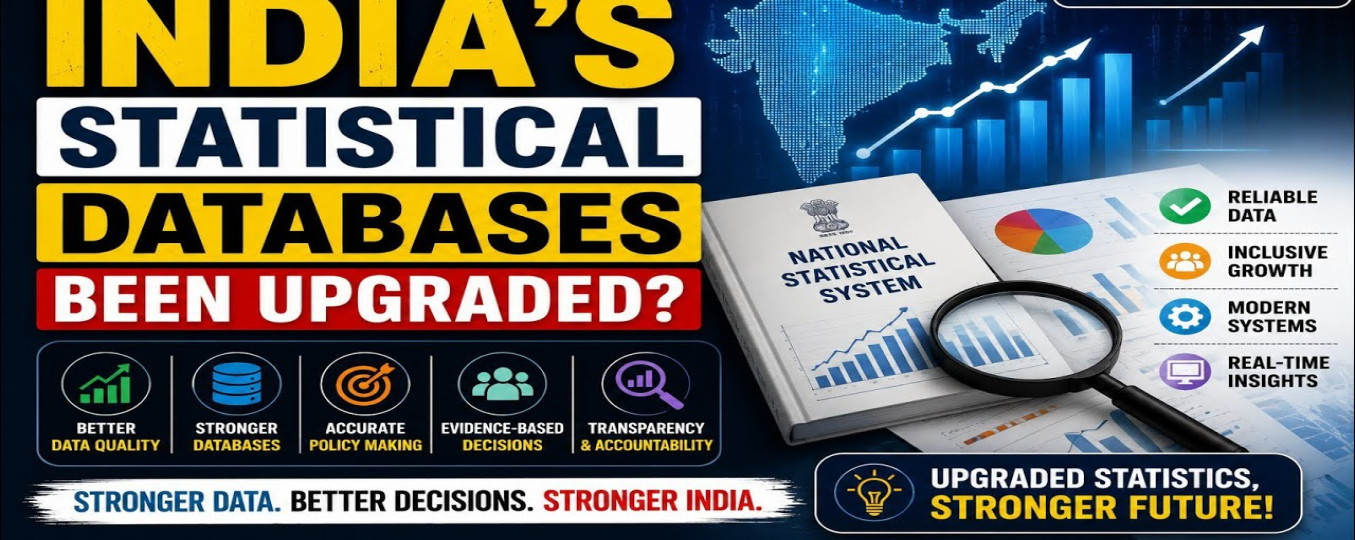
India has undertaken one of the most significant overhauls of its statistical system in over a decade. Over the past year, the Government has revised the base years and methodology of key macroeconomic indicators, including GDP/GVA, the Index of Industrial Production (IIP), the Consumer Price Index (CPI), and the Wholesale Price Index (WPI). Alongside these changes, India has also introduced its first-ever Producer Price Index (PPI).
The objective is to make India's economic statistics more representative of today's economy, improve policymaking, and enhance the credibility of Indian data in line with international standards.
Why Was This Overhaul Necessary?
IMF's Quality Concerns
In late 2025, the International Monetary Fund (IMF) assigned India's National Accounts Statistics a 'C' grade, the second-lowest rating, citing concerns regarding quality, representativeness, and timeliness. This created strong institutional pressure to modernise the country's statistical framework.
Outdated Base Years
Most major indices were still using base years fixed more than a decade ago:
-
GDP/GVA and IIP — 2011-12
-
CPI — 2012
-
WPI — 2011-12
Over the last fifteen years, India's economy has undergone massive structural transformation through GST-led formalisation, rapid digitalisation, expansion of the services sector, and changing consumption patterns. Older weights no longer reflected the present-day economy.
Obsolete Consumption Basket
The previous CPI still included products such as: VCRs, Cassette tapes, Radios
At the same time, it failed to capture modern consumption items like: Online streaming subscriptions, CNG, PNG
Such outdated baskets reduced the accuracy of inflation measurement.
Better Policy Decisions
Accurate statistical data is critical because:
-
RBI's Monetary Policy Committee uses CPI inflation while deciding repo rates.
-
Dearness Allowance (DA) and Dearness Relief (DR) for government employees are linked to inflation indices.
-
Real GDP estimation depends on proper price deflators.
Updating these databases therefore directly improves policy effectiveness.
Understanding India's Major Economic Indices
| Index | Measures | Published By | New Base Year |
|---|---|---|---|
| GDP/GVA | National output and value addition | MoSPI | 2022-23 |
| IIP | Industrial production volume | MoSPI | 2022-23 |
| CPI | Retail prices paid by consumers | MoSPI | 2024 |
| WPI | Wholesale prices of goods | DPIIT, Ministry of Commerce | 2022-23 |
| PPI | Producer prices of goods and services | DPIIT, Ministry of Commerce | 2022-23 |
Major Methodological Changes
1. GDP & National Accounts
Double Deflator Method
India has adopted the Double Deflator Method for agriculture and manufacturing.
Instead of using a single price index, this method separately adjusts: Output prices, Input prices
This provides a more accurate estimate of real GDP and is expected to be gradually extended to other sectors.
Better Sectoral Allocation
Earlier, if a company operated across multiple sectors, its entire output was often assigned to its primary sector.
Now, output is distributed proportionately across all economic activities, improving sector-wise GDP estimation.
New Data Sources
The revised methodology integrates:
-
GST returns
-
Periodic Labour Force Survey (PLFS)
This reduces discrepancies and improves the reliability of national accounts.
2. Index of Industrial Production (IIP)
Several improvements have been introduced.
-
Basket expanded from 839 items (407 groups) to 1,042 items (463 groups).
-
New sectors added:Gas supply, Water supply, Sewerage, Waste management
-
Electricity generation is now separately measured for: Renewable sources, Non-renewable sources
These changes better reflect India's evolving industrial structure.
3. Consumer Price Index (CPI)
The CPI has undergone a major revision.
New Base Year
The base year has shifted to 2024.
Updated Weights
Weights are now derived from the Household Consumption Expenditure Survey (HCES) 2023-24, making the index more representative of current household spending.
Expanded Basket
The number of items has increased from 299 to 358, organised into 12 categories instead of six.
New Additions
The revised CPI now includes:Rural house rent, Online media and streaming services, CNG, PNG
Removed Items
Outdated products such as: VCRs, Cassette recorders, Radios have been removed.
4. Wholesale Price Index (WPI) and Producer Price Index (PPI)
Wholesale Price Index
The WPI basket has expanded from 697 to 957 items.
Additionally, crude petroleum and natural gas have been shifted from Primary Articles to Fuel and Power, improving classification.
India's First Producer Price Index (PPI)
India has introduced its first Producer Price Index, bringing its statistical framework closer to international best practices.
Output PPI
Output PPI measures the prices producers receive for goods and services.
It excludes Net indirect taxes, Trade margins, Transport margins
Over time, Output PPI will replace WPI as the principal indicator for producer inflation and GDP deflation.
Input PPI
Currently under an experimental two-year trial, Input PPI measures prices paid by producers for inputs using purchaser prices.
Its methodology is relatively closer to CPI.
Services PPI
For the first time, India has also launched a quarterly Services PPI covering:
-
Banking
-
Securities transactions
-
Insurance
-
Pension fund management
-
Railways
-
Air passenger transport
-
Telecommunications
Parallel Operation
WPI and PPI will coexist for around five years before WPI is gradually phased out.
Long-term contracts relying on WPI-based escalation clauses will eventually need to transition to PPI.
Why These Reforms Matter
Better Global Alignment
The introduction of PPI aligns India with IMF recommendations and international statistical standards followed by most advanced economies.
Services Sector Finally Included
Unlike WPI, which measured only goods, PPI captures price movements in both goods and services, an important improvement since services contribute more than half of India's GDP.
Improved Real GDP Estimation
Output PPI will eventually replace the current WPI-CPI combination used for GDP deflation, leading to more accurate estimates of real economic growth.
Challenges That Still Remain
Delay in Census
India's 2021 Census is still pending.
Without updated population data, estimates related to:
-
Per capita income
-
Poverty
-
Demographic indicators
continue to rely on ageing 2011 population projections.
The next Census, planned for 2027, is expected to be India's first fully digital, app-based census.
Weak Coverage of the Informal Sector
Nearly 80% of India's workforce remains in the informal economy.
Since much of the revised statistical framework relies on GST and MCA databases, there is a risk that faster growth in the formal sector may overstate overall GDP if informal sector performance is not adequately captured.
Institutional Independence
The 2019 merger of the CSO and NSSO into the National Statistical Office (NSO) reduced the oversight role of the National Statistical Commission (NSC).
Further, the draft Indian Statistical Institute (ISI) Bill, 2025 has raised concerns among academics regarding greater government control over institutional governance.
Poverty Line Needs Revision
India continues to use the poverty estimation framework based on the Tendulkar Committee methodology using 2011-12 consumption data.
An updated poverty line is still awaited.
Lack of Local-Level Data
Reliable district-level and block-level economic statistics remain limited, restricting evidence-based planning at the grassroots level.
The Way Forward
Several reforms can further strengthen India's statistical ecosystem.
-
Grant statutory autonomy to the National Statistical Commission on the lines of constitutional institutions like the CAG, as recommended by the C. Rangarajan Commission (2000) and the Parliamentary Standing Committee on Finance (2025).
-
Standardise District Domestic Product (DDP) estimation across states and integrate it with block-level PLFS sampling, as suggested by NITI Aayog.
-
Expand the Support for Statistical Strengthening (SSS) Scheme to help states adopt CAPI tablets and AI-enabled validation tools.
-
Promote open-data architecture by providing anonymised microdata to researchers through platforms such as e-Sankhyiki.
Conclusion
India's simultaneous revision of GDP, IIP, CPI, and WPI, along with the introduction of the Producer Price Index, marks the most comprehensive modernisation of the country's macroeconomic statistical framework in more than a decade.
However, updating base years alone is not sufficient. The long-term credibility of India's economic statistics will depend equally on completing the Census, improving informal sector measurement, strengthening institutional independence, and expanding the availability of high-quality local-level data.
Only by addressing these structural challenges can India build a statistical system that inspires confidence among policymakers, researchers, investors, and global institutions.
Prelims Pointers
-
Base Year: Reference year against which an index is measured (Index = 100); revised periodically to reflect current economic conditions.
-
Double Deflator Method: Estimates real GDP by separately deflating input and output prices.
-
GDP Deflator: Converts nominal GDP into real GDP; India is gradually shifting from the WPI+CPI combination towards Output PPI.
-
WPI: Published by DPIIT; measures wholesale prices of goods; new base year 2022-23; basket expanded to 957 items.
-
PPI: India's first Producer Price Index; measures producer-level prices of goods and services; excludes taxes and trade/transport margins in Output PPI.
-
CPI: Published by MoSPI; new base year 2024; weights based on HCES 2023-24; used by RBI for inflation targeting.
-
IIP: Monthly industrial production index published by MoSPI; new base year 2022-23; basket expanded to 1,042 products across 463 item groups.
-
NSC: National Statistical Commission; currently functions through an executive resolution without statutory backing.
-
HCES: Household Consumption Expenditure Survey; provides weights for the revised CPI.
-
Tendulkar Committee: Basis of India's last officially accepted poverty line using 2011-12 consumption data.