
GS Paper 2 – International Relations | Bilateral Agreements | India's Foreign Policy
Why in News?
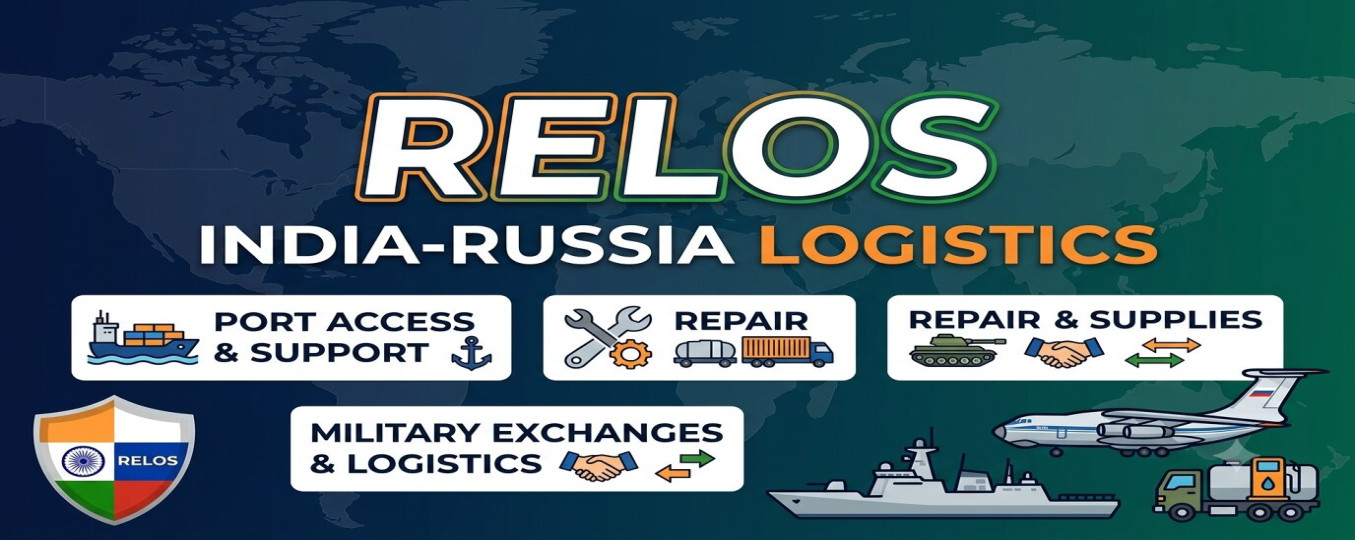
The India–Russia bilateral Logistics Support Agreement (LSA), officially known as the Reciprocal Exchange of Logistics Agreement (RELOS), became operational in January 2026 after several years of negotiations.
The agreement recently attracted attention on social media due to claims that it permits the deployment of 3,000 Russian troops in India or vice versa. These claims created confusion and led many to portray RELOS as a military alliance. However, RELOS is a standard Logistics Support Agreement, similar to those India has already signed with several other countries. It does not create military bases or permanent troop deployments.
Understanding Logistics Support Agreements (LSAs)
A Logistics Support Agreement is a foundational military cooperation arrangement that enables the armed forces of two countries to access each other's military facilities for logistical purposes.
Its primary objective is to simplify military cooperation by reducing administrative hurdles during:
• Joint military exercises
• Training activities
• Port calls by naval vessels
• Humanitarian Assistance and Disaster Relief (HADR) operations
• Refuelling and replenishment missions
In simple terms, an LSA allows military platforms to receive support such as fuel, repairs, food, transportation, and maintenance while operating in friendly territories.
LEMOA: India's First Logistics Agreement
India's first logistics pact was the Logistics Exchange Memorandum of Agreement (LEMOA) signed with the United States in 2016.
LEMOA serves as the basic template for India's subsequent logistics agreements.
Facilities Covered Under LEMOA
The agreement covers:
• Food and water supplies
• Billeting and accommodation
• Transportation services
• Petroleum, oils and lubricants (POL)
• Clothing and equipment support
• Communication services
• Medical facilities
• Storage facilities
• Training services
• Spare parts supply
• Repair and maintenance services
• Calibration services
• Port-related services
Importantly, the Government of India clarified in Parliament in February 2017 that LEMOA does not permit foreign military bases or basing arrangements in India.
The same principle applies to RELOS.
India's Expanding Network of Logistics Agreements
India currently has logistics support agreements with nine countries.
Standard LSAs
• United States
• United Kingdom
• France
• Vietnam
• Japan
• Australia
• Singapore
• Russia
Special Arrangement
• Oman (under a broader defence cooperation agreement)
These agreements have significantly enhanced India's military reach and operational flexibility.
Practical Benefits of LSAs
1. Eastern Ladakh Crisis (2020)
During the Eastern Ladakh standoff with China, India used its logistics agreement with the United States to quickly procure high-altitude winter clothing for more than 50,000 troops deployed in extreme conditions.
2. Cooperation with the United Kingdom
Under the India–UK logistics arrangement, Royal Navy ships have received India-manufactured spare parts and maintenance support at Indian shipyards.
3. Anti-Piracy Operations
Indian Naval ships and P-8I maritime patrol aircraft regularly use logistics facilities provided under partner-country agreements during anti-piracy missions in the Gulf of Aden.
This enables rapid turnaround without the need to return to Indian ports.
India–Russia RELOS: Features
RELOS establishes procedures for:
• Supporting military formations of both countries
• Port visits by naval warships
• Use of airspace and airfield facilities by military aircraft
• Technical and logistical support for military equipment
• Support for warships, aircraft, and other defence platforms
The agreement strengthens defence cooperation while remaining limited to logistical and technical support.
Important Facts About RELOS
| Parameter | Details |
|---|---|
| Signed | Moscow, 18 February 2025 |
| Russian Ratification | 15 December 2025 (signed into law by President Vladimir Putin) |
| Operationalised | January 2026 |
| Personnel Ceiling | Maximum 3,000 troops |
| Asset Ceiling | Up to 5 warships and 10 military aircraft |
| Validity | 5 years with provision for extension or revision |
Does RELOS Allow Foreign Troops to be Stationed Permanently?
No, Government officials have clearly stated that: "No permanent or long-term stationing has been agreed upon as part of the Agreement."
The figure of 3,000 personnel represents only an upper limit that may be required during exercises, port visits, training programmes, or mutually agreed military engagements.
Similarly:
• Maximum 5 warships
• Maximum 10 military aircraft
represent operational ceilings and not permanent deployment rights.
Therefore, RELOS is not a basing agreement and not a military alliance.
The Arctic Dimension of RELOS
One of the most strategically important aspects of RELOS is its Arctic component.
As climate change and global warming continue to reduce Arctic ice cover, new maritime routes such as the Northern Sea Route (NSR) are becoming increasingly viable.
Through RELOS, India gains access to Russian military facilities in the Arctic region.
Significance for India
• Expands India's maritime reach into the Arctic
• Enhances access to emerging trade routes
• Supports future energy and resource cooperation
• Improves long-range naval and air operations
Significance for Russia
• Strengthens Russian engagement in the Indian Ocean Region (IOR)
• Deepens strategic partnership with India
Thus, RELOS introduces an important Arctic dimension to India–Russia defence cooperation.
How LSAs Strengthen India's Strategic Autonomy
India follows a policy of Strategic Autonomy, avoiding formal military alliances while maintaining partnerships with multiple powers.
LSAs help achieve this objective.
1. Multi-Alignment Rather Than Bloc Politics
India has logistics agreements with both:
• United States
• Russia
Despite their geopolitical rivalry.
This demonstrates India's ability to engage competing powers without joining any military bloc.
India gains practical military benefits from all sides while preserving decision-making independence.
2. Alternative to China's "String of Pearls"
China secures its maritime interests through:
• Military bases (e.g., Djibouti)
• Dual-use ports (e.g., Hambantota)
This strategy is often described as the String of Pearls.
India has adopted a different approach.
Through LSAs, India obtains what analysts describe as an "Invisible Footprint" across major maritime chokepoints.
Examples include:
• Mozambique Channel (through France)
• Strait of Malacca (through Singapore)
• Lombok and Sunda Straits (through Australia)
This expands India's operational reach without owning overseas bases.
3. Support for Integrated Theatre Commands
India is currently moving toward the creation of Integrated Theatre Commands.
These commands require reliable logistical infrastructure across multiple regions.
LSAs provide ready-made external support networks that can enhance the effectiveness of future theatre commands.
Challenges Associated with RELOS
Despite its benefits, RELOS presents several strategic challenges.
1. Balancing Relations Between Russia and the West
India simultaneously maintains:
• RELOS with Russia
• LEMOA (2016) with the United States
• COMCASA (2018) with the United States
This requires careful diplomatic balancing.
Western countries often view logistics agreements as tools for containing China, whereas Russia tends to interpret them through the lens of opposition to NATO.
India must continuously navigate these competing expectations.
2. CAATSA-Related Risks
The United States enacted the Countering America's Adversaries Through Sanctions Act (CAATSA) in 2017.
The law allows sanctions against countries engaging in significant defence transactions with Russia.
To avoid sanctions risks, India often relies on:
• Rupee-Ruble trade mechanisms
• Alternative payment systems
However, these arrangements face practical challenges, including trade imbalances.
3. The Neutrality Dilemma
Unlike NATO's Article 5, LSAs do not contain mutual defence commitments.
This protects India's strategic autonomy.
However, if a partner country requests logistical support during an active conflict, India may face diplomatic pressure.
Refusing assistance to preserve neutrality could generate friction with partners.
4. Growing Russia–China Proximity
Russia's increasing dependence on China creates uncertainty.
In the event of a future India–China border conflict, questions may arise regarding the reliability and availability of Russian logistics facilities in regions such as:
• Russian Far East
• Arctic territories
This remains a potential vulnerability in the long term.
Conclusion
The India–Russia Reciprocal Exchange of Logistics Agreement (RELOS) is fundamentally a logistics support arrangement, not a military alliance and not a basing agreement. It facilitates reciprocal access to military facilities for refuelling, repairs, maintenance, training, exercises, and humanitarian operations. The agreement strengthens India's global operational reach, including in the strategically important Arctic region, while remaining consistent with India's policy of strategic autonomy. To maximize the benefits of its growing network of LSAs, India must integrate overseas logistics nodes with domestic initiatives such as:
• PM Gati Shakti
• Integrated Theatre Commands
• Aatmanirbhar Bharat
Ultimately, India's strategic autonomy will depend not only on logistics agreements but also on the development of a strong indigenous military-industrial base.
OPSC Mains Practice Question
"Logistics Support Agreements (LSAs) are emerging as key force multipliers for India's defence diplomacy without compromising its strategic autonomy." Critically examine this statement in the context of the India–Russia RELOS agreement.