GS Paper 1 – Women Empowerment | GS Paper 3 – Defence & Security
Why in News?
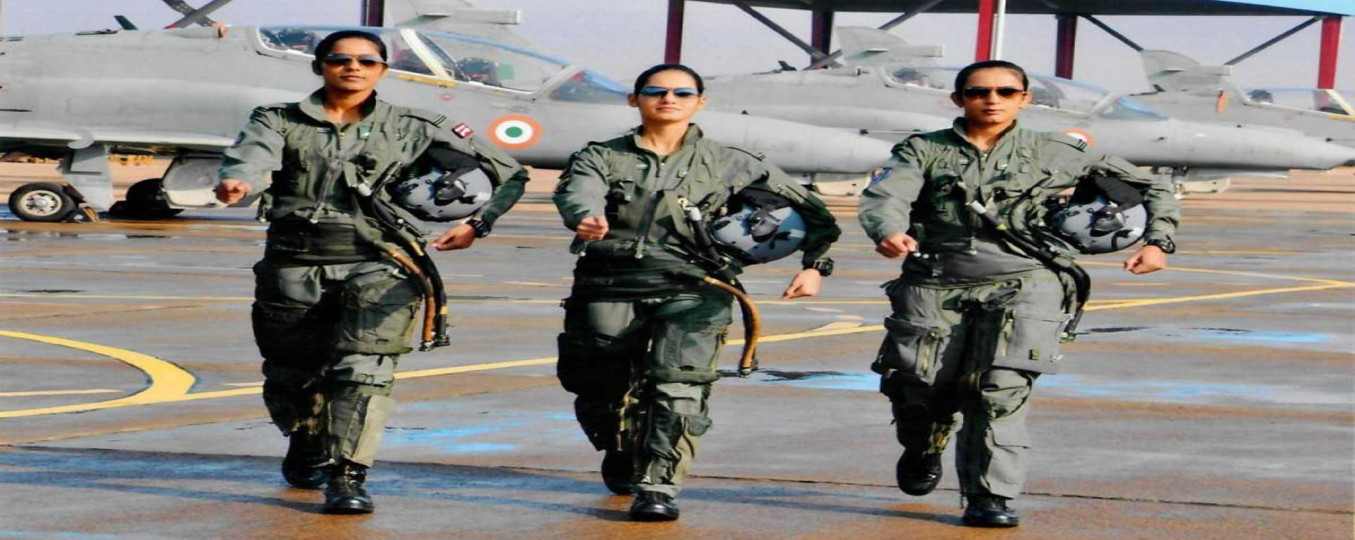
The Indian Air Force (IAF) achieved a historic milestone during the 217th Combined Graduation Parade (CGP) at the Air Force Academy (AFA), Dundigal, Telangana, by commissioning the first batch of women officers trained through the National Defence Academy (NDA) route. Reviewing the parade, Defence Minister Rajnath Singh highlighted that increasing participation of women is making the armed forces more balanced, inclusive and operationally stronger.
Highlights
- For the first time in the history of the IAF, women cadets who completed training at the NDA, Khadakwasla, were commissioned as officers after undergoing specialised training at the Air Force Academy.
- Five women officers received their wings:
- 2 in the Fighter Stream
- 3 in Maintenance and Ground Duty branches
- A total of 231 flight cadets graduated, including:
- 194 men
- 37 women
- Wings were also awarded to:
- 9 Indian Navy officers
- 3 Indian Coast Guard officers
- 2 trainees from Vietnam
- Three officers received Navigation Brevets.
- Flying Officer Ashish Kumar Yadav secured the President's Plaque and Nawanagar Sword of Honour for standing first in the Pilot Course.
- Flying Officer Ekta Gupta topped the Navigation Stream.
- Flying Officer Divyanshi Singh secured first position among Ground Duty branches.
- In a special highlight, Chief of Air Staff Amar Preet Singh personally participated in a Kiran aircraft flypast during the ceremony.
Evolution of Women's Role in the Indian Armed Forces
Initial Entry Phase (1991–92)
- Women were first inducted into the Indian Air Force through the Short Service Commission (SSC).
- Their participation was initially restricted to non-combat and support services.
Expansion of Opportunities
- Over time, women gained entry into operational and technical branches.
- In 2016, India commissioned its first women fighter pilots:
- Avani Chaturvedi
- Bhawana Kanth
- Mohana Singh
- The experimental fighter pilot scheme was subsequently made permanent.
Judicial Push Towards Equality
- In the landmark Secretary, Ministry of Defence v. Babita Puniya judgment (2020), the Supreme Court granted Permanent Commission opportunities to women officers in the Army.
- In Kush Kalra v. Union of India, the Court directed that women be allowed to appear for NDA examinations.
- Following this decision, the first batch of women cadets joined the NDA in 2022.
Significance of NDA-Based Induction
Institutionalisation of Gender Integration
- Women now enter the armed forces through the same foundational training system as men.
- This places them on an equal professional footing from the beginning of their careers.
From Symbolism to Structural Change
- Earlier participation was largely through SSC-based induction.
- NDA entry integrates women into the regular officer pipeline, making gender inclusion a permanent institutional feature.
Strengthening Combat Capability
- Women entering the fighter stream through the NDA route reflects growing confidence in their operational capabilities.
- It promotes merit-based deployment rather than gender-based restrictions.
Better Utilisation of Human Resources
- A wider recruitment base enables the armed forces to attract the best talent available in the country.
- It contributes to a stronger and more diverse leadership pool.
Constitutional Values
- The development advances:
- Article 14 – Equality before Law
- Article 15 – Prohibition of Discrimination
- Article 16 – Equality of Opportunity in Public Employment
Challenges that Continue to Persist
- Gender stereotypes and societal biases regarding combat roles.
- Need for gender-sensitive infrastructure and support systems.
- Work-life balance concerns arising from frequent postings and operational commitments.
- Limited representation of women in senior command and leadership positions.
- Requirement for continuous policy reforms to ensure substantive equality.
Conclusion
The commissioning of the first NDA-trained women officers marks a transformative moment in the evolution of India's armed forces. The journey from induction into non-combat roles in 1991 to fighter cockpits in 2016 and now to a fully integrated NDA training pathway demonstrates the steady expansion of opportunities for women. Beyond promoting gender equality, this reform strengthens operational effectiveness and reflects the emergence of a modern, inclusive and capability-driven military force.
OPSC Mains Practice Question
"The commissioning of the first NDA-trained women officers in the Indian Air Force represents a structural transformation in gender integration rather than a symbolic achievement." Examine the evolution of women's participation in the Indian Armed Forces and discuss the challenges that need to be addressed for achieving substantive gender equality in the defence sector. (250 Words)