(Important for OPSC OAS Examination – Indian Polity, Constitutional Amendments, Federalism, Gender Justice, Representation & Delimitation)
Introduction
The passage of the Women’s Reservation Act, 2023 was widely celebrated as a historic milestone in India’s democratic journey. By providing for 33% reservation for women in the Lok Sabha and State Legislative Assemblies, Parliament appeared to deliver long-awaited structural reform in political representation. For aspirants of competitive examinations such as OPSC OAS, the Act represents a crucial topic intersecting constitutional law, federal politics, gender justice, and electoral reforms.
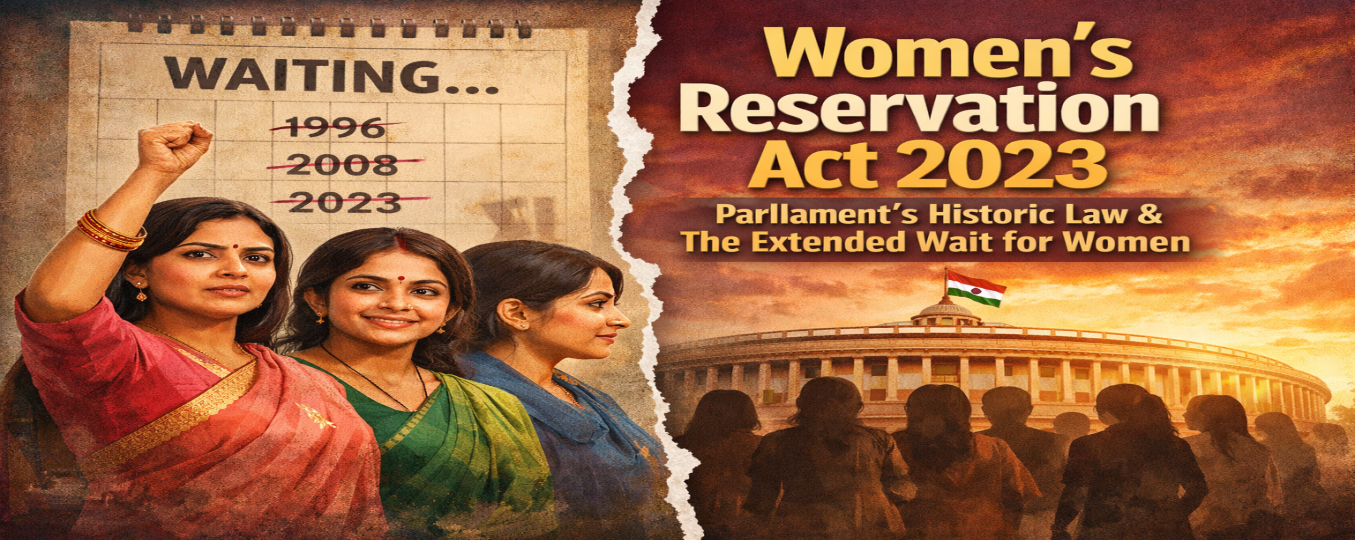
However, despite its symbolic significance, the operationalisation of the Act has been deferred. Its implementation has been made contingent upon the next Census and a subsequent delimitation exercise—effectively postponing the realisation of women’s representation for several years. The gap between constitutional promise and political execution raises deeper questions about design, intent, and democratic timing.
What the Women’s Reservation Act Provides
The Act mandates:
-
Reservation of 33% of seats in Lok Sabha and State Legislative Assemblies
-
Inclusion of sub-reservation for SC/ST women within the existing SC/ST quotas.
It was projected as a transformative reform aimed at correcting long-standing gender imbalance in legislative bodies. Women currently constitute only about 14–15% of the Lok Sabha, reflecting a persistent democratic deficit.
Why Implementation Has Been Delayed
The Act does not come into force immediately. Instead, it requires two mandatory steps:
-
Completion of the next National Census (expected around 2027).
-
A fresh delimitation exercise based on updated Census data.
Delimitation is an extensive and politically sensitive process involving:
-
Redrawing all 543 Lok Sabha constituencies.
-
Revising thousands of Assembly constituencies.
-
Balancing population equality, geography, and reserved categories.
Given administrative timelines and political negotiations, actual implementation could extend well into the next decade.
Political Logic Behind the Design
The linkage between reservation and delimitation is not accidental—it reflects political calculation.
-
Immediate implementation would convert around 181 Lok Sabha constituencies into women-only seats.
-
This would directly displace many male incumbents, triggering resistance across party lines.
-
By tying reservation to delimitation:
-
Women’s seats can be introduced during constituency restructuring.
-
If the total number of Lok Sabha seats expands, women’s seats can be added without eliminating existing ones.
-
Seat expansion softens political opposition, but at the cost of delay. Political accommodation has been prioritised over immediate justice.
Historical Trajectory: A Reform Decades in the Making
The journey of women’s political reservation has been prolonged:
-
First introduced in Parliament in 1996.
-
Passed in the Rajya Sabha in 2010 but lapsed.
-
Reintroduced and passed in 2023, ending a legislative stalemate.
Yet, even after decades of debate, operational empowerment remains deferred. Women now face another extended wait before seeing tangible change in representation.
Federal and Demographic Tensions
The design of the Act entangles women’s representation with the contentious issue of delimitation.
-
Delimitation is linked to population growth.
-
Southern States, which have successfully controlled population growth, fear:
-
Reduction in their parliamentary representation.
-
-
Northern States may gain additional seats.
By linking women’s reservation to this politically sensitive redistribution debate, the reform becomes entangled in broader north–south federal tensions.
Thus, a gender justice measure is now embedded within a federal restructuring controversy.
Design Gaps and Structural Questions
Beyond delay, the Act presents several unresolved concerns:
-
No OBC Sub-Reservation: Unlike SC/ST quotas, there is no specific OBC sub-quota within the women’s reservation.
-
No Reservation in Rajya Sabha or Legislative Councils: Upper Houses remain outside the framework.
-
Rotation Mechanism Unclear
-
The rotation of reserved constituencies lacks operational detail.
-
Frequent rotation may:
-
Disrupt constituency development.
-
Discourage long-term political investment.
-
-
These gaps suggest that while the principle is transformative, the design remains incomplete.
Important Democratic Question
Representation delayed risks becoming representation denied.
-
Women’s political empowerment has been linked to:
-
Demographic exercises unrelated to gender equity.
-
Administrative processes that may take years.
-
-
The constitutional amendment affirms equality in theory.
-
But democratic justice demands timely realisation in practice.
The paradox is striking: Parliament has passed a historic law, yet women may not see its benefits for nearly a decade.
Possible Constitutional and Policy Solutions
To ensure that the reform does not remain symbolic, several options merit consideration:
-
Amend the Constitution to delink reservation from delimitation.
-
Implement reservation within existing constituencies without waiting for seat expansion.
-
Temporarily expand Lok Sabha seats to accommodate women’s quota.
-
Clarify rotation rules to ensure stability and fairness.
-
Consider inclusion of OBC sub-reservation to deepen social equity.
Such measures would require political will but could restore immediacy to the reform.
Conclusion
The Women’s Reservation Act, 2023 stands as a landmark reform in principle, reaffirming India’s commitment to gender justice and inclusive democracy. Yet by tethering its implementation to Census and delimitation, Parliament has extended the timeline of women’s political empowerment. For students of polity and governance, the episode illustrates the complex interplay between constitutional ideals and political realities. The true measure of this reform will not be its passage, but its implementation. Until then, the promise of equal representation remains constitutionally enshrined but democratically deferred.