Introduction
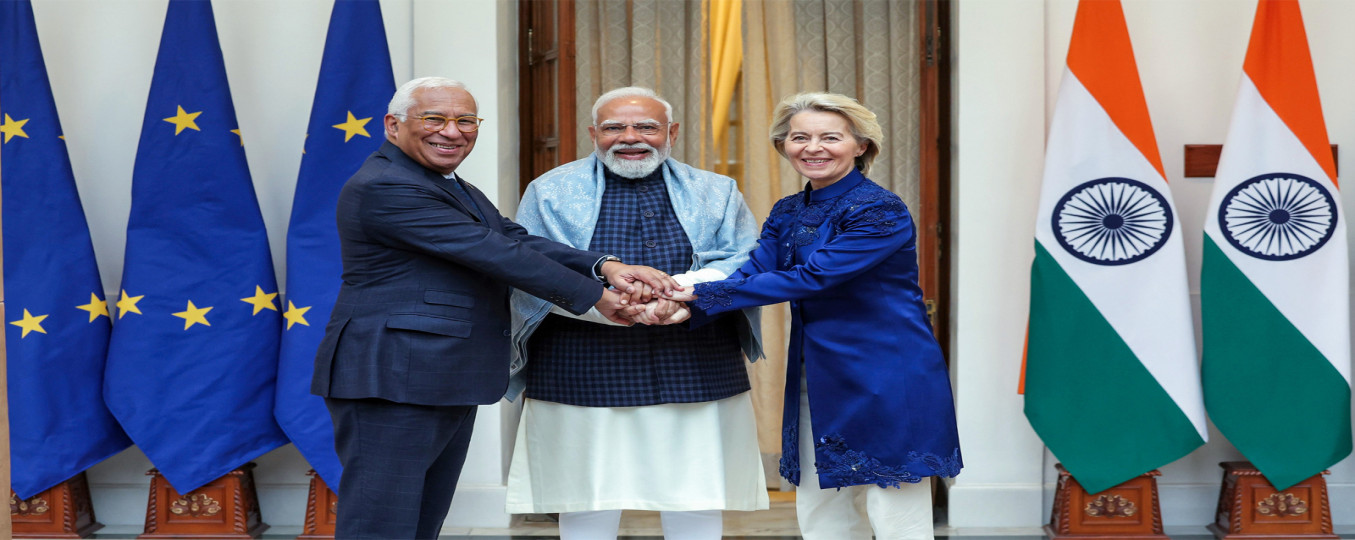
After nearly two decades of negotiations, pauses, and restarts, India and the European Union have finally concluded a comprehensive Free Trade Agreement (FTA). The talks, originally launched in 2007, had remained stalled for years due to differences over market access, regulatory standards, and political sensitivities, before being revived in 2022 in a very different global economic and geopolitical environment. Prime Minister Narendra Modi has described this agreement as the “mother of all deals”, and not without reason: it is India’s largest-ever FTA, covering a market of 27 European countries and over 450 million people. The agreement is not just a trade document; it reflects a strategic recalibration by both sides in an era of supply chain uncertainty, geopolitical rivalry, and pressure on the multilateral trading system.
What Does the Agreement Contain?
At the heart of the deal lies deep tariff liberalisation on both sides.
-
The European Union will remove or reduce tariffs on about 99.5% of Indian exports.
-
India will offer tariff concessions on roughly 97.5% of EU imports.
For Indian consumers, this means that:
-
European wines, spirits, and luxury cars will become cheaper over time, though:
-
The reductions will be phased and quota-bound, to protect domestic industry from sudden shocks.
-
For Indian exporters, the agreement opens up significant duty-free or low-duty access for a wide range of products, including:
- Textiles and apparel
- Leather and footwear
- Gems and jewellery
- Spices, tea, and coffee
- Marine products and handicrafts
- Engineering and manufactured goods
This breadth of coverage makes the agreement far more consequential than many of India’s earlier trade deals.
Why This Deal Matters for India
The most immediate gain for India is secure and preferential access to one of the world’s richest consumer markets.
-
The EU is:
-
A high-income, high-standards market
-
With stable demand for quality manufactured and processed goods
-
-
The agreement is expected to boost labour-intensive sectors such as textiles, garments, leather, and footwear, which are crucial for employment generation
-
There are also important non-tariff and services-related gains:
-
Easier mobility for skilled Indian professionals in certain categories
-
Better opportunities for India’s services sector
-
-
Strategically, the FTA:
-
Strengthens India’s manufacturing and MSME ecosystems
-
Helps Indian firms integrate more deeply into global value and supply chains
-
Reduces over-dependence on a few markets or regions
-
In a world where trade is increasingly shaped by geopolitics, having preferential access to the EU gives India both economic and strategic leverage.
What the European Union Gains
From the EU’s perspective, the deal offers something equally valuable: deeper access to one of the fastest-growing large markets in the world.
-
More than 90% of EU goods entering India will face reduced tariffs.
-
This creates major opportunities for European firms in sectors such as:
- Automobiles
- Wines and spirits
- Machinery and industrial equipment
- Pharmaceuticals
- Aircraft and aviation-related industries, especially for companies like Airbus
At a time when:
-
European companies face slower growth at home
-
And rising trade uncertainties elsewhere
India represents a huge long-term market with expanding middle-class demand.
What the Deal Deliberately Leaves Out
Equally important is what the agreement does not include, reflecting India’s red lines and negotiating priorities.
-
There are no concessions on sensitive agricultural products such as rice and chicken, protecting farmers and food security.
-
There is no binding agreement on government procurement & no commitments on energy and raw material procurement
-
India also:
-
Rejected a binding “sustainable development” chapter, which it feared could become a backdoor for trade restrictions and regulatory pressure.
-
-
Geographical Indications (GIs) have been kept outside the main FTA and are to be addressed separately.
This shows that while India was willing to open up significantly, it has also been careful to preserve policy space in politically and economically sensitive areas.
Strategic and Geopolitical Significance
The timing of the India–EU FTA is as important as its content.
-
The deal comes against the backdrop of:
-
U.S. tariff pressures and protectionist tendencies
-
Repeated global supply chain disruptions
-
Growing uncertainty about the future of the multilateral trading system
-
-
For both India and the EU, the agreement:
-
Reduces strategic and economic dependence on a narrow set of partners
-
Signals commitment to diversification and resilience in trade relations
-
-
Beyond economics, the deal strengthens the broader India–EU partnership in areas such as Security and defence cooperation, Counter-terrorism, Maritime security, Cybersecurity
-
It also reinforces support for a rules-based international trade order at a time when such rules are under strain.
The Larger Picture: What This Deal Represents
The India–EU FTA marks a shift in India’s trade strategy:
-
From defensive and cautious engagement
-
Towards selective but ambitious integration with major economic blocs
For the EU, it reflects:
-
Recognition of India as:
-
A long-term economic partner
-
A strategic pillar in the Indo-Pacific and global order
-
The agreement is not perfect, and its real impact will depend on:
-
How effectively Indian industry uses the new market access
-
How quickly regulatory and logistical bottlenecks are addressed at home
-
How both sides manage disputes and implementation challenges
Conclusion
The India–EU Free Trade Agreement is a historic and transformative step in India’s external economic policy. It opens up one of the world’s largest and richest markets to Indian producers, strengthens domestic manufacturing and services, and embeds India more deeply into global supply chains. At the same time, it serves a larger strategic purpose by diversifying partnerships and reinforcing a rules-based trading order in an uncertain world. If implemented with care and complemented by domestic reforms, this agreement has the potential to become not just the “mother of all deals” in size, but also one of the most consequential in shaping India’s economic future.