
Introduction
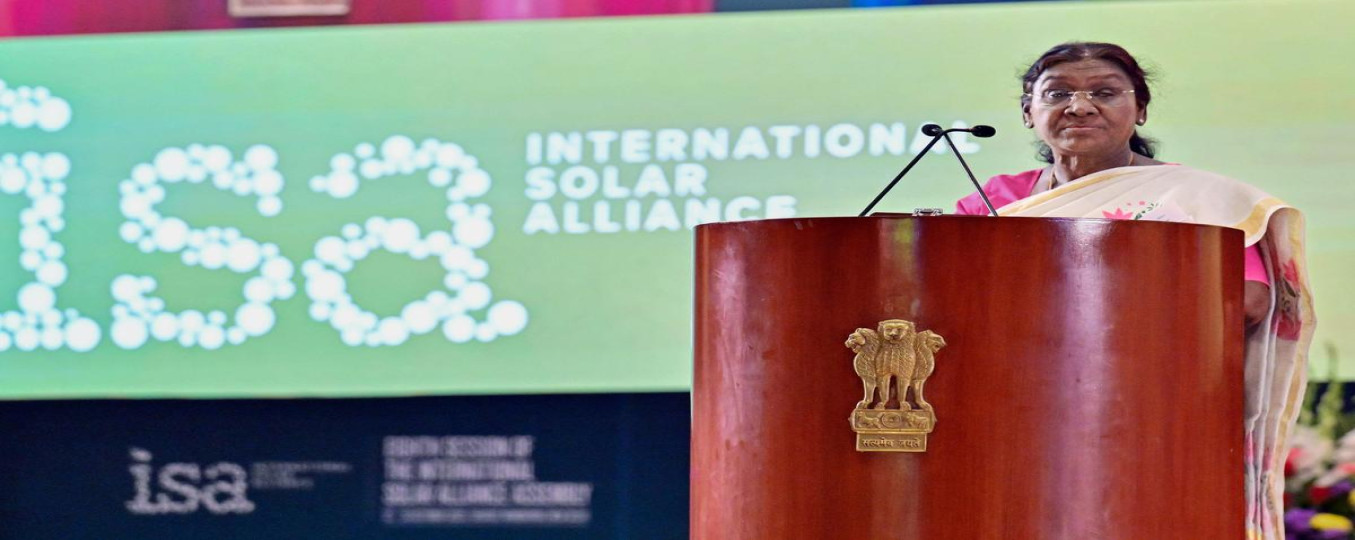
The recent announcement by the United States to withdraw from several international organisations, including the International Solar Alliance (ISA), has raised questions about the future of this important multilateral initiative. The ISA, headquartered in India and jointly led by India and France, was created to promote solar energy adoption across the world, especially in developing countries, by facilitating access to finance, technology, and capacity building. Given India’s central role in the Alliance and the urgency of global climate action, it is important to assess what the U.S. exit really means — not just for ISA as an institution, but also for India’s solar sector and for poorer countries that depend on international solar finance.
What Is the International Solar Alliance?
The ISA was launched with a clear and practical objective: to accelerate the deployment of solar energy, particularly in tropical and developing countries that have high solar potential but limited financial and technological capacity.
-
It focuses on:
-
Mobilising affordable finance
-
Enabling access to technology and best practices
-
Building local capacity and institutional frameworks
-
-
India hosts the ISA Secretariat, and along with France, provides political and strategic leadership to the initiative.
-
Over the years, ISA has positioned itself not just as a climate platform, but also as a development and South–South cooperation mechanism.
Impact on ISA’s Finances: More Symbolic Than Substantive
From a purely financial perspective, the U.S. exit is unlikely to cause a major shock to the functioning of the ISA.
-
The U.S. contribution reportedly accounts for only about 1% of the total ISA funds.
-
This means there will be no serious disruption to Capacity-building initiatives, Training programmes & Day-to-day operations
-
The core funding and institutional support base of ISA remains intact, especially with India, France, and other member countries continuing their commitments.
In financial terms, therefore, the withdrawal is more symbolic than destabilising.
What Does It Mean for India’s Solar Sector?
India’s solar story is driven overwhelmingly by domestic demand and policy priorities, not by U.S. funding or ISA-linked finance.
-
India’s solar projects are anchored in:
-
Long-term power purchase agreements (PPAs)
-
Procurement by central agencies and state utilities
-
-
The momentum of India’s energy transition is rooted in Energy security needs, Falling solar costs, Domestic climate and development goals
In short, the U.S. exit from ISA does not affect the fundamentals of India’s solar expansion.
Solar Manufacturing in India: No Direct Impact
India has made significant strides in building its own solar manufacturing ecosystem.
-
Domestic capacity for:Solar modules, Solar cells has expanded rapidly in recent years.
-
These investments are largely driven by Indian policy incentives & Anchored in domestic and non-U.S. global markets
-
The U.S. exit from ISA:
-
Does not reduce India’s manufacturing capacity
-
Does not affect ongoing production or planned expansions
-
Interestingly, there could even be a potential upside:
-
If the U.S. slows down renewable approvals or installations domestically due to policy shifts, Indian manufacturers who meet U.S. technical standards may find export opportunities and fill supply gaps in other markets that still demand compliant equipment
Will Investment in Solar Projects Slow Down?
A large-scale investment slowdown in India is unlikely.
-
Solar investments in India are currently driven by:
-
Indian banks and financial institutions
-
Global infrastructure and climate funds
-
Multilateral development finance institutions
-
-
These investors base their decisions on:
-
India’s market size
-
Policy stability
-
Long-term growth prospects
-
-
The project pipeline in India remains deep, diverse and Commercially viable
Therefore, the U.S. exit from ISA does not materially change the investment calculus for the Indian solar market.
Real Area of Concern: Africa and Poorer Developing Countries
The more serious impact of the U.S. exit is likely to be felt outside India, particularly in Africa, Least Developed Countries (LDCs), Small and vulnerable developing economies
These countries depend heavily on:
-
Cheap and concessional international finance
-
The confidence and signalling effect created by the presence of major global powers in multilateral initiatives
The U.S. withdrawal could:
-
Create a confidence shock among global lenders and investors
-
Make them more cautious, more risk-averse, Slower in approving finance for solar projects in poorer countries
-
This could:
-
Delay or reduce solar deployment in precisely those regions that need it the most
-
Widen the gap between energy transitions in middle-income and low-income countries
-
In this sense, the biggest cost of the U.S. exit is not financial, but psychological and political.
Strategic and Diplomatic Implications for India
For India, the ISA is not just a technical platform — it is a flagship instrument of climate diplomacy and Global South leadership.
-
The U.S. exit removes one influential partner
-
But does not Change the leadership structure of ISA & Undermine India’s central role in the Alliance
-
In a more fragmented global climate politics environment, India’s leadership role in ISA becomes more important, not less.
The Bigger Challenge: A Fragmented Global Climate Finance Landscape
The deeper problem revealed by this episode is:
-
The growing uncertainty and fragmentation in:
-
Global climate cooperation
-
Multilateral finance and institutions
-
For developing countries, the key challenge is not:
-
Technology availability
-
Or even project viability
If major powers step back from multilateral platforms, the burden on Middle powers like India, Multilateral development banks, Regional and South–South cooperation mechanisms
will only increase.
Conclusion
The U.S. withdrawal from the International Solar Alliance is not a fatal blow to the institution. ISA remains financially and operationally resilient, and India’s own solar sector is well insulated thanks to strong domestic demand, policy support, and a growing manufacturing base. The more serious concern lies in the impact on poorer developing countries, where confidence, concessional finance, and political signalling matter as much as technology itself. Going forward, the real test for ISA — and for India’s climate leadership — will be whether it can sustain momentum and credibility in a world of increasingly fragmented and uncertain global climate cooperation.