
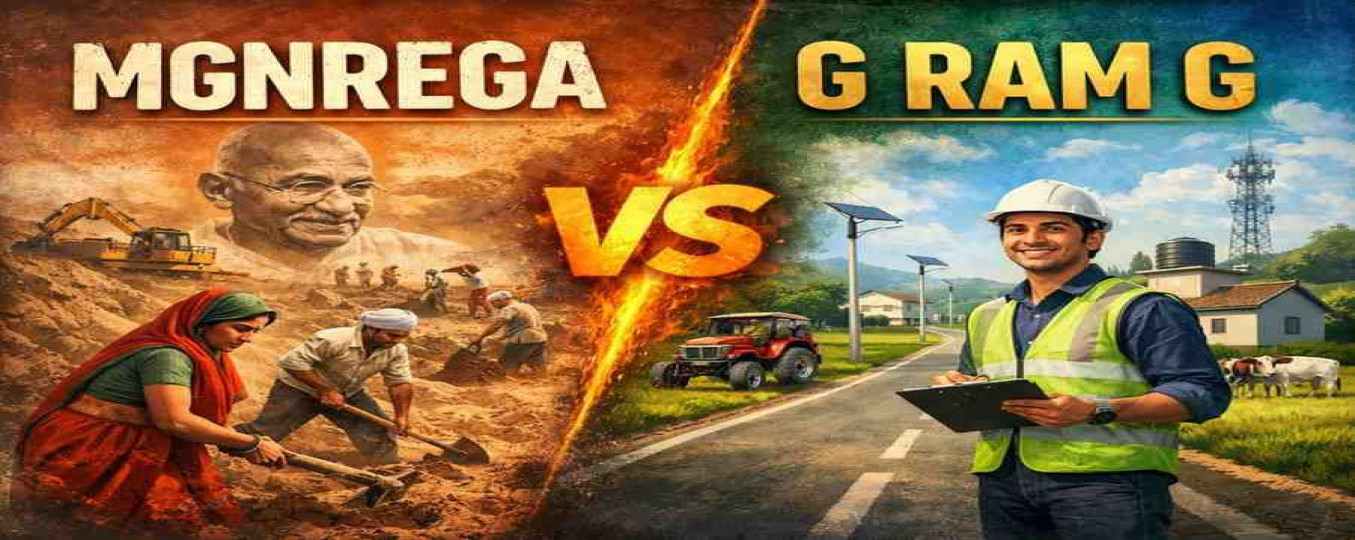
India's Rural Employment at a Crossroads
Study OAS Prism
Why India Needed a Statutory Employment Guarantee
Rural India has always carried a paradox. Despite housing more than 65 percent of the population at Independence and nearly 45 percent even today, the rural economy remains structurally vulnerable — heavily seasonal, poorly diversified, and deeply exposed to monsoon variability. For the agricultural labourer who owns no land and whose livelihood depends entirely on the demand for their physical labour, a failed monsoon, an early frost, or a prolonged lean season could mean literal starvation.
Post-Independence India attempted to address this through a succession of food-for-work and crash employment programmes — the Employment Assurance Scheme, the Jawahar Rozgar Yojana, the Sampoorna Grameen Rozgar Yojana. These were discretionary, budgetary in nature, and suffered from two fatal weaknesses: the worker had no right to demand work, and the State had no legal obligation to provide it. When revenues tightened, these programmes shrank first.
The conceptual shift came from civil society. Economists Jean Dreze and activists Aruna Roy, working through the Mazdoor Kisan Shakti Sangathan (MKSS) in Rajasthan, articulated a fundamentally different idea — that employment for a willing labourer should be a legal entitlement, not a political gift. The result was the National Rural Employment Guarantee Act (NREGA), passed by Parliament on 7 September 2005 and brought into force on 2 February 2006 in 200 of India's most backward districts. By 2008, it covered all rural areas. In 2009, the 'Mahatma Gandhi' prefix was added — giving us MGNREGS as we have known it.
The constitutional architecture supporting this right is in Part IV (Directive Principles of State Policy): Article 41 directs the State to secure citizens the right to work; Article 43 mandates a living wage for workers; and Article 46 specifically requires upliftment of Scheduled Castes and Scheduled Tribes. Crucially, in Olga Tellis v. Brihanmumbai Municipal Corporation (1985), the Supreme Court interpreted Article 21 (right to life) to include the right to livelihood — making deprivation of employment a potential constitutional violation.
MGNREGS: Two Decades of Rights-Based Employment — Achievements and Limits
MGNREGS was a demand-driven statute. Any rural household whose adult members were willing to do unskilled manual work could register for a job card. Within 15 days of registering, the state was legally obligated to provide employment. If work was not provided within 15 days, the worker was entitled to an unemployment allowance. The Centre bore 100 percent of wage costs and 75 percent of material costs. States covered 25 percent of materials and all administrative expenses.
Achievements
|
Indicator |
Data |
|
Cumulative person-days since 2006 |
Over 4.58 billion person-days |
|
Women's participation (FY 2013–14) |
48% of person-days |
|
Women's participation (FY 2024–25) |
58.1% of person-days — exceeded statutory requirement |
|
Peak year: FY 2020–21 (COVID response) |
389.09 crore person-days generated |
|
National average days per worker |
~48 days/year (rarely exceeded 50 days despite 100-day guarantee) |
|
Budget allocation FY 2025–26 |
~?86,000 crore (revised estimates) |
Two achievements deserve special emphasis. First, the scheme functioned as an automatic economic stabiliser: during COVID-19 in 2020–21, when urban migrants returned to villages en masse, MGNREGS absorbed the shock by generating 389 crore person-days — more than any year since the scheme began. Second, the mandatory one-third reservation for women transformed the scheme into a vehicle for gender-inclusive employment, taking women's share from 48 percent to 58 percent over a decade.
Structural Weaknesses the New Law Claims to Fix
MGNREGS was also plagued by documented problems. The 100-day guarantee was largely notional — nationally, fewer than 10 percent of registered households ever reached 100 days; the average was 48 days. Wage payments were routinely delayed, sometimes by months, violating the Act's own 15-day payment norm. Works were often of poor quality, with road-building predominating over asset creation. The demand-driven model allowed states with weak administrative machinery to suppress demand — by simply not registering workers or not opening worksites. And wages, set below state minimum wages in many states (gaps of ?16–?68 between notified and market wages have been documented), failed to attract workers in states with viable alternatives.
The VB-G RAM G Act, 2025:
Origin and Legislative History
The Viksit Bharat – Guarantee for Rozgar and Ajeevika Mission (Gramin) Bill, 2025 was introduced in Parliament as part of the government's Viksit Bharat 2047 framework — the vision of a developed India by the centenary of Independence. Passed by Parliament in the Winter Session 2025, it received Presidential assent from President Droupadi Murmu on 21 December 2025. The Act came into force on 1 July 2026, replacing MGNREGS entirely from that date.
The Act's stated rationale was to move from 'passive employment' to 'productive asset creation', integrate rural wage employment with livelihood-building missions, and curb the alleged inefficiencies of the demand-driven model. Union Minister Shivraj Singh Chouhan described it as a law that 'plugs the loopholes of MGNREGS and builds on its legacy.'
Structural Changes: A Comparative View
|
Feature |
MGNREGS (2005–2026) |
VB-G RAM G (2026–) |
|
Employment guarantee |
100 days/household/year |
125 days/household/year |
|
Seasonal restriction |
None — demand can be raised any time |
Up to 60-day pause during peak agricultural seasons |
|
Centre-State funding |
Centre: 100% of wages; 75% of material cost |
Centre: 60%; States: 40% (exceptions for NE/Himalayan states) |
|
Allocation model |
Demand-driven (state labour budgets) |
Normative top-down allocation by Centre |
|
Wage payment method |
Account transfer (Aadhar-linked) |
Direct Benefit Transfer (DBT) — mandatory |
|
Performance conditionality |
None — funds cannot be withheld |
Centre can withhold allocation for non-compliance with audit/wage payment norms |
|
Scope of works |
Primarily wage employment; land, water, road works |
Four pillars: water security, rural infrastructure, livelihood assets, climate resilience |
|
Legal character |
Rights-based entitlement (demand triggers obligation) |
Mission-based delivery (government defines targets) |
|
Minimum daily wage |
State-specific notified rates (frequently below minimum wage) |
?300/day established as floor |
|
Budget FY 2026–27 |
?86,000 crore (last MGNREGS allocation) |
?95,692.31 crore |
The shift from demand-driven to normative allocation is the most consequential change. Under MGNREGS, a state's labour budget — its entitlement to funds — was driven by how many workers registered for work. Under VB-G RAM G, the Centre determines in advance what quantum of employment each state will get. This converts an entitlement into an allocation.
The Employment Collapse:
The Scale of the Crisis
The transition to VB-G RAM G has coincided with — and appears to have caused — a dramatic collapse in rural employment generation. The data is unambiguous and alarming.
|
Metric |
July 2025 (MGNREGS) |
July 2026 (VB-G RAM G) |
Change |
|
National person-days |
15.33 crore |
7.67 crore |
? 49.94% |
|
Households served |
1.42 crore |
68.94 lakh |
? 51.45% |
|
April–July cumulative person-days |
119–128 crore (avg) |
70 crore |
? ~43% |
The April–July 2026 figure of 70 crore person-days compares against the prior two-year average of 123 crore for the same period — a structural collapse, not seasonal variation. Analysis of state-level data shows that 10 of 19 major states witnessed declines between 60 and 85 percent. Opposition leader Jairam Ramesh termed this "rozgar chori" — employment theft — arguing that expanding the guarantee on paper while collapsing it in practice is a fraud on the rural worker.
Why the Collapse Happened:
- First, rule finalization was delayed. Despite the Act taking effect on 1 July 2026, the operational rules were only finalised on 30 June 2026 — one day before the scheme commenced. This left state governments, District Programme Coordinators, and Gram Panchayats without implementing guidelines for weeks.
- Second, the Gramin Rozgar Guarantee Cards that replaced the original job cards under a new e-KYC and facial-recognition authentication system created significant bottlenecks. In areas with poor biometric infrastructure — tribal hamlets, hilly regions, areas with unreliable internet — workers were effectively locked out of the system.
- Third, the shift from demand-driven to normative allocation created a mismatch. States accustomed to raising demand as needed now had fixed allocations that, in some cases, were exhausted by June while workers continued to seek employment in July.
- Fourth, the monsoon dimension compounded the problem. Rainfall deficits affected 50 percent of districts nationally, and kharif sowing declined 26.50 percent year-over-year. When agricultural employment dries up and the rural safety net collapses simultaneously, the consequences fall most heavily on the most vulnerable households.
Constitutional Architecture:
The Rights-Based Framework Under Challenge
MGNREGS was unique in Indian welfare policy: it converted a Directive Principle (Article 41's aspiration for the right to work) into a legally enforceable entitlement. Workers could go to court if work was denied. This created a justiciable socioeconomic right — unusual in the Indian constitutional framework where DPSP provisions are normally non-justiciable.
VB-G RAM G has, at least in practice if not explicitly in text, reversed this. When allocation rather than demand drives employment, the right becomes conditional on government decisions about targets and compliance — it is no longer the worker's right to assert. Legal scholars describe this as a "constitutional regression" from a near-Fundamental Right back into a DPSP.
The Supreme Court Challenge
The Supreme Court of India, in Aruna Roy & Others v. Union of India (W.P.(C) No. 768/2015), was hearing a long-running petition regarding MGNREGS wage delays and minimum wage adequacy. When VB-G RAM G replaced MGNREGS, the bench (comprising Chief Justice Surya Kant, Justice Joymalya Bagchi, and Justice V. Mohana) disposed of the original petition but explicitly granted liberty to file a fresh petition targeting the VB-G RAM G Act, specifically its wage provisions.
Justice Bagchi noted that 'the right to work is not expressly recognised as a Fundamental Right under Part III' but flagged that where the State itself creates employment and then pays below minimum wage, the Article 21 guarantee of dignified life is implicated. This leaves the minimum wage question under VB-G RAM G constitutionally open — and legally vulnerable.
The key constitutional questions now before the judiciary are: (a) whether the VB-G RAM G allocation model violates the spirit of Article 41 by converting a demand-based right into a State-determined allocation; (b) whether ?300/day constitutes adequate compensation under Article 43's "living wage" mandate; and (c) whether the 60-day seasonal pause provision discriminates against agricultural workers in agrarian-crisis regions.
Seven Structural Gaps:
What the Optimistic Narrative Misses
The government's communication around VB-G RAM G has focused on its expanded 125-day guarantee, the ?95,692 crore budget, and the quality-of-work improvement narrative. These are not without merit. But the structural gaps are significant and must be named directly.
- Gap 1 — The 40 Percent State Burden: States with higher poverty and weaker fiscal capacity — Odisha, Jharkhand, Chhattisgarh — are precisely the states where MGNREGS demand was highest. Imposing a 40 percent cost share on them without differentiated fiscal federalism provisions undermines both equity and effectiveness. The earlier 100 percent Centre funding of wages was intentional — the architects of MGNREGS understood that poor states would otherwise suppress demand.
- Gap 2 — Normative Allocation Kills Countercyclicality: The scheme's anti-poverty power came from being demand-driven. In a drought year, demand surged and the government absorbed the shock. With normative allocations fixed in advance, a climate shock that increases demand will now find the allocation ceiling already reached — exactly when safety nets are most needed.
- Gap 3 — The 60-Day Seasonal Pause: Allowing states to suspend employment during sowing and harvesting seasons sounds reasonable — until you consider that agricultural labourers who find no work in local farms (due to mechanisation, sharecropping disputes, or climate failure) now have no fallback during the very period when agricultural work should be their primary income. The pause removes the safety net's most relevant use case.
- Gap 4 — Authentication as Exclusion: Facial recognition requirements for job card renewal and wage disbursement systematically exclude tribal workers, elderly women, and workers with physical disabilities — precisely the groups most dependent on the scheme. Biometric exclusion is not a technical glitch; it is a documented, predictable failure mode.
- Gap 5 — Performance Conditionality and Political Risk: The Centre's power to withhold allocations from non-compliant states introduces a political variable into welfare delivery. In a federal system with competitive multiparty politics, the conditionality risks becoming a tool of fiscal pressure on opposition-governed states. The pre-existing MGNREGS model avoided this by giving states legal entitlements rather than conditional allocations.
- Gap 6 — The ?300 Wage Floor Without Inflation Indexation: At ?300/day, the VB-G RAM G wage is higher than many state MGNREGS notified rates but lower than actual unskilled labour market rates in states like Kerala, Tamil Nadu, and even parts of Odisha. Without a robust inflation indexation mechanism, the real value of this floor will erode — reproducing exactly the wage inadequacy problem that MGNREGS critics documented.
- Gap 7 — Mission-Based vs Rights-Based: The deepest structural gap is philosophical. MGNREGS gave the rural poor agency — the right to demand work was theirs. VB-G RAM G replaces this with government-designed missions. When the government decides the mission achieves its target, employment can contract without the worker having any legal recourse. India's constitutional framework for the poor works best as a floor of rights, not a ceiling of missions.
Way Forward:
- Immediate Actions (First Six Months)
- The single most urgent need is a six-month performance audit. The government must commission an independent, district-level assessment of why person-days have fallen so sharply — distinguishing between administrative transition delays (which are temporary and fixable) and structural design failures (which require legislative amendment). The audit results should be tabled in Parliament.
- Fiscal Federalism Reform
- The 40 percent state cost-sharing provision must be made differentiated. States in Aspirational Districts Programme regions, states with Tribal Sub-Plan areas exceeding 20 percent of geography, and states with per capita income below the national median should remain on the original 100 percent Central funding for wages. This is not a fiscal concession; it is fiscal federalism operating according to its own logic.
- Restoring Countercyclicality
- The normative allocation model should be retained as a baseline planning tool, but a demand-top-up mechanism must be created: if certified worker demand in a state exceeds its normative allocation, the Centre should automatically release supplementary funds within 30 days. This preserves the planning discipline of normative allocation while restoring the anti-poverty countercyclicality that made MGNREGS nationally important.
- Authentication and Inclusion
- The Unique Identification Authority of India and the Ministry of Rural Development must jointly develop alternative authentication pathways for tribal workers with biometric failure rates exceeding 20 percent. Mobile-based OTP verification through Jan Dhan accounts, Gram Panchayat-certified attestation, and a visible grievance redress mechanism are minimum requirements. Exclusion from authentication is exclusion from the scheme.
- Convergence Architecture
- The shift to mission-based development makes sense only if the missions are well-designed and well-coordinated. VB-G RAM G works must be mapped to Jal Jeevan Mission assets, PM Awas Yojana–Gramin housing sites, and the PM Gram Sadak Yojana road network so that rural labour generates lasting infrastructure rather than temporary employment. Odisha's success with convergence under the Biju Adarsha Gram Yojana framework offers a model worth studying.
- Supreme Court Monitoring
- Given the constitutional stakes — a rights-based scheme replaced by a mission-based one — Parliament should consider a joint committee on rural employment, similar to the Joint Parliamentary Committee that oversees MGNREGS-era audits. This would institutionalise oversight independent of the executive and give the Supreme Court's liberty-to-petition an alternative legislative safety valve.