
India's Presidency of a Shifting World Order
Study OAS Prism
Why This Summit Is a Watershed Moment
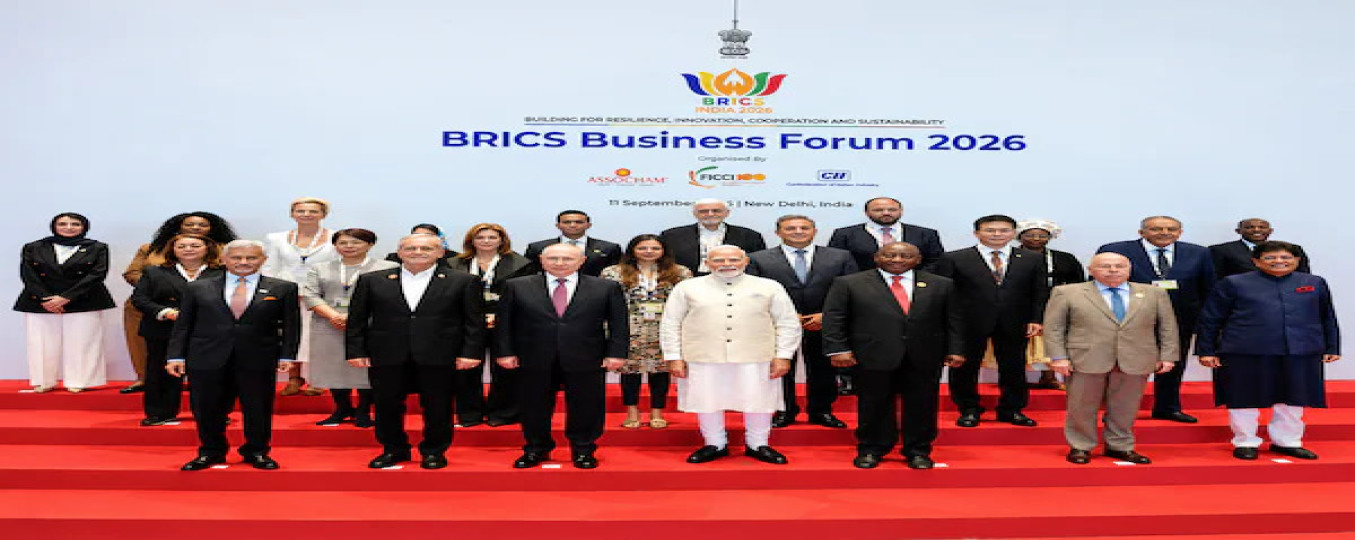
The XVIII BRICS Summit, held in New Delhi on September 12–13, 2026, coincides with three convergences that make it historically consequential. BRICS marks its 20th anniversary (counting from the first BRIC Foreign Ministers’ meeting in New York in 2006). India holds the Presidency for the second time, having hosted the 4th Summit in New Delhi in 2012. And the bloc formally adopts the New Delhi Declaration — unanimously — a document that goes beyond diplomatic language to propose concrete architecture for trade, technology, finance, and security that structurally bypasses Western-dominated multilateral institutions.
BRICS nations today represent over 35% of global GDP (PPP basis), more than 45% of the world’s population, and approximately 40% of global trade — figures that substantially exceed the G7 on all three metrics. For OAS aspirants, BRICS must be understood not as an annual diplomatic event but as an ongoing institutional project to rebalance global governance.
From Economist’s Forecast to Geopolitical Architecture
Jim O’Neill of Goldman Sachs coined the term “BRIC” in November 2001 in the paper “Building Better Global Economic BRICs.” His intent was macroeconomic — a projection of which emerging economies would dominate global GDP growth by 2050. Two decades later, his forecast has become a formal geopolitical institution. The trajectory follows a clear institutional logic:
|
Year |
Milestone |
|---|---|
|
2001 |
Jim O’Neill (Goldman Sachs) coins “BRIC” in a macroeconomic forecast paper |
|
2006 |
First BRIC Foreign Ministers’ Meeting, New York (on UN General Assembly sidelines) |
|
2009 |
1st BRIC Summit, Yekaterinburg, Russia — formal institutionalisation begins |
|
2010 |
South Africa joins → BRICS formed; 3rd Summit in Sanya, China, first as BRICS |
|
2012 |
4th BRICS Summit, New Delhi — India’s first Presidency; NDB proposed |
|
2014 |
NDB formally established, Fortaleza (Brazil); Contingent Reserve Arrangement ($100 bn) signed |
|
2015 |
New Development Bank (NDB) becomes operational; headquartered in Shanghai |
|
2023 |
Johannesburg 15th Summit: Egypt, Ethiopia, Iran, UAE invited to join; Argentina declines |
|
2024 |
Egypt, Ethiopia, Iran, UAE become full members (effective January 2024); 13 partner states designated |
|
2026 |
XVIII BRICS Summit, New Delhi — India’s second Presidency; New Delhi Declaration adopted unanimously |
The New Delhi Declaration:
The Summit’s theme — “Building for Resilience, Innovation, Cooperation and Sustainability” — was preceded by over 400 preparatory meetings held across 30 Indian cities throughout India’s Presidency. The Declaration, running to over 100 paragraphs, is organised around three formal pillars.
Political and Security Cooperation
- UNSC Reform: All BRICS members unanimously backed permanent membership expansion for India and Brazil at the UN Security Council — the clearest collective endorsement India has ever received in this forum.
- Pahalgam Terror Attack Condemned: The Declaration specifically condemns the April 22, 2025 terrorist attack in Jammu & Kashmir that killed 26 people — a significant diplomatic win, marking the first time a multilateral BRICS communiqué names an India-targeted attack.
- Gaza Ceasefire Demand: The bloc calls for an immediate Israeli ceasefire, unrestricted humanitarian aid, rejection of forced Palestinian displacement, and a two-state solution based on 1967 borders, including Palestinian UN membership.
- Counter-Terrorism Architecture: Five Counter-Terrorism Working Group subgroups formally established; the bloc renews the call for adoption of the Comprehensive Convention on International Terrorism (CCIT) at the UN — a framework India has championed since 1996.
- Nuclear Non-Proliferation: Commitment to nuclear-weapons-free zones; support for UNSC Resolution 1325 on Women, Peace and Security.
Economic and Financial Architecture
- BRICS Cross-Border Payments Initiative: A voluntary framework for trade and investment settlements in local currencies of BRICS members, reducing structural dependence on the US dollar and the SWIFT system.
- BRICS Risk Lab at GIFT City: India secured bloc endorsement to establish a shared risk modelling and reinsurance capability at GIFT City’s International Financial Services Centre (IFSC) in Gujarat — India’s bid to become the BRICS financial risk management hub.
- Jaipur Consensus: A BRICS study on an Invoice Discounting Mechanism for export-oriented MSMEs — designed to ease credit access for small enterprises in BRICS nations through receivables-backed lending.
- BRICS SME Forum Established: A dedicated Framework for SME cooperation adopted; the Forum becomes a permanent BRICS institution.
- Anti-Protectionism Stance: The bloc explicitly condemned unilateral tariffs, non-tariff barriers, and — in a pointed reference — the European Union’s Carbon Border Adjustment Mechanism (CBAM) as discriminatory trade measure inconsistent with WTO rules.
- BRICS Grain Exchange: Development of a BRICS-managed grain trading platform ongoing; BRICS AGRIN (Agro-Inputs, Genetic Resources, Information Network) launched.
Science, Technology and Digital Governance
- AI Governance: The Leaders’ Statement on Global Governance of Artificial Intelligence — agreed at the BRICS AI Impact Summit in February 2026 — is formally adopted by the bloc, constituting the first significant multilateral AI governance consensus outside the G7/OECD framework.
- BRICS GRAIN Centres: Global Research Advanced Infrastructure Network — a distributed network of research computing facilities proposed across member states.
- Digital Public Infrastructure Repository: A shared DPI repository for BRICS is proposed, with India’s Aadhaar-UPI-DigiLocker stack serving as the reference model for digital governance.
- Submarine Cable Study: Feasibility study for a direct BRICS submarine digital connectivity cable — bypassing Western-controlled undersea infrastructure that carries over 95% of global internet traffic.
- NIMHANS as BRICS Hub: National Institute of Mental Health and Neurosciences, Bengaluru, designated as the coordinating centre of the BRICS Mental Health Training Hub Network.
India’s Strategic Harvest at New Delhi
India’s Presidency was deliberately structured to convert diplomatic consensus into institutional architecture. The Declaration reflects several of India’s longest-standing multilateral demands:
|
India’s Strategic Ask |
Outcome in New Delhi Declaration 2026 |
|---|---|
|
UNSC Permanent Membership |
Unanimously backed by all BRICS members — strongest collective endorsement yet |
|
Condemnation of terrorism targeting India |
Pahalgam attack (April 22, 2025; 26 killed) specifically named and condemned |
|
AI governance leadership |
Leaders’ Statement on Global Governance of AI formally adopted by bloc |
|
Big Cats conservation (International Big Cats Alliance) |
BRICS bloc endorses India’s International Big Cats Alliance |
|
BRICS financial risk hub |
BRICS Risk Lab approved for GIFT City IFSC, Gujarat |
|
Global DPI promotion (Aadhaar-UPI model) |
DPI Repository for BRICS nations proposed; India’s stack as reference architecture |
|
MSME export credit facilitation |
Jaipur Consensus on invoice discounting; BRICS SME Forum established |
|
Counter-protectionism and CCIT |
Bloc condemns CBAM; renews CCIT call at UN — India’s 26-year-old demand |
The Global South Paradigm: What BRICS Is Actually Building
BRICS 2026 consolidates what analysts describe as “parallel multilateralism” — not a dismantling of existing institutions, but the deliberate construction of alternate pathways where those institutions have systematically failed developing nations. Three structural shifts are underway.
- The first is the anti-coercion principle. The bloc’s unified rejection of unilateral sanctions, secondary sanctions, and carbon border tariffs formalises a norm: economic measures used as foreign policy leverage require UNSC authorisation to be internationally legitimate. India, China, Russia, Iran, and the UAE have all experienced US sanctions or threatened sanctions at various times; the Declaration converts their shared experience into a multilateral legal argument.
- The second is development-without-conditionality. Unlike the IMF’s structural adjustment frameworks or World Bank conditionality requirements, BRICS frameworks explicitly emphasise “nationally determined paths,” respect for sovereignty, and technology transfer without political conditions. This directly addresses the Global South’s historical grievance with Bretton Woods institutions created in 1944 without meaningful developing-country representation.
- The third is institutional duplication as strategy. The NDB (approved loans: $35+ billion), the CRA ($100 billion forex pool), the proposed BRICS Risk Lab, and the Grain Exchange are not symbolic alternatives. They are functional institutions capable of providing financial services that member states previously had to obtain exclusively from Western-dominated entities. Whether they eventually achieve scale comparable to the IMF or World Bank is a different question; what matters for governance architecture is that the alternative exists and is used.
The Fault Lines:
An aspirant who only studies what BRICS declared will score less than one who also analyses what it could not resolve. The following contradictions are real and should feature in any Mains answer on BRICS.
- India-China Strategic Contradiction: BRICS requires India and China to act as partners on the world stage. Yet 73,000 sq km of the Aksai Chin remains disputed, and the LAC disengagement after 2020’s Galwan clash is incomplete. The Modi-Xi meeting’s language (“differences should not become disputes”) is a diplomatic formula, not a resolution.
- Dollar Dependence Persists: Despite repeated calls for local currency trade, the US dollar accounts for over 84% of global foreign exchange reserves and roughly 88% of BRICS inter-member trade. The Cross-Border Payments Initiative is voluntary; no BRICS common currency was endorsed. The Declaration’s anti-dollar posture is aspirational, not operational.
- Russia’s Sanctions Dilemma: With Russia under comprehensive Western sanctions since 2022 (following the Ukraine invasion), the NDB suspended new Russian activities. BRICS financial integration with Russia risks triggering secondary sanctions on Indian and Chinese entities — a real commercial constraint that limits BRICS economic solidarity.
- Expansion vs. Cohesion: With 10 full members spanning democracies (India, Brazil, South Africa), authoritarian states (Russia, Iran, Ethiopia), and Gulf monarchies (UAE), building political consensus is structurally harder. The Declaration’s silence on Ukraine reflects this: no common language could satisfy both Russia and India simultaneously.
- NDB Scale Limitation: The NDB’s $35+ billion approved project portfolio remains small relative to the World Bank’s $200+ billion annual disbursements. The NDB has no crisis lending facility equivalent to IMF’s Special Drawing Rights mechanism — it cannot function as a lender of last resort.
- BRICS’s Democratic Legitimacy Deficit: Unlike the UN or the WTO, BRICS has no charter, no dispute resolution mechanism, and no binding compliance structure. Its declarations are political commitments, not international obligations. This limits its ability to enforce the norms it espouses.
Way Forward:
The gap between BRICS’s declaratory ambition and institutional reality is the central challenge India must manage as it hands over the Presidency to Brazil in 2027.
- Operationalise DPI Repository as a Technical Assistance Platform: India’s expertise in Aadhaar, UPI, and Digi Locker must be converted into an active capacity-building programme, not merely a shared database. India should propose a BRICS Digital Governance Academy, offering training to BRICS finance and technology ministries.
- Fast-Track the Jaipur Consensus: The Invoice Discounting Mechanism for MSMEs should graduate from a ‘study’ to a formal BRICS Credit Guarantee Corporation — modelled on India’s CGTMSE framework — before the 2027 Presidency changes.
- Secure BRICS Risk Lab Mandate Before Brazil 2027: India must ensure the GIFT City Risk Lab has its founding charter, governance structure, and initial capitalisation in place before the institutional gravity shifts to Brazil’s Presidency.
- Link BRICS CT Framework to FATF: India should push for BRICS Counter-Terrorism subgroups to formally align with the Financial Action Task Force (FATF) process — cutting off terrorist financing is more tractable, and more measurable, than intelligence-sharing.
- Odisha Must Engage NDB Proactively: The state government should develop bankable project proposals for NDB financing of the Paradip port expansion, the Keonjhar-Barbil rail connectivity, and green energy infrastructure in tribal districts — supplementing the Centre’s Viability Gap Funding framework.
- Push CCIT Through BRICS Channels: India should use BRICS bloc consensus to build pressure in the UN General Assembly’s Sixth Committee, where the Comprehensive Convention on International Terrorism has been deadlocked since 1996. A unified BRICS position would be the largest voting bloc behind the Convention’s adoption.
Mains Practice Question
The New Delhi Declaration 2026 has been described as India’s most strategically productive BRICS Presidency, yet the bloc faces deep structural contradictions that could limit its transformative potential in global governance. Critically examine the key outcomes of the XVIII BRICS Summit for India, the specific institutional gaps that BRICS must address to evolve beyond declaratory politics, and the steps India should take to translate the New Delhi Declaration into durable geopolitical and economic gains before the Presidency shifts to Brazil in 2027.