
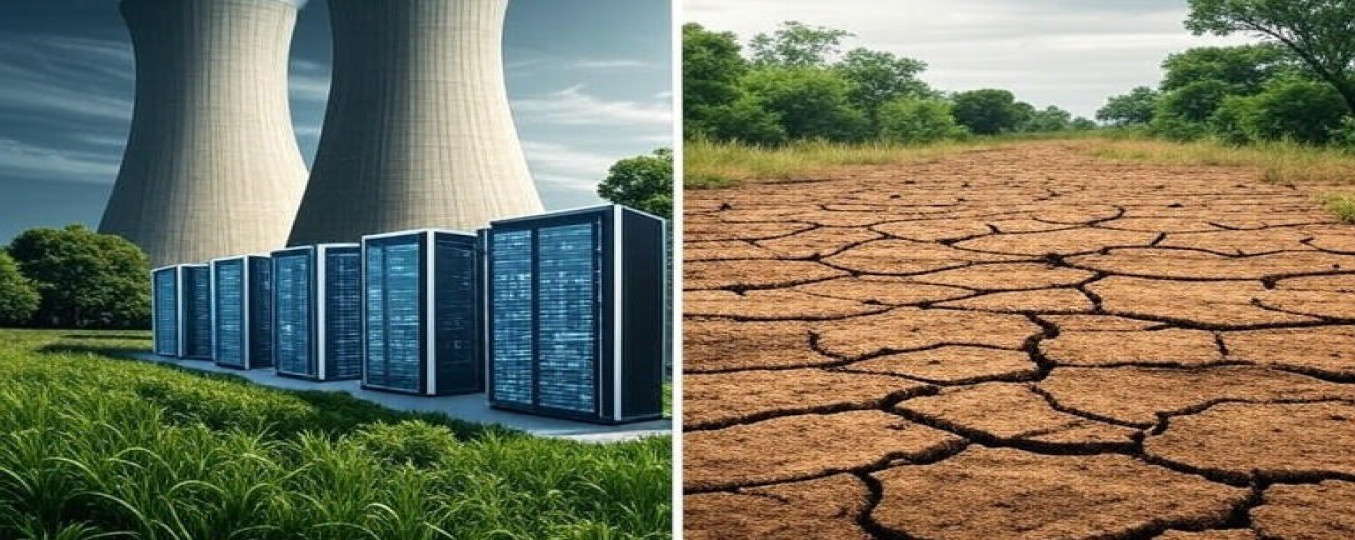
The Data Centre Boom and Its Environmental Paradox
Study OAS Prism
The Digital Imperative Behind the Boom
India’s data centre story did not begin with a policy — it began with demand. Three simultaneous forces drove exponential growth: the explosion of artificial intelligence requiring massive GPU compute clusters; the surge of 800 million-plus internet users generating cloud workloads; and the legal imperative of data localisation crystallised by the Digital Personal Data Protection Act, 2023 (DPDP Act — Act No. 22 of 2023, Presidential assent: 11 August 2023).
The DPDP Act does not mandate blanket data localisation. However, Section 16 empowers the Central Government to restrict transfer of personal data to notified countries and territories. This regulatory uncertainty — with rules still being finalised in 2026 — has led multinationals and Indian firms alike to accelerate India-based infrastructure investment as a preemptive hedge. Separately, the Reserve Bank of India’s 2018 circular mandating exclusive in-India storage of all payment system data set a landmark sectoral precedent that specifically drove capacity additions in the payments vertical.
The cumulative result: India’s data centre installed capacity leapt from 520 MW in 2020 to approximately 2 GW by 2026, backed by a $30 billion investment pipeline. The market is projected to reach USD 21 billion by 2031. The country now hosts data centre corridors in Mumbai (approximately 60% of national capacity), Chennai, Hyderabad, Bengaluru, Pune, and Delhi-NCR — with Odisha, Andhra Pradesh, and Telangana aggressively courting the next wave.
India’s Data Centre Capacity Trajectory
|
Year |
Installed Capacity |
Key Driver |
|---|---|---|
|
2020 |
520 MW |
Initial cloud wave; early hyperscaler entry into India |
|
2024 |
~1.2 GW |
Post-pandemic digital surge; Indian startup and fintech boom |
|
2026 (est.) |
~2 GW |
AI/ML workloads; DPDP Act 2023 compliance investment; RBI data localisation |
|
2030 (proj.) |
6.5–10 GW |
AI hyperscale; data sovereignty mandates; market projected to reach USD 21 billion |
Grid Strain Against a Green Vision
India’s updated Nationally Determined Contribution (NDC, 2022) commits to 500 GW of non-fossil fuel-based electricity generation capacity by 2030 and meeting 50% of total electricity requirements from non-fossil sources. As of June 2026, installed renewable energy capacity stood at 288.58 GW — led by solar energy (162.15 GW) — against a total installed power capacity of 548.8 GW (Central Electricity Authority, June 2026). India ranks third globally in renewable energy installed capacity.
Data centres, however, tell a disconcerting parallel story. Their projected power demand of 8–10 GW by 2030 — roughly 1.5–2% of projected total capacity — is concentrated, inflexible, and continuous. Unlike industrial consumers who can load-shift during grid stress, a data centre’s computational load is non-negotiable: it must receive reliable power around the clock. Renewable sources, without significant battery storage, cannot yet guarantee this baseload reliability. Most Indian data centres today therefore run primarily on coal-fed grid power, despite their operators’ green marketing claims.
The Renewable Curtailment Paradox
An instructive statistic: India curtailed approximately 300 GWh of renewable electricity in Q1 2026 alone due to transmission bottlenecks — electrons generated from wind and solar farms but wasted because the grid could not absorb them. Simultaneously, data centres in the same regions drew coal power. This is not a supply failure; it is a grid integration and transmission infrastructure failure. Upgrading the transmission network — not simply adding more renewable generation — is the critical missing link.
The scale of investment signals the strategic stakes: Google’s $15 billion Andhra Pradesh data centre project — part of a $10 billion India AI infrastructure commitment — will require power equivalent to a small city. Left to coal-fed grid supply, it undermines India’s emission intensity reduction commitments even as it advances its digital economy ambitions. The Google AP project currently faces legal challenges over water usage and wildlife corridor concerns — an early signal that the twin pressures of power and environment will shape the sector’s trajectory.
The Hidden Water Cost
The water footprint of data centres is less visible than their power draw but equally alarming. Data centres use water primarily for cooling — either through evaporative cooling towers that consume water as it evaporates, or indirect free cooling systems. Two metrics are central to understanding this burden:
- Power Usage Effectiveness (PUE): Total facility energy ÷ IT equipment energy. Ideal = 1.0. Global average ~1.5–1.6. Indian data centres, operating in high-ambient-temperature conditions, typically reach 1.6–2.0 — meaning up to twice the energy is consumed in cooling relative to the useful computing work being done.
- Water Usage Effectiveness (WUE): Annual water usage (litres) ÷ IT equipment energy (kWh). Global average ~1.8 L/kWh. As workloads shift toward AI — which demands far more intensive processing than conventional data storage — WUE values are worsening at even otherwise-efficient facilities worldwide.
Scale of India’s Water Challenge
|
Indicator |
2024-25 |
2030 (Projected) |
Direction |
|---|---|---|---|
|
Total data centre water consumption (India) |
~150 billion litres |
~358 billion litres |
+139% |
|
Single 100 MW facility — daily water use |
~2 million litres |
Increasing with AI cooling demands |
↑↑ |
|
Rajasthan data centre groundwater extraction (% of annual recharge) |
147.11% of annual recharge |
Over-exploited zone — permanent depletion trajectory |
Critical |
|
Micro-climate warming within 10 km radius of clusters |
+2°C avg; 9.1°C at core |
Compounds urban heat island effect; increases cooling load |
Rising |
Groundwater Depletion and Thermal Pollution
The groundwater dimension is particularly alarming. Data centres in Rajasthan’s clusters extract at 147.11% of annual groundwater recharge — meaning the aquifer is being drawn down faster than nature can replenish it. This is not temporary stress but a trajectory toward permanent depletion. The Central Ground Water Authority (CGWA), constituted under Section 3(3) of the Environment (Protection) Act, 1986, has the regulatory mandate to issue No Objection Certificates (NOCs) for groundwater extraction. Its September 2020 revised guidelines (effective December 2020) mandate NOCs for industries extracting above 100 cubic metres per day in safe groundwater blocks, with stricter conditions in semi-critical, critical, and over-exploited blocks. Yet no CGWA-specific category exists for data centres, and bulk water users in the digital infrastructure space operate under generic industrial NOC conditions.
Beyond depletion, data centre clusters generate localised thermal pollution: sector studies report average micro-climate warming of +2°C within a 10 km radius, peaking at 9.1°C at cluster cores. This compounds urban heat island effects — a self-reinforcing cycle where hotter ambient temperatures require more cooling, which generates more heat. The National Water Policy 2012 is unambiguous on allocation priority: drinking water first, sanitation second, ecological needs third, agriculture fourth, industries last. Data centres — as bulk industrial water users — occupy the bottom of this hierarchy, yet the approvals process rarely enforces this statutory ordering.
The Regulatory Maze
India’s regulatory architecture for data centres is distributed across multiple ministries with no single enacted statute governing the sector’s environmental obligations:
|
Law |
Provision Relevant to Data Centres |
Ministry |
|---|---|---|
|
IT Act, 2000 |
Section 43A: data security for sensitive personal data; Section 69: interception powers requiring India-accessible servers |
MeitY |
|
DPDP Act, 2023 (Act No. 22 of 2023) |
Section 16: restricts international data transfer to notified countries — primary legislative driver of India-based infrastructure investment; Presidential assent: 11 August 2023 |
MeitY |
|
Environment (Protection) Act, 1986 |
Section 3(3): constitutes CGWA; Section 5: CGWA may issue directions for groundwater extraction limits and NOC conditions |
MoEF&CC / Jal Shakti |
|
National Water Policy, 2012 |
Para 13: Water priority order — drinking water first, industries last; Para 7: groundwater recharge mandatory in over-exploited areas |
Jal Shakti |
|
India Cooling Action Plan (ICAP), 2019 |
India is the first country globally with a comprehensive cooling action plan; covers CRAC/CRAH units by implication; 25–40% cooling energy reduction target by 2037-38; MoEF&CC under Kigali Amendment |
MoEF&CC |
|
Draft Data Centre Policy, 2025 (MeitY) |
Infrastructure status for data centres (priority financing); sustainability standards proposed but NOT yet enacted — still at consultative stage as of 2026 |
MeitY |
|
BIS SP 7:2026 |
Voluntary norms for data centre cooling, energy efficiency, cloud computing, and ethical AI (August 2026); no mandatory enforcement mechanism; most operators still do not disclose WUE |
BIS / MeitY |
The Bureau of Indian Standards issued voluntary norms (BIS SP 7:2026) for data centre cooling and energy efficiency in August 2026. Well-designed as they are, voluntary compliance has historically produced poor outcomes in energy-intensive sectors in India. Down to Earth’s 2026 investigation found that most Indian data centre operators do not publicly disclose their WUE — the primary metric of water consumption efficiency — even voluntarily. Without baseline data, there is no foundation from which to enforce improvement.
The structural gap is stark: no single enacted statute specifically governs data centres. Regulatory responsibilities are fragmented across at least four ministries — MeitY (demand drivers and infrastructure policy), MoEF&CC (environmental clearances, CGWA), Jal Shakti (water), and Ministry of Power (grid reliability) — with no inter-ministerial coordination mechanism for data centre sustainability. The Draft National Data Centre Policy (MeitY, 2025) remains consultative, and even its proposed infrastructure-status classification for data centres focuses primarily on financing incentives rather than environmental obligations.
Constitutional Compass
India’s Constitution does not explicitly mention the right to clean water, but five decades of judicial interpretation have embedded it within Article 21. The foundational precedent is Subhash Kumar v. State of Bihar (AIR 1991 SC 420 / (1991) 1 SCC 598), in which the Supreme Court held that the right to life under Article 21 includes the right to enjoyment of pollution-free water and air for the full enjoyment of life. Any citizen deprived of this right may approach the Court under Article 32.
- M.C. Mehta v. Kamal Nath ((1997) 1 SCC 388) established the Public Trust Doctrine in Indian law: natural resources — rivers, groundwater, forests, open air — are held by the State in trust for public use and cannot be alienated to private parties for commercial exploitation contrary to public interest. This doctrine is directly invocable against data centres that permanently deprive communities of shared groundwater resources. Applied rigorously, it mandates that every data centre NOC be conditioned on demonstrated non-depletion of shared aquifers.
- Vellore Citizens Welfare Forum v. Union of India ((1996) 5 SCC 647) recognised the Precautionary Principle and the Polluter Pays Principle as integral parts of Indian environmental law under Articles 21 and 48A. The Precautionary Principle demands that regulatory approval not await scientific certainty of harm — where the threat exists, preventive action is mandatory. Applied to data centres: sustainability standards must precede capacity approvals, not follow environmental damage. The Google AP data centre litigation (2026) — challenging groundwater extraction and wildlife corridor disruption — is testing these principles in real time, and its outcome will establish critical precedent for the sector.
Supporting provisions: Article 48A (Directive Principle of State Policy) mandates the State shall endeavour to protect and improve the environment and safeguard forests and wildlife. Article 51A(g) (Fundamental Duty) obligates every citizen to protect and improve the natural environment including forests, lakes, rivers, and wildlife. These provisions, read with the judicial precedents above, establish a constitutional architecture within which data centre approvals that ignore groundwater depletion or thermal pollution are constitutionally indefensible.
ODISHA PERSPECTIVE
- Policy Framework: Positioning as an Emerging Data Centre Hub
- Odisha has strategically positioned itself at the frontier of India’s data centre expansion. The state’s Data Centre Policy 2022 offers investors a comprehensive incentive package: power tariff concessions, stamp duty exemption, SGST reimbursement, land at concessional rates, and single-window clearance for approvals. At the Utkarsh Odisha — Make in Odisha Conclave 2025 (January 2025, inaugurated by Prime Minister Narendra Modi in Bhubaneswar), the IT/ITeS sector alone attracted investment intent of Rs 20,900 crore — underscoring the digital sector’s confidence in Odisha’s emerging infrastructure and governance framework.
- The Energy Transition Imperative: From Coal Surplus to Green Infrastructure
- Odisha’s power sector is architecturally coal-dominant. The state grid is managed through GRIDCO (Grid Corporation of Odisha Ltd), which functions as the bulk power purchaser, and OPTCL (Odisha Power Transmission Corporation Ltd), which operates the intra-state 400/220/132 kV transmission network. Distribution reaches consumers through four DISCOMs: CESU (Central), NESCO (North), WESCO (West), and SOUTHCO (South). This infrastructure, built on the coal wealth of Ib Valley and Talcher coalfields, gives Odisha a legacy power surplus that data centre investors find attractive.
- Yet Odisha is simultaneously pursuing an ambitious green transition. Under the Odisha Renewable Energy Policy 2022, the state has set a target of 10 GW (detailed planning documents cite 10.95 GW) of renewable energy capacity by 2030. In 2026, MoUs worth approximately Rs 67,000 crore were signed for 6.8 GW of renewable projects, and the January 2026 Green Energy Investment Summit in Bhubaneswar marked a conscious policy pivot. A data centre attracted to Odisha today primarily runs on coal — the green transition must accelerate faster than new digital demand if Odisha is to achieve both its digital economy and carbon responsibility goals simultaneously.
- Research and Innovation: IIT Bhubaneswar Renewable Energy Research Centre
- The establishment of the IIT Bhubaneswar Renewable Energy Research Centre (September 2026), through a formal partnership between the Odisha government and IIT Bhubaneswar, directly addresses this challenge. By developing indigenous solutions for renewable energy integration, smart grid management, and energy-efficient cooling — the precise technology stack that green data centres require — Odisha is positioning to attract not merely data centres, but sustainable data centres. This research-policy integration is a governance model other states should replicate. Odisha’s advantage, if developed correctly, will not be its coal surplus but its transition-ready intellectual infrastructure.
- Governance Vision: Data Centres Serving Citizens
- The Yatri Safety App (launched August 31, 2026 on Local Self-Government Day by Chief Minister Mohan Charan Majhi) illustrates what digital infrastructure in Odisha must ultimately serve: SOS connectivity to 112 emergency services, Shake & Alert emergency activation, real-time location sharing, and audio recording during emergencies — tools that put digital power directly in the hands of women using public transport. Odisha’s Data Centre Policy 2022 should be progressively revised to incentivise government and public service data hosting, not merely private commercial workloads. Data centres that serve Odisha’s citizens and public institutions advance constitutional goals; those serving only global cloud storage merely advance market goals.
Where the World Has Got It Right
|
Country |
Initiative |
Lesson for India |
|---|---|---|
|
Singapore |
Data centre moratorium (2019–2022) to assess environmental impact; post-moratorium: managed capacity framework with mandatory PUE and WUE thresholds for new approvals |
Regulate first, scale later; growth tied to efficiency benchmarks, not just demand |
|
European Union |
EU Energy Efficiency Directive 2023/1781: mandatory annual reporting on energy, water, and waste for data centres above 500 kW; minimum efficiency thresholds enforceable from 2030 |
Disclosure mandates precede enforcement; building the data ecosystem is itself a governance intervention |
|
Microsoft |
Water-positive commitment by 2030: replenish more water than consumed globally across all data centre operations; publishing WUE data publicly since 2022 |
Corporate commitments need regulatory backing to become sector-wide norms, not competitive differentiators |
|
Google DeepMind |
AI-optimised cooling control: 40% reduction in data centre cooling energy; PUE improved from 1.20 to 1.10 at DeepMind-managed Google facilities |
India can leverage domestic AI and IIT research capacity to develop smart cooling solutions — IIT Bhubaneswar RE Centre is a step in this direction |
What these examples share is an architecture of managed, conditional growth: expansion linked to performance benchmarks; mandatory transparency enabling public accountability; and institutional mechanisms that internalise environmental costs before damage occurs rather than seeking remedies afterward. India, with the world’s third-largest renewable energy capacity and fastest-growing data centre market, is uniquely positioned to combine digital ambition with environmental leadership — but the governance architecture has not kept pace with the investment pipeline.
Where India Falls Short
Beyond structural regulatory fragmentation, specific institutional gaps compound the problem. No mandatory WUE or PUE disclosure norms exist for Indian data centre operators. Most operators do not voluntarily publish these metrics, making sectoral trend assessment impossible. Voluntary BIS SP 7:2026 standards, however well-designed, will not change industry behaviour without mandatory compliance tied to operating licenses or capacity expansion approvals.
The CGWA’s groundwater NOC framework was designed for agriculture and traditional industry — it has no data centre-specific category, no mandatory closed-loop cooling requirement for bulk users, and no automatic escalation mechanism when an area’s groundwater classification deteriorates from safe to semi-critical to critical. A 100 MW data centre approved under a generic industrial NOC can legally extract approximately 2 million litres per day with minimal site-specific sustainability conditions.
India’s data localisation-driven demand is growing faster than its renewable energy capacity can cleanly service it. The renewable curtailment problem — approximately 300 GWh wasted in Q1 2026 alone due to transmission bottlenecks — means that even where renewable capacity exists, data centres cannot reliably be powered by it. Without Green Power Purchase Agreement (Green PPA) frameworks specifically designed for data centres — including provisions for round-the-clock renewable supply through a combination of solar, wind, hydro, and grid balancing — data centres will remain coal-dependent by regulatory default.
Finally, India has no equivalent of Singapore’s capacity management regime or the EU’s mandatory environmental reporting framework. Growth is driven entirely by market demand, with sustainability remaining aspirational rather than enforceable. The absence of a national Environmental Impact Assessment (EIA) mandate for data centres above a threshold capacity is the single most critical gap — it means the fastest-growing industrial water and power consumers in the country face no mandatory pre-approval environmental scrutiny.
Way Forward
- Enact the National Data Centre Policy: Move from MeitY’s consultative draft to enacted policy with enforceable sustainability clauses. Mandate PUE ≤ 1.4 and WUE ≤ 1.5 for new builds above 10 MW; escalate to PUE 1.3 / WUE 1.2 by 2030. Enact in one parliamentary session — do not allow indefinite consultative paralysis.
- Mandatory Sustainability Reporting: All data centres above 5 MW to annually report PUE, WUE, carbon intensity, and water source (groundwater / surface / recycled) to MeitY; data published on a public dashboard and integrated with India’s GHG reporting framework.
- Green Power Purchase Agreements (PPAs): Government-facilitated round-the-clock renewable PPAs for data centres, combining solar, wind, and storage to guarantee baseload reliability. Pair with transmission network upgrades to eliminate the 300 GWh/quarter curtailment waste — a grid investment that simultaneously serves data centres and rural electrification.
- CGWA Framework Reform: Create a dedicated Digital Infrastructure category in the CGWA NOC regime. Mandate closed-loop cooling systems in all semi-critical and over-exploited groundwater zones. Require 1 litre of rainwater harvested and recharged for every litre of groundwater consumed. Auto-escalate NOC conditions when a block’s classification deteriorates.
- Extend ICAP Targets Explicitly to Data Centres: The next revision of India’s Cooling Action Plan should include CRAC/CRAH units and cooling towers in data centres under its efficiency mandate, with sector-specific HFC reduction targets aligned with the Kigali Amendment phase-down schedule.
- Mandatory EIA for Large Data Centres: Data centres above 50 MW to be listed as Category A projects under MoEF&CC’s EIA Notification. The Precautionary Principle (Vellore Citizens Forum, 1996) demands that sustainability benchmarks be pre-conditions for approval, not post-factum remedies.
- Odisha’s Leadership Opportunity: Revise Odisha Data Centre Policy 2022 to adopt Singapore-style managed growth — new capacity tied to PUE/WUE benchmarks; priority incentives for data centres co-locating with Odisha’s 10 GW RE targets; preference for government and public service data hosting. The IIT Bhubaneswar RE Research Centre should be designated a data centre sustainability innovation hub, linking research output to state policy.
Study OAS | Odisha’s Most Trusted OPSC Preparation Platform | studyoas.in