
Study OAS Prism
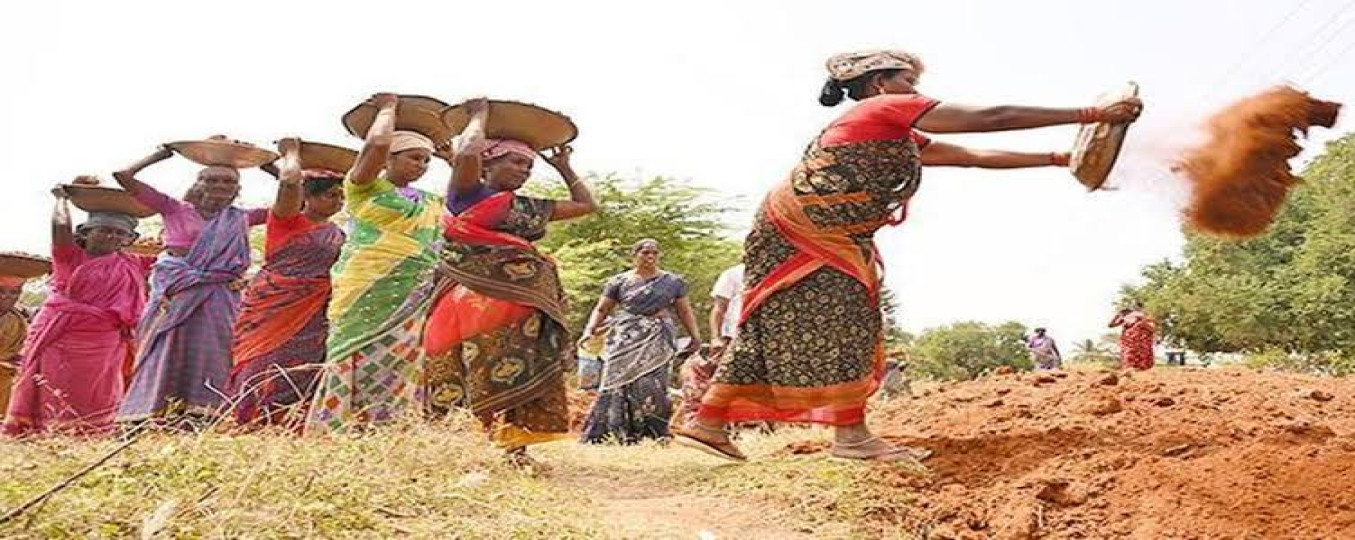
What MGNREGA Built Over Twenty Years
The Mahatma Gandhi National Rural Employment Guarantee Act, 2005 (MGNREGA) was not merely a welfare transfer programme. It was a statutory entitlement — the first time in India's legislative history that the Central government legally guaranteed any rural adult the right to demand wage employment. The burden of providing work lay on the state, not the worker: if employment was not provided within 15 days of demand, the worker was entitled to an unemployment allowance. This demand-driven architecture was its defining feature.
Between FY 2014-15 and FY 2023-24, MGNREGA generated over 2,700 crore person-days cumulatively. In FY 2020-21 alone, it generated 389 crore person-days — the highest ever — absorbing workers displaced by COVID-19. Odisha alone generated approximately 20 crore person-days in FY 2020-21. MGNREGA was an automatic stabiliser: demand surged precisely when private employment collapsed, and the legal architecture obligated the state to respond.
MGNREGA's accountability design was also distinctive: mandatory social audits, Gram Sabha-level disclosure, a quasi-judicial ombudsman under Section 27, and a public MIS enabling real-time tracking. It was a law with teeth — imperfectly implemented, but legally enforceable. This is what the VB-G RAM G Act inherited and partially transformed.
The VB-G RAM G Act, 2025:
The Parliamentary Timeline
The Viksit Bharat — Guarantee for Rozgar & Ajeevika Mission (Gramin) Act, 2025 was introduced in the Lok Sabha on 16 December 2025. It passed the Lok Sabha on 18 December, the Rajya Sabha on 19 December, and received Presidential assent on 21 December 2025. MGNREGA formally ceased on 30 June 2026; VB-G RAM G came into force on 1 July 2026.
The government's stated rationale rested on three grounds: alignment with Viksit Bharat 2047, a shift from employment generation to permanent productive asset creation, and technological modernisation to eliminate ghost-beneficiary fraud. The Act increased guaranteed days from 100 to 125, tightened the wage payment deadline from 15 to 7 days, and mandated biometric authentication and geospatial site verification.
MGNREGA vs VB-G RAM G: A Structural Comparison
|
Aspect |
MGNREGA (2005) |
VB-G RAM G Act (2025) |
|---|---|---|
|
Name |
Mahatma Gandhi NREGA (Mahatma Gandhi in title) |
Mahatma Gandhi removed; Viksit Bharat branding |
|
Days Guaranteed |
100 days per household per year |
125 days per household per year |
|
Funding Model |
Demand-driven: Centre obligated to fund all legitimate demand; no expenditure ceiling |
Normative allocations: fixed state-wise budget ceilings irrespective of actual demand |
|
Wage Payment |
Within 15 days; compensation for delays (often not enforced) |
Within 7 days; interest mandatory for delays — stricter standard |
|
Cost Sharing (wages) |
Centre bears 100% of wage costs |
60:40 Centre-State; 90:10 for NE and Himalayan states |
|
Agricultural Pause |
Not codified; informal pause in practice |
Statutory pause up to 60 days/year during sowing and harvest |
|
Work Focus |
Broad flexible categories |
4 mandated pillars: Water security, Rural infrastructure, Livelihood infrastructure, Extreme weather mitigation |
|
Grievance Redressal |
Independent Ombudsman (Section 27) — quasi-judicial authority |
Council oversight + Gram Panchayat social audits; no independent adjudicatory forum |
|
Technology |
Paper MIS + Aadhaar-based payments |
Biometric authentication, geospatial verification, mobile dashboards |
|
Planning Level |
State/district labour budget |
Village-level Viksit Gram Panchayat Plan |
The Institutional Changes That Matter Most
The most consequential structural change is the shift from demand-driven to normative funding. Under MGNREGA, the Centre was legally obligated to fund all legitimate work demand with no expenditure ceiling. Under VB-G RAM G, state-wise normative allocations impose a fixed budget ceiling. When demand exceeds the normative estimate — as regularly occurred in Odisha during drought years and cyclone recovery periods — workers risk being turned away not due to legal ineligibility but fund exhaustion.
Second, the Section 27 MGNREGA Ombudsman — an independent quasi-judicial authority empowered to hear grievances, award compensation, and recommend penal action — has been replaced by Council oversight and GP-level social audits. Civil society organisations, including LibTech India, have described this as a structural weakening: social audits are deliberative, not adjudicatory; they cannot order compensation or penalise defaulting officials. Workers who are denied work or underpaid lose their legal remedy.
Third, the statutory 60-day agricultural pause is calibrated to Gangetic plain sowing and harvest calendars. In Odisha's tribal uplands and the KBK region, where agricultural work is dispersed differently through the year, a 60-day pause calibrated to an alien seasonal pattern may exclude genuine demand from workers with no alternative income source.
The Supreme Court's Scrutiny:
On 21 August 2026, the Supreme Court heard Aruna Roy and Ors. v. Union of India (WP(C) No. 768/2015) — a PIL originally filed in 2015 seeking compensation for delayed MGNREGA wages and parity with state-notified minimum wages. The case took new constitutional dimensions when the bench was invited to examine the transition from MGNREGA to VB-G RAM G.
The bench — CJI Surya Kant, Justice Joymalya Bagchi, and Justice V. Mohana — raised a question of far-reaching significance: whether the statutory guarantee of employment for rural workers can be placed on the same footing as the fundamental right to life and dignity under Article 21. The petitioner's counsel argued that a dignified life requires, at minimum, payment of minimum wages — below which life ceases to have constitutional quality.
CJI Surya Kant notably observed that MGNREGA "did a wonderful job... it was a very selfless scheme, a good, effective welfare scheme — not a freebie kind of scheme." The bench disposed the original petition and granted petitioners liberty to file fresh proceedings specifically challenging the VB-G RAM G Act. The constitutional question — whether effective curtailment of guaranteed rural employment violates Article 21 — was left judicially open. The Act now faces live Supreme Court scrutiny.
The Constitutional Architecture: Article 21 and Article 41
Indian constitutional law draws a sharp structural distinction between fundamental rights (Part III) and directive principles (Part IV). The right to work exists in the Constitution only as a directive principle — not a fundamental right.
Article 41 states: "The State shall... make effective provision for securing the right to work, to education and to public assistance in cases of unemployment..." Directive principles are "fundamental to the governance of the country" (Article 37) but are not judicially enforceable as standalone rights.
The constitutional opening is provided by Olga Tellis v. Bombay Municipal Corporation ((1985) 3 SCC 545; 1986 AIR 180). A five-judge Constitution Bench held: "No person can live without the means of living, that is, the means of livelihood... Deprive a person of his right to livelihood and you shall have deprived him of his life." Right to livelihood was recognised as an integral component of Article 21.
The logical chain for future litigation: if livelihood is an Article 21 right (Olga Tellis), and if statutory employment schemes are the only available livelihood source for millions of rural poor, then legislation that effectively forecloses that source — through normative fund caps or removal of the adjudicatory ombudsman — may constitute an Article 21 violation. This argument remains judicially untested but has been clearly articulated.
Constitutional provisions:
- Article 21: Right to Life — extended to right to livelihood (Olga Tellis, 1985).
- Article 41 (DPSP): State to make effective provision for the right to work.
- Article 43 (DPSP): Living wage ensuring decent standard of life for workers.
- Article 39(a) (DPSP): Adequate means of livelihood for men and women equally.
- Article 23: Prohibition of forced labour — contextually relevant to minimum wage debates.
- Article 246 + Concurrent List Entry 24: Parliament's competence over welfare of labour.
Can the State Roll Back an Established Entitlement?
The doctrine of non-retrogression holds that a state cannot deliberately reverse or curtail rights already progressively established. In international law, it derives from Article 2(1) of the ICESCR — which India ratified in 1979 — requiring "progressive realisation" of economic, social, and cultural rights. Deliberate backward steps require compelling justification.
In Indian constitutional law, the doctrine has been applied in specific contexts. In Navtej Singh Johar v. Union of India ((2018) 10 SCC 1), the Court stated states should not regress on progressive realisation of constitutional rights. In Anushka Rengunthwar v. Union of India (2023 INSC 99), the Court applied it to prevent retrograde curtailment of previously granted OCI cardholder rights to medical admissions.
The doctrine has not yet been applied to rural employment rights or the MGNREGA-to-VB-G RAM G transition. But the argument is available for the fresh Supreme Court challenge invited in August 2026: MGNREGA created a progressively established statutory entitlement exercised by millions for over two decades; the shift to normative funding and elimination of the quasi-judicial ombudsman constitute a retrogressive step requiring compelling constitutional justification.
Aspirants should understand non-retrogression as a live academic and legal argument — not settled precedent in the employment domain — but one with genuine doctrinal support in both Indian and international law.
What the First Month's Data Reveals
The first full month of VB-G RAM G produced sharp declines in rural employment. The data below draws from MoRD-linked MIS reports, LibTech India monitoring, and government press releases.
|
Indicator |
Period |
Figure |
|---|---|---|
|
National Person-Days |
July 2025 (MGNREGA) |
15.33 crore |
|
National Person-Days |
July 2026 — VB-G RAM G month 1 |
7.67 crore (↓ ~50%) |
|
National Households |
July 2025 |
1.42 crore |
|
National Households |
July 2026 |
68.94 lakh (↓ ~51%) |
The government has offered two explanations. First, Odisha and several states invoked the statutory agricultural pause during kharif sowing in July 2026. Second, the new biometric and geospatial platform required GP-level familiarisation, creating implementation friction. These may partially explain July 2026 numbers. But the longer-term trend matters: Odisha's person-days fell 48.4% in H1 2024-25 vs H1 2023-24 even before VB-G RAM G came into force. The new scheme inherited a system already in decline.
Whether the July 2026 collapse reflects a temporary implementation gap or a structural feature of normative funding — systematically providing less than demand requires — will be answered by 12 to 18 months of consistent data.
Odisha's Stakes: Why the State Has More to Lose Than Most
Odisha's Structural Dependence
Odisha is among India's most MGNREGA-dependent states — not coincidentally but structurally. The state has a 22.8% tribal population (Census 2011), a predominantly agrarian economy concentrated in the KBK region, and a coastal geography repeatedly disrupted by cyclones and floods. In tribal and KBK districts, MGNREGA was not supplementary income; for many households it was the primary guaranteed income during lean seasons and post-disaster recovery.
Odisha generated approximately 20 crore person-days in FY 2020-21. By April–September 2024-25 this had collapsed to 5.8 crore — a 48.4% decline from the same period the prior year. LibTech India identified Odisha as one of the two worst-performing major states nationally in H1 2024-25. Under VB-G RAM G, partial data for July–August 26, 2026 shows 28.41 lakh person-days and 2.89 lakh households — against 1.51 crore person-days and 10.01 lakh households in the equivalent 2025-26 period.
Odisha's Political Response
The government has supported VB-G RAM G. On 6 January 2026, CM Majhi defended it publicly, stating the Act aligned with "Mahatma Gandhi's vision of Gram Swaraj" and that technology would end the corruption that had plagued MGNREGA in Odisha. Opposition parties.
Odisha invoked the statutory agricultural pause in July 2026, contributing to the first-month decline. This is legally permissible, but it raises a structural concern: if the 60-day pause is applied to a period when KBK workers — who follow different agricultural rhythms — would otherwise have demanded work, the pause effectively excludes genuine demand under a legislative provision designed for a different geography.
The KBK and Tribal Dimension
Kalahandi, Bolangir, Nuapada, Koraput, Nabarangpur, and Malkangiri — Odisha's KBK districts — have historically recorded the state's highest MGNREGA dependence ratios. They also have the lowest agricultural land productivity and the highest incidence of distress migration. The shift to normative funding creates a specific systemic risk: if Odisha's normative allocation for KBK districts is set on the basis of recent low-utilisation years rather than crisis-year demand peaks, the budget will systematically underestimate demand exactly when the safety-net function is most needed — during drought, crop failure, or cyclone recovery.
The presence of large Schedule V areas in these districts adds a governance dimension. PESA, 1996 grants Gram Sabhas autonomy in tribal areas. Substituting the MGNREGA quasi-judicial ombudsman with Gram Panchayat social audits under VB-G RAM G may weaken accountability in precisely those areas where power asymmetries between Panchayat officials and tribal workers are historically most pronounced.
Structural Limitations:
A credible analysis must acknowledge what VB-G RAM G corrects. MGNREGA had serious, documented failures: wage payments routinely delayed months beyond the statutory 15-day window; ghost beneficiaries and fraudulent muster rolls widespread in many states including Odisha; work-site asset quality frequently poor; and paper-based systems enabling large-scale diversion. These are real problems, not opposition rhetoric.
VB-G RAM G's genuine improvements: 7-day payment with mandatory interest for delays is a tighter standard; biometric authentication should reduce ghost beneficiaries; geospatial verification is a meaningful accountability upgrade; the four-pillar thematic focus should yield better-quality assets. These are worth acknowledging.
The structural limitations that remain unresolved:
- Normative vs. demand-driven funding: No mechanism exists to augment state allocations when actual demand exceeds projections during crises. This is the most fundamental structural gap.
- Wage-minimum wage disconnect: VB-G RAM G wages are not statutorily linked to state-notified minimum wages. At Rs 266/day in Odisha, the rate remains below several states' agricultural minimum wages. The Supreme Court flagged this directly in August 2026.
- Accountability gap: The MGNREGA ombudsman (quasi-judicial, Section 27) gave workers a legal remedy. VB-G RAM G Council oversight is administrative — it cannot order compensation or impose penalties. Workers lose their adjudicatory forum.
- Agricultural pause and tribal calendars: The 60-day pause is designed for Gangetic plain agriculture. Odisha's tribal uplands follow different seasonal rhythms; applying a misaligned pause may exclude genuine demand from workers with no alternative income.
- Gender regression risk: MGNREGA's one-third women's reservation is absent as a statutory requirement in VB-G RAM G. The risk of women being reclassified as unpaid family workers as formal work sites contract is a documented pattern in periods of employment contraction.
Way Forward:
VB-G RAM G is operational. The constructive path is targeted reform within the new framework to address the structural gaps:
- Demand-responsive contingency mechanism: Amend the Act to include a crisis-triggered supplementary allocation — triggered by drought declaration, flood damage, or crop failure — so normative caps do not become employment ceilings in years of acute need.
- Minimum wage linkage: Index VB-G RAM G wages to state-notified minimum wages, as recommended by the Mehrotra Committee (2016) on MGNREGA wage revision. The Supreme Court's August 2026 scrutiny makes this a near-term legislative imperative.
- Restore independent adjudicatory authority: Establish a statutory VB-G RAM G Grievance Redressal Authority — independent of State Steering Committees — with quasi-judicial powers equivalent to the MGNREGA ombudsman. Social audits alone are insufficient.
- KBK-specific normative calibration: Set Odisha's normative allocations for KBK districts using multi-year, crisis-year-sensitive baselines rather than recent low-utilisation averages. A notified higher normative floor for chronically poor districts — analogous to the erstwhile KBK Special Plan approach — would prevent systematic underprovision.
- Statutory gender floor: Reinstate the one-third women's reservation as a statutory requirement to prevent gender retrogression in rural work participation.
- Independent 18-month implementation review: Commission disaggregated district-level data analysis for tribal and KBK areas before normative allocation norms become permanently entrenched.
For Prelims
- VB-G RAM G Act, 2025 replaced MGNREGA; in force from 1 July 2026; Presidential assent 21 December 2025.
- Days guaranteed: 125 days/household/year (vs 100 under MGNREGA).
- Wage deadline: Within 7 days under VB-G RAM G (was 15 days); interest mandatory for delays.
- Olga Tellis v. Bombay Municipal Corporation (1986 AIR 180; (1985) 3 SCC 545): Right to livelihood = integral part of right to life under Article 21.
- Article 41 (DPSP): State shall make effective provision for securing the right to work — directive principle, not a judicially enforceable fundamental right.
- SC case: Aruna Roy & Ors. v. Union of India, WP(C) 768/2015; Bench: CJI Surya Kant, Justices Bagchi & Mohana; heard 21 August 2026.
- Non-retrogression doctrine: Applied in Navtej Singh Johar (2018) and Anushka Rengunthwar v. UOI (2023 INSC 99); not yet applied to rural employment rights in India.
Mains Practice Question
"The Viksit Bharat — Guarantee for Rozgar & Ajeevika Mission (Gramin) Act, 2025 modernises India's rural employment architecture but structurally alters the nature of the entitlement it purports to guarantee." Critically examine (250 words)