
Mineral Governance, Fiscal Federalism, and Odisha's Stakes
Study OAS Prism
Why Minerals Define India's Future:
India sits atop an estimated ?12.5 lakh crore worth of mineral wealth — iron ore, coal, bauxite, chromite, manganese, and an emerging inventory of critical minerals essential to clean energy and defence technologies. Yet the country imports over 80 per cent of its lithium, cobalt, and rare earth elements, primarily from China. This import dependency is not merely an economic problem; it is a strategic vulnerability.
The Viksit Bharat 2047 vision — which envisions India as a developed economy — rests on infrastructure, electric mobility, defence manufacturing, and semiconductor production. All four are mineral-intensive. The National Critical Mineral Mission (NCMM), launched in January 2025, reflects the urgency: 1,200 exploration projects by the Geological Survey of India from 2025 to 2031, 100+ critical mineral blocks earmarked for auction, and KABIL (Khanij Bidesh India Ltd) mandated to secure overseas mineral assets.
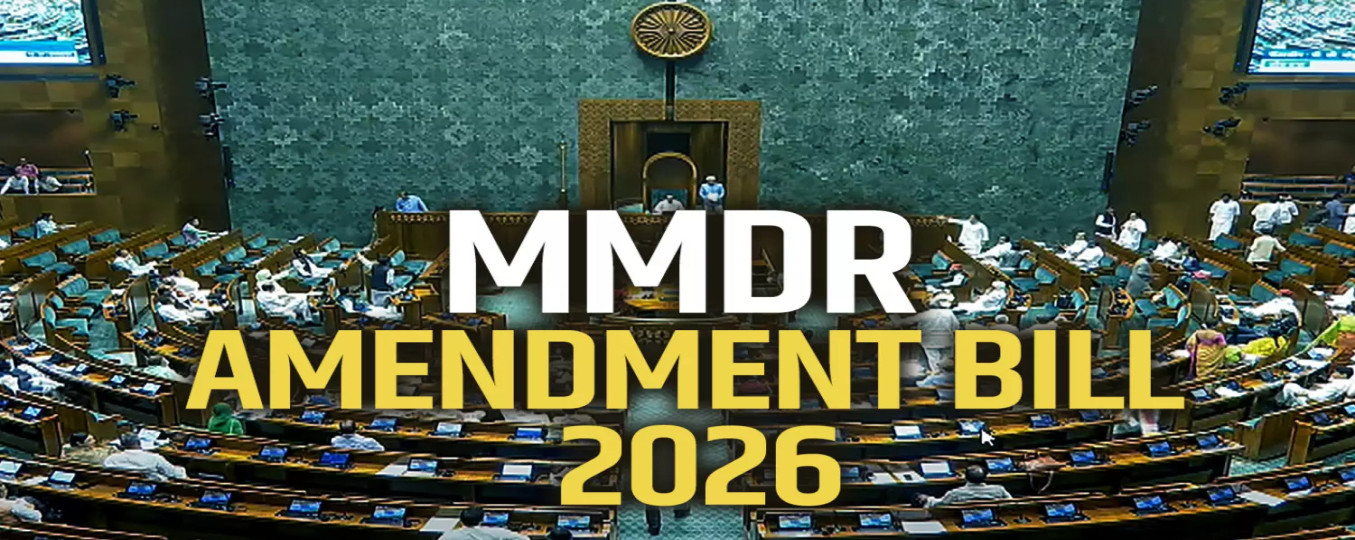
Against this backdrop, how India regulates its mines — who controls taxation, who benefits from extraction, and how states and communities are treated — is not merely an administrative question. It is a question about the kind of republic India chooses to be. The Mines and Minerals (Development and Regulation) Amendment Bill, 2026, passed by Parliament on 13 August 2026, places this question at the centre of national debate.
The MMDR Act, 1957:
The Mines and Minerals (Development and Regulation) Act, 1957 was enacted under Entry 54 of the Union List (Seventh Schedule, Article 246), which empowers Parliament to regulate mines and mineral development when it declares such regulation expedient in the public interest. The Act established the foundational architecture: mining leases granted by states, royalty collected by the Union, and a framework of prospecting licences and concessions. Over seven decades, the Act has been amended repeatedly, each amendment reflecting the dominant political economy of its time.
|
Year |
Amendment |
Key Change |
Significance |
|---|---|---|---|
|
1957 |
Original MMDR Act |
Nationalisation framework; royalties to Union; states grant leases |
Established public interest doctrine |
|
1994 |
Liberalisation |
Minor minerals opened to private sector |
First step toward market-based governance |
|
2015 |
Transformative Amendment |
Auction replaced first-come-first-served; DMF created; PMKKKY launched |
Transparency, community benefit, revenue efficiency |
|
2021 |
Captive Mines |
Extended lease periods; captive mines may sell 50% surplus in open market |
Increased domestic coal and mineral supply |
|
2023 |
Critical Minerals |
24 minerals in Part D — Centre auctions exclusively; private sector allowed in atomic mineral exploration |
National security, clean energy supply chains |
|
2026 |
Taxation Centralisation |
Centre regulates mineral-bearing lands; states barred from new levies without central approval; retrospective dues invalidated |
Tax certainty vs. fiscal federalism debate |
The 2024 Supreme Court Verdict:
To understand the 2026 Amendment, one must first understand why the Union moved with such urgency. The catalyst was the landmark nine-judge Constitution Bench verdict in Mineral Area Development Authority (MADA) v. M/S Steel Authority of India (SAIL), delivered on 25 July 2024 by an 8:1 majority.
What the Court Decided
The Court settled a constitutional question contested for decades: is royalty paid by mine leaseholders to the government a form of taxation? The majority held that royalty is NOT a tax — it is a contractual payment for the right to extract minerals. Crucially, this distinction had profound consequences for state fiscal power.
The Court held that states possess full legislative competence under Entry 50 of the State List to tax mineral rights, subject only to parliamentary limitations. It overruled two earlier judgments — India Cement Ltd. v. State of Tamil Nadu (1990) and Kesoram Industries v. State of West Bengal (2004) — which had incorrectly merged royalty with taxation and thereby constrained state taxing powers.
Most significantly for Odisha, Jharkhand, and Chhattisgarh, the Court allowed retrospective recovery of state mineral taxes from 1 April 2005. For Odisha alone, this translated to a potential windfall of over ?1 trillion in validated, recoverable dues. The 2026 Amendment was, in significant part, a legislative response to this judgment — one that the mining industry lobbied for intensively, arguing that retrospective demands would render multiple operations commercially unviable.
The MMDR Amendment Bill, 2026:
The Bill makes three amendments to the parent Act, each with distinct constitutional and economic consequences.
- Expanding Union Control Over Mineral-Bearing Lands
- The Bill amends Section 2 of the MMDR Act to explicitly place “mineral-bearing lands” — defined by parameters the Centre prescribes — under central regulatory authority. Previously, the Union’s power extended to regulating mineral development and mining operations. This new provision extends that authority to the land itself that contains minerals, a domain traditionally treated as a state subject under Entries 18 and 49 of the State List.
- Capping State Taxation (New Section 9D)
- Section 9D is the Amendment’s most consequential provision. It prohibits states from imposing any tax, cess, or levy on mineral rights or mineral-bearing lands except under conditions specifically prescribed by the Central Government. The prohibition covers levies based on mineral quantity, value, royalty, or any other basis. Entry 50 of the State List does permit Parliament to impose limitations on state mineral taxation — Section 9D invokes precisely that power. The controversy is whether using it to completely pre-empt state fiscal judgment goes beyond regulation into abrogation of a constitutional right.
- Retrospective Invalidation of Unpaid Dues
- The Bill declares all unpaid state levies on mineral rights and mineral-bearing lands, accrued before the Amendment’s commencement, invalid and unrecoverable. Critically, it does not require refund of dues already paid. This creates an anomalous situation: two mining companies in identical circumstances — one which paid its dues, one which did not — are treated entirely differently. Those who contested and delayed payment are effectively rewarded; those who complied are penalised relative to them. This differential treatment has drawn serious challenge under Article 14 of the Constitution.
Federalism Under Structural Pressure
The MMDR Amendment 2026 raises constitutional questions of the first order. It does not merely amend a statute; it reconfigures the balance of financial power between the Union and the States.
|
Provision |
Authority |
Scope |
Relevance to 2026 Amendment |
|---|---|---|---|
|
Entry 54, Union List |
Parliament |
Regulation of mines and mineral development in public interest |
Primary constitutional basis for Union’s power over mines |
|
Entry 50, State List |
States (Parliament may limit) |
Taxes on mineral rights, subject to parliamentary limitations |
States’ taxing power; Section 9D invokes the parliamentary limitation proviso |
|
Entry 49, State List |
States (pure subject) |
Taxes on lands and buildings |
Bill’s regulation of mineral-bearing lands may encroach on this pure state domain |
|
Article 14 |
Fundamental Right |
Equality before law; no arbitrary discrimination |
Differential treatment of payers vs non-payers of pre-amendment dues |
|
Fifth Schedule + PESA |
Scheduled Areas |
Special governance for tribal areas; Gram Sabha authority |
Mining in Scheduled Areas; PESA compliance unaddressed in Bill |
The Federalism Problem in Plain Terms
India’s constitutional design on mineral taxation is not ambiguous. Entry 50 grants states taxing power and explicitly contemplates that Parliament may impose limitations — but limitations, not wholesale elimination. When a constitutional provision says power exists “subject to parliamentary limitation,” it envisions Parliament drawing boundaries, not erasing the power entirely. Whether Section 9D crosses that line will almost certainly be adjudicated by the Supreme Court.
A second concern relates to the separation of powers. The 2024 Supreme Court judgment specifically validated retrospective state tax demands from April 2005. Parliament’s attempt to legislatively nullify those validated claims — without granting refunds to those who had already paid — raises serious questions about whether the legislature is impermissibly overturning a judicial decision rather than changing the underlying law prospectively.
The PRS Legislative Research analysis of the Bill identified at least four constitutional vulnerabilities: competence to regulate mineral-bearing land under Entry 54; retrospective invalidation against the grain of judicial directives; Article 14 inequality between payers and non-payers; and excessive delegation of essential legislative function to executive rule-making without any legislative guiding principles.
Critical Minerals and National Security:
Whatever the constitutional objections, the Union Government’s motivation for centralising mineral governance cannot be dismissed as mere power accumulation. India’s critical mineral position is genuinely precarious.
The 2022 Expert Committee (led by V.L. Kantha Rao, former Secretary, Ministry of Mines) identified 30 critical minerals essential to India’s economic and strategic future. Of these, 24 are now listed in Part D of the MMDR Act’s First Schedule, giving the Central Government exclusive authority to auction their mining leases. This consolidation was the defining feature of the 2023 Amendment; the 2026 Amendment reinforces it by creating uniform taxation across the sector.
- India’s Import Dependency: The Numbers
- India imports nearly 100 per cent of its lithium and cobalt requirements — both essential for electric vehicle batteries. Rare earth elements (REEs), critical for wind turbines and defence electronics, are sourced overwhelmingly from China, which controls over 60 per cent of global REE production and more than 85 per cent of refining capacity. This dependency is strategically dangerous: a disruption of supply chains — whether by geopolitical friction or export controls — could simultaneously cripple India’s clean energy transition and defence manufacturing.
- The National Critical Mineral Mission (NCMM)
- The NCMM, launched in January 2025 and running through 2030–31, is the most ambitious mineral exploration programme in independent India’s history. The Geological Survey of India is executing 1,200 exploration projects. Over 100 critical mineral blocks are earmarked for auction. KABIL — a joint venture of NALCO, HCL, and MECL — is pursuing overseas acquisition in Argentina, Australia, and Chile. The Deep Ocean Mission targets polymetallic nodules from India’s seabed exclusive economic zone.
The 2026 Amendment supports this architecture by creating a predictable, uniform taxation environment across states — reducing the risk premium that investors assign to Indian mining ventures. A company planning a lithium or graphite mine on a 20-year lease needs certainty about its tax burden. Fragmented, state-by-state levy structures subject to retrospective reassessment make that certainty impossible. That is the Union’s legitimate concern, even if the method of addressing it is constitutionally contentious.
Odisha:
No state has more at stake in the MMDR Amendment 2026 than Odisha. The state’s economic identity is intertwined with its mineral wealth in ways that no policy analysis should underestimate.
Odisha’s Mineral Profile
|
Mineral |
National Significance |
Key Districts |
Additional Context |
|---|---|---|---|
|
Iron Ore |
2nd largest reserves in India (~5.5 billion tonnes) |
Keonjhar, Sundargarh, Mayurbhanj |
Major supplier to SAIL, TISCO, JSPL, ArcelorMittal Nippon Steel India (AMNS) |
|
Chromite |
98% of India’s chromite; Sukinda Valley = world’s 2nd largest deposit |
Jajpur (Sukinda Valley) |
Critical for stainless steel and aerospace; also among the world’s most polluted industrial zones |
|
Bauxite |
Major national reserves; feeds NALCO’s aluminium industry |
Koraput, Kalahandi, Rayagada (Niyamgiri Hills) |
Niyamgiri Case (2013 SC): Gram Sabha veto upheld; Vedanta project stalled |
|
Coal |
Talcher coalfields — one of Asia’s largest coal basins |
Angul, Deogarh |
Powers NTPC thermal plants; chemical industry cluster in Talcher (fertiliser, methanol) |
|
Nickel |
Baula-Nuasahi — India’s most significant nickel deposit |
Keonjhar |
Critical mineral; essential for EV batteries and stainless steel alloys |
|
Rare Earth / Heavy Minerals |
Monazite, ilmenite, rutile on Chhatrapur coast |
Ganjam (Chhatrapur) |
Regulated by Atomic Minerals Directorate; significant defence and nuclear applications |
The Economic Stakes: Mining Feeds the Odisha State Budget
The Odisha Mining Corporation (OMC) — a state government PSU — achieved its highest-ever revenue of ?25,300 crore in FY 2025–26, producing 44.82 million tonnes of minerals (iron ore: 40.02 MT, a 12% year-on-year increase; chrome ore: 1.69 MT; bauxite: 2.83 MT). Mining contributes 35 to 40 per cent of Odisha’s own tax and non-tax revenue and approximately 21 per cent of the state’s total revenue pool including central transfers. The state holds over 600 mining leases covering approximately one lakh hectares.
For comparison, mining revenue in Maharashtra or Gujarat amounts to less than five per cent of their respective state revenues. No other large Indian state is comparably dependent on mineral extraction for its fiscal health.
What the Amendment Costs Odisha
The financial impact is severe and binary. First, the invalidation of retrospective dues wipes out what the Supreme Court’s 2024 judgment had validated: Odisha stood to recover over ?1 trillion in state mineral levies from companies that had contested payment for years. That figure is now extinguished. Second, the cap on future state levies eliminates Odisha’s ability to independently calibrate mineral taxation to local environmental, social, and infrastructure costs — a capacity the state had exercised for decades. The annual revenue loss is estimated at approximately ?12,000 crore.
The Biju Janata Dal (BJD) in Opposition described the amendment as a “serious threat to Odisha’s fiscal autonomy,” accusing the Union Government of acting in partisan interests favouring large mining corporations. The ruling BJP in Odisha argued that uniform taxation will attract higher investment and ultimately generate more revenue through enhanced mining activity. Both positions contain a measure of truth, and neither addresses the structural asymmetry.
Odisha’s Governance Architecture for Mining
Odisha has developed a sophisticated institutional architecture for mineral governance. The Odisha Minerals Act, 2004 governs minor minerals. The Odisha Industrial Policy Resolution 2022 prioritises mineral value-addition — steel, aluminium, stainless steel — over raw mineral export, generating higher revenue per tonne. The Odisha Steel Policy 2021 targets 100 MT of steel capacity by 2030, anchored entirely on the state’s iron ore. The 2026 Amendment, by reducing state fiscal capacity, constrains the infrastructure investment that this industrial transformation requires, without any compensatory mechanism.
Tribal Rights, DMF, and Accountability Deficits
Mining in Odisha is not merely an economic activity — it is a contest over land, identity, and survival for millions of tribal people whose territories contain the bulk of the state’s mineral wealth.
- Odisha’s Tribal Demography and the Mining Overlap
- Tribal communities constitute 22.85 per cent of Odisha’s population (2011 Census) — the third-highest tribal share among all Indian states. The overlap between Scheduled Tribe concentration and mineral wealth is not coincidental: the geological formations hosting iron ore, bauxite, and chromite are also the ancestral territories of the Kondh, Santhali, Munda, Bonda, and Soura peoples. Keonjhar, Sundargarh, Mayurbhanj, Koraput, and Rayagada districts — which account for the bulk of Odisha’s mineral production — are all partly or wholly Scheduled Areas under the Fifth Schedule of the Constitution.
- In Scheduled Areas, the Panchayats (Extension to Scheduled Areas) Act, 1996 (PESA) mandates Gram Sabha consultation before land acquisition and resource extraction. The Forest Rights Act, 2006 recognises community forest rights. Both require free, prior, and informed consent for forest land diversion for mining.
- The Niyamgiri Precedent: A Constitutional Landmark
- The most consequential assertion of tribal rights against mining in Odisha was the Niyamgiri case (Orissa Mining Corporation v. Ministry of Environment and Forest, 2013). The Supreme Court upheld the Gram Sabha’s right to veto the proposed Vedanta/BALCO bauxite mine in the Niyamgiri Hills. Twelve Gram Sabhas in Koraput and Rayagada rejected the project unanimously. The judgment established that the right to worship ancestral deity — the Niyam Raja, held sacred by the Kondh tribals — is a fundamental religious and cultural right that mining approvals must account for. This precedent has not been incorporated into statutory law, leaving its application dependent on litigation.
- The District Mineral Foundation: Promise and Performance
- The DMF, created by the 2015 MMDR Amendment, ensures communities bearing the costs of mining receive a share of the benefits. Every leaseholder pays into the DMF of the affected district: 30 per cent of royalty for pre-January 2015 leases, 10 per cent for post-2015 leases. The Pradhan Mantri Khanij Kshetra Kalyan Yojana (PMKKKY) mandates 60 per cent of DMF funds for high-priority areas (drinking water, environment, health, education) and 40 per cent for other infrastructure.
- Odisha has collected ?11,984 crore under the DMF since 2015 — more than one-quarter of the national DMF corpus of ?45,095 crore. Seven districts account for 90 per cent of collections: Keonjhar, Sundargarh, Jajpur, Angul, Jharsuguda, Koraput, and Rayagada. However, performance has been uneven. Allegations of fund diversion surfaced from Keonjhar and Sundargarh. By January 2021, Odisha had spent ?5,364 crore — the highest absolute expenditure of any state, but still only 44.76 per cent of the accumulated corpus. DMF governance lacks independent technical audit, social audit, and outcome measurement, allowing funds to accumulate rather than transform lives in mining communities.
Structural Limitations of the Amendment:
The 2026 Amendment’s goals — investment certainty, uniform taxation, critical mineral security — are legitimate. Its method raises concerns that any policy analyst writing about Indian mineral governance must understand clearly.
- Legislative Overruling of a Judicial Decision
- Legislative overruling of judicial decisions is constitutionally permissible when Parliament changes the underlying law, not when it simply annuls the judgment’s effect. The 2026 Amendment’s retrospective clause does the latter — it declares pre-existing, court-validated claims void without any substantive change in the governing legal principle. Multiple constitutional scholars and the PRS Legislative Research analysis have flagged this as a separation of powers concern that the Supreme Court is likely to scrutinise carefully.
- Excessive Delegation Without Legislative Guardrails
- Section 9D’s critical provisions — what conditions states must meet before imposing any levy, what the Centre can permit or deny — are left entirely to executive rule-making. The Supreme Court’s essential legislative function doctrine (In re Delhi Laws Act, 1951) prohibits delegation of the core of legislative power. Leaving the entire shape of state mineral taxation to central executive discretion, without any legislative principles to guide that discretion, is legally precarious.
- No Revenue-Sharing Mechanism for States
- The Union Government has offered no compensatory mechanism for states that lose revenue as a result of the Amendment. If mineral governance is being centralised in the national public interest, the national revenue gains from increased investment should be shared with mineral-bearing states through a statutory formula that reflects their environmental and social costs. The absence of such a mechanism transforms the reform from a cooperative federalism initiative into a unilateral fiscal transfer from states to the Union.
- Silence on Environmental and Mine Closure Obligations
- The most glaring omission in the 2026 Amendment is its complete silence on mine closure, ecological restoration, and legacy pollution. India has thousands of abandoned mines. Odisha’s Sukinda chromite belt — one of the world’s ten most polluted sites — is a product of this governance failure. The Amendment strengthens Union power over mineral taxation but does nothing to strengthen enforcement of mine closure plans, Mine Closure Fund requirements, or ecological restoration obligations. Centralising revenue power without centralising environmental accountability is structurally incoherent.
Way Forward:
A mature mineral governance framework must resolve the fundamental tension between national strategic interest and state fiscal autonomy, between investment certainty and community justice. The following measures emerge from committee recommendations, constitutional logic, and comparative international experience.
- Permanent Inter-State Mining Council
- India needs a statutory Inter-State Mining Council — analogous to the GST Council — where mineral-rich states participate in decisions about royalty rates, state levy caps, and revenue-sharing formulas. Ad hoc consultations before Parliament passes a bill are insufficient for decisions of this fiscal magnitude. The council should have the power to propose formula changes to Parliament, ensuring that states most affected by mining policy have a structural voice in it.
- Revenue-Sharing with Producing States
- The Union’s incremental revenue from centralised critical mineral auctions — especially for the 24 minerals now under exclusive Centre jurisdiction — should be distributed partly to mineral-bearing states through a statutory formula. A 20–30 per cent passthrough of net additional auction revenue to producing states would compensate for lost state levy autonomy without undermining the investment certainty objective.
- DMF Governance Reform
- DMF trusts must be reformed through mandatory independent technical secretariats, social audit (recommended by the CAG), outcome-based fund release rather than mere expenditure tracking, and third-party project impact evaluation. Odisha has the resources — Keonjhar’s DMF corpus is among the largest of any single district in India — but needs the governance architecture to deploy those resources effectively for mining-affected communities.
- Statutory PESA and Free Prior Informed Consent
- Any mine in a Scheduled Area must obtain a positive Gram Sabha resolution — not merely a notification — before environmental clearance is granted. This is what PESA mandates. Making Gram Sabha consent a mandatory statutory pre-condition for lease grant, rather than an advisory process that can be overridden administratively, would align Indian mining law with both its constitutional intent and international best practices under ILO Convention 169.
- Technology-Enabled Oversight and Mine Closure
- Satellite-based boundary compliance monitoring, GPS-based mineral consignment tracking, drone surveillance of overburden dumps, and e-permit systems for mineral despatch — all recommended by the Centre for Science and Environment and Parliamentary Standing Committee on Coal and Mines — should be made mandatory rather than optional. Simultaneously, progressive mine closure funding from Year One of every lease must be made a legally enforceable obligation, not a paper plan.
Mains Practice Question
|
The Mines and Minerals (Development and Regulation) Amendment Bill, 2026 attempts to create a uniform, investment-friendly mineral taxation framework by centralising levy powers and invalidating retrospective state dues. Critically examine the key provisions of the Amendment and evaluate whether it strikes an appropriate balance between national mineral security, state fiscal autonomy, and the constitutional rights of tribal communities in mineral-bearing areas. Suggest a constitutionally sound and administratively viable way forward. |
Study OAS | Odisha’s Most Trusted OPSC Preparation Platform | studyoas.in