
Vande Mataram Receives Legal Protection — Constitutional, Historical & Examination Analysis
Study OAS Prism
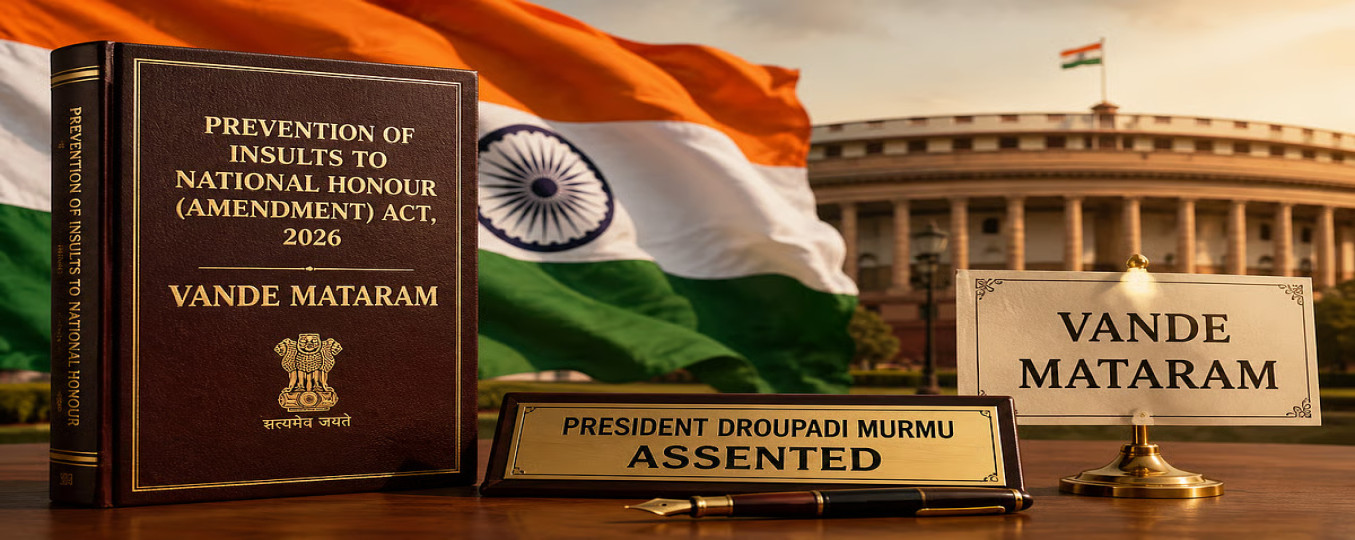
President Droupadi Murmu granted assent to the Prevention of Insults to National Honour (Amendment) Act, 2026 in August 2026, formally extending statutory protection to India's National Song, 'Vande Mataram.' With this, a legal gap that had persisted since independence — the absence of any penal provision specifically covering the National Song — has been closed.
The amendment modifies Section 3 of the parent Act (1971), which previously restricted criminal liability to interference with the National Anthem, 'Jana Gana Mana.' The new provision places Vande Mataram on legal parity with the National Anthem for purposes of the 1971 Act.
Both Houses of Parliament approved the legislation before Presidential assent. The law was seen by the government as a long-overdue measure of honouring a song that served as the battle cry of India's independence movement for decades before independence itself was achieved.
Vande Mataram: (1870s–1950)
Origin and Authorship
Bankim Chandra Chattopadhyay — civil servant, novelist, and intellectual — composed Vande Mataram in the 1870s while serving as a government official, reportedly at Chinsura on the banks of the Hooghly in Bengal. The poem was written in Sanskritised Bengali, weaving together invocations of the motherland with imagery of natural abundance. It first appeared in his 1882 novel Anandamath, a fictional account set during the Sanyasi Rebellion of the 18th century. The title means 'I bow to thee, Mother.'
The Song Becomes a Movement
Rabindranath Tagore recited the composition at the Indian National Congress session in Calcutta in 1896 — marking its first political performance. By 1905, when the British administration announced the Partition of Bengal, Vande Mataram became the rallying cry of the Swadeshi Movement. Protesters who defied the partition marched with it on their lips; the British colonial government responded by banning the novel Anandamath and imprisoning activists who sang it publicly. The banned song spread further precisely because of that suppression.
The 1937 Compromise and Adoption as National Song
By the late colonial period, the poem's later stanzas — which invoke Hindu deities like Durga and Lakshmi — had created genuine concern about religious inclusivity. In 1937, a committee comprising Rabindranath Tagore, Mahatma Gandhi, Jawaharlal Nehru, and Maulana Abul Kalam Azad deliberated on the matter. Their considered recommendation: only the first two stanzas, which celebrate the land itself without specific religious reference, should be recognised officially. Tagore observed that the later verses 'cannot be expected to be sung with whole-hearted patriotism by all communities.'
On January 24, 1950 — the day before the Constitution came into force — the Constituent Assembly formally adopted Vande Mataram as the National Song. President Rajendra Prasad declared it would 'be honoured equally with Jana Gana Mana and shall have equal status with it.' The official recognition extends to the first two stanzas only.
What the 1971 Law Already Prohibited
The Prevention of Insults to National Honour Act, 1971 was Parliament's first consolidated statute for protecting India's national symbols from contemptuous treatment. Its key provisions are:
- Section 2: Prohibits disrespect to the National Flag and the Constitution of India. Covered acts include: burning, mutilation, defacement, trampling, or any contemptuous act. Specific flag misuses such as wearing it below the waist, embroidering it on undergarments, inscribing on it, draping it over vehicles, or allowing it to touch the ground are explicitly prohibited.
- Section 3: Addresses the National Anthem (Jana Gana Mana). Makes it an offence to intentionally prevent its singing or to cause disturbance during an assembly singing it.
- Punishment (Section 2 & 3): Imprisonment up to three years, or fine, or both. Repeat offenders face a minimum one-year term. Government officials, including the President and Prime Minister, face disqualification for violations.
- Legal exception: Comments expressing disapproval of the Constitution or National Flag with a view to obtaining amendment through lawful means are excluded from prosecution. This preserves democratic space for constitutional critique.
- Key amendments: The Act was significantly amended in 2003 and 2005, primarily tightening flag-related provisions — for instance, prohibiting its use to drape a podium during a speech.
National Anthem vs. National Song: Distinctions
|
Dimension |
National Anthem (Jana Gana Mana) |
National Song (Vande Mataram) |
|---|---|---|
|
Author |
Rabindranath Tagore |
Bankim Chandra Chattopadhyay |
|
Officially adopted |
January 24, 1950 |
January 24, 1950 |
|
Constitutional status |
Recognised under Fundamental Duties (Art. 51-A(a)) |
No explicit constitutional mention |
|
Duration of formal rendition |
52 seconds (full), 20 seconds (short) |
No prescribed duration |
|
Stanzas officially recognised |
Full text |
First two stanzas only |
|
Language |
Bengali (adapted) |
Sanskritised Bengali |
|
Legal protection pre-2026 |
Section 3, 1971 Act |
None (statutory gap) |
|
Legal protection post-2026 |
Section 3, 1971 Act |
Section 3, 1971 Act (amended) |
2026 Amendment: What Is Criminalised and What Is Not
The amendment is narrow and precise. It does not create a general duty to sing Vande Mataram, nor does it impose any obligation on citizens to participate in its rendition. Its operation is limited to two specific acts:
- Intentionally preventing the singing of Vande Mataram: This covers acts of active disruption — physically preventing a gathering from singing, switching off sound systems, or coercive interference. The word 'intentionally' is legally significant — it excludes accidental or inadvertent disruptions.
- Disturbing an assembly engaged in singing it: Covers acts that interrupt an ongoing performance with intent to disrupt — shouting, creating noise, or other deliberate interference.
The penalty is identical to what already exists under Section 3 for the National Anthem: imprisonment for up to three years, or a fine, or both. The law does not create a higher offence; it simply extends equal treatment.
Critical clarification: The law does NOT require anyone to stand to attention while Vande Mataram is sung, nor does it compel singing. This distinction is constitutionally essential and is what separates this amendment from a potential clash with the Supreme Court's ruling in Bijoe Emmanuel v. State of Kerala (1986).
Constitutional Crossroads: Article 19, Article 25, and the Article 51A(a) Gap
Freedom of Speech and Expression — Article 19(1)(a)
Article 19(1)(a) guarantees all citizens the right to freedom of speech and expression. The right to remain silent — including silence during patriotic performances — is a constitutionally protected form of expression. However, Article 19(2) permits Parliament to impose reasonable restrictions on free speech in the interests of sovereignty and integrity of India, security of the State, and public order. The 2026 amendment can be argued to fall within this 'sovereignty and integrity' exception, since national symbols are directly tied to the idea of the nation.
The amendment's precision — targeting only active obstruction, not silence — is its strongest constitutional shield. Courts have previously distinguished between 'compelled speech' (unconstitutional) and 'prohibition of active disruption' (permissible). The amendment stays firmly on the permissible side.
Freedom of Religion — Article 25
Vande Mataram's religious controversy — specifically the later stanzas' invocation of Hindu deities — has historically generated resistance from members of minority communities. The 1937 committee's decision to limit official recognition to the first two stanzas was precisely to address this. The 2026 law protects only the officially recognised National Song (i.e., those two stanzas), ensuring religious neutrality is preserved in law, even if political controversy persists.
The Critical Constitutional Gap: Article 51A(a)
Article 51A, inserted by the 42nd Constitutional Amendment in 1976, lists eleven fundamental duties of citizens. Article 51A(a) requires every citizen 'to abide by the Constitution and respect its ideals and institutions, the national Flag and the National Anthem.'
Vande Mataram is conspicuously absent from Article 51A(a). The Supreme Court and legal scholars have consistently noted that respecting the National Song is NOT a fundamental duty in the constitutional sense. This creates an unusual situation: Parliament has extended criminal law protection to a symbol that the Constitution itself does not list among fundamental duties. The 2026 Act is thus robust as legislation but points to a gap in the constitutional text that remains unaddressed.
The Supreme Court Guardrail That Still Stands
Facts of the Case
Three siblings — Bijoe, Binu, and Bindu Emmanuel — belonging to the Jehovah's Witnesses faith were expelled from their school in Kerala for refusing to sing the National Anthem during the morning assembly. They did not sit down or walk away; they stood respectfully throughout the rendition. The school authorities treated their silence as disrespect.
The Supreme Court's Ruling
The Supreme Court, in a judgment delivered by Justice O. Chinnappa Reddy, ruled unambiguously in favour of the children. Their expulsion was held to violate Articles 19(1)(a) and 25. The Court established three enduring principles:
- Respectful silence is sufficient demonstration of respect for national symbols. The State cannot demand active participation in patriotic acts as a condition of citizenship or education.
- Compulsion to sing — or to perform any patriotic ritual — violates the freedom of speech and expression and freedom of conscience.
- Patriotism cannot be measured by outward compliance with mandated gestures. Justice Reddy observed: 'Our tradition teaches tolerance; our philosophy preaches tolerance; our constitution practices tolerance; let us not dilute it.'
Why the 2026 Amendment Survives this Precedent
The Emmanuel case concerned compulsion to sing. The 2026 amendment does not compel singing. It criminalises disruption. A person who stands silently, walks away, or simply does not participate when Vande Mataram is being sung is committing no offence under the amended Act. The law targets the person who actively prevents others from singing — a materially different act. The amendment is therefore constitutionally consistent with Emmanuel, though how courts interpret 'intentionally disturbing an assembly' in edge cases remains to be seen.
Strengths, Gaps, and the Risk of Misuse:
What the Amendment Gets Right
- Closing a genuine legal gap: Songs can be interrupted in ways that are undeniably provocative, and the law provides a deterrent against deliberate disruption of cultural gatherings.
- Proportionate penalty: The three-year maximum is not excessive. Courts have discretion to impose fines where imprisonment would be disproportionate.
- Constitutional precision: By not compelling singing, the amendment preserves the individual's freedom of conscience while protecting collective gatherings.
- Historical justice: A song that served as the anthem of the independence movement for decades before independence deserves at least the protection that post-independence law affords to its sibling symbol.
What Remains Problematic
- The vagueness of 'disturbing an assembly': The phrase can be stretched to cover constitutionally protected protest. If a group of activists holds placards silently near a Vande Mataram event, does that constitute 'disturbance'? The absence of a definition of 'disturbance' in the Act is a real lacuna that enforcement authorities and magistrates will fill by interpretation — with unpredictable results.
- Article 51A(a) still does not list Vande Mataram: There is now a constitutional asymmetry: criminal law protects the song, but the fundamental duty framework does not mention it. Parliament should consider a constitutional amendment to bring 51A(a) in line with the statute, not the other way around.
- Selective enforcement concerns: Laws protecting national symbols have, in the past, been selectively applied in politically charged contexts. The absence of sufficient procedural safeguards — such as requiring senior police officer approval before registration of FIRs — could lead to misuse.
- No definition of 'Vande Mataram': The Act must clarify that 'Vande Mataram' refers specifically to the first two stanzas as officially recognised. A rendition of the later stanzas — which some communities object to — could theoretically trigger competing claims.
Way Forward:
- Amend Article 51A(a): Parliament should bring constitutional text in line with the statute by adding Vande Mataram to the list of symbols that citizens have a fundamental duty to respect. This will provide constitutional grounding to the criminal law protection.
- Define 'disturbance' legislatively: A proviso or explanatory note in the Act specifying what constitutes and what does not constitute a 'disturbance' — drawing on the Emmanuel principle of respectful silence being permissible — would prevent the law from being weaponised.
- Procedural safeguard: Require prior sanction of a designated authority (such as the District Magistrate) for registration of complaints under the amended Section 3, mirroring similar safeguards in other public order statutes.
- State-level counterparts for official state songs: State legislatures — particularly Odisha, with its formally recognised Bande Utkala Janani — should consider analogous protective legislation under their Entry 1 (Public Order) competence in the State List.
- Education over enforcement: The deeper objective — genuine respect for national symbols — is better achieved through curriculum-level education on the history and significance of Vande Mataram than through criminal prosecution. Law should be the last resort, not the first.
Mains Practice Question
(Indian Polity & Governance) | 250 words
"The Prevention of Insults to National Honour (Amendment) Act, 2026 extends criminal protection to Vande Mataram, yet Article 51-A(a) of the Constitution does not list the National Song among the subjects of fundamental duty. Critically examine the constitutional validity of this legislative measure, the tension it creates between national honour and individual liberty, and what it reveals about Parliament's approach to protecting national symbols. Support your answer with relevant judicial precedents and suggest institutional safeguards to prevent misuse of the law."
Study,OAS • Odisha’s Most Trusted OPSC Preparation Platform • studyoas.in