
Current Affairs
Stay updated with the latest national and international events.
29 January 2026
World Bank Releases 'A Breath of Change' Report on Indo-Gangetic Air Pollution
What’s the News?
- The World Bank released a comprehensive report titled 'A Breath of Change: Solutions for Cleaner Air in the Indo-Gangetic Plains and Himalayan Foothills'.
- Highlights that the Indo-Gangetic Plains (IGP) and Himalayan Foothills (HF) region faces the world's most severe air pollution crisis, affecting India, Pakistan, Nepal, and Bangladesh.
- Calls for urgent cross-border cooperation and region-specific mitigation strategies to address transboundary pollution and protect 1.5 billion people living in the region.
Indo-Gangetic Pollution Crisis?
- Geographic Spread: The IGP-HF region covers 57% of India's population but generates only 25% of national GDP, indicating high population density with relatively lower economic productivity.
- Pollution Levels: PM2.5 concentrations in the region are 10-12 times higher than WHO prescribed guidelines, with seasonal spikes during winter months due to stubble burning and temperature inversion.
- Health Burden: 40% of global air pollution-related deaths occur in South Asia, disproportionately affecting vulnerable populations including children and elderly; causes an estimated 8-10% GDP loss annually due to health costs and productivity losses.
- Climate Nexus: Black carbon deposits from IGP pollution accelerate Himalayan glacier melt, threatening water security for downstream nations.
Report Recommendations?
- Regional Cooperation: Establish South Asia Air Quality Management Framework to tackle transboundary pollution through standardized monitoring, data sharing, and joint early warning systems.
- Sectoral Interventions:
- Agriculture: Promote alternatives to crop residue burning through ex-situ management, bio-decomposer usage, and crop diversification.
- Transport: Accelerate adoption of electric vehicles (EVs), strengthen public transport networks, and enforce BS-VI norms strictly.
- Industry: Mandate Flue Gas Desulphurization (FGD) units in thermal power plants and promote zig-zag technology in brick kilns.
- Household: Expand LPG penetration under Pradhan Mantri Ujjwala Yojana (PMUY) and promote improved biomass cookstoves in rural areas to reduce solid fuel burning.
- Institutional Strengthening: Enhance technical and financial capabilities of State Pollution Control Boards (SPCBs) and establish dedicated air quality cells at district levels.
Additional Info
- Indo-Gangetic Plains (IGP):
- Also known as Indus-Ganga-Brahmaputra Plains, stretches from Pakistan to Bangladesh covering approximately 2.5 million sq km.
- Home to over 400 million people, making it one of the world's most densely populated regions.
- Agricultural Heartland: Accounts for 50% of India's food grain production with intensive rice-wheat cropping system contributing to seasonal biomass burning.
- Regulatory Framework:
- National Clean Air Programme (NCAP): Launched by Ministry of Environment, Forest and Climate Change (MoEFCC), targets 20-30% reduction in PM10 and PM2.5 levels by 2024-25 in 131 non-attainment cities through city-specific action plans.
- Commission for Air Quality Management (CAQM): Statutory body established under CAQM Act, 2021 for National Capital Region (NCR) and adjoining areas; replaced Environment Pollution (Prevention and Control) Authority (EPCA).
- Graded Response Action Plan (GRAP): Emergency measures triggered based on Air Quality Index (AQI) levels in Delhi-NCR; implemented by CAQM.
- National Ambient Air Quality Standards (NAAQS): Prescribed by Central Pollution Control Board (CPCB); PM2.5 annual limit 40 μg/m³ (against WHO's 5 μg/m³).
- Constitutional & Legal Provisions:
- Article 21: Right to clean air recognized as part of Right to Life (Subhash Kumar v. State of Bihar, 1991; M.C. Mehta v. Union of India series).
- Article 48A: Directive Principle for State to protect and improve the environment and safeguard forests and wildlife.
- Article 51A(g): Fundamental duty of citizens to protect and improve the natural environment including forests, lakes, rivers, and wildlife.
- Article 253: Empowers Parliament to legislate on matters related to international agreements (led to Environment Protection Act, 1986 following Stockholm Conference, 1972).
- Air (Prevention and Control of Pollution) Act, 1981: Primary legislation administered by CPCB and SPCBs; provides framework for air quality monitoring and regulation.
- International Commitments:
- Sustainable Development Goals (SDGs): SDG 11 (Sustainable Cities and Communities) and SDG 3 (Good Health and Well-being).
- Paris Agreement: India's Nationally Determined Contributions (NDCs) include reducing emission intensity of GDP by 45% by 2030 from 2005 levels and achieving Net Zero by 2070.
- Climate and Clean Air Coalition (CCAC): India is a partner in this global initiative to reduce short-lived climate pollutants (SLCPs) including methane and black carbon.
- Key Pollutants & Sources:
- PM2.5 and PM10: Primary pollutants of concern; major sources include vehicular emissions (20-30%), industrial discharge (20-25%), dust (construction and road), agricultural burning (15-20% during winter), and domestic heating/cooking.
- Ground-level Ozone: Secondary pollutant formed by reaction between NOx and VOCs in presence of sunlight; affects crop yields significantly.
Sources
Centre Notifies Solid Waste Management Rules 2026
What’s the News?
- The Ministry of Environment, Forest and Climate Change (MoEFCC) notified the Solid Waste Management (SWM) Rules, 2026, replacing the SWM Rules, 2016 to address emerging challenges in urban waste management.
- Introduces stringent compliance mechanisms for urban local bodies (ULBs), enhanced Extended Producer Responsibility (EPR) frameworks, and mandates digital monitoring of waste streams from generation to disposal.
- Targets complete remediation of legacy waste (old landfill sites) by 2031 and mandates 100% source segregation in all statutory towns within two years of notification.
Key Regulatory Changes?
- Source Segregation Mandate:
- Three-bin system (dry, wet, hazardous) mandatory at all households, commercial establishments, and institutions.
- Bulk waste generators (housing societies, hotels, malls producing >100 kg/day) must process biodegradable waste on-site or pay operational charges to ULBs for external processing.
- Digital Waste Tracking:
- GPS-enabled monitoring of waste transport vehicles and QR-code based tracking of waste collection to prevent illegal dumping.
- Centralized digital platform integration mandatory for all ULBs with population >1 lakh for real-time compliance reporting.
- Enhanced EPR Framework:
- Producers, importers, and brand owners (PIBOs) now accountable for plastic packaging waste and e-waste through revised EPR targets with quarterly compliance filings.
- Deposit Refund Scheme (DRS) introduced for specific plastic products to incentivize return and recycling.
- Legacy Waste Remediation:
- Bio-mining and bio-remediation made mandatory for all landfill sites >10 years old.
- Landfill reclamation targets: 50% by 2028, 100% by 2031; reclaimed land to be used for parks, green belts, or solar installations only.
- Construction & Demolition (C&D) Integration:
- C&D waste processing facilities mandatory in all cities with population >5 lakh.
- Utilization of recycled C&D waste mandated in all government infrastructure projects within 100 km radius of processing facilities.
Implementation Architecture?
- Institutional Hierarchy:
- Central Pollution Control Board (CPCB): National monitoring and EPR registry maintenance.
- State Pollution Control Boards (SPCBs): State-level enforcement, authorization to waste processing facilities, and penalty imposition.
- District Magistrates: Chairman of District Level Monitoring Committees (DLMC) for rural and small town oversight.
- Financial Mechanisms:
- Solid Waste Management Cess: ULBs empowered to levy user charges based on polluter pays principle; differential pricing for residential, commercial, and industrial categories.
- Green Bonds: Municipal corporations eligible to raise funds through SWM-specific green municipal bonds for capital infrastructure.
- Penalty Structure:
- Environmental Compensation (EC) charges for non-segregation: ₹500–₹20,000 depending on waste volume and repeat violations.
- Criminal liability for illegal dumping in water bodies or public spaces, including imprisonment up to 5 years and fines up to ₹1 crore for repeat corporate offenders.
Additional Info
- Constitutional & Legal Framework:
- Article 243W (12th Schedule): Municipalities mandated to manage solid waste and public sanitation as per 74th Constitutional Amendment Act, 1992.
- Article 51A(g): Fundamental duty of citizens to protect and improve the natural environment.
- Environment (Protection) Act, 1986: Parent legislation enabling SWM Rules notification under Section 3 and Section 6.
- Biomedical Waste Management Rules, 2016 and Hazardous and Other Wastes (Management and Transboundary Movement) Rules, 2016: Operate concurrently; SWM Rules exclude these specific waste streams from their purview.
- Related Initiatives:
- Swachh Bharat Mission-Urban 2.0: Focuses on garbage-free cities and sewerage management; SWM Rules 2026 provide statutory backing to mission targets.
- Circular Economy Action Plan: MoEFCC’s framework promoting reduce, reuse, recycle (3R) principles; SWM Rules operationalize circularity in municipal solid waste.
- Plastic Waste Management Rules, 2016 (Amended): Convergence with SWM Rules for single-use plastic ban enforcement and plastic waste minimization.
- Key Concepts:
- Legacy Waste: Old municipal waste deposited at landfill sites without proper segregation or processing, often spanning decades; estimated 3,000+ lakh tonnes accumulated across Indian landfills.
- Biomining: Processing of legacy waste to recover recyclables (metals, plastics), inert materials (sand, grit), and organic fractions for composting.
- Material Recovery Facilities (MRFs): Specialized centers for sorting dry waste into high-value recyclables; Rules mandate MRFs in all cities >10 lakh population and towns >1 lakh with high waste generation.
Sources
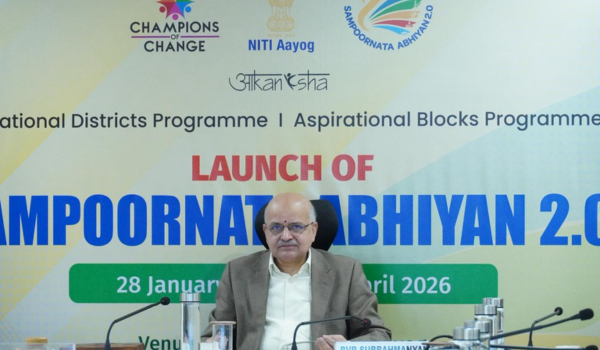
NITI Aayog Launches Sampoornata Abhiyan 2.0 for Aspirational Districts and Blocks
What’s the News?
- NITI Aayog launched Sampoornata Abhiyan 2.0, a mission-mode campaign to achieve 100% saturation of critical social indicators across 112 Aspirational Districts and 513 Aspirational Blocks.
- The three-month intensive drive aims to ensure universal coverage of essential services in health, nutrition, education, sanitation, and livestock welfare through convergent governance.
- NITI Aayog CEO emphasized the campaign builds upon the first phase’s success, targeting the most underserved regions to ensure Antyodaya (last-mile delivery) under the Viksit Bharat vision.
Key Performance Indicators?
- Aspirational Districts (5 KPIs):
- Newborn Health: Proportion of live births weighed at birth.
- TB Elimination: Case notification rates from both public and private healthcare sectors.
- Health Outreach: Regular conduct of Village/Urban Health, Sanitation and Nutrition Days (VHSND/UHSND).
- School Infrastructure: Availability of functional separate toilets for girls.
- Livestock Security: Universal vaccination coverage for bovine animals against Foot and Mouth Disease (FMD).
- Aspirational Blocks (6 KPIs):
- Supplementary Nutrition: Regular intake by children (6 months to 6 years) under Integrated Child Development Services (ICDS).
- Growth Monitoring: Real-time measurement and tracking of enrolled children at Anganwadi Centres.
- Anganwadi Sanitation: Percentage of operational centers with functional toilets.
- Safe Drinking Water: Availability of clean drinking water at Anganwadi facilities.
- Girls' Education: Schools with adequate and functional separate toilet facilities for girls.
- Animal Welfare: Coverage of cattle vaccination against FMD.
Implementation Architecture?
- Mission-Mode Execution: District and Block administrations to formulate three-month action plans with clear monthly milestones and saturation targets.
- Concurrent Monitoring: Mandated frequent field visits by district-level officers for real-time data validation and bottleneck resolution.
- Behavior Change Communication: Intensive awareness campaigns using Nukkad Nataks, Gram Sabhas, and community mobilization to drive beneficiary participation.
- Inter-Departmental Convergence: Coordinated efforts between Central Ministries, State Governments, and NITI Aayog for resource optimization and technical support.
- Competitive Federalism: Monthly tracking and ranking of districts/blocks to foster healthy competition and knowledge sharing through Champions of Change platform.
Additional Info
- Aspirational Districts Programme (ADP):
- Launched by the Prime Minister in January 2018.
- Covers 112 districts across 28 states identified based on 49 quantitative development indicators.
- Five thematic areas: Health & Nutrition, Education, Agriculture & Water Resources, Financial Inclusion & Skill Development, and Infrastructure.
- Delta Ranking: Monthly performance ranking system to track incremental progress rather than absolute achievement.
- Aspirational Blocks Programme (ABP):
- Launched in January 2023 to extend the ADP model to sub-district level.
- Covers 513 Blocks across 329 Districts identified from 40 key socioeconomic indicators.
- Five focus sectors: Health & Nutrition, Education, Agriculture and Allied Services, Basic Infrastructure, and Social Development.
- Constitutional & Policy Framework:
- Article 38: Directive Principle mandating the State to secure a social order for the promotion of welfare of the people by minimizing inequalities.
- Article 46: Obligation to promote educational and economic interests of weaker sections, particularly Scheduled Castes (SCs) and Scheduled Tribes (STs).
- Sustainable Development Goals (SDGs):
- SDG 3 (Good Health and Well-being): TB notification, newborn health, vaccination coverage.
- SDG 4 (Quality Education): Girls' education infrastructure.
- SDG 6 (Clean Water and Sanitation): Anganwadi WASH facilities.
Sources
Indian Army Procures Shield AI's V-BAT Autonomous Drones Under Emergency Acquisition

What’s the News?
- The Indian Army officially selected US-based Shield AI to supply V-BAT autonomous vertical take-off and landing (VTOL) drones under emergency procurement provisions
- The deal includes transfer of Hivemind AI software, enabling India to develop sovereign autonomous military capabilities and indigenous AI-behaviors tailored to operational requirements
- JSW Defence will serve as the Indian strategic partner, establishing a $90 million manufacturing hub in Hyderabad to produce V-BAT systems domestically and position India as a global export hub for these platforms
V-BAT System Capabilities?
- Platform Classification: Group 3 VTOL Unmanned Aircraft System (UAS), capable of operating in high-threat environments where GPS and communications may be jammed or denied
- Unique Propulsion: Single-engine ducted-fan design allows vertical launch and landing like a helicopter, transitioning to horizontal wing-borne flight for extended endurance; requires only 12×12 feet clearing for operations
- Autonomy Package: Hivemind AI software provides:
- GPS-Denied Navigation: Autonomous waypoint navigation without satellite dependency
- Electronic Warfare Resilience: Dynamic threat avoidance and path recalculation when targeted by enemy EW systems
- Swarming Capabilities: Coordinated autonomous operations between multiple drones on single missions without human micromanagement
- Operational Specifications:
- Endurance: 12+ hours continuous flight time
- Engine: Heavy-fuel compatible (JP-8, diesel) for logistical interoperability with existing military fuel supplies
- Payload: High-definition ISR sensors, electro-optical/infrared cameras, and target designation systems
Strategic Significance?
- Terrain Versatility: Ideal for Line of Actual Control (LAC) and Line of Control (LOC) operations in narrow Himalayan ridges, as well as Indian Navy shipboard deployments in the Indian Ocean Region (IOR) without requiring runways or recovery nets
- Technology Transfer: Unlike standard foreign procurement, the agreement provides Software Development Kit (SDK) access for Indian engineers to develop mission-specific autonomous behaviors and integrate indigenous payloads
- Atmanirbhar Bharat: Hyderabad manufacturing facility aligns with Make in India and defence indigenization goals, creating capacity to export V-BAT systems to friendly nations and reducing import dependency for critical ISR platforms
- Lessons from Ukraine: Shield AI's systems gained combat validation in the Ukraine conflict for operations in contested electromagnetic environments, offering the Indian military proven autonomous capabilities for potential high-intensity warfare scenarios
Additional Info
- Drone Classification Systems:
- Group 1: Micro/mini drones (<20 lbs), tactical handheld systems (e.g., Black Hornet)
- Group 2: Small tactical drones (21-55 lbs), short-range ISR (e.g., RQ-11 Raven)
- Group 3: Medium tactical drones (<1320 lbs), persistent ISR with significant payload capacity; V-BAT falls in this category alongside systems like Shadow, RQ-7
- Group 4/5: Large strategic drones (persistent attack/reconnaissance, e.g., MQ-9 Reaper, Predator)
- Defence Procurement Procedures:
- Emergency Procurement (EP): Financial Powers delegated to Defence Services (FPDS) allow Services to acquire critical capabilities bypassing standard lengthy procurement cycles during operational necessities or emerging threats; recently enhanced to ₹300 crore per case for the Army
- Buy (Indian-IDDM), Buy (Indian), Buy & Make (Indian), Buy (Global-Global), Buy (Global-Manufacture in India): Categories under Defence Acquisition Procedure (DAP) 2020; V-BAT procurement aligns with high-technology acquisition under emergency provisions with subsequent indigenous manufacturing
- Constitutional & Legal Framework:
- Article 53: Executive power of the Union vested in the President, exercisable through the Ministry of Defence for military acquisitions
- Article 246 (Seventh Schedule):
- Union List (Entry 1): Defence of India, including military operations and defence works
- Union List (Entry 7): Defence industries under Union control
- Article 343A: Establishes Chief of Defence Staff (CDS) to ensure tri-service synergy in procurement and capability development (through Department of Military Affairs)
- International Export Control Considerations:
- Missile Technology Control Regime (MTCR): India is a member since 2018; controls export of systems including certain unmanned aerial vehicles capable of delivering payloads; V-BAT being manufactured in India provides export flexibility to friendly nations within MTCR frameworks
- International Traffic in Arms Regulations (ITAR): US regulations governing export of defence articles; the Shield AI deal likely includes ITAR waivers or licenses for technology transfer and Indian manufacturing
Sources
Sunabeda Wildlife Sanctuary Declared Maoist-Free; Emerges as Potential Leopard Habitat
What’s the News?
- The Sunabeda Wildlife Sanctuary in Odisha's Nuapada district was officially declared 'Maoist-free', enabling unhindered wildlife monitoring after years of security constraints
- Recent camera trap surveys indicate a thriving leopard population (estimated over 70 individuals), with nearly 90% of camera stations capturing leopard images or signs
- The sanctuary, designated as a proposed Tiger Reserve, transitions from a conflict-affected zone to a potential leopard conservation hub, with improved prey density and reduced human disturbance facilitating carnivore recovery
Sanctuary Profile?
- Location & Extent: Situated in western Odisha's Nuapada district, spanning approximately 600 sq. km (proposed reserve area extends to 956 sq. km); borders Chhattisgarh's Sitanadi and Udanti Sanctuaries forming a transboundary conservation landscape
- Geological Features: High-altitude grass-covered plateau characterized by deep canyons and valleys; primary catchment for the Jonk River (Mahanadi tributary); hosts 11 significant waterfalls with significant eco-tourism potential
- Vegetation: Predominantly Dry Deciduous Tropical Forest with commercial and ecological species including Teak, Bija, Sissoo, and Sandalwood
Conservation Significance?
- Tiger Recovery Potential: Designated as a proposed Tiger Reserve under Project Tiger; historical records indicate 4 tigers in 2016 census though recent surveys reported zero sightings due to security disruptions; ongoing all-India tiger estimation expected to reflect ecological recovery post-Maoist withdrawal
- Leopard Density: Estimated 70+ leopards thriving across the sanctuary, supported by robust prey base including spotted deer, chowsingha (four-horned antelope), wild boar, and bison; increased man-leopard conflict incidents in adjacent villages confirm stable breeding populations
- Critical Corridor: Serves as vital migration route for Wild Water Buffalo between Odisha and Chhattisgarh populations; supports Hard-ground Barasingha (Swamp Deer) and Nilgai; 200+ bird species documented including the Forest Owlet and Banded Bay Cuckoo
Security-Wildlife Nexus?
- Maoist Impact: Nearly 50% of sanctuary area remained inaccessible to forest personnel since 2009 due to Left-wing extremism; camera traps routinely removed or damaged; infrastructure destruction hampered protection efforts
- Monitoring Breakthrough: Post-declaration deployment of camera traps across all sectors enabled comprehensive carnivore and herbivore population assessment; Divisional Forest Officer attributes improved data quality to enhanced security enabling systematic scientific monitoring
- Transboundary Coordination: Improved security facilitates collaboration with Udanti Wildlife Sanctuary (Chhattisgarh) for landscape-level conservation of wide-ranging species
Additional Info
- Legal Status & Framework:
- Wildlife (Protection) Act, 1972: Provides protection under Section 18 (declaration of sanctuary) and Section 35 (declaration of national parks); Sunabeda notified as sanctuary in 1983
- Project Tiger: Centrally Sponsored Scheme for in-situ conservation of tigers; Sunabeda pending final notification as Tiger Reserve under Section 38V of WLPA
- National Tiger Conservation Authority (NTCA): Statutory body under WLPA addressing administrative, ecological, and conservation concerns of tiger reserves; oversees all-India tiger estimation every 4 years using camera trap methodology
- Camera Trapping Methodology:
- Non-invasive technique using motion-activated cameras to photograph animals with unique stripe/pattern markings (tigers, leopards)
- Individual identification through computer-assisted pattern matching enables population estimation without physical capture
- Standardized protocol under Phase IV monitoring of NTCA requires minimum 25 trap stations per 100 sq. km operated for 25 days
- Conservation Challenges:
- Man-Animal Conflict: Increasing leopard sightings in agricultural peripheries raising human safety concerns; requires community-based conflict mitigation and compensation mechanisms
- Habitat Fragmentation: Linear infrastructure projects threatening connectivity with Chhattisgarh forests; need for wildlife corridors and overpasses/underpasses
- Prey Poaching: Despite security improvements, illegal hunting of ungulates remains threat to carnivore population viability
- Constitutional Context:
- Article 48A: Directive Principle mandating State to protect wildlife and safeguard forests
- Article 51A(g): Fundamental duty of citizens to protect and improve natural environment including wildlife
- Seventh Schedule: Concurrent List (Entry 17B) - Protection of wild animals and birds; State List (Entry 19) - Prevention of cruelty to animals
Sources
January 2026
31 January 202630 January 202629 January 202628 January 202627 January 202626 January 202624 January 202623 January 202622 January 202621 January 202620 January 202619 January 202616 January 202615 January 202614 January 202613 January 202612 January 202610 January 202609 January 202608 January 202607 January 202606 January 202605 January 202603 January 202602 January 202601 January 2026
Archive
October 2026
- 27 October 2026
- 26 October 2026
- 24 October 2026
- 23 October 2026
- 22 October 2026
- 21 October 2026
- 20 October 2026
- 19 October 2026
- 17 October 2026
- 16 October 2026
- 15 October 2026
- 14 October 2026
- 13 October 2026
- 12 October 2026
- 10 October 2026
- 09 October 2026
- 08 October 2026
- 07 October 2026
- 06 October 2026
- 05 October 2026
- 03 October 2026
- 02 October 2026
- 01 October 2026
September 2026
- 30 September 2026
- 29 September 2026
- 28 September 2026
- 26 September 2026
- 25 September 2026
- 24 September 2026
- 23 September 2026
- 22 September 2026
- 21 September 2026
- 19 September 2026
- 18 September 2026
- 17 September 2026
- 16 September 2026
- 15 September 2026
- 12 September 2026
- 11 September 2026
- 10 September 2026
- 09 September 2026
- 08 September 2026
- 07 September 2026
- 05 September 2026
- 04 September 2026
- 03 September 2026
- 02 September 2026
- 01 September 2026
August 2026
- 31 August 2026
- 29 August 2026
- 27 August 2026
- 26 August 2026
- 25 August 2026
- 24 August 2026
- 22 August 2026
- 21 August 2026
- 20 August 2026
- 19 August 2026
- 18 August 2026
- 17 August 2026
- 14 August 2026
- 13 August 2026
- 12 August 2026
- 11 August 2026
- 10 August 2026
- 08 August 2026
- 07 August 2026
- 06 August 2026
- 05 August 2026
- 04 August 2026
- 03 August 2026
- 01 August 2026
July 2026
- 31 July 2026
- 30 July 2026
- 29 July 2026
- 28 July 2026
- 27 July 2026
- 25 July 2026
- 23 July 2026
- 22 July 2026
- 21 July 2026
- 20 July 2026
- 18 July 2026
- 17 July 2026
- 15 July 2026
- 14 July 2026
- 13 July 2026
- 11 July 2026
- 10 July 2026
- 09 July 2026
- 08 July 2026
- 07 July 2026
- 06 July 2026
- 04 July 2026
- 03 July 2026
- 02 July 2026
- 01 July 2026
June 2026
May 2026
April 2026
March 2026
- 31 March 2026
- 30 March 2026
- 28 March 2026
- 27 March 2026
- 26 March 2026
- 25 March 2026
- 24 March 2026
- 23 March 2026
- 21 March 2026
- 20 March 2026
- 19 March 2026
- 18 March 2026
- 17 March 2026
- 16 March 2026
- 14 March 2026
- 13 March 2026
- 12 March 2026
- 11 March 2026
- 10 March 2026
- 09 March 2026
- 07 March 2026
- 06 March 2026
- 05 March 2026
- 03 March 2026
- 02 March 2026
February 2026
- 28 February 2026
- 27 February 2026
- 26 February 2026
- 25 February 2026
- 24 February 2026
- 23 February 2026
- 21 February 2026
- 20 February 2026
- 19 February 2026
- 18 February 2026
- 17 February 2026
- 16 February 2026
- 13 February 2026
- 12 February 2026
- 11 February 2026
- 10 February 2026
- 09 February 2026
- 07 February 2026
- 06 February 2026
- 05 February 2026
- 04 February 2026
- 03 February 2026
- 02 February 2026
January 2026
- 31 January 2026
- 30 January 2026
- 29 January 2026
- 28 January 2026
- 27 January 2026
- 26 January 2026
- 24 January 2026
- 23 January 2026
- 22 January 2026
- 21 January 2026
- 20 January 2026
- 19 January 2026
- 16 January 2026
- 15 January 2026
- 14 January 2026
- 13 January 2026
- 12 January 2026
- 10 January 2026
- 09 January 2026
- 08 January 2026
- 07 January 2026
- 06 January 2026
- 05 January 2026
- 03 January 2026
- 02 January 2026
- 01 January 2026
December 2025
- 31 December 2025
- 30 December 2025
- 29 December 2025
- 27 December 2025
- 26 December 2025
- 24 December 2025
- 23 December 2025
- 22 December 2025
- 20 December 2025
- 19 December 2025
- 18 December 2025
- 17 December 2025
- 16 December 2025
- 15 December 2025
- 13 December 2025
- 12 December 2025
- 11 December 2025
- 10 December 2025
- 09 December 2025
- 08 December 2025
- 05 December 2025
- 04 December 2025
- 03 December 2025
- 02 December 2025
November 2025
- 29 November 2025
- 28 November 2025
- 27 November 2025
- 26 November 2025
- 25 November 2025
- 24 November 2025
- 22 November 2025
- 21 November 2025
- 20 November 2025
- 19 November 2025
- 18 November 2025
- 17 November 2025
- 15 November 2025
- 14 November 2025
- 13 November 2025
- 12 November 2025
- 11 November 2025
- 10 November 2025
- 08 November 2025
- 07 November 2025
- 06 November 2025
- 05 November 2025
- 04 November 2025
- 03 November 2025
- 01 November 2025
October 2025
- 31 October 2025
- 30 October 2025
- 29 October 2025
- 28 October 2025
- 27 October 2025
- 25 October 2025
- 24 October 2025
- 23 October 2025
- 22 October 2025
- 21 October 2025
- 20 October 2025
- 18 October 2025
- 17 October 2025
- 16 October 2025
- 15 October 2025
- 14 October 2025
- 13 October 2025
- 11 October 2025
- 10 October 2025
- 09 October 2025
- 08 October 2025
- 07 October 2025
- 06 October 2025
- 04 October 2025
- 03 October 2025
- 02 October 2025
- 01 October 2025
September 2025
- 30 September 2025
- 29 September 2025
- 27 September 2025
- 26 September 2025
- 25 September 2025
- 24 September 2025
- 23 September 2025
- 22 September 2025
- 20 September 2025
- 19 September 2025
- 18 September 2025
- 17 September 2025
- 16 September 2025
- 15 September 2025
- 13 September 2025
- 12 September 2025
- 11 September 2025
- 10 September 2025
- 09 September 2025
- 08 September 2025
- 06 September 2025
- 05 September 2025
- 04 September 2025
- 03 September 2025
- 02 September 2025
- 01 September 2025
August 2025
- 30 August 2025
- 29 August 2025
- 28 August 2025
- 27 August 2025
- 26 August 2025
- 25 August 2025
- 23 August 2025
- 22 August 2025
- 21 August 2025
- 20 August 2025
- 19 August 2025
- 18 August 2025
- 16 August 2025
- 14 August 2025
- 13 August 2025
- 12 August 2025
- 11 August 2025
- 08 August 2025
- 07 August 2025
- 06 August 2025
- 05 August 2025
- 04 August 2025
- 02 August 2025
- 01 August 2025
July 2025
- 31 July 2025
- 30 July 2025
- 29 July 2025
- 28 July 2025
- 26 July 2025
- 25 July 2025
- 24 July 2025
- 23 July 2025
- 22 July 2025
- 21 July 2025
- 19 July 2025
- 18 July 2025
- 17 July 2025
- 16 July 2025
- 15 July 2025
- 12 July 2025
- 11 July 2025
- 10 July 2025
- 09 July 2025
- 07 July 2025
- 05 July 2025
- 04 July 2025
- 03 July 2025
- 02 July 2025
- 01 July 2025
June 2025
- 30 June 2025
- 28 June 2025
- 27 June 2025
- 26 June 2025
- 25 June 2025
- 24 June 2025
- 23 June 2025
- 21 June 2025
- 20 June 2025
- 19 June 2025
- 18 June 2025
- 17 June 2025
- 16 June 2025
- 14 June 2025
- 13 June 2025
- 12 June 2025
- 11 June 2025
- 10 June 2025
- 09 June 2025
- 07 June 2025
- 06 June 2025
- 05 June 2025
- 04 June 2025
- 03 June 2025
- 02 June 2025
May 2025
April 2025
- 30 April 2025
- 29 April 2025
- 28 April 2025
- 26 April 2025
- 25 April 2025
- 24 April 2025
- 23 April 2025
- 22 April 2025
- 21 April 2025
- 19 April 2025
- 18 April 2025
- 17 April 2025
- 16 April 2025
- 15 April 2025
- 14 April 2025
- 12 April 2025
- 11 April 2025
- 10 April 2025
- 09 April 2025
- 08 April 2025
- 07 April 2025
- 05 April 2025
- 04 April 2025
- 03 April 2025
- 02 April 2025
- 01 April 2025
March 2025
- 31 March 2025
- 29 March 2025
- 28 March 2025
- 27 March 2025
- 26 March 2025
- 25 March 2025
- 24 March 2025
- 22 March 2025
- 21 March 2025
- 20 March 2025
- 19 March 2025
- 18 March 2025
- 17 March 2025
- 15 March 2025
- 13 March 2025
- 12 March 2025
- 11 March 2025
- 10 March 2025
- 08 March 2025
- 07 March 2025
- 06 March 2025
- 05 March 2025
- 04 March 2025
- 03 March 2025
- 01 March 2025
February 2025
- 28 February 2025
- 27 February 2025
- 26 February 2025
- 25 February 2025
- 24 February 2025
- 22 February 2025
- 21 February 2025
- 20 February 2025
- 19 February 2025
- 18 February 2025
- 17 February 2025
- 15 February 2025
- 14 February 2025
- 13 February 2025
- 12 February 2025
- 11 February 2025
- 10 February 2025
- 08 February 2025
- 07 February 2025
- 06 February 2025
- 05 February 2025
- 04 February 2025
- 03 February 2025
- 01 February 2025
January 2025
- 31 January 2025
- 30 January 2025
- 29 January 2025
- 28 January 2025
- 27 January 2025
- 25 January 2025
- 24 January 2025
- 23 January 2025
- 22 January 2025
- 21 January 2025
- 20 January 2025
- 18 January 2025
- 17 January 2025
- 16 January 2025
- 15 January 2025
- 14 January 2025
- 13 January 2025
- 11 January 2025
- 10 January 2025
- 09 January 2025
- 08 January 2025
- 07 January 2025
- 06 January 2025
- 04 January 2025
- 03 January 2025
- 02 January 2025
- 01 January 2025