
Current Affairs
Stay updated with the latest national and international events.
28 March 2026
Government Reduces Special Additional Excise Duty on Petrol and Diesel

What’s the News?
- The Union Government has announced a significant reduction in the Special Additional Excise Duty (SAED) on petroleum products.
- The move aims to provide relief to consumers and stabilize domestic retail prices amidst fluctuations in the global energy market.
- The Central Board of Indirect Taxes and Customs (CBIC) issued the notification to implement these changes, focusing on lowering the tax burden on essential transport fuels.
Why the Cut Now?
- Geopolitical Tensions: The decision comes amid escalating US-Israel-Iran tensions, which have led to a near-closure of the Strait of Hormuz, a critical chokepoint for global oil flows.
- Supply Disruptions: The disruption threatens global supply chains, making India—the world’s third-largest oil importer—vulnerable to price volatility.
- Protecting Consumers & OMCs: The move aims to cushion consumers from potential price spikes and offset the mounting losses of Oil Marketing Companies (OMCs) , which were absorbing high international crude prices to keep retail prices stable.
Fuel Pricing & Tax Structure
The retail price of fuel is determined by a multi-stage process:
- Components of Retail Price:
- Crude Oil Cost: The base cost of imported crude, influenced by global prices and the rupee-dollar exchange rate.
- Refining & Freight: Costs incurred to convert crude into fuel and transport it.
- OMC Margin: The marketing margin retained by oil companies.
- Central Excise Duty: A union government levy, which now stands at approx. ₹3 per litre for both fuels post-cut.
- State VAT: A value-added tax levied by state governments, which varies significantly and contributes 20-30% to the final price.
- Tax Contribution: Prior to the cut, central and state taxes together accounted for 40-55% of the retail price paid by consumers.
Will Petrol Prices Drop Immediately?
Not necessarily! Here's why:
- OMCs often absorb short-term volatility to avoid frequent price changes
- Excise cut may initially help offset losses for companies rather than immediately lowering pump prices
- Consumers are likely to see gradual relief rather than immediate reduction
Additional Info
- Special Additional Excise Duty (SAED):
- It is a type of Windfall Tax often imposed when global prices rise significantly, allowing the government to capture a portion of the "supernormal profits" earned by energy companies.
- The rates are reviewed fortnightly based on the moving average of international oil prices.
- Constitutional and Legal Framework:
- Article 271: This article allows the Union government to levy a surcharge on certain duties and taxes for the purpose of the Union. Unlike the basic excise duty, the revenue from such surcharges and cesses is not required to be shared with the States.
- The Finance Act: The legal authority to modify excise duty rates is derived from the annual Finance Act and the Central Excise Act, 1944.
This topic is crucial for UPSC, State PSC, SSC, State SSC and Banking exams under Economy, Governance, and Current Affairs sections. Focus on excise duty structure, fiscal federalism, inflation management, energy security policies, and GST exclusion on fuel for mains answers and interview discussions.
Sources
RBI Unveils ‘Payments Vision 2028’ to Shape India's Payment Frontier

What’s the News?
- The Reserve Bank of India (RBI) has released its strategic roadmap, “Payments Vision 2028,” titled “Shaping India's Payment Frontier.”
- The document outlines the policy direction for the country's payment systems through December 2028, aiming to consolidate India’s position as a global leader in digital finance.
- The vision primarily focuses on five key goals: User Empowerment, Fraud Prevention, Cross-Border Efficiency, Interoperability, and Ease of Doing Business.
Pillars & Initiatives
The vision document proposes a series of initiatives across several critical areas to strengthen the payments ecosystem.
- MSME Financing & Interoperability
- Interoperable TReDS: Proposes a unified framework for Trade Receivables Discounting Systems (TReDS) to create an integrated and efficient receivables financing market.
- MSME Focus: Aims to extend financing to export-oriented MSMEs and introduce factoring with recourse, unlocking liquidity for small businesses.
- User Empowerment & Fraud Protection
- Universal Transaction Controls: Plans to introduce a “switch on/off” facility for all digital payment modes (like UPI, IMPS), similar to existing card controls, to give users greater control and mitigate fraud.
- Shared Liability Framework: Proposes a new model where both the issuing bank (customer’s bank) and the beneficiary bank share liability for unauthorized transactions, strengthening consumer protection.
- Payments Switching Service (PaSS): A centralized service to allow customers to seamlessly migrate payment instructions when switching bank accounts (account portability).
- Cyber Resilience & Systemic Stability:
- Cyber Key Risk Indicators (KRI): A new framework for non-bank payment system operators to provide early warning signals for potential security breaches.
- Expanded Regulatory Perimeter: Entities playing a critical role in facilitating digital payments (e.g., e-commerce marketplaces) may be brought under direct regulation to ensure systemic stability.
- Cross-Border Payments Overhaul
- Single-Window Authorization: Aims to streamline regulatory processes under the PSS Act, 2007 and FEMA, 1999 through a single-window mechanism.
- Benchmarking & Reports: Will publish periodic reports tracking transaction costs, speed, and performance against 15 global indicators to identify areas for improvement.
Additional Info
- Reserve Bank of India (RBI):
- Established under RBI Act, 1934
- Functions as India's central banking institution and payments system regulator
- Operates under Union List, Entry 45 (Banking) of the Constitution
- Legal Framework:
- Payment and Settlement Systems Act, 2007: Governs all payment systems in India
- Information Technology Act, 2000: Provides legal framework for digital transactions and cyber security
- Prepaid Payment Instruments (PPI) Guidelines: Regulates digital wallets and prepaid cards
This topic is crucial for UPSC, State PSC, SSC, State SSC and Banking exams under Economy, Governance, and Current Affairs sections. Focus on digital payment infrastructure, RBI regulatory framework, financial inclusion policies, cyber security measures, and cross-border payment reforms for mains answers and interview discussions.
Sources
PLFS Annual Report 2025: Stable Labour Market with Persistent Structural Challenges
What’s the News?
- The Ministry of Statistics and Programme Implementation (MoSPI) has released the Periodic Labour Force Survey (PLFS) Annual Report for 2025, covering the period January to December 2025.
- This is the first annual report based on the revamped survey methodology, which shifted the reference period from the agricultural year (July–June) to the calendar year and introduced a significantly larger sample size.
- Key figures indicate a total estimated workforce of 61.6 crore persons (aged 15+), comprising 41.6 crore males and 20.0 crore females.
Labour Market Indicators?
- Unemployment Rate (UR): The overall unemployment rate for persons aged 15 and above declined to 3.1%, down from 3.2% in the previous year.
- Urban UR: Stood at 4.8%.
- Rural UR: Recorded at 2.4%.
- Youth UR (15–29 years): Dropped to 9.9% from 10.3%.
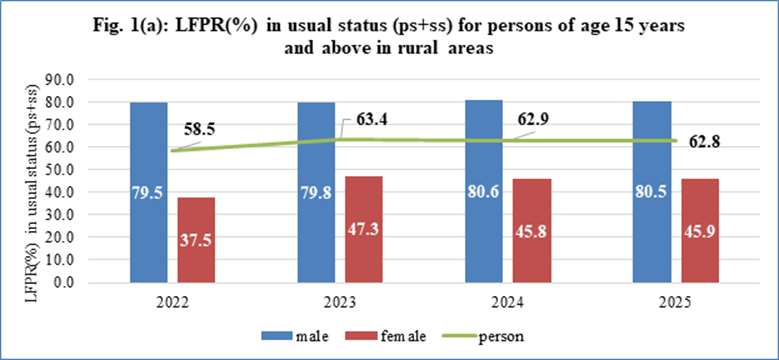
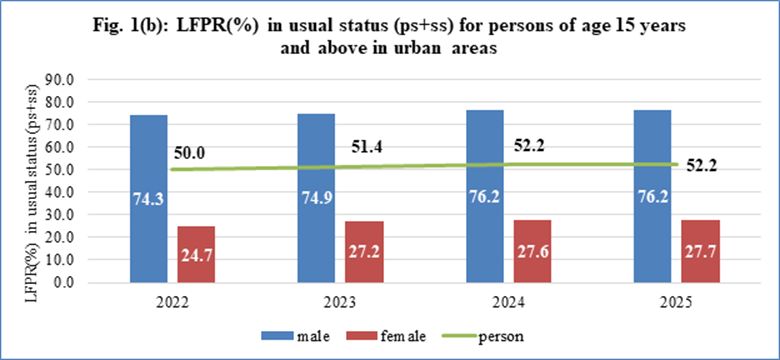
- Labour Force Participation Rate (LFPR): Remained stable at 59.3%
- Male LFPR: 79.1%.
- Female LFPR: 40.0% (showing sustained integration of women into the workforce).
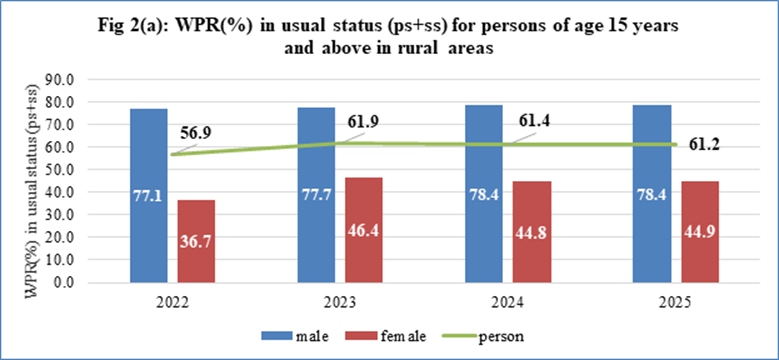
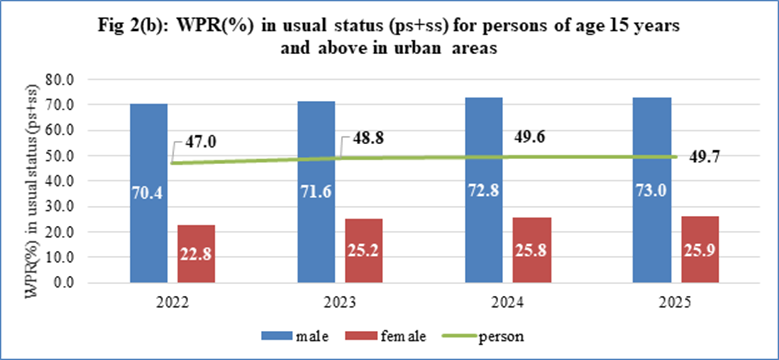
- Worker Population Ratio (WPR): The percentage of employed persons in the population stood at 57.4%.
Stable Labour Force Participation Rate (LFPR) for persons of age 15 years and above
Worker Population Ratio (WPR) for persons of age 15 years and above remains sustained
Unemployment Rates (UR) reflect stability and improvement for persons of age 15 years and above
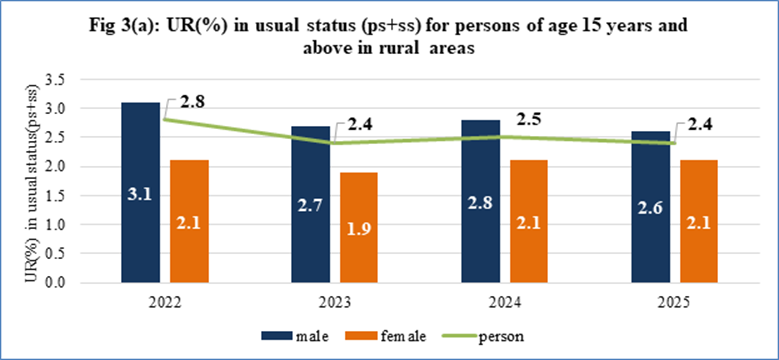
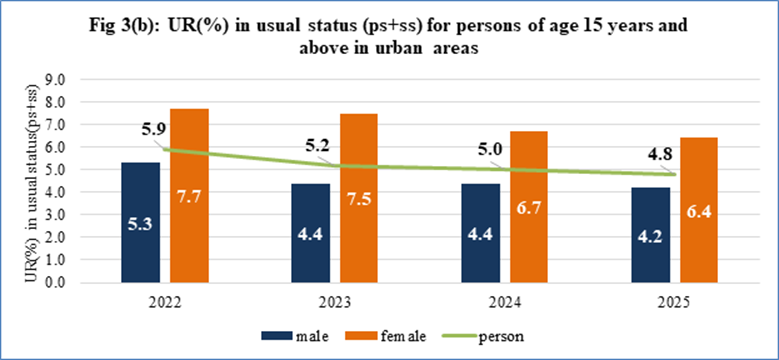
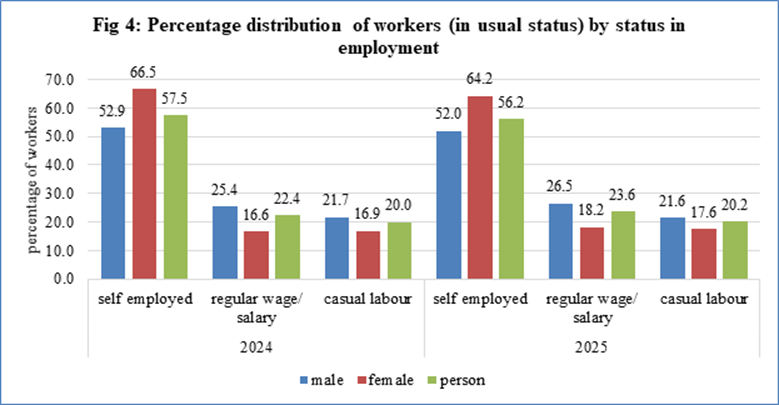
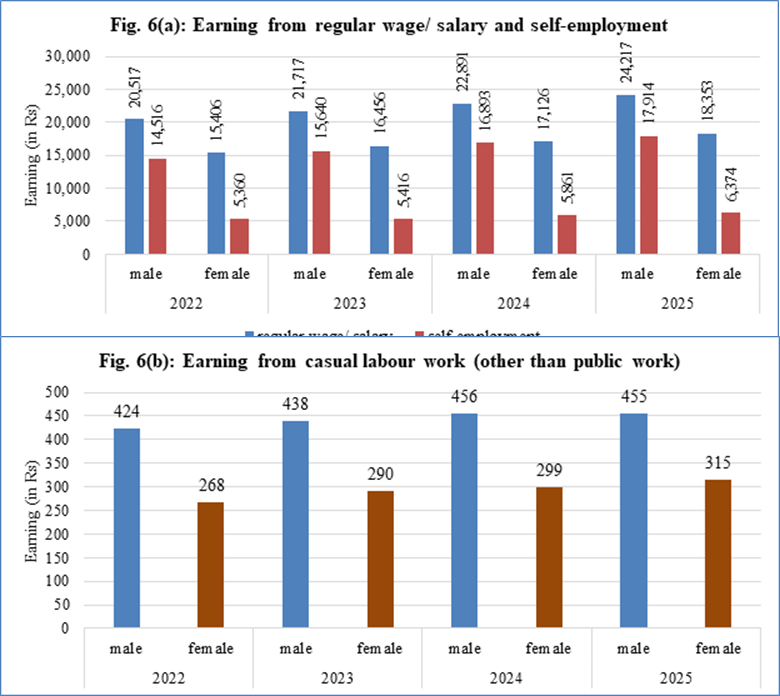
Increase in proportion of workers with regular wage/ salary employment
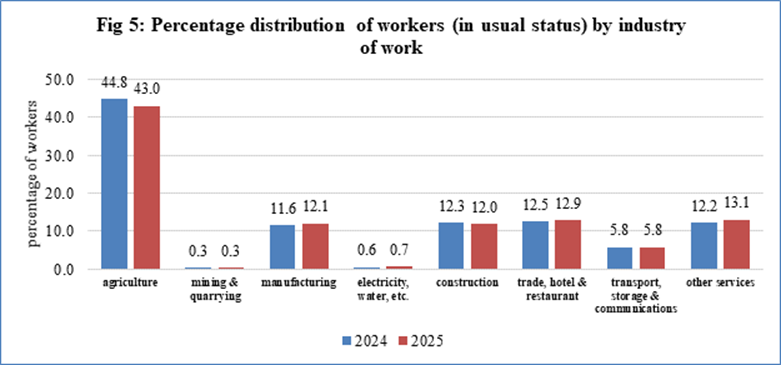
Manufacturing and service sectors witnessed enhanced worker participation
Earnings of female workers have seen a notable shift
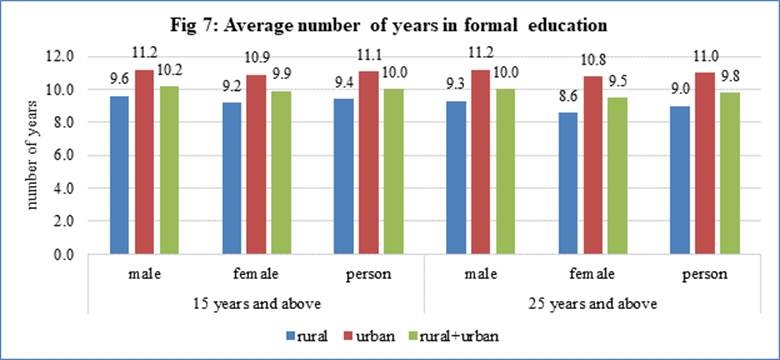
Average number of years in formal education
This topic is crucial for UPSC, State PSC, SSC, State SSC, and Banking exams under Economy, Social Justice, and Current Affairs sections. Focus on labour force indicators (LFPR, WPR, UR), employment quality (regular vs. self-employment), sectoral shifts, gender disparities in workforce participation, the NEET challenge, and vocational training gaps. For Mains and interview, link these findings to government schemes like Skill India Mission, MGNREGA, and policies for female labour force participation.
Additional Info
- Terminology & Definitions:
- Labour Force Participation Rate (LFPR): The percentage of persons in the labour force (working or seeking work) in the total population.
- Worker Population Ratio (WPR): The percentage of employed persons in the total population.
- Unemployment Rate (UR): The percentage of persons unemployed among the persons in the labour force.
- Usual Status (ps+ss): Activity determined based on a reference period of the last 365 days.
- Current Weekly Status (CWS): Activity determined based on a reference period of the last 7 days.
- Survey Methodology Changes (since Jan 2025):
- Revamped Sampling: The district has been made the primary geographical unit (basic stratum) for selecting First Stage Units (FSUs).
- Sample Size: Increased to 22,692 FSUs (villages/urban blocks) from the previous 12,800.
- NIC 2025: Introduced a new 6-digit coding structure for classifying economic activities, replacing the older NIC 2008 5-digit system.
Sources
Ministry of Defence Signs ₹858 Crore Contracts for Tunguska System and P-8I Maintenance
What’s the News?
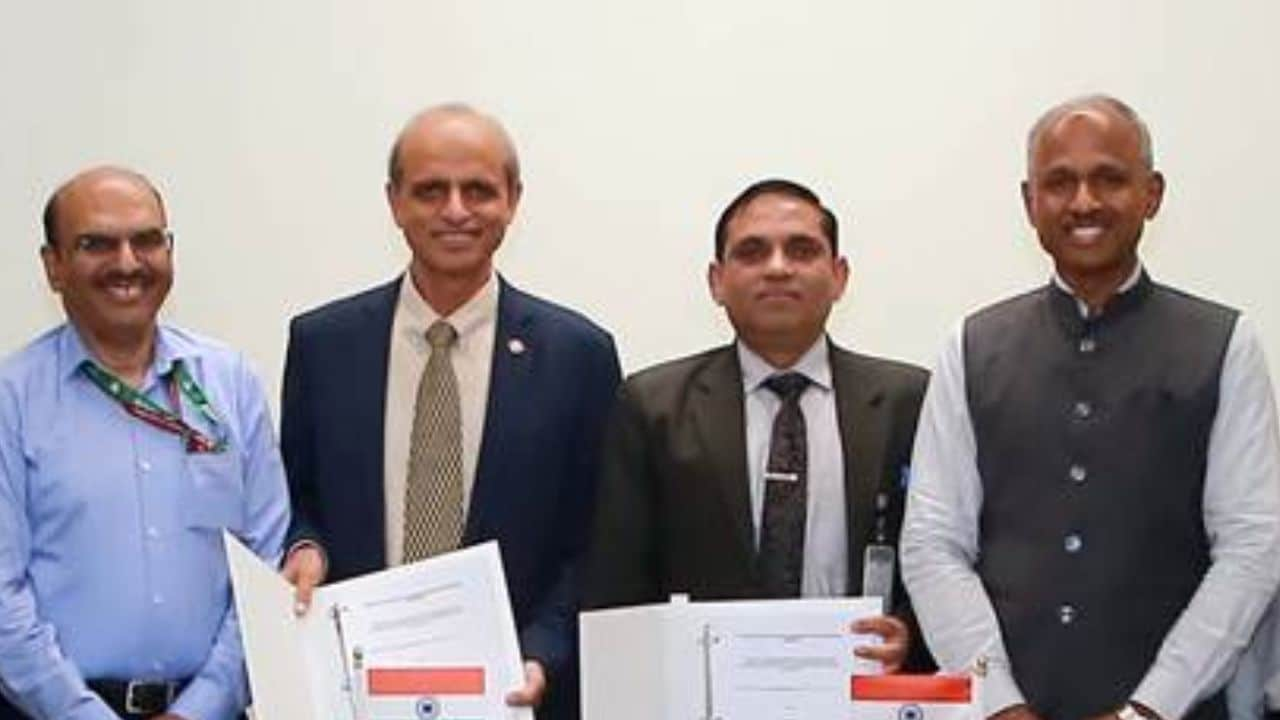
- The Ministry of Defence (MoD) has signed two significant contracts worth a combined total of ₹858 crore to bolster India’s aerial defense and maritime surveillance capabilities.
- The first contract involves the procurement of components and support for the Tunguska-M1 air defence system from Russia’s Rosoboronexport.
- The second contract focuses on the scheduled maintenance and inspection of the Indian Navy's P-8I long-range maritime patrol aircraft, involving domestic private sector participation.
The Tunguska-M1 (2K22M) System
- Hybrid Capability: It is a unique Self-Propelled Anti-Aircraft Gun and Missile (SPAAGM) system designed to provide day-and-night protection for infantry and tank regiments.
- Armament:
- Guns: Equipped with two 30mm 2A38M automatic cannons capable of firing up to 5,000 rounds per minute.
- Missiles: Carries eight 9M311-M1 surface-to-air missiles.
- Operational Range:
- Missiles: Can intercept targets at a range of 1.5 km to 10 km and altitudes up to 3.5 km.
- Guns: Effective against low-flying targets within a range of 0.2 km to 4 km.
- Target Profile: It is specifically engineered to engage low-flying aircraft, helicopters, cruise missiles, and even lightly armored ground targets while on the move.
P-8I Maintenance
- The Contract: The MoD has partnered with M/s Air Works for the Phase-II maintenance and inspection of the P-8I fleet.
- Maritime Surveillance: The P-8I (Neptune) is the Indian Navy’s primary platform for Anti-Submarine Warfare (ASW), Anti-Surface Warfare (ASuW), and Intelligence, Surveillance, and Reconnaissance (ISR) in the Indian Ocean Region.
Additional Info
- Tunguska System Context:
- Soviet Heritage: Originally developed by the Soviet Union in the 1970s to replace the ZSU-23-4 Shilka.
- Mobility: The system is mounted on a tracked armored chassis, allowing it to provide continuous cover to mobile mechanized columns.
- P-8I Aircraft Specifications:
- Manufacturer: Developed by Boeing (USA), customized for Indian requirements.
- Payload: Equipped with Harpoon Block II missiles and Mk-54 lightweight torpedoes.
This topic is crucial for UPSC, State PSC, SSC, State SSC and Banking exams under Defence, Security, International Relations, and Current Affairs sections. Focus on air defence systems, India-Russia defence cooperation, maritime security, defence procurement policies, and indigenous defence manufacturing for mains answers and interview discussions.
Sources
IOC Mandates SRY Gene Screening for Female Category Eligibility

What’s the News?
- The International Olympic Committee (IOC) has announced a landmark policy change requiring SRY gene screening to determine eligibility for the female category in international competitions.
- This move shifts the criteria for the female category from hormonal levels (testosterone) to a genetic/biological basis.
- The decision follows a global debate on "fairness versus inclusion," with the IOC now prioritizing biological markers to ensure a "level playing field" in women's sports.
The SRY Gene and Its Role
- Definition: The Sex-determining Region Y (SRY) is a master-switch gene located on the Y chromosome.
- Biological Function: It is responsible for initiating the development of male sex organs (testes) in an embryo.
- Physiological Impact: The presence of the SRY gene typically triggers male puberty, leading to physiological advantages such as increased bone density, larger muscle mass, and higher hemoglobin levels.
- Testing Mechanism: The screening involves a simple genetic test to detect the presence or absence of this specific DNA sequence, regardless of an individual's external anatomy or hormone levels.
New Eligibility Framework
- Biological Criteria: Under the new rules, only athletes who do not possess the SRY gene—generally those with XX chromosomes—are eligible to compete in the female category.
- Impact on Transgender Athletes: Transgender women (assigned male at birth) who possess the SRY gene will be ineligible for the female category, regardless of their current testosterone levels or transition status.
- DSD Athletes: Individuals with Differences in Sexual Development (DSD)—who may have female anatomy but possess a Y chromosome and the SRY gene—will also face restrictions in the female category.
- Implementation: The policy is intended for the 2026 Winter Olympics and will serve as a standard for international federations under the Olympic Charter.
Additional Info
- Evolution of Gender Testing:
- 1960s: Initial testing involved invasive physical examinations.
- 1968–1990s: Barr Body tests were used to check for two X chromosomes.
- 2011–2021: The focus shifted to hyperandrogenism (high testosterone) levels, famously impacting athletes like Caster Semenya.
- Current (2026): A shift toward genetic sex-determination markers.
- Legal and Human Rights Context:
- Article 14 (Indian Constitution): While not directly applicable to the IOC, the concept of "reasonable classification" for fairness is often debated in Indian legal circles regarding sports quotas and gender identity.
- Court of Arbitration for Sport (CAS): This international body has historically upheld biological restrictions in sports if they are "necessary, reasonable, and proportionate" to achieve fair competition.
This topic is crucial for UPSC, State PSC, SSC, State SSC and Banking exams under Sports, Governance, Ethics, and Current Affairs sections. Focus on IOC policies, gender equality in sports, scientific basis of sex determination, ethical considerations in sports governance, and transgender rights for mains answers and interview discussions.
Sources
March 2026
Archive
October 2026
- 27 October 2026
- 26 October 2026
- 24 October 2026
- 23 October 2026
- 22 October 2026
- 21 October 2026
- 20 October 2026
- 19 October 2026
- 17 October 2026
- 16 October 2026
- 15 October 2026
- 14 October 2026
- 13 October 2026
- 12 October 2026
- 10 October 2026
- 09 October 2026
- 08 October 2026
- 07 October 2026
- 06 October 2026
- 05 October 2026
- 03 October 2026
- 02 October 2026
- 01 October 2026
September 2026
- 30 September 2026
- 29 September 2026
- 28 September 2026
- 26 September 2026
- 25 September 2026
- 24 September 2026
- 23 September 2026
- 22 September 2026
- 21 September 2026
- 19 September 2026
- 18 September 2026
- 17 September 2026
- 16 September 2026
- 15 September 2026
- 12 September 2026
- 11 September 2026
- 10 September 2026
- 09 September 2026
- 08 September 2026
- 07 September 2026
- 05 September 2026
- 04 September 2026
- 03 September 2026
- 02 September 2026
- 01 September 2026
August 2026
- 31 August 2026
- 29 August 2026
- 27 August 2026
- 26 August 2026
- 25 August 2026
- 24 August 2026
- 22 August 2026
- 21 August 2026
- 20 August 2026
- 19 August 2026
- 18 August 2026
- 17 August 2026
- 14 August 2026
- 13 August 2026
- 12 August 2026
- 11 August 2026
- 10 August 2026
- 08 August 2026
- 07 August 2026
- 06 August 2026
- 05 August 2026
- 04 August 2026
- 03 August 2026
- 01 August 2026
July 2026
- 31 July 2026
- 30 July 2026
- 29 July 2026
- 28 July 2026
- 27 July 2026
- 25 July 2026
- 23 July 2026
- 22 July 2026
- 21 July 2026
- 20 July 2026
- 18 July 2026
- 17 July 2026
- 15 July 2026
- 14 July 2026
- 13 July 2026
- 11 July 2026
- 10 July 2026
- 09 July 2026
- 08 July 2026
- 07 July 2026
- 06 July 2026
- 04 July 2026
- 03 July 2026
- 02 July 2026
- 01 July 2026
June 2026
May 2026
April 2026
March 2026
- 31 March 2026
- 30 March 2026
- 28 March 2026
- 27 March 2026
- 26 March 2026
- 25 March 2026
- 24 March 2026
- 23 March 2026
- 21 March 2026
- 20 March 2026
- 19 March 2026
- 18 March 2026
- 17 March 2026
- 16 March 2026
- 14 March 2026
- 13 March 2026
- 12 March 2026
- 11 March 2026
- 10 March 2026
- 09 March 2026
- 07 March 2026
- 06 March 2026
- 05 March 2026
- 03 March 2026
- 02 March 2026
February 2026
- 28 February 2026
- 27 February 2026
- 26 February 2026
- 25 February 2026
- 24 February 2026
- 23 February 2026
- 21 February 2026
- 20 February 2026
- 19 February 2026
- 18 February 2026
- 17 February 2026
- 16 February 2026
- 13 February 2026
- 12 February 2026
- 11 February 2026
- 10 February 2026
- 09 February 2026
- 07 February 2026
- 06 February 2026
- 05 February 2026
- 04 February 2026
- 03 February 2026
- 02 February 2026
January 2026
- 31 January 2026
- 30 January 2026
- 29 January 2026
- 28 January 2026
- 27 January 2026
- 26 January 2026
- 24 January 2026
- 23 January 2026
- 22 January 2026
- 21 January 2026
- 20 January 2026
- 19 January 2026
- 16 January 2026
- 15 January 2026
- 14 January 2026
- 13 January 2026
- 12 January 2026
- 10 January 2026
- 09 January 2026
- 08 January 2026
- 07 January 2026
- 06 January 2026
- 05 January 2026
- 03 January 2026
- 02 January 2026
- 01 January 2026
December 2025
- 31 December 2025
- 30 December 2025
- 29 December 2025
- 27 December 2025
- 26 December 2025
- 24 December 2025
- 23 December 2025
- 22 December 2025
- 20 December 2025
- 19 December 2025
- 18 December 2025
- 17 December 2025
- 16 December 2025
- 15 December 2025
- 13 December 2025
- 12 December 2025
- 11 December 2025
- 10 December 2025
- 09 December 2025
- 08 December 2025
- 05 December 2025
- 04 December 2025
- 03 December 2025
- 02 December 2025
November 2025
- 29 November 2025
- 28 November 2025
- 27 November 2025
- 26 November 2025
- 25 November 2025
- 24 November 2025
- 22 November 2025
- 21 November 2025
- 20 November 2025
- 19 November 2025
- 18 November 2025
- 17 November 2025
- 15 November 2025
- 14 November 2025
- 13 November 2025
- 12 November 2025
- 11 November 2025
- 10 November 2025
- 08 November 2025
- 07 November 2025
- 06 November 2025
- 05 November 2025
- 04 November 2025
- 03 November 2025
- 01 November 2025
October 2025
- 31 October 2025
- 30 October 2025
- 29 October 2025
- 28 October 2025
- 27 October 2025
- 25 October 2025
- 24 October 2025
- 23 October 2025
- 22 October 2025
- 21 October 2025
- 20 October 2025
- 18 October 2025
- 17 October 2025
- 16 October 2025
- 15 October 2025
- 14 October 2025
- 13 October 2025
- 11 October 2025
- 10 October 2025
- 09 October 2025
- 08 October 2025
- 07 October 2025
- 06 October 2025
- 04 October 2025
- 03 October 2025
- 02 October 2025
- 01 October 2025
September 2025
- 30 September 2025
- 29 September 2025
- 27 September 2025
- 26 September 2025
- 25 September 2025
- 24 September 2025
- 23 September 2025
- 22 September 2025
- 20 September 2025
- 19 September 2025
- 18 September 2025
- 17 September 2025
- 16 September 2025
- 15 September 2025
- 13 September 2025
- 12 September 2025
- 11 September 2025
- 10 September 2025
- 09 September 2025
- 08 September 2025
- 06 September 2025
- 05 September 2025
- 04 September 2025
- 03 September 2025
- 02 September 2025
- 01 September 2025
August 2025
- 30 August 2025
- 29 August 2025
- 28 August 2025
- 27 August 2025
- 26 August 2025
- 25 August 2025
- 23 August 2025
- 22 August 2025
- 21 August 2025
- 20 August 2025
- 19 August 2025
- 18 August 2025
- 16 August 2025
- 14 August 2025
- 13 August 2025
- 12 August 2025
- 11 August 2025
- 08 August 2025
- 07 August 2025
- 06 August 2025
- 05 August 2025
- 04 August 2025
- 02 August 2025
- 01 August 2025
July 2025
- 31 July 2025
- 30 July 2025
- 29 July 2025
- 28 July 2025
- 26 July 2025
- 25 July 2025
- 24 July 2025
- 23 July 2025
- 22 July 2025
- 21 July 2025
- 19 July 2025
- 18 July 2025
- 17 July 2025
- 16 July 2025
- 15 July 2025
- 12 July 2025
- 11 July 2025
- 10 July 2025
- 09 July 2025
- 07 July 2025
- 05 July 2025
- 04 July 2025
- 03 July 2025
- 02 July 2025
- 01 July 2025
June 2025
- 30 June 2025
- 28 June 2025
- 27 June 2025
- 26 June 2025
- 25 June 2025
- 24 June 2025
- 23 June 2025
- 21 June 2025
- 20 June 2025
- 19 June 2025
- 18 June 2025
- 17 June 2025
- 16 June 2025
- 14 June 2025
- 13 June 2025
- 12 June 2025
- 11 June 2025
- 10 June 2025
- 09 June 2025
- 07 June 2025
- 06 June 2025
- 05 June 2025
- 04 June 2025
- 03 June 2025
- 02 June 2025
May 2025
April 2025
- 30 April 2025
- 29 April 2025
- 28 April 2025
- 26 April 2025
- 25 April 2025
- 24 April 2025
- 23 April 2025
- 22 April 2025
- 21 April 2025
- 19 April 2025
- 18 April 2025
- 17 April 2025
- 16 April 2025
- 15 April 2025
- 14 April 2025
- 12 April 2025
- 11 April 2025
- 10 April 2025
- 09 April 2025
- 08 April 2025
- 07 April 2025
- 05 April 2025
- 04 April 2025
- 03 April 2025
- 02 April 2025
- 01 April 2025
March 2025
- 31 March 2025
- 29 March 2025
- 28 March 2025
- 27 March 2025
- 26 March 2025
- 25 March 2025
- 24 March 2025
- 22 March 2025
- 21 March 2025
- 20 March 2025
- 19 March 2025
- 18 March 2025
- 17 March 2025
- 15 March 2025
- 13 March 2025
- 12 March 2025
- 11 March 2025
- 10 March 2025
- 08 March 2025
- 07 March 2025
- 06 March 2025
- 05 March 2025
- 04 March 2025
- 03 March 2025
- 01 March 2025
February 2025
- 28 February 2025
- 27 February 2025
- 26 February 2025
- 25 February 2025
- 24 February 2025
- 22 February 2025
- 21 February 2025
- 20 February 2025
- 19 February 2025
- 18 February 2025
- 17 February 2025
- 15 February 2025
- 14 February 2025
- 13 February 2025
- 12 February 2025
- 11 February 2025
- 10 February 2025
- 08 February 2025
- 07 February 2025
- 06 February 2025
- 05 February 2025
- 04 February 2025
- 03 February 2025
- 01 February 2025
January 2025
- 31 January 2025
- 30 January 2025
- 29 January 2025
- 28 January 2025
- 27 January 2025
- 25 January 2025
- 24 January 2025
- 23 January 2025
- 22 January 2025
- 21 January 2025
- 20 January 2025
- 18 January 2025
- 17 January 2025
- 16 January 2025
- 15 January 2025
- 14 January 2025
- 13 January 2025
- 11 January 2025
- 10 January 2025
- 09 January 2025
- 08 January 2025
- 07 January 2025
- 06 January 2025
- 04 January 2025
- 03 January 2025
- 02 January 2025
- 01 January 2025