
Current Affairs
Stay updated with the latest national and international events.
28 July 2025
Operation Mahadev: Neutralizing Pahalgam Attack Mastermind
What’s New?
- On July 28, 2025, Indian security forces executed Operation Mahadev, neutralizing three Pakistani terrorists, including Suleiman Shah (alias Hashim Musa), the alleged mastermind of the April 22, 2025, Pahalgam attack that killed 26 civilians in Baisaran Valley, Jammu and Kashmir.
- The operation, conducted in the Dachigam forests near Srinagar, involved a joint team of the Indian Army (24 Rashtriya Rifles, 4 Para), J&K Police, and CRPF, recovering 17 grenades, one M4 carbine, and two AK-47 rifles.
- The operation followed a 14-day pursuit, triggered by a Chinese satellite phone detected on July 11, with intelligence from local nomads and intercepted communications confirming terrorist presence.
What is Operation Mahadev?
- A counter-terrorism operation launched by the Chinar Corps in the Lidwas-Harwan area near Dachigam National Park, aimed at eliminating terrorists linked to the Pahalgam attack.
- Key details:
- Intelligence-driven: Began after detecting a satellite phone in Baisaran, with further inputs confirming movement in Dachigam forests.
- Swift execution: Contact established at 11:30 AM, with all three terrorists neutralized by 12:37 PM using surprise tactics and drone surveillance.
- Terrorist profiles: Suleiman Shah, a Lashkar-e-Taiba (LeT) commander and former Pakistan Army operative, was involved in the Pahalgam attack and Z-Morh tunnel killings (2024). The other two, Abu Hamza and Yasir, are also linked to LeT and possibly Jaish-e-Mohammed (JeM).
- The operation continues to track remaining associates, with body identification ongoing to confirm links to the Pahalgam attack.
Strategic and Political Context
- Pahalgam Attack: Claimed by The Resistance Front (TRF), an LeT offshoot, it targeted tourists in Baisaran Valley, dubbed “mini Switzerland,” prompting a Rs 20 lakh reward by J&K Police for information on Suleiman Shah.
- Operation Sindoor: India’s broader surgical strike response to the attack, debated in Parliament on July 28, 2025, with Defence Minister Rajnath Singh defending its success, while the opposition, led by Rahul Gandhi, questioned its scope.
- NIA Involvement: The National Investigation Agency arrested two locals, Parvaiz Ahmad Jothar and Bashir Ahmad, in June 2025 for harboring the attackers, aiding identification of the terrorists.
Additional Info
- Lashkar-e-Taiba (LeT): A Pakistan-based terrorist group, responsible for major attacks like 2008 Mumbai and Pahalgam 2025, often operating through proxies like TRF.
- Chinar Corps: The Indian Army’s 15 Corps, based in Srinagar, oversees counter-terrorism operations in Jammu and Kashmir, critical for LoC security.
- National Investigation Agency (NIA): Established under the NIA Act, 2008, it investigates terrorism-related cases across India, coordinating with state police.
- Dachigam National Park: A protected area near Srinagar, often used as a hideout by terrorists due to its dense forests and proximity to 20 km from the city center.
Simplified Summary
- Operation Mahadev: Neutralized three terrorists, including Suleiman Shah, mastermind of the Pahalgam attack (26 killed), on July 28, 2025, in Dachigam, Srinagar.
- Execution: 14-day pursuit using satellite phone tracking, local intelligence, and drone surveillance led to a swift encounter by Army, CRPF, and J&K Police.
- Recoveries: 17 grenades, M4 carbine, and AK-47s found, with ongoing efforts to identify bodies and track associates.
- Impact: Strengthens counter-terrorism efforts, supports Operation Sindoor, and boosts India’s security posture in J&K.
Exam Focus Points
- Definition: Operation Mahadev is a counter-terrorism operation neutralizing LeT terrorists linked to the Pahalgam attack.
- Key Event: July 28, 2025, encounter killed Suleiman Shah, Abu Hamza, and Yasir in Dachigam forests.
- Strategic Context: Aligns with Operation Sindoor and NIA investigations, addressing cross-border terrorism.
- Static Linkages: Chinar Corps, NIA, LeT, TRF, and J&K’s security framework.
- Challenges: Identifying remaining associates, countering Pakistan-backed terrorism, and ensuring civilian safety in conflict zones.
World Nature Conservation Day 2025: India’s Green Push
What’s New?
- World Nature Conservation Day 2025, observed on July 28, 2025, adopted the theme “Connecting People and Plants: Exploring Digital Innovation in Wildlife Conservation”, emphasizing technology-driven conservation like AI, GIS, and drones.
- India highlighted its environmental initiatives, including the National Mission for Green India (GIM), Namami Gange Mission, and Lifestyle for Environment (LiFE), to promote sustainable practices and combat climate change, deforestation, and biodiversity loss.
- Over 1 million species face extinction globally, with India’s efforts focusing on forest restoration, river rejuvenation, and community-driven conservation to ensure ecological balance.
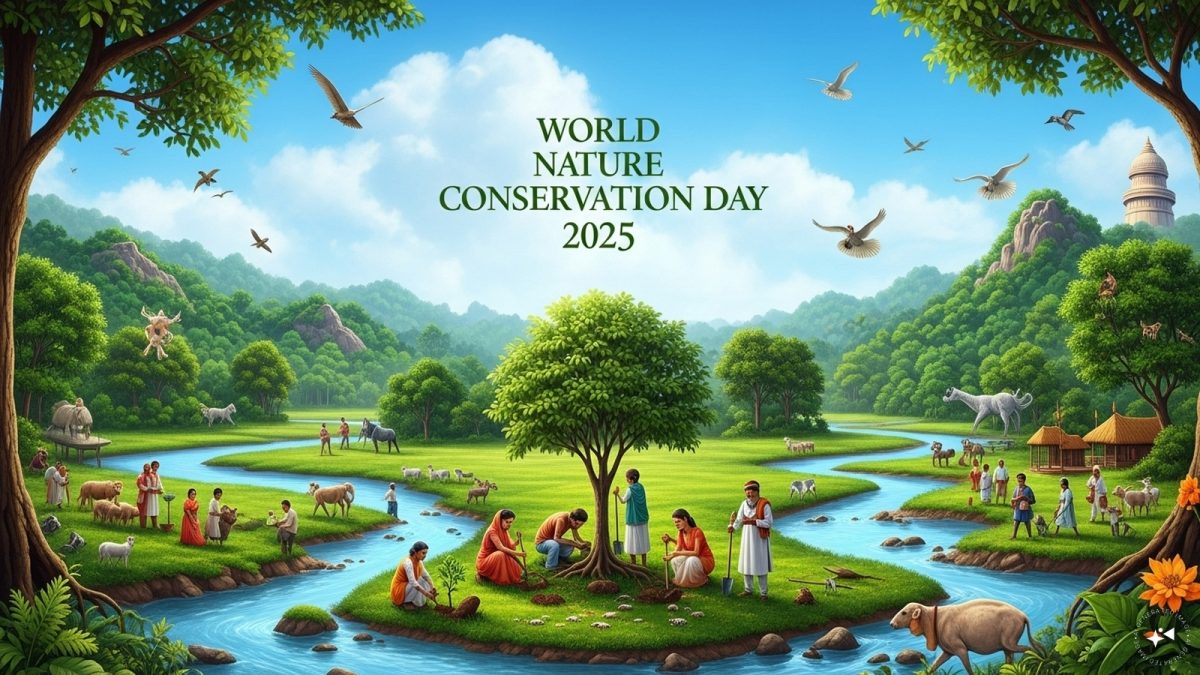
What is World Nature Conservation Day?
- Observed annually on July 28, it raises awareness about protecting natural resources (air, water, soil, forests) and biodiversity to ensure a sustainable future.
- Key objectives:
- Promote sustainable practices like recycling, tree planting, and reducing carbon footprints.
- Address environmental threats: climate change, pollution, deforestation, and habitat loss.
- Encourage community participation through education, workshops, and clean-up drives.
- Originated in the 1970s with the rise of global environmental movements, notably linked to the 1972 UN Conference on the Human Environment in Stockholm.
India’s Conservation Initiatives
- National Mission for Green India (GIM): Part of the National Action Plan on Climate Change (NAPCC), it aims to increase forest cover by 5 million hectares, restore degraded forests, and protect biodiversity.
- Namami Gange Mission: Focuses on cleaning and rejuvenating the Ganga River, addressing pollution, protecting wetlands, and preserving aquatic biodiversity.
- Lifestyle for Environment (LiFE): Introduced by PM Narendra Modi at COP26, Glasgow (2021), it promotes eco-friendly habits like avoiding single-use plastics, conserving water, and using public transport.
- Community efforts: Tree planting, green marathons, and digital campaigns (e.g., using AI and GIS for wildlife monitoring) engage youth and indigenous communities.
Additional Info
- National Action Plan on Climate Change (NAPCC): Launched in 2008, it includes eight missions (e.g., Green India, Solar Mission) to address climate change and promote sustainable development.
- International Union for Conservation of Nature (IUCN): Founded in 1948, it supports global conservation efforts, influencing India’s biodiversity policies and protected areas like Sundarbans and Western Ghats.
- India’s Biodiversity: Hosts 4 biodiversity hotspots (Himalaya, Indo-Burma, Sundaland, Western Ghats) and 91 Ramsar Sites, critical for global ecosystems.
- Ministry of Environment, Forest and Climate Change (MoEFCC): Oversees conservation policies, wildlife protection, and initiatives like GIM and Namami Gange.
Simplified Summary
- Theme 2025: “Connecting People and Plants”, focusing on digital tools (AI, GIS, drones) for wildlife conservation.
- India’s Role: Leads with GIM, Namami Gange, and LiFE to restore forests, clean rivers, and promote sustainable lifestyles.
- Global Context: Over 1 million species at risk; conservation ensures clean air, water, and food security.
- Action: Encourages tree planting, recycling, and community drives to reduce environmental harm.
Exam Focus Points
- Definition: World Nature Conservation Day (July 28) promotes resource conservation and biodiversity protection.
- Theme 2025: “Connecting People and Plants”, highlighting digital innovation in conservation.
- India’s Initiatives: GIM, Namami Gange, and LiFE drive forest restoration, river cleaning, and eco-friendly habits.
- Static Linkages: MoEFCC, IUCN, NAPCC, and India’s biodiversity hotspots.
- Challenges: Combating deforestation, pollution, ensuring community participation, and scaling digital conservation tools.
World Hepatitis Day 2025: Breaking Down Barriers
What’s New?
- World Hepatitis Day 2025, observed on July 28, 2025, adopted the theme “Hepatitis: Let’s Break It Down”, urging action to dismantle financial, social, and systemic barriers (including stigma) to achieve hepatitis elimination by 2030.
- The World Health Organization (WHO) reported 304 million people live with chronic hepatitis B (HBV) or C (HCV), causing 1.3 million deaths annually (3,500 daily), surpassing HIV, tuberculosis, and malaria combined.
- In India, 40 million have chronic HBV, and 6–12 million have HCV, with Bihar, Punjab, Haryana, and tribal areas like Odisha and Madhya Pradesh showing high prevalence (up to 12%).
What is Hepatitis and World Hepatitis Day?
- Hepatitis is liver inflammation, often caused by viral infections (hepatitis A, B, C, D, E), leading to cirrhosis, liver cancer, or liver failure. HBV and HCV cause 90% of hepatitis-related deaths.
- World Hepatitis Day: Established by the World Health Assembly in 2010, observed on July 28 to honor Dr. Baruch Blumberg, who discovered HBV in 1967 and developed its vaccine, earning the Nobel Prize in 1976.
- History:
- Began as International Hepatitis C Awareness Day on October 1, 2004, by European and Middle Eastern patient groups.
- Shifted to May 19 in 2008 by the World Hepatitis Alliance, then to July 28 in 2010 for global alignment.
- Objectives: Raise awareness, promote testing, vaccination, and treatment, and reduce stigma to eliminate hepatitis as a public health threat by 2030.
India’s Efforts and Global Context
- India’s Burden: With 2–4% HBV prevalence, India is in the intermediate endemic range. The Universal Immunisation Programme (UIP) includes HBV vaccination since 2007, but awareness and adult coverage remain low.
- Initiatives:
- National Viral Hepatitis Control Program (NVHCP), launched in 2018, provides free testing and treatment for HBV and HCV, targeting high-risk groups like pregnant women and blood transfusion recipients.
- Community campaigns: Free screening camps, webinars, and social media drives (e.g., #HepCantWait) raise awareness.
- Global Efforts: WHO promotes vaccination (only 45% of babies receive HBV vaccine within 24 hours), safe injection practices, and antiviral treatments (e.g., HCV cure rates exceed 95%). Egypt reduced HCV prevalence through coordinated action.
Additional Info
- World Health Organization (WHO): Leads global health campaigns, including World Hepatitis Day, one of 11 official health days, and sets the 2030 elimination goal via the Global Health Sector Strategy on Viral Hepatitis.
- World Hepatitis Alliance (WHA): A 400-member NGO network across 120 countries, coordinating awareness events like torchlight processions and landmark illuminations (e.g., Burj Khalifa in yellow and blue).
- Hepatitis Types:
- A and E: Spread via contaminated food/water, cause acute infections (78,000 deaths in 2019).
- B and C: Spread via blood, unsafe injections, or mother-to-child, cause chronic infections and liver cancer.
- D: Only infects HBV carriers, classified as carcinogenic in 2025 by IARC.
- India’s NVHCP: Managed by the Ministry of Health and Family Welfare, it integrates hepatitis care into primary health centers and addresses stigma.
Simplified Summary
- Theme 2025: “Hepatitis: Let’s Break It Down”, focusing on removing stigma, financial barriers, and improving access to testing and treatment.
- India’s Challenge: 40 million HBV, 6–12 million HCV cases; NVHCP offers free services, but awareness is low.
- Global Impact: 304 million live with chronic hepatitis, causing 1.3 million deaths/year; vaccines and treatments exist but are underutilized.
- Action: Promote testing, HBV vaccination, and awareness to achieve a hepatitis-free future.
Exam Focus Points
- Definition: World Hepatitis Day (July 28) raises awareness about viral hepatitis (A, B, C, D, E) to eliminate it by 2030.
- Theme 2025: “Hepatitis: Let’s Break It Down”, emphasizing simplified services and stigma reduction.
- India’s Role: NVHCP, UIP, and community campaigns address high prevalence in Bihar, Punjab, and tribal areas.
- Static Linkages: WHO, WHA, NVHCP, and Dr. Blumberg’s contributions (Nobel Prize, 1976).
- Challenges: Low testing rates (26% for HBV, 45% for HCV), stigma, high costs, and inadequate adult vaccination.
Yantai Penglai Named World’s Most Beautiful Airport 2025
What’s New?
- Yantai Penglai International Airport’s Terminal 2 in China was crowned the world’s most beautiful airport for 2025 by the Prix Versailles Awards, surpassing Singapore’s Changi Airport, a long-time favorite known for its indoor waterfall and lush greenery.
- The Prix Versailles 2025 list, announced on July 28, 2025, highlighted six airports for their aesthetic architecture, sustainability, and passenger experience, including Marseille Provence Airport (France) and Roland Garros Airport (Réunion Island, France) in second and third places.
- India’s airports, notably Mumbai’s Chhatrapati Shivaji Maharaj International Airport (ranked 9th in Travel + Leisure’s World’s Best Awards 2025), did not feature in the Prix Versailles top six, marking a shift in global recognition.

What are the Prix Versailles Awards?
- An annual architecture and design award, often called the “world architecture and design award,” recognizing outstanding public infrastructure like airports, museums, and hotels since 2015.
- Criteria:
- Aesthetic excellence: Innovative design reflecting local culture (e.g., Yantai’s coastal-inspired architecture spanning 167,000 sqm).
- Sustainability: Use of eco-friendly materials, energy efficiency, and green technology (e.g., solar panels in San Francisco’s Harvey Milk Terminal).
- Passenger experience: Focus on comfort, functionality, and cultural integration.
- 2025 Airport List:
- Yantai Penglai Terminal 2 (China): Coastal design, flexible structure.
- Marseille Provence Airport (France): Modern, passenger-friendly layout.
- Roland Garros Airport (Réunion Island): Tropical bioclimatic design with 91% local materials.
- Kansai International Airport Terminal 1 (Japan): Longest terminal, designed by Renzo Piano.
- San Francisco International Airport Terminal 1 (USA): 40% less energy use, home to the world’s first airport museum.
- Portland International Airport Main Terminal (USA): Nature-inspired, eco-friendly design with llamas for traveler relaxation.
Global and Indian Context
- Global shift: Singapore’s Changi Airport, with its Jewel complex and 600,000 plants, lost its top spot in Prix Versailles 2025, despite ranking second in Travel + Leisure’s World’s Best Awards (score: 98.57, behind Istanbul Airport). This reflects rising competition in airport design.
- India’s aviation growth: India’s aviation sector is expanding, with 153 airports and plans for 300 by 2030 under the UDAN scheme. Mumbai Airport’s ranking highlights India’s growing global presence, though infrastructure gaps persist.
- Sustainability focus: Airports like San Francisco and Roland Garros set benchmarks for green design, pushing India to integrate renewable energy and smart systems in projects like Navi Mumbai International Airport.
Additional Info
- Prix Versailles: Administered by a UNESCO-partnered committee, it evaluates design innovation across sectors, with past winners including Paris’ Louvre Pyramid and Tokyo’s Shibuya Station.
- Yantai Penglai International Airport: Located in Shandong, China, its Terminal 2 reflects the region’s maritime heritage, designed for flexibility and natural light.
- India’s Aviation Sector: Managed by the Ministry of Civil Aviation, with Airports Authority of India (AAI) overseeing operations and UDAN (Ude Desh ka Aam Nagrik) promoting regional connectivity.
- Mumbai’s Chhatrapati Shivaji Maharaj International Airport: Operated by Adani Airports, it handles 50 million passengers annually, known for its art installations and Terminal 2 design.
Simplified Summary
- Winner: Yantai Penglai Terminal 2 (China) named most beautiful airport for 2025 by Prix Versailles, surpassing Changi Airport.
- Key Features: Coastal design, sustainability, and passenger comfort define the top six, including Marseille, Roland Garros, and Kansai.
- India’s Role: Mumbai Airport ranks 9th globally (Travel + Leisure), but India misses Prix Versailles list, highlighting the need for design innovation.
- Global Trend: Rising focus on eco-friendly and culturally resonant airport architecture.
Exam Focus Points
- Definition: Prix Versailles Awards recognize architectural excellence in airports, emphasizing design, sustainability, and passenger experience.
- Key Event: Yantai Penglai Terminal 2 named most beautiful airport for 2025, with Changi absent from the top six.
- India’s Context: Mumbai Airport ranks high globally, but India lags in sustainable design compared to San Francisco or Roland Garros.
- Static Linkages: Ministry of Civil Aviation, AAI, UDAN, and Adani Airports drive India’s aviation growth.
- Challenges: Scaling green infrastructure, bridging design gaps, and competing with global hubs like China and Japan.
Delhi HC Pushes for Technology in Transparent Probes
What’s New?
- On July 24, 2025, the Delhi High Court, in a ruling by Justice Ravinder Dudeja, directed investigating agencies to leverage technology to enhance transparency and fairness in criminal investigations, particularly under the Narcotic Drugs and Psychotropic Substances (NDPS) Act, 1985.
- The observation was made while denying bail to Ravi Prakash, arrested on April 19, 2023, for possessing 1 kg of heroin, with the court noting that the absence of videography or photography does not discredit the police’s case, given limited technological availability in 2023.
- The court emphasized that tools like CCTV footage, body cameras, and digital evidence should be used to strengthen investigative integrity, aligning with the Bharatiya Nagarik Suraksha Sanhita (BNSS), 2023.
Why Technology in Investigations?
- Purpose: Using technological tools ensures efficiency, transparency, and fairness in probes, reducing reliance on potentially biased human testimony and enhancing evidence credibility.
- Tools highlighted:
- Videography and photography for documenting seizures.
- CCTV footage to verify incident locations.
- Digital forensics for analyzing electronic evidence like mobile data.
- Context: The ruling aligns with the BNSS, 2023, which mandates forensic examination for serious offenses and promotes video conferencing and electronic evidence under the Bharatiya Sakshya Adhiniyam, 2023.
- Case specifics: In the heroin seizure case, the prosecution noted no CCTV cameras were available at the site, and the accused’s bail plea was rejected as his 15-month custody was not deemed excessive.
Broader Implications
- Judicial push for modernization: The court’s directive builds on prior rulings, such as a 2023 order urging probe agencies to adopt technology for cases like missing children and human trafficking, emphasizing Standard Operating Procedures (SOPs) with digital checklists.
- Challenges:
- Limited infrastructure in rural areas for tools like CCTV or body cameras.
- Need for training police in digital forensics and evidence management.
- Balancing technological adoption with privacy concerns under laws like the Information Technology Act, 2000.
- Global relevance: Countries like the US and UK use body-worn cameras and AI analytics in policing, setting a benchmark for India’s investigative reforms.
Additional Info
- Delhi High Court: Established in 1966, it exercises jurisdiction over Delhi under Article 226 and 227 of the Constitution, overseeing legal reforms like the Electronic Evidence and Video Conferencing Rules, 2025.
- Bharatiya Nagarik Suraksha Sanhita (BNSS), 2023: Replaces the Code of Criminal Procedure, 1973, mandating forensic evidence for offenses with over seven years’ punishment and promoting digital judicial processes.
- Narcotic Drugs and Psychotropic Substances (NDPS) Act, 1985: Governs drug-related offenses, with strict provisions (e.g., Section 15, 25, 29) and limited bail scope due to public safety concerns.
- Central Bureau of Investigation (CBI) and Narcotics Control Bureau (NCB): Key agencies handling NDPS cases, now urged to integrate technology for transparency.
Simplified Summary
- Ruling: Delhi High Court (July 24, 2025) directed probe agencies to use technology (e.g., CCTV, videography) for transparent investigations.
- Case: Bail denied to Ravi Prakash in a heroin seizure case, as absence of video evidence in 2023 was justified, but technology use emphasized for future probes.
- Impact: Aligns with BNSS, 2023, promoting digital evidence and forensic tools to ensure fairness.
- Goal: Modernize police investigations, reduce bias, and enhance public trust in justice delivery.
Exam Focus Points
- Definition: Delhi HC ruling mandates technology in investigations to ensure transparency and fairness under NDPS Act and BNSS, 2023.
- Key Event: July 24, 2025, bail denial in heroin case highlighted need for videography and CCTV.
- Strategic Context: Supports judicial reforms, aligns with Electronic Evidence Rules, 2025, and addresses investigative gaps.
- Static Linkages: Delhi High Court, BNSS, 2023, NDPS Act, 1985, CBI, and NCB.
- Challenges: Scaling technological infrastructure, ensuring police training, and balancing privacy with evidence collection.
NALSA’s Veer Parivaar Sahayata Yojana: Legal Aid for Defence Families
What’s New?
- On July 26, 2025, the National Legal Services Authority (NALSA) launched the Veer Parivaar Sahayata Yojana 2025 in Srinagar, during the North Zone Regional Conference on “Reaffirming the Constitutional Vision of Justice for Defence Personnel and Tribals” at the Sher-i-Kashmir International Conference Centre (SKICC).
- Launched in collaboration with the High Court of Jammu and Kashmir and Ladakh and the J&K Legal Services Authority, the scheme aims to provide free legal aid to defence personnel, including soldiers, paramilitary forces (e.g., BSF, CRPF, CISF, NDRF), and their families, addressing issues like land disputes, service entitlements, and matrimonial cases.
- The initiative, unveiled on Kargil Vijay Diwas, was presided over by Justice Surya Kant, Supreme Court Judge and NALSA Executive Chairman, who emphasized it as a “solemn pledge” to support those protecting India’s borders.
What is the Veer Parivaar Sahayata Yojana?
- A legal aid scheme to ensure accessible justice for defence personnel and their families, addressing their unique challenges due to remote postings and limited leave time.
- Three pillars:
- Legal Services Clinics: Established at Zilla, Rajya, and Kendriya Sainik Boards to provide localized support.
- Trained Personnel: Nodal officers, legal aid counsels, and paralegal volunteers (including ex-servicemen) for compassionate and timely assistance.
- Digital Access: e-Lok Adalats and online mediation to ensure speedy resolution of cases, minimizing delays.
- Objective: Fulfill Article 39A of the Constitution, which mandates equal access to justice, ensuring dignity and rights for defence families.
Strategic and Regional Context
- Significance: The scheme addresses legal hurdles faced by defence personnel, such as land disputes in rural areas or pension issues, which are complicated by their frequent relocations and service conditions.
- Endorsements:
- Union Minister Arjun Ram Meghwal (Law and Justice) praised the scheme for aligning with the government’s push for inclusive justice and digital empowerment.
- J&K Chief Minister Omar Abdullah highlighted its role in supporting soldiers in challenging terrains like J&K and Ladakh.
- J&K High Court Chief Justice Arun Palli emphasized judiciary-led tech interventions to fast-track cases, ensuring minimal disruption to soldiers’ leave.
- Impact in J&K: Over 12,000 people benefited from J&K Legal Services Authority schemes in 2025, with the new yojana enhancing support for soldiers and tribal communities.
Additional Info
- National Legal Services Authority (NALSA): Established under the Legal Services Authorities Act, 1987, it provides free legal aid to marginalized groups, with State and District Legal Services Authorities implementing programs.
- Article 39A: A Directive Principle of State Policy in the Constitution, mandating free legal aid to ensure equal justice for all citizens.
- J&K Legal Services Authority: Coordinates legal aid in Jammu and Kashmir, with Justice Sindhu Sharma as Executive Chairperson for Ladakh.
- Kargil Vijay Diwas: Observed on July 26, it marks India’s victory in the 1999 Kargil War, making the scheme’s launch symbolically significant.
Simplified Summary
- Launch: Veer Parivaar Sahayata Yojana 2025 was launched on July 26, 2025, in Srinagar by NALSA to provide free legal aid to defence personnel and their families.
- Features: Includes legal clinics at Sainik Boards, trained staff (including ex-servicemen), and digital tools like e-Lok Adalats for quick resolutions.
- Impact: Supports soldiers facing legal issues (e.g., land disputes, pensions), aligning with Article 39A and inclusive justice.
- Endorsements: Backed by Justice Surya Kant, Omar Abdullah, and Arjun Ram Meghwal, with over 12,000 beneficiaries of J&K legal aid in 2025.
Exam Focus Points
- Definition: Veer Parivaar Sahayata Yojana provides free legal aid to defence personnel and families, addressing legal hurdles via clinics, trained staff, and digital platforms.
- Key Event: Launched on July 26, 2025, in Srinagar, coinciding with Kargil Vijay Diwas.
- Strategic Context: Enhances justice access in J&K, supports digital empowerment, and aligns with NALSA’s 30-year mission.
- Static Linkages: NALSA, Article 39A, J&K Legal Services Authority, and Kargil Vijay Diwas.
- Challenges: Ensuring effective implementation, training nodal officers, and scaling digital infrastructure in remote areas.
WHO’s Global Specs 2030: Affordable Eyecare for All
What’s New?
- On July 26, 2025, the World Health Organization (WHO), in collaboration with NGO Drishti, launched the Global Specs 2030 Initiative during a conference on adolescent eye health at Amity University, Noida, aiming to ensure universal access to affordable eyecare by 2030.
- The initiative targets a 40% increase in effective refractive error coverage, addressing the 800 million people globally with unaddressed vision impairments due to refractive errors like myopia and presbyopia.
- Dr. Yutaro Setoya, WHO India Team Lead for Non-communicable Diseases, highlighted the socioeconomic impact of vision loss, particularly among children aged 5–15, with myopia cases rising alarmingly in India.
What is the Global Specs 2030 Initiative?
- A WHO-led global strategy endorsed at the 74th World Health Assembly (2021), aiming to provide quality, affordable, and people-centered refractive error services to all by 2030.
- Five strategic pillars (SPECS):
- Services: Expand access to refractive error services like spectacles and vision screenings.
- Personnel: Strengthen the eye care workforce through training and capacity building.
- Education: Raise awareness about eye health, especially among youth and adolescents.
- Cost: Make eyeglasses and services affordable, particularly in low- and middle-income countries.
- Surveillance: Enhance data systems and research to monitor progress and improve outcomes.
- Global SPECS Network: A platform for stakeholders to coordinate advocacy, share experiences, and expand professional networks for collective action.
Strategic Importance
- Global burden: 1.1 billion people suffer from vision impairment, with 800 million due to unaddressed refractive errors, costing the global economy $411 billion annually in lost productivity. Women, girls, and vulnerable populations are disproportionately affected.
- India’s context: Myopia is rising among schoolchildren (5–15 years), with urban areas reporting up to 20% prevalence due to screen time and lifestyle changes. Initiatives like school-based vision screenings are critical.
- Youth engagement: Vision health champions (youth ambassadors) promote eye health awareness, leveraging digital campaigns like Love Your Eyes to reduce stigma and encourage early intervention.
Additional Info
- World Health Organization (WHO): Leads global health initiatives, including the 2030 eye care targets for 30% increase in cataract surgery coverage and 40% increase in refractive error coverage, set in 2021.
- Love Your Eyes Campaign: A WHO initiative launched in 2021, it recorded 6.5 million pledges and 542 million media impressions in 2022, focusing on workplace eye health in 2023 and youth engagement in 2025.
- National Programme for Control of Blindness and Visual Impairment (NPCBVI): India’s flagship program under the Ministry of Health and Family Welfare, providing free spectacles and eye screenings in schools and rural areas.
- 2030 In Sight Strategy: A global framework aligned with WHO’s World Report on Vision (2019) and the UN Resolution on Vision for Everyone (2021), aiming to integrate eye health into Sustainable Development Goals (SDGs).
Simplified Summary
- Launch: Global Specs 2030 Initiative launched on July 26, 2025, in Noida, targeting affordable eyecare for all by 2030.
- Focus: Increase refractive error coverage by 40%, addressing 800 million vision-impaired people, with emphasis on youth and affordability.
- India’s Role: Tackles rising myopia through school screenings and NPCBVI, supported by youth ambassadors and digital campaigns.
- Impact: Reduces economic losses ($411 billion/year) and promotes inclusive eye health.
Exam Focus Points
- Definition: Global Specs 2030 is a WHO initiative to ensure affordable eyecare by 2030, focusing on refractive errors and youth engagement.
- Key Event: Launched on July 26, 2025, with NGO Drishti at Amity University, Noida.
- Strategic Context: Aligns with 2030 In Sight, Love Your Eyes, and NPCBVI to address vision impairment.
- Static Linkages: WHO, 74th World Health Assembly, NPCBVI, and SDGs.
- Challenges: Scaling eye care infrastructure, reducing stigma, and ensuring affordability in rural India.
India Bans Over 20 OTT Platforms for Obscene Content
What’s New?
- On July 23, 2025, the Ministry of Information and Broadcasting (MIB) banned 25 OTT platforms, including Ullu, ALTT, Big Shots App, and Desiflix, for streaming obscene, vulgar, and pornographic content, violating Indian laws.
- The decision, following public complaints and National Commission for Protection of Child Rights (NCPCR) references in July–August 2024, directed Internet Service Providers (ISPs) to block access to 26 websites and 14 apps under the Information Technology Act, 2000, and IT Rules, 2021.
- Public figures like Kangana Ranaut and Ravi Kishan supported the ban, citing protection of cultural values and youth, while Ekta Kapoor clarified she and Shobha Kapoor have had no association with ALTT since June 2021.

Why the Ban?
- Violations: Content on platforms like Ullu (over 100 web-series) and ALTT included sexually explicit scenes, nudity, and inappropriate depictions (e.g., family relationships), breaching:
- Section 67 and 67A of the IT Act, 2000 (obscene and sexually explicit content).
- Section 294 of the Bharatiya Nyaya Sanhita, 2023 (obscene acts).
- Section 4 of the Indecent Representation of Women (Prohibition) Act, 1986.
- NCPCR findings: Ullu temporarily removed content (e.g., House Arrest, May 2025) but re-uploaded unedited versions, while ALTT featured distasteful scenes without contextual justification.
- Public outcry: Save Culture Save Bharat Foundation and others, including Uday Mahurkar, criticized such content as a threat to India’s cultural heritage.
Background and Actions
- Prior warnings: The MIB issued advisories, including one on February 19, 2025, urging compliance with IT Rules, 2021’s Code of Ethics. In March 2024, 18 OTT platforms, 19 websites, 10 apps, and 57 social media handles were blocked for similar violations.
- Regulatory oversight: The Digital Publisher Content Grievances Council (DPCGC), a self-regulatory body with 40 OTT members, had previously flagged Ullu and ALTT, ordering content edits or removals.
- Consultation: The ban was coordinated with the Ministry of Home Affairs, Ministry of Electronics and IT, Ministry of Women and Child Development, FICCI, CII, and women/child rights experts.
Additional Info
- Information Technology Act, 2000: Governs digital content, with Section 67 (obscene content) and 67A (sexually explicit material) enabling content blocking.
- IT Rules, 2021: Mandate a Code of Ethics for OTT platforms, requiring self-regulation, content classification, and grievance redressal.
- National Commission for Protection of Child Rights (NCPCR): Established under the CPCR Act, 2005, it monitors child safety, flagging harmful digital content.
- Banned Platforms: Include Big Shots App, Boomex, NeonX VIP, Navarasa Lite, Gulab, Kangan, Bull, Jalva, Wow Entertainment, Look Entertainment, Hitprime, Feneo, ShowX, Sol Talkies, Adda TV, HotX VIP, Hulchul, MoodX, Triflicks, and Mojflix.
Simplified Summary
- Ban: 25 OTT platforms, including Ullu and ALTT, banned on July 23, 2025, for obscene and pornographic content.
- Reason: Violated IT Act, BNS, and Indecent Representation of Women Act; featured explicit scenes without social context.
- Action: ISPs blocked 26 websites and 14 apps after NCPCR and public complaints. DPCGC had flagged violations earlier.
- Support: Kangana Ranaut and Ravi Kishan endorsed the move to protect youth and culture.
Exam Focus Points
- Definition: OTT ban targets 25 platforms for obscene content, violating IT Act, BNS, and Indecent Representation of Women Act.
- Key Event: July 23, 2025, MIB blocked Ullu, ALTT, and others after NCPCR and public complaints.
- Strategic Context: Aligns with IT Rules, 2021, and efforts to curb harmful digital content, especially for minors.
- Static Linkages: MIB, NCPCR, DPCGC, IT Act, 2000, and CPCR Act, 2005.
- Challenges: Balancing freedom of expression, enforcing compliance, and addressing re-upload tactics by platforms like Ullu.
July 2025
31 July 202530 July 202529 July 202528 July 202526 July 202525 July 202524 July 202523 July 202522 July 202521 July 202519 July 202518 July 202517 July 202516 July 202515 July 202512 July 202511 July 202510 July 202509 July 202507 July 202505 July 202504 July 202503 July 202502 July 202501 July 2025
Archive
October 2026
- 27 October 2026
- 26 October 2026
- 24 October 2026
- 23 October 2026
- 22 October 2026
- 21 October 2026
- 20 October 2026
- 19 October 2026
- 17 October 2026
- 16 October 2026
- 15 October 2026
- 14 October 2026
- 13 October 2026
- 12 October 2026
- 10 October 2026
- 09 October 2026
- 08 October 2026
- 07 October 2026
- 06 October 2026
- 05 October 2026
- 03 October 2026
- 02 October 2026
- 01 October 2026
September 2026
- 30 September 2026
- 29 September 2026
- 28 September 2026
- 26 September 2026
- 25 September 2026
- 24 September 2026
- 23 September 2026
- 22 September 2026
- 21 September 2026
- 19 September 2026
- 18 September 2026
- 17 September 2026
- 16 September 2026
- 15 September 2026
- 12 September 2026
- 11 September 2026
- 10 September 2026
- 09 September 2026
- 08 September 2026
- 07 September 2026
- 05 September 2026
- 04 September 2026
- 03 September 2026
- 02 September 2026
- 01 September 2026
August 2026
- 31 August 2026
- 29 August 2026
- 27 August 2026
- 26 August 2026
- 25 August 2026
- 24 August 2026
- 22 August 2026
- 21 August 2026
- 20 August 2026
- 19 August 2026
- 18 August 2026
- 17 August 2026
- 14 August 2026
- 13 August 2026
- 12 August 2026
- 11 August 2026
- 10 August 2026
- 08 August 2026
- 07 August 2026
- 06 August 2026
- 05 August 2026
- 04 August 2026
- 03 August 2026
- 01 August 2026
July 2026
- 31 July 2026
- 30 July 2026
- 29 July 2026
- 28 July 2026
- 27 July 2026
- 25 July 2026
- 23 July 2026
- 22 July 2026
- 21 July 2026
- 20 July 2026
- 18 July 2026
- 17 July 2026
- 15 July 2026
- 14 July 2026
- 13 July 2026
- 11 July 2026
- 10 July 2026
- 09 July 2026
- 08 July 2026
- 07 July 2026
- 06 July 2026
- 04 July 2026
- 03 July 2026
- 02 July 2026
- 01 July 2026
June 2026
May 2026
April 2026
March 2026
- 31 March 2026
- 30 March 2026
- 28 March 2026
- 27 March 2026
- 26 March 2026
- 25 March 2026
- 24 March 2026
- 23 March 2026
- 21 March 2026
- 20 March 2026
- 19 March 2026
- 18 March 2026
- 17 March 2026
- 16 March 2026
- 14 March 2026
- 13 March 2026
- 12 March 2026
- 11 March 2026
- 10 March 2026
- 09 March 2026
- 07 March 2026
- 06 March 2026
- 05 March 2026
- 03 March 2026
- 02 March 2026
February 2026
- 28 February 2026
- 27 February 2026
- 26 February 2026
- 25 February 2026
- 24 February 2026
- 23 February 2026
- 21 February 2026
- 20 February 2026
- 19 February 2026
- 18 February 2026
- 17 February 2026
- 16 February 2026
- 13 February 2026
- 12 February 2026
- 11 February 2026
- 10 February 2026
- 09 February 2026
- 07 February 2026
- 06 February 2026
- 05 February 2026
- 04 February 2026
- 03 February 2026
- 02 February 2026
January 2026
- 31 January 2026
- 30 January 2026
- 29 January 2026
- 28 January 2026
- 27 January 2026
- 26 January 2026
- 24 January 2026
- 23 January 2026
- 22 January 2026
- 21 January 2026
- 20 January 2026
- 19 January 2026
- 16 January 2026
- 15 January 2026
- 14 January 2026
- 13 January 2026
- 12 January 2026
- 10 January 2026
- 09 January 2026
- 08 January 2026
- 07 January 2026
- 06 January 2026
- 05 January 2026
- 03 January 2026
- 02 January 2026
- 01 January 2026
December 2025
- 31 December 2025
- 30 December 2025
- 29 December 2025
- 27 December 2025
- 26 December 2025
- 24 December 2025
- 23 December 2025
- 22 December 2025
- 20 December 2025
- 19 December 2025
- 18 December 2025
- 17 December 2025
- 16 December 2025
- 15 December 2025
- 13 December 2025
- 12 December 2025
- 11 December 2025
- 10 December 2025
- 09 December 2025
- 08 December 2025
- 05 December 2025
- 04 December 2025
- 03 December 2025
- 02 December 2025
November 2025
- 29 November 2025
- 28 November 2025
- 27 November 2025
- 26 November 2025
- 25 November 2025
- 24 November 2025
- 22 November 2025
- 21 November 2025
- 20 November 2025
- 19 November 2025
- 18 November 2025
- 17 November 2025
- 15 November 2025
- 14 November 2025
- 13 November 2025
- 12 November 2025
- 11 November 2025
- 10 November 2025
- 08 November 2025
- 07 November 2025
- 06 November 2025
- 05 November 2025
- 04 November 2025
- 03 November 2025
- 01 November 2025
October 2025
- 31 October 2025
- 30 October 2025
- 29 October 2025
- 28 October 2025
- 27 October 2025
- 25 October 2025
- 24 October 2025
- 23 October 2025
- 22 October 2025
- 21 October 2025
- 20 October 2025
- 18 October 2025
- 17 October 2025
- 16 October 2025
- 15 October 2025
- 14 October 2025
- 13 October 2025
- 11 October 2025
- 10 October 2025
- 09 October 2025
- 08 October 2025
- 07 October 2025
- 06 October 2025
- 04 October 2025
- 03 October 2025
- 02 October 2025
- 01 October 2025
September 2025
- 30 September 2025
- 29 September 2025
- 27 September 2025
- 26 September 2025
- 25 September 2025
- 24 September 2025
- 23 September 2025
- 22 September 2025
- 20 September 2025
- 19 September 2025
- 18 September 2025
- 17 September 2025
- 16 September 2025
- 15 September 2025
- 13 September 2025
- 12 September 2025
- 11 September 2025
- 10 September 2025
- 09 September 2025
- 08 September 2025
- 06 September 2025
- 05 September 2025
- 04 September 2025
- 03 September 2025
- 02 September 2025
- 01 September 2025
August 2025
- 30 August 2025
- 29 August 2025
- 28 August 2025
- 27 August 2025
- 26 August 2025
- 25 August 2025
- 23 August 2025
- 22 August 2025
- 21 August 2025
- 20 August 2025
- 19 August 2025
- 18 August 2025
- 16 August 2025
- 14 August 2025
- 13 August 2025
- 12 August 2025
- 11 August 2025
- 08 August 2025
- 07 August 2025
- 06 August 2025
- 05 August 2025
- 04 August 2025
- 02 August 2025
- 01 August 2025
July 2025
- 31 July 2025
- 30 July 2025
- 29 July 2025
- 28 July 2025
- 26 July 2025
- 25 July 2025
- 24 July 2025
- 23 July 2025
- 22 July 2025
- 21 July 2025
- 19 July 2025
- 18 July 2025
- 17 July 2025
- 16 July 2025
- 15 July 2025
- 12 July 2025
- 11 July 2025
- 10 July 2025
- 09 July 2025
- 07 July 2025
- 05 July 2025
- 04 July 2025
- 03 July 2025
- 02 July 2025
- 01 July 2025
June 2025
- 30 June 2025
- 28 June 2025
- 27 June 2025
- 26 June 2025
- 25 June 2025
- 24 June 2025
- 23 June 2025
- 21 June 2025
- 20 June 2025
- 19 June 2025
- 18 June 2025
- 17 June 2025
- 16 June 2025
- 14 June 2025
- 13 June 2025
- 12 June 2025
- 11 June 2025
- 10 June 2025
- 09 June 2025
- 07 June 2025
- 06 June 2025
- 05 June 2025
- 04 June 2025
- 03 June 2025
- 02 June 2025
May 2025
April 2025
- 30 April 2025
- 29 April 2025
- 28 April 2025
- 26 April 2025
- 25 April 2025
- 24 April 2025
- 23 April 2025
- 22 April 2025
- 21 April 2025
- 19 April 2025
- 18 April 2025
- 17 April 2025
- 16 April 2025
- 15 April 2025
- 14 April 2025
- 12 April 2025
- 11 April 2025
- 10 April 2025
- 09 April 2025
- 08 April 2025
- 07 April 2025
- 05 April 2025
- 04 April 2025
- 03 April 2025
- 02 April 2025
- 01 April 2025
March 2025
- 31 March 2025
- 29 March 2025
- 28 March 2025
- 27 March 2025
- 26 March 2025
- 25 March 2025
- 24 March 2025
- 22 March 2025
- 21 March 2025
- 20 March 2025
- 19 March 2025
- 18 March 2025
- 17 March 2025
- 15 March 2025
- 13 March 2025
- 12 March 2025
- 11 March 2025
- 10 March 2025
- 08 March 2025
- 07 March 2025
- 06 March 2025
- 05 March 2025
- 04 March 2025
- 03 March 2025
- 01 March 2025
February 2025
- 28 February 2025
- 27 February 2025
- 26 February 2025
- 25 February 2025
- 24 February 2025
- 22 February 2025
- 21 February 2025
- 20 February 2025
- 19 February 2025
- 18 February 2025
- 17 February 2025
- 15 February 2025
- 14 February 2025
- 13 February 2025
- 12 February 2025
- 11 February 2025
- 10 February 2025
- 08 February 2025
- 07 February 2025
- 06 February 2025
- 05 February 2025
- 04 February 2025
- 03 February 2025
- 01 February 2025
January 2025
- 31 January 2025
- 30 January 2025
- 29 January 2025
- 28 January 2025
- 27 January 2025
- 25 January 2025
- 24 January 2025
- 23 January 2025
- 22 January 2025
- 21 January 2025
- 20 January 2025
- 18 January 2025
- 17 January 2025
- 16 January 2025
- 15 January 2025
- 14 January 2025
- 13 January 2025
- 11 January 2025
- 10 January 2025
- 09 January 2025
- 08 January 2025
- 07 January 2025
- 06 January 2025
- 04 January 2025
- 03 January 2025
- 02 January 2025
- 01 January 2025