
Current Affairs
Stay updated with the latest national and international events.
28 April 2025
Boosting Odisha's Farm Exports: APEDA & State Govt Host Key Workshop
A significant step towards increasing agricultural exports from Odisha was taken recently. The Agricultural and Processed Food Products Export Development Authority (APEDA), working together with the Government of Odisha, organized a Workshop cum Capacity Building Programme in Bhubaneswar. The event took place on April 25, 2025, at the Odisha University of Agriculture and Technology (OUAT).
The main goal was to train and inform farmers, Farmer Producer Organizations (FPOs), exporters, and government officials about how to improve and increase the export of farm products from the state.

Key Highlights of the Programme:
- Wide Participation: Over 400 people attended, including farmers, FPO representatives, women agripreneurs, exporters, and officials from various Odisha government departments and OUAT.
- Showcasing Odisha's Best: More than 10 stalls displayed a variety of Odisha's special agricultural products. This included many Geographical Indication (GI) tagged items like Koraput Kalajeera Rice, Nayagarh Kanteimundi Brinjal, Ganjam Kewda Flower Products, Koraput Coffee, and Kandhamal Haldi Powder, along with local sweets and chutneys.
- Focused Technical Sessions: Three important sessions were held:
- Promoting Organic Exports under the updated National Programme for Organic Production (NPOP) rules (8th Edition, launched Jan 2025), covering certification and market access.
- Strategies to increase rice exports from Odisha, focusing on unique varieties and improving logistics.
- Boosting value addition and export of processed agricultural goods and GI products, emphasizing better logistics, cold chain facilities, and market connections.
- Special Interaction: APEDA also held a separate meeting with over 30 organic farmer groups and certification agencies to discuss the new NPOP rules.
Why is this Important for Odisha?
- Untapped Potential: Officials highlighted that Odisha has huge potential for agricultural exports, especially in organic products, due to its diverse produce and large output.
- Boosting Farmer Income: Increasing exports directly helps farmers and FPOs get better prices and access global markets.
- Focus on GI & Organic: Promoting unique GI-tagged and organic products can create a special niche for Odisha in the international market.
- Strengthening Ecosystem: The workshop aimed to build a stronger support system (logistics, quality control, market links) for agricultural exports from the state.
- National Goals: This initiative aligns with national goals like "Viksit Bharat 2047" and "One District, One Product (ODOP)", aiming for economic growth through exports.
Additional Information:
About APEDA:
- Establishment: Set up in 1986 under an Act of Parliament (APEDA Act, 1985).
- Ministry: Works under the Ministry of Commerce and Industry, Government of India.
- Mandate: Responsible for the export promotion and development of scheduled products like fruits, vegetables, meat, poultry, dairy, honey, cereals (including Basmati rice), floriculture, organic products, etc.
- Key Role: Provides financial assistance, sets standards, registers exporters, improves packaging and marketing, and organizes promotional events like Buyer-Seller Meets.
- Organic Exports: APEDA acts as the Secretariat for the National Programme for Organic Production (NPOP), which sets the standards for organic products being exported from India.
Odisha's Agricultural Strength:
- The state boasts a rich diversity of agricultural produce.
- It has several unique products recognized with GI tags, indicating their specific geographical origin and quality (e.g., Koraput Kalajeera Rice, Kandhamal Haldi, Odisha Rasagola, Nayagarh Kanteimundi Brinjal).
- Significant potential exists for exporting rice, vegetables, fruits, spices (like turmeric), coffee, and organic items.
Farmer Producer Organizations (FPOs):
- These are groups or companies formed by farmers to improve their collective strength.
- FPOs help farmers in areas like getting inputs, processing, marketing their produce, and negotiating better prices, thereby increasing their income. They are crucial for linking small farmers to larger markets, including export markets.
India's Industrial Growth Slows in FY25, Despite Small Rise in March
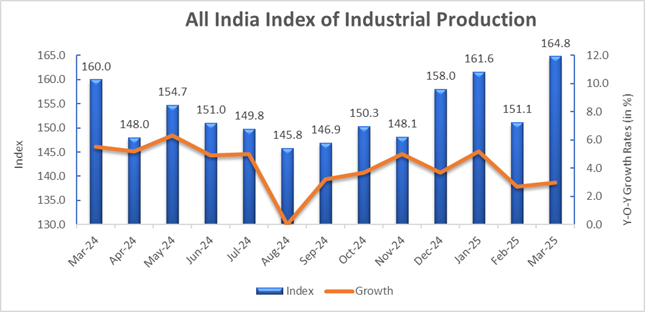
India's industrial output, measured by the Index of Industrial Production (IIP), showed a slight increase in March 2025 but recorded a slowdown for the full financial year 2024-25 (FY25). The data was released by the National Statistical Office (NSO), which is part of the Ministry of Statistics and Programme Implementation (MoSPI).
Key Figures:
- March 2025 Growth: The IIP grew by 3.0% in March 2025. This is slightly better than the revised growth of 2.7% seen in February 2025. However, it's significantly lower than the 5.5% growth recorded in March 2024.
- FY25 Annual Growth: For the entire financial year (April 2024 to March 2025), India's industrial production grew by 4.0%.
- Trend: This annual growth of 4.0% for FY25 is the lowest in four years. It marks a slowdown compared to the 5.9% growth seen in FY24 (2023-24) and 11.4% in FY22 (2021-22). The last time growth was lower was during the pandemic year FY21 (2020-21), when output contracted (-8.4%).
Sector-wise Performance (March 2025 vs March 2024):
- Manufacturing: This largest component of IIP grew by 3.0%, down from 5.9% growth in March 2024.
- Mining: Output growth slowed sharply to 0.4%, compared to 1.3% growth a year ago.
- Electricity: Generation grew by 6.3%, also slower than the 8.6% growth seen in March 2024.
What the Categories Tell Us (Use-Based Classification - March 2025):
- Consumer Non-Durables: This category, which includes everyday items, showed a concerning contraction of 4.7%. This reverses the 5.2% growth seen in March 2024 and marks the fourth consecutive month of contraction, possibly indicating stress in consumption demand, especially in rural areas (though some reports suggest early signs of rural recovery).
- Consumer Durables: Items like electronics and appliances grew by 6.6%, which is strong but slower than the 9.5% growth last year.
- Capital Goods: Production of machinery and equipment used for further production grew by 2.4%, a significant slowdown from 7.0% growth in March 2024. This can indicate trends in investment activity.
- Infrastructure/Construction Goods: This segment showed robust growth at 8.8%, slightly higher than the 7.4% growth last year.
- Primary Goods (like raw materials) grew by 3.1%.
- Intermediate Goods (used in production processes) grew by 2.3%.
Why This Matters for the Economy:
- The IIP data gives a quick look at how the industrial sector is performing.
- It helps the government and the Reserve Bank of India (RBI) make policy decisions.
- It is used in calculating the Gross Domestic Product (GDP) figures.
- The slowdown in FY25, particularly in consumer goods and capital goods, points towards areas that need monitoring for overall economic health.
Additional Information:
What is IIP?
- The Index of Industrial Production (IIP) measures the change in the volume of production of a basket of industrial goods over a specific period.
- It shows the performance of the industrial sector.
- The current Base Year for comparison is 2011-12 (meaning production is compared relative to the average monthly production in 2011-12, which is set to 100).
Who Calculates It?
- The National Statistical Office (NSO) under the Ministry of Statistics and Programme Implementation (MoSPI).
Main Components:
- Broad Sectors: Mining (Weight: 14.37%), Manufacturing (Weight: 77.63%), Electricity (Weight: 7.99%).
- Use-Based Categories: Primary Goods, Capital Goods, Intermediate Goods, Infrastructure/Construction Goods, Consumer Durables, Consumer Non-Durables.
Eight Core Industries:
- These industries have a combined weight of 40.27% in the IIP.
- They are (in decreasing order of weightage): Refinery Products, Electricity, Steel, Coal, Crude Oil, Natural Gas, Cement, Fertilizers. Their performance heavily influences the overall IIP.
IAF Sharpens Combat Edge with Exercise 'Aakraman'
The Indian Air Force (IAF) is currently conducting a major operational exercise named 'Aakraman' (Attack). This large-scale drill is taking place over a wide area, primarily in the central sector of the country, and involves some of the IAF's most potent fighter aircraft and assets.

Objectives of Exercise Aakraman:
- Enhance Operational Readiness: To test and improve the IAF's preparedness for complex combat scenarios.
- Validate Tactics: To practice and confirm various warfighting strategies and doctrines.
- Simulate Combat Missions: To carry out complex missions, including simulated attacks on ground targets in varied terrains (plains and mountains) and electronic warfare drills.
- Improve Synergy: To ensure different aircraft types, squadrons, and ground systems can work together effectively. Assets have reportedly been moved from multiple airbases, possibly including from the Eastern sector, for this exercise.
Key Aircraft and Personnel Involved:
- Dassault Rafale: The cutting-edge, French-origin multirole fighter jets are leading the exercise. The IAF operates two squadrons of Rafales based in Ambala (Haryana) and Hashimara (West Bengal).
- Sukhoi Su-30 MKI: The mainstay and workhorse air superiority fighter of the IAF, built under license in India, is also participating significantly.
- Other Assets: While specific details aren't always revealed, such large exercises typically involve other crucial elements like transport aircraft, mid-air refuellers, Airborne Warning and Control System (AWACS) aircraft, and ground-based air defence systems.
- Top Pilots: Highly skilled pilots, including instructors often referred to as 'Top Guns' (possibly from the Tactics and Air Combat Development Establishment - TACDE), are participating and guiding the exercise, which is being monitored closely by Air Headquarters.
Strategic Importance:
- Capability Demonstration: Exercises like Aakraman showcase the IAF's ability to rapidly deploy assets and conduct high-intensity operations across different regions.
- Integration of New Tech: It allows the IAF to practice using recently acquired platforms and weapons systems, such as advanced missiles (Meteor, SCALP, HAMMER, Rampage) integrated with the Rafales, and potentially coordinate with systems like the S-400 air defence units.
- Deterrence: Such large-scale drills signal preparedness and act as a deterrent in the complex security environment of the region. The exercise is happening at a time of heightened alertness in the region.
Additional Information:
Indian Air Force (IAF):
- The air arm of the Indian Armed Forces, established on October 8, 1932.
- Its primary mission is to secure Indian airspace and conduct aerial warfare during armed conflict.
- The President of India is the Supreme Commander. The Chief of the Air Staff (CAS), an Air Chief Marshal, commands the IAF.
- The IAF is organised into seven commands: Five operational commands (Western - New Delhi; Eastern - Shillong; Central - Prayagraj; South Western - Gandhinagar; Southern - Thiruvananthapuram) and two functional commands (Training Command - Bengaluru; Maintenance Command - Nagpur).
Dassault Rafale:
- A French twin-engine, 4.5 generation multirole combat aircraft.
- Known for its agility, advanced AESA radar, sophisticated SPECTRA electronic warfare suite, and ability to carry a wide range of weapons like the Meteor Beyond Visual Range (BVR) missile and SCALP cruise missile.
- India contracted for 36 Rafales, equipped with several India Specific Enhancements (ISE).
Sukhoi Su-30 MKI:
- A twin-engine, air superiority fighter with multirole capabilities, developed by Russia's Sukhoi and built under license by India's Hindustan Aeronautics Limited (HAL).
- Known for its long range, high manoeuvrability (due to thrust vectoring), and heavy weapons payload.
- Forms the backbone of the IAF's fighter fleet and is undergoing upgrades (Super-30 program) including new indigenous AESA radar (Virupaksha) and advanced cockpit systems.
AI Kiran: New Initiative Launched to Boost Women Leadership in Artificial Intelligence
A new national movement called 'AI Kiran' has been launched in India to empower women in the rapidly growing field of Artificial Intelligence (AI). This initiative aims to increase the participation and leadership of women in AI and Machine Learning (ML).
AI Kiran is a collaborative effort, co-led by the Office of the Principal Scientific Adviser (PSA) to the Government of India, Verix (a blockchain-based credentialing platform), and INK Women. The initiative is driven by Kirthiga Reddy, the CEO & Co-founder of Verix, who was formerly the head of Meta (Facebook) India and a partner at SoftBank Vision Fund.

Why is AI Kiran Needed?
- Gender Gap: Despite more women enrolling in Science, Technology, Engineering, and Mathematics (STEM) education, there's a significant gap in AI jobs. Reports suggest women hold only about 33% of junior-level and 19% of senior-level GenAI roles in India.
- Growing AI Market: India's AI market is expanding quickly (projected to reach $17 billion by 2027) and has the potential to add significantly to the economy.
- Inclusive Development: Ensuring women participate actively and lead in AI is crucial for developing unbiased algorithms and creating technology that benefits everyone. Diverse perspectives lead to better innovation.
What Will AI Kiran Do?
AI Kiran aims to build a strong and supportive ecosystem for women in AI through several key activities:
- Building Community: Creating a vibrant network for women professionals, students, researchers, and entrepreneurs interested in AI.
- Providing Mentorship: Connecting aspiring women with experienced leaders in the AI field for guidance and support.
- Offering Learning Resources: Giving access to curated learning programs and resources to build AI skills.
- Creating Opportunities: Developing pathways for funding, scholarships, global exposure, and leadership roles for women in AI.
- Recognition and Visibility: Celebrating the achievements of women leaders in AI. The initiative has initially highlighted over 250 women leaders across sectors like education, healthcare, and technology. Achievements recognized under AI Kiran will use blockchain technology for digital verification, ensuring credibility and global shareability.
- Fostering Collaboration: Encouraging partnerships between government, industry, and civil society organizations to support women in AI.
- Platform Access: The initiative is hosted on the government's Manthan Platform, making it accessible to a wide audience across India.
Significance of the Initiative:
- Promotes gender equality in the critical field of technology.
- Helps India harness the full potential of its talent pool for AI development.
- Contributes to creating more responsible and unbiased AI systems by including diverse viewpoints.
- Supports national goals related to Digital India, Skill India, and women-led development.
Additional Information:
What is Artificial Intelligence (AI)?
- AI refers to technologies that allow computers and machines to perform tasks that typically require human intelligence, such as learning from experience, solving problems, understanding language, recognizing patterns, and making decisions.
Why are Women Important in AI?
- Reduces Bias: AI systems learn from data. If the teams building AI are not diverse, the systems can inherit and amplify existing societal biases (like gender bias). Having women involved helps create fairer AI.
- Diverse Perspectives: Women bring different experiences and viewpoints, leading to more creative solutions and AI applications that better serve everyone's needs.
- Talent Pool: Excluding women means missing out on a huge pool of talent needed for India's growing tech sector.
Office of the Principal Scientific Adviser (PSA):
- This office advises the Prime Minister and Cabinet on matters related to science, technology, and innovation policy in India.
Mission Amrit Sarovar: India’s Community-Led Revival of Water Bodies
Mission Amrit Sarovar, launched on 24 April 2022 under Azadi Ka Amrit Mahotsav, aims to construct or rejuvenate 75 traditional water bodies in every district across India to address groundwater depletion and rural water scarcity.
As of March 2025, over 68,000 Amrit Sarovars have been completed—with 46,000 under Mahatma Gandhi NREGA—and linked to 65,285 user groups, symbolising a nationwide people’s movement for water security. This mission blends grassroots governance, e-governance via the National Informatics Centre, and traditional practices, boosting rural livelihoods and nearly doubling groundwater recharge from 13.98 BCM in 2017 to 25.34 BCM in 2024.
Background & Objectives
- Azadi Ka Amrit Mahotsav: A GOI initiative (12 Mar 2021–15 Aug 2023) celebrating 75 years of independence to “activate India 2.0” through five themes: Freedom Struggle, Ideas@75, Resolve@75, Action@75, Achievements@75.
- Launch & Scale-Up: Announced by the Prime Minister on National Panchayati Raj Day (24 Apr 2022), initially targeting 50,000 ponds by 15 Aug 2023; Phase I achieved 59,492 ahead of schedule; Phase II (since Sep 2023) has identified 3,182 new sites as of 17 Apr 2025
- Core Objectives
- Conserve water and promote sustainable management
- Empower Gram Panchayats through decentralized governance
- Generate rural employment under MGNREGA and allied schemes
- Revive cultural water heritage and strengthen community ownership
Institutional Framework
- Ministry of Rural Development (MoRD): Nodal ministry responsible for rural welfare, housing, and public works; focuses on poverty eradication, piped water, affordable housing, and infrastructure grants.
- Mahatma Gandhi NREGA (MGNREGA): Guarantees 100 days of wage employment per rural household in unskilled manual labour; creates durable assets like ponds and check dams.
- Bhaskaracharya National Institute for Space Applications & Geoinformatics (BISAG-N): Autonomous scientific society under MeitY, established 2003, providing geo-spatial technology and satellite communication for site selection, monitoring, and capacity building.
- National Informatics Centre (NIC): IT arm of MeitY, established 1976, providing e-Governance support and the amritsarovar.gov.in portal to track real-time progress nationally.
- Panchayati Raj Institutions (PRIs): Three-tier local self-government (Gram Panchayat → Panchayat Samiti → Zilla Panchayat) empowered for planning and execution; constitutional status via 73rd Amendment.
Implementation & Community Participation
- Convergence of Schemes: Works executed under MGNREGA, 15th Finance Commission grants, PMKSY (Watershed/Har Khet ko Pani), state schemes, ensuring efficient use of funds and manpower.
- Local Oversight: Each site has a Panchayat Pratinidhi (citizen supervisor) and a Panchayat Level Officer, ensuring faithful execution, documentation, and reporting.
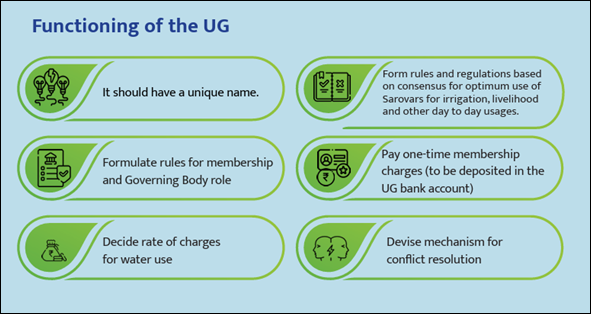
- User Groups: Over 65,285 voluntary groups (SHGs, VWSCs, fisherfolk, cultivators) manage upkeep, plantation, and silt removal; membership ensures representation of women and weaker sections.
- Cultural Connect: Foundation stones laid by freedom fighters’ families or Padma awardees; Independence/Republic Day celebrations at sites foster national pride and Jan Bhagidari.
World Day for Safety and Health at Work 2025
On April 28, 2025, the world observed the World Day for Safety and Health at Work, focusing on the theme: "Revolutionising Health and Safety: The Role of AI and Digitalisation at Work". This annual event, initiated by the International Labour Organization (ILO) in 2003, aims to promote safe and healthy workplaces globally .

Significance of the Theme: The 2025 theme underscores the transformative impact of Artificial Intelligence (AI) and digital technologies on occupational safety and health (OSH). While these technologies offer opportunities to enhance workplace safety, they also present new challenges that need to be addressed.
Opportunities Presented by AI and Digitalisation:
- Automation of Hazardous Tasks: Robots and automated systems can perform dangerous tasks, reducing the risk to human workers.
- Predictive Analytics: AI can analyze data to predict and prevent potential workplace accidents.
- Smart Monitoring Systems: Sensors and IoT devices can continuously monitor workplace conditions, ensuring real-time hazard detection.
- Virtual and Augmented Reality: These technologies can be used for immersive training programs, preparing workers for real-life scenarios without exposure to actual risks.
Challenges and Risks:
- Worker Surveillance: Increased monitoring can infringe on privacy rights.
- Algorithmic Bias: AI systems may perpetuate existing biases, leading to unfair treatment.
- Job Displacement: Automation may lead to job losses in certain sectors.
- Blurring Work-Life Boundaries: Digital tools can make it harder for employees to disconnect from work, affecting mental health.
India's Context:
In India, labour is a subject in the Concurrent List, allowing both the Centre and states to legislate on it. The Directorate General Factory Advice Service and Labour Institutes (DGFASLI) under the Ministry of Labour and Employment plays a pivotal role in ensuring workplace safety. Key legislations include:
- Factories Act, 1948: Regulates labour in factories concerning health, safety, and welfare.
- Mines Act, 1952: Ensures safety in mining operations.
- Building and Other Construction Workers Act, 1996: Addresses safety in construction sites.
World Veterinary Day 2025
Every year, the last Saturday of April marks the celebration of World Veterinary Day. In 2025, it was observed on April 26, focusing on the theme: "Animal Health Takes a Teams". This day acknowledges the indispensable contributions of veterinarians to global health, encompassing animal welfare, public health, and environmental conservation.

Historical Background:
- Established by: The World Veterinary Association (WVA) in collaboration with the World Organisation for Animal Health (WOAH).
- First Observed: In the year 2000.
- Purpose: To highlight and promote the crucial work of veterinarians worldwide and to raise awareness about the importance of animal health and welfare.
Key Roles of Veterinarians:
- Disease Prevention and Control: Monitoring and controlling outbreaks of animal diseases that can impact human health.
- Food Safety: Ensuring the health of livestock, thereby maintaining the safety of animal-derived food products.
- Animal Welfare: Providing medical care and advocating for the humane treatment of animals.
- Environmental Protection: Contributing to biodiversity conservation and monitoring environmental hazards that affect both animal and human populations.
World Intellectual Property Day 2025
On April 26, 2025, the world celebrated World Intellectual Property Day, focusing on the theme: "IP and Music: Feel the Beat of IP". This annual event, initiated by the World Intellectual Property Organization (WIPO), aims to raise awareness about the importance of intellectual property (IP) rights in fostering innovation and creativity .

Significance of the 2025 Theme: The 2025 theme underscores the vital role of IP rights in the music industry, highlighting how they:
- Protect Creators: Ensure that musicians, composers, and producers have legal rights over their creations.
- Encourage Innovation: Provide incentives for artists to create new works, knowing their rights are safeguarded.
- Foster Economic Growth: Support the music industry's contribution to the global economy by securing revenue streams for creators.
World Tapir Day 2025: Protecting the Forest’s Gentle Gardeners
On April 27, 2025, the world observed the 17th World Tapir Day, dedicated to raising awareness about tapirs—unique, ancient mammals vital to tropical ecosystems. Established in 2008 by conservationists, this day emphasizes the importance of tapirs in maintaining forest health and the urgent need for their conservation.

Significance of Tapirs:
- Ecological Role: Tapirs are often called "gardeners of the forest" because they help in seed dispersal through their droppings, facilitating forest regeneration .
- Evolutionary History: These herbivorous mammals have existed for millions of years, with their lineage tracing back to prehistoric times .
Threats to Tapirs:
- Habitat Loss: Deforestation for agriculture and urban development has significantly reduced their natural habitats.
- Hunting: In some regions, tapirs are hunted for their meat and hide.
- Climate Change: Altered rainfall patterns and temperatures affect the availability of food and suitable habitats.
Global Conservation Efforts:
- Captive Breeding Programs: Zoos and wildlife parks, like Bioparc Fuengirola in Spain, participate in breeding programs to increase tapir populations .
- Public Awareness Campaigns: Educational events, social media campaigns, and community outreach programs are organized worldwide to inform the public about tapirs' plight.
World Social Report 2025
On April 24, 2025, the United Nations Department of Economic and Social Affairs (UN DESA) released the World Social Report 2025, highlighting escalating global challenges such as economic insecurity, rising inequality, and declining social trust. The report emphasizes the urgent need for a new policy consensus to foster sustainable development and social cohesion .

Key Highlights:
- Economic Insecurity: Despite reductions in extreme poverty, over 2.8 billion people live on daily incomes between $2.15 and $6.85, making them vulnerable to economic shocks.
- Rising Inequality: The concentration of wealth and power at the top has intensified, leading to social fragmentation and eroding trust in institutions.
- Declining Social Trust: More than half of the global population lacks trust in their governments, a situation exacerbated by the spread of misinformation.
Proposed Policy Framework:
The report advocates for a new policy consensus anchored in three core principles:
- Equity: Ensuring fair access to resources and opportunities for all individuals.
- Economic Security for All: Implementing universal social protection systems to safeguard against economic vulnerabilities.
- Solidarity: Fostering social cohesion and collective responsibility to address shared challenges.
Implications for India:
- Social Protection: Strengthening schemes like Mahatma Gandhi National Rural Employment Guarantee Act (MGNREGA) and Pradhan Mantri Jan Dhan Yojana to enhance economic security.
- Addressing Inequality: Implementing progressive taxation and inclusive policies to reduce wealth disparities.
- Building Trust: Enhancing transparency and accountability in governance to rebuild public trust.
April 2025
Archive
October 2026
- 28 October 2026
- 27 October 2026
- 26 October 2026
- 24 October 2026
- 23 October 2026
- 22 October 2026
- 21 October 2026
- 20 October 2026
- 19 October 2026
- 17 October 2026
- 16 October 2026
- 15 October 2026
- 14 October 2026
- 13 October 2026
- 12 October 2026
- 10 October 2026
- 09 October 2026
- 08 October 2026
- 07 October 2026
- 06 October 2026
- 05 October 2026
- 03 October 2026
- 02 October 2026
- 01 October 2026
September 2026
- 30 September 2026
- 29 September 2026
- 28 September 2026
- 26 September 2026
- 25 September 2026
- 24 September 2026
- 23 September 2026
- 22 September 2026
- 21 September 2026
- 19 September 2026
- 18 September 2026
- 17 September 2026
- 16 September 2026
- 15 September 2026
- 12 September 2026
- 11 September 2026
- 10 September 2026
- 09 September 2026
- 08 September 2026
- 07 September 2026
- 05 September 2026
- 04 September 2026
- 03 September 2026
- 02 September 2026
- 01 September 2026
August 2026
- 31 August 2026
- 29 August 2026
- 27 August 2026
- 26 August 2026
- 25 August 2026
- 24 August 2026
- 22 August 2026
- 21 August 2026
- 20 August 2026
- 19 August 2026
- 18 August 2026
- 17 August 2026
- 14 August 2026
- 13 August 2026
- 12 August 2026
- 11 August 2026
- 10 August 2026
- 08 August 2026
- 07 August 2026
- 06 August 2026
- 05 August 2026
- 04 August 2026
- 03 August 2026
- 01 August 2026
July 2026
- 31 July 2026
- 30 July 2026
- 29 July 2026
- 28 July 2026
- 27 July 2026
- 25 July 2026
- 23 July 2026
- 22 July 2026
- 21 July 2026
- 20 July 2026
- 18 July 2026
- 17 July 2026
- 15 July 2026
- 14 July 2026
- 13 July 2026
- 11 July 2026
- 10 July 2026
- 09 July 2026
- 08 July 2026
- 07 July 2026
- 06 July 2026
- 04 July 2026
- 03 July 2026
- 02 July 2026
- 01 July 2026
June 2026
May 2026
April 2026
March 2026
- 31 March 2026
- 30 March 2026
- 28 March 2026
- 27 March 2026
- 26 March 2026
- 25 March 2026
- 24 March 2026
- 23 March 2026
- 21 March 2026
- 20 March 2026
- 19 March 2026
- 18 March 2026
- 17 March 2026
- 16 March 2026
- 14 March 2026
- 13 March 2026
- 12 March 2026
- 11 March 2026
- 10 March 2026
- 09 March 2026
- 07 March 2026
- 06 March 2026
- 05 March 2026
- 03 March 2026
- 02 March 2026
February 2026
- 28 February 2026
- 27 February 2026
- 26 February 2026
- 25 February 2026
- 24 February 2026
- 23 February 2026
- 21 February 2026
- 20 February 2026
- 19 February 2026
- 18 February 2026
- 17 February 2026
- 16 February 2026
- 13 February 2026
- 12 February 2026
- 11 February 2026
- 10 February 2026
- 09 February 2026
- 07 February 2026
- 06 February 2026
- 05 February 2026
- 04 February 2026
- 03 February 2026
- 02 February 2026
January 2026
- 31 January 2026
- 30 January 2026
- 29 January 2026
- 28 January 2026
- 27 January 2026
- 26 January 2026
- 24 January 2026
- 23 January 2026
- 22 January 2026
- 21 January 2026
- 20 January 2026
- 19 January 2026
- 16 January 2026
- 15 January 2026
- 14 January 2026
- 13 January 2026
- 12 January 2026
- 10 January 2026
- 09 January 2026
- 08 January 2026
- 07 January 2026
- 06 January 2026
- 05 January 2026
- 03 January 2026
- 02 January 2026
- 01 January 2026
December 2025
- 31 December 2025
- 30 December 2025
- 29 December 2025
- 27 December 2025
- 26 December 2025
- 24 December 2025
- 23 December 2025
- 22 December 2025
- 20 December 2025
- 19 December 2025
- 18 December 2025
- 17 December 2025
- 16 December 2025
- 15 December 2025
- 13 December 2025
- 12 December 2025
- 11 December 2025
- 10 December 2025
- 09 December 2025
- 08 December 2025
- 05 December 2025
- 04 December 2025
- 03 December 2025
- 02 December 2025
November 2025
- 29 November 2025
- 28 November 2025
- 27 November 2025
- 26 November 2025
- 25 November 2025
- 24 November 2025
- 22 November 2025
- 21 November 2025
- 20 November 2025
- 19 November 2025
- 18 November 2025
- 17 November 2025
- 15 November 2025
- 14 November 2025
- 13 November 2025
- 12 November 2025
- 11 November 2025
- 10 November 2025
- 08 November 2025
- 07 November 2025
- 06 November 2025
- 05 November 2025
- 04 November 2025
- 03 November 2025
- 01 November 2025
October 2025
- 31 October 2025
- 30 October 2025
- 29 October 2025
- 28 October 2025
- 27 October 2025
- 25 October 2025
- 24 October 2025
- 23 October 2025
- 22 October 2025
- 21 October 2025
- 20 October 2025
- 18 October 2025
- 17 October 2025
- 16 October 2025
- 15 October 2025
- 14 October 2025
- 13 October 2025
- 11 October 2025
- 10 October 2025
- 09 October 2025
- 08 October 2025
- 07 October 2025
- 06 October 2025
- 04 October 2025
- 03 October 2025
- 02 October 2025
- 01 October 2025
September 2025
- 30 September 2025
- 29 September 2025
- 27 September 2025
- 26 September 2025
- 25 September 2025
- 24 September 2025
- 23 September 2025
- 22 September 2025
- 20 September 2025
- 19 September 2025
- 18 September 2025
- 17 September 2025
- 16 September 2025
- 15 September 2025
- 13 September 2025
- 12 September 2025
- 11 September 2025
- 10 September 2025
- 09 September 2025
- 08 September 2025
- 06 September 2025
- 05 September 2025
- 04 September 2025
- 03 September 2025
- 02 September 2025
- 01 September 2025
August 2025
- 30 August 2025
- 29 August 2025
- 28 August 2025
- 27 August 2025
- 26 August 2025
- 25 August 2025
- 23 August 2025
- 22 August 2025
- 21 August 2025
- 20 August 2025
- 19 August 2025
- 18 August 2025
- 16 August 2025
- 14 August 2025
- 13 August 2025
- 12 August 2025
- 11 August 2025
- 08 August 2025
- 07 August 2025
- 06 August 2025
- 05 August 2025
- 04 August 2025
- 02 August 2025
- 01 August 2025
July 2025
- 31 July 2025
- 30 July 2025
- 29 July 2025
- 28 July 2025
- 26 July 2025
- 25 July 2025
- 24 July 2025
- 23 July 2025
- 22 July 2025
- 21 July 2025
- 19 July 2025
- 18 July 2025
- 17 July 2025
- 16 July 2025
- 15 July 2025
- 12 July 2025
- 11 July 2025
- 10 July 2025
- 09 July 2025
- 07 July 2025
- 05 July 2025
- 04 July 2025
- 03 July 2025
- 02 July 2025
- 01 July 2025
June 2025
- 30 June 2025
- 28 June 2025
- 27 June 2025
- 26 June 2025
- 25 June 2025
- 24 June 2025
- 23 June 2025
- 21 June 2025
- 20 June 2025
- 19 June 2025
- 18 June 2025
- 17 June 2025
- 16 June 2025
- 14 June 2025
- 13 June 2025
- 12 June 2025
- 11 June 2025
- 10 June 2025
- 09 June 2025
- 07 June 2025
- 06 June 2025
- 05 June 2025
- 04 June 2025
- 03 June 2025
- 02 June 2025
May 2025
April 2025
- 30 April 2025
- 29 April 2025
- 28 April 2025
- 26 April 2025
- 25 April 2025
- 24 April 2025
- 23 April 2025
- 22 April 2025
- 21 April 2025
- 19 April 2025
- 18 April 2025
- 17 April 2025
- 16 April 2025
- 15 April 2025
- 14 April 2025
- 12 April 2025
- 11 April 2025
- 10 April 2025
- 09 April 2025
- 08 April 2025
- 07 April 2025
- 05 April 2025
- 04 April 2025
- 03 April 2025
- 02 April 2025
- 01 April 2025
March 2025
- 31 March 2025
- 29 March 2025
- 28 March 2025
- 27 March 2025
- 26 March 2025
- 25 March 2025
- 24 March 2025
- 22 March 2025
- 21 March 2025
- 20 March 2025
- 19 March 2025
- 18 March 2025
- 17 March 2025
- 15 March 2025
- 13 March 2025
- 12 March 2025
- 11 March 2025
- 10 March 2025
- 08 March 2025
- 07 March 2025
- 06 March 2025
- 05 March 2025
- 04 March 2025
- 03 March 2025
- 01 March 2025
February 2025
- 28 February 2025
- 27 February 2025
- 26 February 2025
- 25 February 2025
- 24 February 2025
- 22 February 2025
- 21 February 2025
- 20 February 2025
- 19 February 2025
- 18 February 2025
- 17 February 2025
- 15 February 2025
- 14 February 2025
- 13 February 2025
- 12 February 2025
- 11 February 2025
- 10 February 2025
- 08 February 2025
- 07 February 2025
- 06 February 2025
- 05 February 2025
- 04 February 2025
- 03 February 2025
- 01 February 2025
January 2025
- 31 January 2025
- 30 January 2025
- 29 January 2025
- 28 January 2025
- 27 January 2025
- 25 January 2025
- 24 January 2025
- 23 January 2025
- 22 January 2025
- 21 January 2025
- 20 January 2025
- 18 January 2025
- 17 January 2025
- 16 January 2025
- 15 January 2025
- 14 January 2025
- 13 January 2025
- 11 January 2025
- 10 January 2025
- 09 January 2025
- 08 January 2025
- 07 January 2025
- 06 January 2025
- 04 January 2025
- 03 January 2025
- 02 January 2025
- 01 January 2025