
Current Affairs
Stay updated with the latest national and international events.
26 September 2025
India Reiterates Zero-Tolerance Policy Towards Terrorism at Global Platforms

What’s the News?
- India reaffirmed its zero-tolerance stance against terrorism at the G20 Foreign Ministers’ Meeting in Rio de Janeiro and at a UN Ministerial Meeting in New York.
- External Affairs Minister S. Jaishankar criticized selective approaches to terrorism and the misuse of sanctions for political purposes.
- He stressed the need for global unity, accountability of perpetrators, and dismantling of cross-border terror networks to ensure lasting peace and security.
Counter-Terrorism Approach
- India’s position emphasizes that terrorism is one of the gravest threats to international peace, requiring:
- Collective international cooperation against terror financing, safe havens, and radicalization.
- Rejection of double standards—no distinction between “good” and “bad” terrorists.
- Effective multilateralism through bodies like the UN, G20, and FATF.
- India highlighted that unilateral sanctions and politically motivated restrictions weaken collective action.
Additional Info
- Global Counter-Terrorism Forum (GCTF):
- An informal, multilateral counter-terrorism platform launched in 2011.
- It comprises 30 founding members (29 countries + the European Union). India is a founding member.
- Its primary objective is to reduce the vulnerability of people worldwide to terrorism by mobilizing expertise and resources to prevent, combat, and prosecute terrorist acts.
- Financial Action Task Force (FATF):
- An inter-governmental body established in 1989 to combat money laundering.
- Its mandate was expanded to include combating terrorist financing in 2001.
- India has been a full member of the FATF since 2010.
- Comprehensive Convention on International Terrorism (CCIT):
- A draft treaty proposed by India at the UN in 1996.
- Objective: To establish a universal legal framework to criminalize all forms of international terrorism and deny terrorists, their financiers, and supporters access to funds, arms, and safe havens.
- The convention remains stalled due to a lack of consensus among member states, primarily over the definition of "terrorism."
- Domestic Counter-Terrorism Framework:
- Unlawful Activities (Prevention) Act (UAPA), 1967: India's primary anti-terror law. It has been amended several times to strengthen its provisions.
- National Investigation Agency (NIA): A central agency established in 2009 (post the 26/11 Mumbai attacks) to investigate and prosecute offenses affecting the sovereignty, security, and integrity of India.
Sources
“Mukhyamantri Mahila Rojgar Yojana” Launched in Bihar to Support Women’s Livelihoods
What’s the News?
- The Bihar government, with support from the Central government, launched the Mukhyamantri Mahila Rojgar Yojana.
- Under the scheme, ₹10,000 will be directly transferred into the bank accounts of 75 lakh women across Bihar via DBT (Direct Benefit Transfer).
- The scheme allows for additional support up to ₹2,00,000 depending on the success of the enterprise, evaluated after six months.
- The rural development department is the nodal agency, and the scheme will be executed via Bihar Rural Livelihood Promotion Society (JEEViKA).
Scheme Details & Objectives
The primary goal of the Mukhyamantri Mahila Rojgar Yojana is to promote financial independence and self-employment among women.
- Objective: To empower women from poor families by providing them with seed money to start small-scale businesses or other income-generating activities.
- Key Features:
- Financial Assistance: A one-time grant of ₹10,000 will be provided directly to the beneficiary.
- Target Group: The scheme specifically targets unemployed women who are permanent residents of Bihar and belong to economically disadvantaged households.
- Eligibility Criteria:
- The applicant must be a woman and a permanent resident of Bihar.
- She must be unemployed.
- She must belong to a poor family, as per government norms.
Sources
IAF and IIT Ropar Forge Alliance for Indigenous Defence Innovation

What’s the News?
- The Indian Air Force (IAF) Maintenance Command and Indian Institute of Technology (IIT) Ropar have signed an MoU to collaborate on technology development and indigenisation of defence systems.
- The agreement was signed by Air Marshal Vijay Kumar Garg (AOC-in-C, Maintenance Command) and Rajeev Ahuja (Director, IIT Ropar).
- IIT Ropar will support through consultancy, feasibility studies, and development of technology demonstrators in niche areas.
- The partnership is intended to deepen academia–military synergy and boost self-reliance in defence tech.
Focus Areas & Implementation Strategy
- Priority Technology Domains:
- Development of indigenous solutions for weapon system sustainment.
- Creation of technology demonstrators based on IAF-identified operational needs.
- Conduct of feasibility studies and advanced research to support IAF’s maintenance and modernization goals.
- Capacity Building & Knowledge Exchange:
- Joint training programs, workshops, and knowledge-sharing sessions to nurture defence innovation and skill development.
- Consultancy support from IIT Ropar in critical technology areas, leveraging its research infrastructure.
- Strategic Objective:
- Accelerate indigenisation of critical defence components and systems.
- Foster a robust defence-academia ecosystem to support long-term self-reliance in air power capabilities.
Additional Info
- Innovations for Defence Excellence (iDEX):
- An initiative launched by the Ministry of Defence.
- It aims to create an ecosystem to foster innovation and technology development in Defence and Aerospace by engaging with startups, MSMEs, R&D institutes, and academia.
- It provides grants and other support to carry out R&D with potential for future adoption.
- Technology Development Fund (TDF) Scheme:
- A program executed by the Defence Research and Development Organisation (DRDO).
- It promotes self-reliance in defence technology by funding Indian industries, especially startups and MSMEs, for the design and development of defence and dual-use technologies.
- Defence Industrial Corridors:
- The government is establishing two Defence Industrial Corridors, one in Uttar Pradesh and the other in Tamil Nadu.
- These corridors aim to create a concentrated and efficient defence manufacturing ecosystem to bolster indigenous production capabilities.
Sources
Over ₹1 Lakh Crore MoUs Signed in First Two Days at World Food India 2025
What’s the News?
- During World Food India 2025 held at Bharat Mandapam, New Delhi, MoUs with investment commitments exceeding ₹1 lakh crore were signed within the first two days.
- On Day 2 alone, 21 companies committed over ₹25,000 crore in investments.
- Major corporates like Reliance Consumer Products Ltd (RCPL) and Coca-Cola bottlers pledged deals worth ₹65,000 crore in aggregate.
Investment & Strategic Focus Areas
- Investment Breakdown:
- Day 1 & 2: Over ₹1 lakh crore in MoUs signed.
- Day 2 alone: 21 companies committed ₹25,000 crore.
- Key Sectors Covered:
- Pet food, nutraceuticals, plant-based foods, alcoholic beverages, and specialty foods.
- Emphasis on sustainability, food safety, and farmer-producer linkages.
- Participating Entities:
- Focus States: Uttar Pradesh, Gujarat, Punjab, Jharkhand, and Bihar hosted dedicated sessions.
- International Partners: Delegations from Russia, Portugal, Japan, Vietnam, and New Zealand engaged in bilateral talks.
- Central Agencies: FSSAI, APEDA, Ministry of Agriculture, Ministry of AYUSH, and World Bank contributed thematic sessions.
- Parallel Events:
- 3rd Global Food Regulators Summit (by FSSAI) to align India with international food safety standards.
- 24th India International Seafood Show to boost seafood exports.
Additional Info
- World Food India (WFI):
- Launched in 2017 by the Ministry of Food Processing Industries (MoFPI).
- Aims to position India as a global food processing hub and attract FDI in the sector.
- Previous editions facilitated investments exceeding ₹50,000 crore.
- Policy & Scheme Linkages:
- Pradhan Mantri Kisan SAMPADA Yojana (PMKSY):
- Outlay of ₹4,600 crore (2021–26).
- Supports Mega Food Parks, Cold Chain Infrastructure, and Food Processing Units.
- Production Linked Incentive (PLI) Scheme for Food Processing:
- ₹10,900 crore allocated to incentivize branded food manufacturing.
- Targets ₹3.5 lakh crore in output by 2026–27.
- Pradhan Mantri Kisan SAMPADA Yojana (PMKSY):
- Employment & Export Impact:
- Food processing sector contributes ~10% to India’s manufacturing GDP and employs over 20 lakh people.
- India is the world’s second-largest fruit and vegetable producer, yet only 2–3% of perishables are processed—highlighting massive untapped potential.
Sources
India Launches Nationwide Indigenous 4G Network via BSNL
What’s the News?
- The Government formally rolled out BSNL’s indigenously developed 4G stack across the country, dubbed “Swadeshi 4G”, inaugurating over 97,500 towers.
- The stack is designed to be cloud-based and fully upgradable to 5G, built using a C-DoT core, Tejas RAN, with TCS integrating the components.
- The deployment covers over 92,600 operational sites serving 22 million customers initially, with a goal of saturating connectivity (100% 4G saturation) via the Digital Bharat Nidhi (DBN) program.
- The project is expected to add 2 million new subscribers to the digital ecosystem.
Indigenous 4G Infrastructure & Strategic Significance
- Technology Stack Composition:
- Radio Access Network (RAN): Developed by Tejas Networks.
- Core Network: Built by Centre for Development of Telematics (C-DOT)—now the 6th global entity with such capability.
- Integration & Cloud Platform: Handled by Tata Consultancy Services (TCS).
- Investment & Scale:
- Total outlay: ₹37,000 crore.
- 26,700+ villages, including remote, border, and Left-Wing Extremism (LWE)-affected areas, now connected.
- Over 4,700 towers co-funded by Reliance Jio and Airtel under Digital Bharat Nidhi (DBN).
- Sustainability & Future-Readiness:
- All 18,903 new 4G towers are solar-powered, forming India’s largest green telecom network.
- Stack is cloud-native and upgradable to 5G/6G; 5G trials already underway in Chandigarh and Ambala.
Additional Info
- Atmanirbhar Bharat in Telecom:
- The 4G stack was developed under a 2020 strategic decision to avoid foreign dependency.
- Developed in 22 months through public-private collaboration, aligning with National Digital Communications Policy (NDCP) 2018.
- BSNL’s Revival Strategy:
- After years of losses, BSNL reported recent quarterly profits and subscriber growth.
- Offers 30–40% cheaper plans than private operators, aiming to regain market share via number portability.
- Digital Bharat Nidhi (DBN):
- Successor to Universal Service Obligation Fund (USOF).
- Funds connectivity in rural and remote areas; has awarded 7 projects to private TSPs and 4 to BSNL.
- 6G Vision:
- India targets 6G launch by 2030, with indigenous R&D under Bharat 6G Alliance and Telecom Standards Development Society of India (TSDSI).
Sources
President Confers National Geoscience Awards 2024
What’s the News?
- President Droupadi Murmu conferred the National Geoscience Awards 2024 at Rashtrapati Bhavan Cultural Centre, New Delhi, honouring 20 geoscientists across 12 awards—including 9 individual and 3 team awards.
- The President underscored the strategic importance of geosciences in national development, calling for sustainable mining practices, indigenous technology for rare earth element (REE) refining, and greater use of AI, drones, and machine learning in mineral exploration.
- She stressed that mining must balance economic growth with environmental and social responsibility, urging strict adherence to regulations and proper mine closure protocols.
Award Categories & Key Recipients
- National Geoscience Award for Lifetime Achievement:
- Prof. Shyam Sundar Rai (IISER Pune) – Recognized for pioneering work in seismology and Earth structure, especially in the India-Himalayan-Tibet region.
- Prize: ₹5 lakh + Certificate.
- National Young Geoscientist Award:
- Susobhan Neogi (GSI) – Honoured for outstanding research in geosciences.
- Prize: ₹1 lakh + ₹5 lakh research grant over 5 years + Certificate.
- National Geoscience Awards (10 awards):
- Mineral Discovery & Exploration: 3 awards (including critical minerals and coal/CBM exploration) – all team-based from Geological Survey of India (GSI).
- Mining & Sustainable Development:
- Dr. Jai Krishna Pandey (CSIR-CIMFR) – for innovations in mining technology and safety.
- Dr. Ranjeet Kumar Singh (CSIR-NML) – for work in mineral beneficiation and sustainable development.
- Basic Geosciences: 2 individual awards (details not fully disclosed in public domain).
- Applied Geosciences:
- Prof. Ghulam Jeelani (University of Kashmir) – groundwater and geo-environmental studies.
- Prof. Sanjit Kumar Pal (IIT ISM Dhanbad) – applied geophysics and instrumentation.
- Prof. Mukat Lal Sharma (IIT Roorkee) – natural hazard investigation (earthquakes, landslides).
Additional Info
- National Geoscience Awards (NGA):
- Instituted in 1966 by the Ministry of Mines.
- Governed by NGA Regulations 2022, covering four core sections:
- Mineral Discovery & Exploration
- Mining, Mineral Beneficiation & Sustainable Development
- Basic Geosciences
- Applied Geosciences
- Selection Process: Based on 208 nominations reviewed by expert committees; team awards limited to max 4 members.
- Strategic Focus Areas Highlighted by President:
- Rare Earth Elements (REEs):
- Critical for defence, EVs, smartphones, and clean energy.
- Not scarce in crust, but complex to refine—India must develop indigenous refining tech for self-reliance.
- Ocean Minerals:
- India’s three-ocean coastline holds vast seabed mineral potential; geoscientists urged to develop eco-sensitive extraction methods.
- Technology Integration:
- Promotion of AI, ML, drone surveys, and recovery of valuable elements from mine tailings by the Ministry of Mines.
- Rare Earth Elements (REEs):
- Geological Survey of India (GSI):
- Established: 1851
- Headquarters: Kolkata
- Director General: Asit Saha
- Primary agency for geological mapping, mineral exploration, and geohazard assessment.
Sources
JNPA Launches India’s First Electric Heavy Truck Fleet with Swappable Batteries
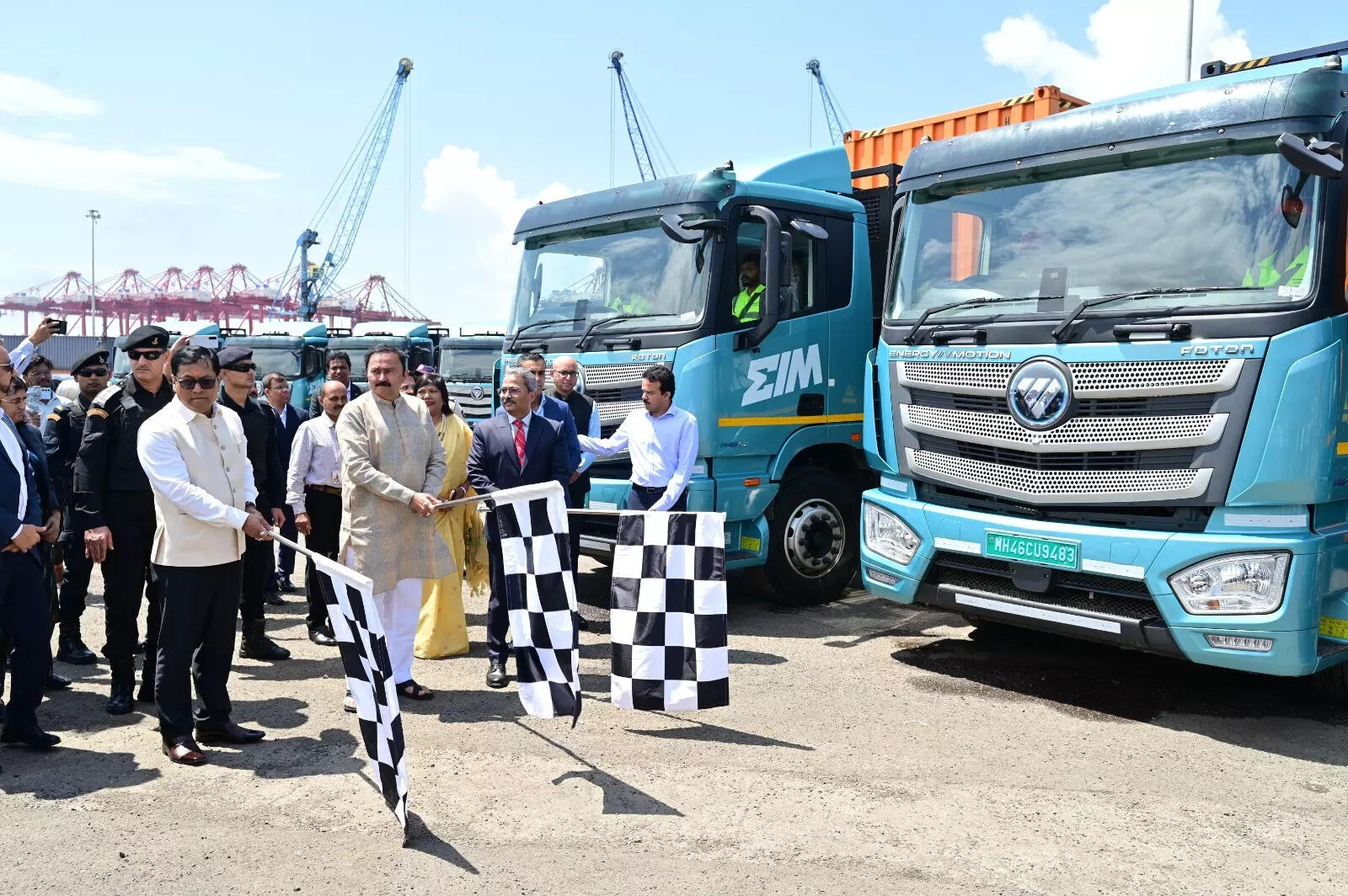
What’s the News?
- The Jawaharlal Nehru Port Authority (JNPA) has deployed India’s first fleet of electric heavy trucks equipped with swappable battery technology at the Nhava Sheva Distribution Terminal, marking a major step toward green port logistics.
- Union Minister Sarbananda Sonowal flagged off the initial 50 electric trucks, with plans to scale the fleet to 80 by end-2025 and electrify 90% of its 600-vehicle internal heavy truck fleet by December 2026.
- A dedicated heavy-duty battery swapping station has been commissioned to support uninterrupted operations, making this the first such infrastructure for heavy commercial vehicles at an Indian port.
Green Logistics & Strategic Impact
- Environmental & Operational Benefits:
- Expected to significantly cut carbon emissions, noise pollution, and dust within port premises.
- Aligns with India’s Net-Zero 2070 target, National Electric Mobility Mission Plan (NEMMP), and Green Ports Initiative.
- Policy & Infrastructure Alignment:
- Supports Maritime India Vision 2030 and PM Gati Shakti National Master Plan by integrating clean energy into multimodal logistics.
- JNPA, which handles nearly 50% of India’s container trade, aims to set a replicable model for other major and non-major ports.
- Tariff Framework Collaboration:
- JNPA signed an MoU with the Isaac Centre for Public Policy, Ashoka University, to develop a reference framework for port tariff determination based on cost and benchmarking across cargo types.
Additional Info
- Jawaharlal Nehru Port Authority (JNPA):
- Location: Nhava Sheva, Navi Mumbai, Maharashtra.
- Status: India’s largest container port by volume.
- Global Recognition: Ranked among top 25 ports in the World Bank’s Container Port Performance Index (CPPI).
- Green Ports Initiative:
- Launched under the Ministry of Ports, Shipping and Waterways.
- Focuses on renewable energy adoption (solar, wind), LNG/hydrogen infrastructure, and electrification of cargo handling and transport.
- National Logistics Policy (2022):
- Aims to reduce logistics costs from 14% to 8% of GDP by 2030.
- Promotes sustainable logistics, digital integration, and infrastructure modernization—of which JNPA’s EV fleet is a flagship example.
Sources
World Contraception Day 2025

What’s the News?
- World Contraception Day was observed globally on September 26, 2025, under the theme “A choice for all. Freedom to plan, power to choose.”
- Spearheaded by the United Nations Population Fund (UNFPA) and global health partners, the day reaffirmed contraception as a fundamental human right and a cornerstone of gender equality, maternal health, and sustainable development.
- The campaign highlighted that 257 million women worldwide, mostly in low- and middle-income countries, still face an unmet need for modern contraception, leading to higher risks of unintended pregnancies, unsafe abortions, and maternal mortality.
Key Focus Areas & Health Benefits
- Beyond Pregnancy Prevention:
- Cycle regulation: Hormonal contraceptives help manage heavy or painful periods.
- Cancer risk reduction: Long-term use of combined oral contraceptives lowers risks of endometrial and ovarian cancers.
- Treatment of gynaecological conditions: Used to manage acne, endometriosis, ovarian cysts, and menstrual migraines.
- Safe Sex and STI Prevention:
- Only barrier methods (e.g., condoms) offer dual protection against both pregnancy and sexually transmitted infections (STIs) like HIV.
- Additional strategies include HPV vaccination, regular testing, mutual monogamy, and open communication.
- Public Health Impact:
- Meeting unmet contraceptive needs could prevent over 50% of maternal deaths by reducing high-risk pregnancies and unsafe abortions.
- Supports SDG 3 (Good Health) and SDG 5 (Gender Equality) by empowering women to control their reproductive futures.
Additional Info
- World Contraception Day:
- Launched: 2007 by a coalition of international family planning organizations.
- Objective: Ensure universal access to accurate, evidence-based information on contraception and reproductive health services.
- Global and Indian Context:
- Global funding gap: Expected to reach $1.5 billion by 2030 for contraceptive services in LMICs.
- India’s Family Planning Programme:
- One of the world’s oldest, launched in 1952.
- Offers free contraceptives (condoms, oral pills, IUCDs, injectables, sterilization) through National Health Mission (NHM).
- Mission Parivar Vikas: Focuses on high-fertility districts to improve access and reduce TFR (Total Fertility Rate).
- Current TFR: 2.0 (NFHS-5), below replacement level, but disparities persist across states.
- Reproductive Rights Framework:
- Recognized at the 1994 International Conference on Population and Development (ICPD) in Cairo, which affirmed voluntary family planning as essential to human development.
Sources
Release of “Children in India 2025”: Key Indicators & Policy Signals

What’s the News?
- The Ministry of Statistics & Programme Implementation (MoSPI) released the fourth edition of Children in India 2025 at the 29th CoCSSO conference in Chandigarh.
- The publication offers updated data and analysis across health, education, child protection, demographics, and SDG-related metrics.
- Several notable trends are highlighted: a sharp decline in infant mortality rate (IMR), drop in school dropout rates, and shifts in child adoption figures.
Key Indicators and Trends
- Health & Nutrition:
- IMR (2023): 25 per 1,000 live births (26 for males, 25 for females).
- Under-Five Mortality Rate (U5MR): 29 per 1,000 live births, down from 30 in 2022.
- Rural-Urban Divide: U5MR is 33 in rural vs. 20 in urban areas.
- Education:
- Dropout Rates (2024–25):
- Preparatory: 2.3% (down from 8.7%)
- Middle: 3.5% (down from 8.1%)
- Secondary: 8.2% (down from 13.8%).
- Gender Parity Index (GPI): 1.1 at secondary level, indicating parity or slight female advantage.
- Dropout Rates (2024–25):
- Child Protection & Social Indicators:
- Child Marriage: Still prevalent but declining; challenges remain in enforcement and socio-economic drivers.
- Adoptions (2024–25): 4,155 in-country (2,336 girls, 1,819 boys), suggesting greater preference for girl child adoption.
- New Data Inclusions:
- Causes of death, mobile/device usage among children, adoption trends, and SDG-aligned indicators.
Additional Info
- “Children in India” Publication Series:
- Launched: 2008 as an ad-hoc statistical compendium.
- 2025 Edition: Restructured into 7 thematic chapters:
- Overview
- Population & Vital Statistics
- Health & Nutrition
- Education & Development
- Crimes Involving Children & Child Protection
- Policy & Legal Framework
- SDGs related to Children.
- Policy Linkages:
- Aligns with National Child Policy, Right to Education (RTE) Act, 2009, and POCSO Act, 2012.
- Supports Sustainable Development Goals (SDGs):
- SDG 3: Good Health and Well-being
- SDG 4: Quality Education
- SDG 5: Gender Equality
- SDG 16: Protection from violence and exploitation.
- Supporting Government Schemes:
- National Health Mission (NHM) and Universal Immunization Programme contributed to IMR decline.
- Mid-Day Meal Scheme and Sarva Shiksha Abhiyan aided in reducing dropout rates.
- Mission Vatsalya (formerly Child Protection Services Scheme) strengthens adoption and child welfare infrastructure.
Sources
World Environmental Health Day 2025: Focus on “Clean Air, Healthy People”

What’s the News?
- World Environmental Health Day was observed globally on September 26, 2025, under the theme “Clean Air, Healthy People”, highlighting the critical link between air quality and public health.
- The day, coordinated by the International Federation of Environmental Health (IFEH), aims to raise awareness about environmental threats—especially indoor and outdoor air pollution—and promote sustainable solutions to protect human health.
- In India, the focus centered on household air pollution, with experts noting that over 60% of Indian households still rely on solid fuels like wood, dung, or kerosene for cooking, exposing women and children to hazardous levels of indoor pollutants.
Key Concerns and Public Health Impacts
- Indoor Air Pollution in India:
- PM2.5 levels inside homes using solid fuels can exceed 300 µg/m³—12 times the WHO safe limit of 25 µg/m³.
- Linked to respiratory infections, cardiovascular diseases, low birth weight, and premature deaths, especially among women and children.
- Outdoor Air Pollution:
- India is home to 39 of the world’s 50 most polluted cities (IQAir 2024).
- Air pollution contributes to 1.67 million premature deaths annually in India (Lancet 2023).
- Policy Gaps:
- Despite the Pradhan Mantri Ujjwala Yojana (PMUY), which has distributed over 10 crore LPG connections, sustained usage remains low due to refill affordability and supply chain issues.
Additional Info
- World Environmental Health Day:
- Instituted: 2011 by the International Federation of Environmental Health (IFEH).
- Observed annually: September 26.
- Objective: Promote environmental health as a core public health intervention and recognize the work of environmental health professionals globally.
- Recent Global Themes:
- 2024: “Environmental Health: Creating Resilient Communities through Disaster Risk Reduction and Climate Change Mitigation”
- 2023: “Global Environmental Public Health: Standing Up to Protect Everyone’s Health”
- 2022: “Strengthening Environmental Health Systems for SDG Implementation”
- Relevant Indian Initiatives:
- National Clean Air Programme (NCAP): Launched in 2019, targets 20–30% reduction in PM2.5 and PM10 by 2026 (extended to 40% by 2026 in 2022).
- Pradhan Mantri Ujjwala Yojana (PMUY): Aims to provide clean cooking fuel to BPL households; Phase III approved in 2024 with 75 lakh additional connections.
- Swachh Vayu Survekshan: City ranking initiative under NCAP to incentivize air quality improvements.
- Environmental Health and SDGs:
- Directly supports SDG 3 (Good Health), SDG 11 (Sustainable Cities), and SDG 13 (Climate Action).
- Clean air interventions can prevent 7 million global deaths annually (WHO estimate).
Sources
September 2025
30 September 202529 September 202527 September 202526 September 202525 September 202524 September 202523 September 202522 September 202520 September 202519 September 202518 September 202517 September 202516 September 202515 September 202513 September 202512 September 202511 September 202510 September 202509 September 202508 September 202506 September 202505 September 202504 September 202503 September 202502 September 202501 September 2025
Archive
October 2026
- 27 October 2026
- 26 October 2026
- 24 October 2026
- 23 October 2026
- 22 October 2026
- 21 October 2026
- 20 October 2026
- 19 October 2026
- 17 October 2026
- 16 October 2026
- 15 October 2026
- 14 October 2026
- 13 October 2026
- 12 October 2026
- 10 October 2026
- 09 October 2026
- 08 October 2026
- 07 October 2026
- 06 October 2026
- 05 October 2026
- 03 October 2026
- 02 October 2026
- 01 October 2026
September 2026
- 30 September 2026
- 29 September 2026
- 28 September 2026
- 26 September 2026
- 25 September 2026
- 24 September 2026
- 23 September 2026
- 22 September 2026
- 21 September 2026
- 19 September 2026
- 18 September 2026
- 17 September 2026
- 16 September 2026
- 15 September 2026
- 12 September 2026
- 11 September 2026
- 10 September 2026
- 09 September 2026
- 08 September 2026
- 07 September 2026
- 05 September 2026
- 04 September 2026
- 03 September 2026
- 02 September 2026
- 01 September 2026
August 2026
- 31 August 2026
- 29 August 2026
- 27 August 2026
- 26 August 2026
- 25 August 2026
- 24 August 2026
- 22 August 2026
- 21 August 2026
- 20 August 2026
- 19 August 2026
- 18 August 2026
- 17 August 2026
- 14 August 2026
- 13 August 2026
- 12 August 2026
- 11 August 2026
- 10 August 2026
- 08 August 2026
- 07 August 2026
- 06 August 2026
- 05 August 2026
- 04 August 2026
- 03 August 2026
- 01 August 2026
July 2026
- 31 July 2026
- 30 July 2026
- 29 July 2026
- 28 July 2026
- 27 July 2026
- 25 July 2026
- 23 July 2026
- 22 July 2026
- 21 July 2026
- 20 July 2026
- 18 July 2026
- 17 July 2026
- 15 July 2026
- 14 July 2026
- 13 July 2026
- 11 July 2026
- 10 July 2026
- 09 July 2026
- 08 July 2026
- 07 July 2026
- 06 July 2026
- 04 July 2026
- 03 July 2026
- 02 July 2026
- 01 July 2026
June 2026
May 2026
April 2026
March 2026
- 31 March 2026
- 30 March 2026
- 28 March 2026
- 27 March 2026
- 26 March 2026
- 25 March 2026
- 24 March 2026
- 23 March 2026
- 21 March 2026
- 20 March 2026
- 19 March 2026
- 18 March 2026
- 17 March 2026
- 16 March 2026
- 14 March 2026
- 13 March 2026
- 12 March 2026
- 11 March 2026
- 10 March 2026
- 09 March 2026
- 07 March 2026
- 06 March 2026
- 05 March 2026
- 03 March 2026
- 02 March 2026
February 2026
- 28 February 2026
- 27 February 2026
- 26 February 2026
- 25 February 2026
- 24 February 2026
- 23 February 2026
- 21 February 2026
- 20 February 2026
- 19 February 2026
- 18 February 2026
- 17 February 2026
- 16 February 2026
- 13 February 2026
- 12 February 2026
- 11 February 2026
- 10 February 2026
- 09 February 2026
- 07 February 2026
- 06 February 2026
- 05 February 2026
- 04 February 2026
- 03 February 2026
- 02 February 2026
January 2026
- 31 January 2026
- 30 January 2026
- 29 January 2026
- 28 January 2026
- 27 January 2026
- 26 January 2026
- 24 January 2026
- 23 January 2026
- 22 January 2026
- 21 January 2026
- 20 January 2026
- 19 January 2026
- 16 January 2026
- 15 January 2026
- 14 January 2026
- 13 January 2026
- 12 January 2026
- 10 January 2026
- 09 January 2026
- 08 January 2026
- 07 January 2026
- 06 January 2026
- 05 January 2026
- 03 January 2026
- 02 January 2026
- 01 January 2026
December 2025
- 31 December 2025
- 30 December 2025
- 29 December 2025
- 27 December 2025
- 26 December 2025
- 24 December 2025
- 23 December 2025
- 22 December 2025
- 20 December 2025
- 19 December 2025
- 18 December 2025
- 17 December 2025
- 16 December 2025
- 15 December 2025
- 13 December 2025
- 12 December 2025
- 11 December 2025
- 10 December 2025
- 09 December 2025
- 08 December 2025
- 05 December 2025
- 04 December 2025
- 03 December 2025
- 02 December 2025
November 2025
- 29 November 2025
- 28 November 2025
- 27 November 2025
- 26 November 2025
- 25 November 2025
- 24 November 2025
- 22 November 2025
- 21 November 2025
- 20 November 2025
- 19 November 2025
- 18 November 2025
- 17 November 2025
- 15 November 2025
- 14 November 2025
- 13 November 2025
- 12 November 2025
- 11 November 2025
- 10 November 2025
- 08 November 2025
- 07 November 2025
- 06 November 2025
- 05 November 2025
- 04 November 2025
- 03 November 2025
- 01 November 2025
October 2025
- 31 October 2025
- 30 October 2025
- 29 October 2025
- 28 October 2025
- 27 October 2025
- 25 October 2025
- 24 October 2025
- 23 October 2025
- 22 October 2025
- 21 October 2025
- 20 October 2025
- 18 October 2025
- 17 October 2025
- 16 October 2025
- 15 October 2025
- 14 October 2025
- 13 October 2025
- 11 October 2025
- 10 October 2025
- 09 October 2025
- 08 October 2025
- 07 October 2025
- 06 October 2025
- 04 October 2025
- 03 October 2025
- 02 October 2025
- 01 October 2025
September 2025
- 30 September 2025
- 29 September 2025
- 27 September 2025
- 26 September 2025
- 25 September 2025
- 24 September 2025
- 23 September 2025
- 22 September 2025
- 20 September 2025
- 19 September 2025
- 18 September 2025
- 17 September 2025
- 16 September 2025
- 15 September 2025
- 13 September 2025
- 12 September 2025
- 11 September 2025
- 10 September 2025
- 09 September 2025
- 08 September 2025
- 06 September 2025
- 05 September 2025
- 04 September 2025
- 03 September 2025
- 02 September 2025
- 01 September 2025
August 2025
- 30 August 2025
- 29 August 2025
- 28 August 2025
- 27 August 2025
- 26 August 2025
- 25 August 2025
- 23 August 2025
- 22 August 2025
- 21 August 2025
- 20 August 2025
- 19 August 2025
- 18 August 2025
- 16 August 2025
- 14 August 2025
- 13 August 2025
- 12 August 2025
- 11 August 2025
- 08 August 2025
- 07 August 2025
- 06 August 2025
- 05 August 2025
- 04 August 2025
- 02 August 2025
- 01 August 2025
July 2025
- 31 July 2025
- 30 July 2025
- 29 July 2025
- 28 July 2025
- 26 July 2025
- 25 July 2025
- 24 July 2025
- 23 July 2025
- 22 July 2025
- 21 July 2025
- 19 July 2025
- 18 July 2025
- 17 July 2025
- 16 July 2025
- 15 July 2025
- 12 July 2025
- 11 July 2025
- 10 July 2025
- 09 July 2025
- 07 July 2025
- 05 July 2025
- 04 July 2025
- 03 July 2025
- 02 July 2025
- 01 July 2025
June 2025
- 30 June 2025
- 28 June 2025
- 27 June 2025
- 26 June 2025
- 25 June 2025
- 24 June 2025
- 23 June 2025
- 21 June 2025
- 20 June 2025
- 19 June 2025
- 18 June 2025
- 17 June 2025
- 16 June 2025
- 14 June 2025
- 13 June 2025
- 12 June 2025
- 11 June 2025
- 10 June 2025
- 09 June 2025
- 07 June 2025
- 06 June 2025
- 05 June 2025
- 04 June 2025
- 03 June 2025
- 02 June 2025
May 2025
April 2025
- 30 April 2025
- 29 April 2025
- 28 April 2025
- 26 April 2025
- 25 April 2025
- 24 April 2025
- 23 April 2025
- 22 April 2025
- 21 April 2025
- 19 April 2025
- 18 April 2025
- 17 April 2025
- 16 April 2025
- 15 April 2025
- 14 April 2025
- 12 April 2025
- 11 April 2025
- 10 April 2025
- 09 April 2025
- 08 April 2025
- 07 April 2025
- 05 April 2025
- 04 April 2025
- 03 April 2025
- 02 April 2025
- 01 April 2025
March 2025
- 31 March 2025
- 29 March 2025
- 28 March 2025
- 27 March 2025
- 26 March 2025
- 25 March 2025
- 24 March 2025
- 22 March 2025
- 21 March 2025
- 20 March 2025
- 19 March 2025
- 18 March 2025
- 17 March 2025
- 15 March 2025
- 13 March 2025
- 12 March 2025
- 11 March 2025
- 10 March 2025
- 08 March 2025
- 07 March 2025
- 06 March 2025
- 05 March 2025
- 04 March 2025
- 03 March 2025
- 01 March 2025
February 2025
- 28 February 2025
- 27 February 2025
- 26 February 2025
- 25 February 2025
- 24 February 2025
- 22 February 2025
- 21 February 2025
- 20 February 2025
- 19 February 2025
- 18 February 2025
- 17 February 2025
- 15 February 2025
- 14 February 2025
- 13 February 2025
- 12 February 2025
- 11 February 2025
- 10 February 2025
- 08 February 2025
- 07 February 2025
- 06 February 2025
- 05 February 2025
- 04 February 2025
- 03 February 2025
- 01 February 2025
January 2025
- 31 January 2025
- 30 January 2025
- 29 January 2025
- 28 January 2025
- 27 January 2025
- 25 January 2025
- 24 January 2025
- 23 January 2025
- 22 January 2025
- 21 January 2025
- 20 January 2025
- 18 January 2025
- 17 January 2025
- 16 January 2025
- 15 January 2025
- 14 January 2025
- 13 January 2025
- 11 January 2025
- 10 January 2025
- 09 January 2025
- 08 January 2025
- 07 January 2025
- 06 January 2025
- 04 January 2025
- 03 January 2025
- 02 January 2025
- 01 January 2025