
Current Affairs
Stay updated with the latest national and international events.
25 September 2026
IIT Delhi Develops India’s First Indigenous Micro-GPU
What’s the News?
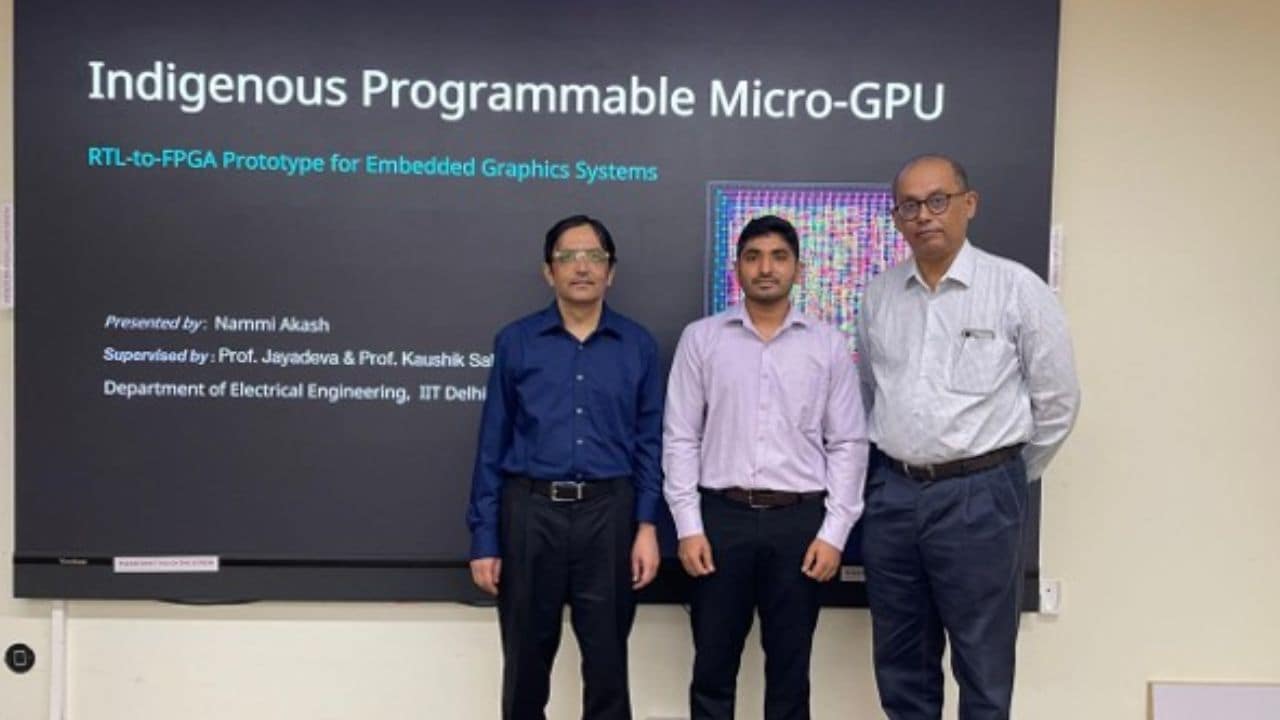
- Researchers at IIT Delhi’s Department of Electrical Engineering have developed India’s first working and demonstrable indigenously designed micro-Graphics Processing Unit (micro-GPU).
- The project was led by M.Tech students Nammi Akash and M. Ravi Teja, under the guidance of Prof. Jayadeva and Prof. Kaushik Saha.
- The processor demonstrates programmable graphics rendering and is aimed primarily at low-cost embedded graphics and display-processing systems.
- The development can strengthen indigenous semiconductor-design capability and reduce dependence on imported graphics-processing technology.
What is the Micro-GPU?
- A GPU (Graphics Processing Unit) is a specialised processor capable of performing many computations in parallel. Besides graphics rendering, GPUs are extensively used in Artificial Intelligence (AI) and Machine Learning (ML).
- IIT Delhi’s micro-GPU uses a custom floating-point GPU engine.
- Its hardware has been implemented entirely in Register Transfer Language (RTL).
- The design has been mapped onto a Spartan-7 Field-Programmable Gate Array (FPGA).
- It is a scalable programmable graphics-processor Intellectual Property (IP) block, which can eventually be implemented either on programmable hardware or as a dedicated silicon chip.
Potential Applications
The micro-GPU has been designed mainly for affordable embedded visualisation systems, including:
- Industrial control displays and low-cost Human-Machine Interfaces (HMIs).
- E-rickshaw dashboard navigation systems.
- Inland-water navigation terminals for small fishing boats.
- Educational e-book readers.
- Other low-cost graphics and display-processing devices.
Future Roadmap
- IIT Delhi researchers plan to develop an 8–16 core vector-style graphics processor architecture.
- The proposed system will be accompanied by an optimised compiler and graphics software toolchain.
- The team plans a proof-of-concept implementation using a 65-nanometre ASIC process node.
- Researchers consider mature nodes such as 65 nm potentially cost-effective for indigenous embedded graphics chips.
- Funding is proposed to be sought for ASIC development, system integration and eventual commercialisation.
Technologies
- FPGA (Field-Programmable Gate Array):
- An integrated circuit whose digital logic can be reconfigured after manufacturing.
- Commonly used to prototype processor architectures before producing dedicated silicon.
- ASIC (Application-Specific Integrated Circuit):
- A chip manufactured for a specific application.
- Unlike an FPGA, its hardware configuration is generally fixed after fabrication.
- RTL (Register Transfer Language/Level):
- A hardware-design representation describing how digital signals and data move between registers and logical components.
- 65 nm Process Node:
- A mature semiconductor fabrication technology.
- Mature nodes can offer lower development and fabrication costs for applications that do not require cutting-edge transistor densities.
Related Indian Semiconductor Initiative
- India Semiconductor Mission (ISM) functions as the nodal initiative for developing India’s semiconductor and display ecosystem.
- The Semicon India Programme was approved with an outlay of ₹76,000 crore.
- Its components include support for semiconductor fabs, display fabs, compound semiconductors and packaging facilities, along with semiconductor design.
- The Design Linked Incentive (DLI) Scheme supports semiconductor designs covering Integrated Circuits (ICs), chipsets, System-on-Chips (SoCs), systems and IP cores.
- Indigenous processor IP such as the IIT Delhi micro-GPU is significant because semiconductor capability involves not only fabrication but also chip architecture, IP design, verification, software tools and system integration.
Sources
India Participates in East Asia Summit Economic Ministers’ Meeting
What’s the News?
- India participated in the 14th East Asia Summit Economic Ministers’ Meeting (EAS-EMM) and the 23rd ASEAN-India Economic Ministers Consultation in Manila, Philippines.
- The Indian delegation was led by Nitin Kumar Yadav, Additional Secretary, Department of Commerce.
- Representatives from all 11 ASEAN member states participated along with EAS partners — India, Australia, China, Japan, New Zealand, Republic of Korea, Russia and the United States.
- Major discussions covered the regional economic outlook, energy security, industrial clusters and the ongoing review of the ASEAN-India Trade in Goods Agreement (AITIGA).
East Asia Summit Economic Ministers’ Meeting
- The meeting provides a platform to discuss regional and global economic developments, trade and investment.
- The ASEAN Secretariat presented the regional and global economic outlook for 2027, including expected implications for trade and investment flows.
- The Economic Research Institute for ASEAN and East Asia (ERIA) presented a study on the next phase of EAS economic growth.
- It advocated an integrated approach linking:
- Energy security and infrastructure.
- Industrial clusters.
- Digital and industrial demand.
- Trade and investment policies.
ASEAN-India Economic Ministers Consultation
- Discussions primarily focused on strengthening India-ASEAN trade relations and reviewing AITIGA.
- India emphasised that the revised agreement should be:
- More balanced and mutually beneficial.
- Easier for businesses to use.
- More effective in facilitating trade.
- Capable of addressing existing trade asymmetries.
- India-ASEAN bilateral trade reached USD 128.38 billion in 2025–26.
- ASEAN accounted for 10.55% of India's total global trade during the period.
ASEAN-India Trade in Goods Agreement (AITIGA)
- AITIGA governs merchandise trade between India and ASEAN.
- It was signed in 2009 and entered into force in 2010.
- It provides for tariff liberalisation and improved market access for goods traded between the two sides.
- The ongoing review seeks to modernise the agreement and address concerns regarding its utilisation and trade imbalance.
Additional Info
- East Asia Summit (EAS):
- A leaders-led Indo-Pacific forum, established in 2005.
- India is a founding participant.
- It deals with strategic, political and economic issues affecting the wider region.
- ASEAN:
- Association of Southeast Asian Nations.
- Founded in 1967 through the Bangkok Declaration.
- Timor-Leste became its 11th member after its formal admission in 2025.
- Members: Brunei, Cambodia, Indonesia, Laos, Malaysia, Myanmar, Philippines, Singapore, Thailand, Timor-Leste and Vietnam.
- India-ASEAN Relations:
- India became a Sectoral Dialogue Partner in 1992 and a full Dialogue Partner in 1995.
- ASEAN-India relations were elevated to the Summit level in 2002 and to a Strategic Partnership in 2012.
- The relationship was upgraded to a Comprehensive Strategic Partnership in 2022.
- ERIA:
- Economic Research Institute for ASEAN and East Asia.
- A regional research organisation supporting economic integration and policy research in East Asia.
Sources
India Rises to 31st in WEF Travel & Tourism Development Index 2026

What’s the News?
- India ranked 31st among 110 economies in the World Economic Forum’s Travel & Tourism Development Index (TTDI) 2026, improving by nine positions from its recalculated 2024 ranking.
- Japan topped the index, followed by the United States, Spain, Australia and France.
- India’s improvement was supported by stronger tourism infrastructure, cultural resources and non-leisure/business travel resources.
- India also benefits from strong price competitiveness, natural assets and cultural heritage, although gaps remain in tourism services, workforce capabilities and environmental sustainability.
Travel & Tourism Development Index
- Published by the World Economic Forum (WEF).
- Developed as a benchmarking tool to assess the factors and policies enabling sustainable and resilient development of the travel and tourism sector.
- It does not directly measure tourist arrivals, tourism receipts or revenues.
- The 2026 edition covers 110 economies.
- It consists of:
- 5 dimensions
- 17 pillars
- 102 indicators
- Indicator values are normalised on a 1–7 scale, where a higher score indicates better enabling conditions.
Five Dimensions
- Enabling Environment
- Business Environment
- Safety and Security
- Health and Hygiene
- Human Resources and Labour Market
- ICT Readiness
- Travel & Tourism Policy and Enabling Conditions
- Prioritisation of Travel & Tourism
- Openness to Travel & Tourism
- Price Competitiveness
- Infrastructure and Services
- Air Transport Infrastructure
- Ground and Port Infrastructure
- Tourist Services and Infrastructure
- Travel & Tourism Resources
- Natural Resources
- Cultural Resources
- Non-Leisure Resources
- Travel & Tourism Sustainability
- Environmental Sustainability
- Travel & Tourism Socioeconomic Impact
- Travel & Tourism Demand Sustainability.
India’s Strengths and Challenges
- Strengths
- Competitive travel costs.
- Rich natural and cultural resources.
- Improving air and tourism infrastructure.
- Growing business and non-leisure travel ecosystem.
- India is among the top 10 economies in the number of UNESCO World Heritage cultural sites.
- Areas requiring improvement
- Tourist services and supporting infrastructure.
- Workforce skills and human-resource capacity.
- Business-enabling conditions.
- Environmental sustainability.
Global Findings
- Top 5: Japan, United States, Spain, Australia and France.
- 101 of 110 economies (92%) improved their TTDI scores compared with 2024.
- Asia-Pacific recorded the strongest regional improvement, with its average score increasing by 3.6%.
- The 10 major emerging tourism economies, including India, China, Indonesia, Malaysia, Thailand and Brazil, collectively account for over 28% of global direct travel and tourism GDP; their share is projected to reach 35% by 2035.
Additional Info
- The 2026 methodology incorporates data revisions and adjustments. The WEF therefore recalculated the 2019, 2021 and 2024 figures to ensure comparability with 2026.
- Consequently, comparisons with rankings published in earlier editions should use the recalculated historical figures provided in the 2026 report, rather than the originally published rankings.
Sources
Make in India Completes 12 Years: Sectoral Gains but Structural Challenges Persist

What’s the News?
- Make in India has completed 12 years since its launch in 2014 with substantial expansion in sectors such as electronics, mobile phones, steel, defence, pharmaceuticals and renewable-energy equipment.
- Make in India 2.0 now covers 27 sectors — 15 manufacturing and 12 services sectors.
- Recent manufacturing indicators have strengthened, but broader metrics show a mixed picture: manufacturing’s share in national output and India’s share in global merchandise exports have not increased proportionately to the growth seen in some individual industries.
Make in India
- Launched: 2014.
- Nodal Ministry: Ministry of Commerce and Industry.
- Objectives:
- Make India a global hub for manufacturing, design and innovation.
- Facilitate domestic and foreign investment.
- Promote innovation and technological capability.
- Develop modern industrial infrastructure.
- Improve the business and regulatory environment.
- The programme has subsequently been complemented by initiatives such as Production Linked Incentive (PLI) schemes, PM GatiShakti, National Single Window System (NSWS) and India Industrial Land Bank.
Manufacturing Performance
- Manufacturing GVA at constant prices recorded a 10.88% CAGR during 2022-23 to 2025-26 under the revised national accounts series.
- Manufacturing output under the Index of Industrial Production (IIP) grew 7% during April-July 2026 year-on-year.
- However, manufacturing's share in GVA increased only from about 14.6% in 2022-23 to 15.6% in 2025-26.
- India’s share in global merchandise exports remained around 1.7%, broadly similar to its level in 2013.
Major Sectoral Achievements
- Electronics
- Production increased from about ₹1.9 lakh crore in 2014-15 to ₹13.11 lakh crore in 2025-26.
- Mobile-phone production increased from around ₹18,900 crore to ₹6.3 lakh crore.
- India is the world’s second-largest mobile-phone manufacturer by volume.
- Steel
- Crude-steel production increased from 81.7 million tonnes to 170 million tonnes between 2014-15 and 2025-26.
- Defence
- Indigenous defence production increased from ₹46,429 crore to ₹1.78 lakh crore over the same period.
- Solar Manufacturing
- Solar-module manufacturing capacity increased from 2.3 GW in 2014 to 192 GW by June 2026.
- Solar-cell capacity increased from 1.2 GW to around 30 GW.
- Pharmaceuticals
- India ranks 3rd globally by pharmaceutical production volume and 11th by value.
- Industry turnover reached about ₹5.09 lakh crore in 2025-26.
Production Linked Incentive Scheme
- PLI schemes cover 14 sectors, including electronics, pharmaceuticals, automobiles, solar PV modules, speciality steel and textiles.
- Latest official figures show:
- Investment: about ₹2.6 lakh crore.
- Production and sales: about ₹23.8 lakh crore.
- Exports: over ₹15.5 lakh crore.
- Employment: about 14.6 lakh jobs.
- Investment has nevertheless been concentrated in a limited number of sectors, particularly electronics, automobiles, pharmaceuticals, solar modules and speciality steel.
Investment and Business Facilitation
- Cumulative FDI inflows during 2014-15 to 2025-26 reached about USD 843 billion, around 169% higher than during the preceding 12-year period.
- National Single Window System (NSWS) provides a unified digital platform for identifying and obtaining business approvals.
- India Industrial Land Bank (IILB) is a GIS-enabled database of industrial land; it mapped 4,220 industrial parks covering about 6.98 lakh hectares by May 2026.
- PM GatiShakti National Master Plan integrates geospatial and infrastructure data to improve multimodal infrastructure planning.
New Manufacturing Initiatives
- Semicon 2.0
- Allocation: ₹1,27,500 crore.
- Covers semiconductor design, fabrication, advanced packaging, materials, equipment, R&D and talent.
- Bharat Audyogik Vikas Yojana (BHAVYA)
- Allocation: ₹33,660 crore.
- Aims to develop 100 investment-ready industrial parks.
- Mobile Phone Manufacturing Scheme
- Allocation: ₹62,500 crore.
- Focuses on higher production, domestic value addition and supply-chain resilience.
- Rare-Earth Permanent Magnet Scheme
- Allocation: ₹7,280 crore.
- Targets 6,000 metric tonnes per annum of integrated sintered NdFeB magnet manufacturing capacity.
Challenges
- Sector-specific production gains have not yet produced a comparable rise in manufacturing’s overall share of the economy.
- Private investment and manufacturing FDI performance have remained uneven.
- India’s global merchandise-export share has remained broadly stable.
- Domestic component ecosystems and value addition remain important issues, particularly where manufacturing is concentrated in final assembly.
- Manufacturing employment growth has also been weaker than the scale initially envisaged for the programme.
Additional Info
- GVA (Gross Value Added):
- Measures the value of goods and services produced after subtracting intermediate consumption.
- GDP = GVA + product taxes − product subsidies.
- PLI Scheme:
- Provides incentives linked to incremental production or sales, rather than merely providing subsidies for establishing a manufacturing unit.
- Intended to improve scale, domestic value addition, exports and integration into global value chains.
- Make in India 2.0:
- Covers 27 priority sectors.
- Implementation is distributed across concerned Union ministries/departments and State governments.
Sources
MoD Signs ₹811 Crore Contract for 160 SAT-SAAW Glide Bombs for IAF

What’s the News?
- The Ministry of Defence (MoD) has signed a ₹810.79 crore contract with Bharat Dynamics Limited (BDL) for procurement of 160 Satellite Smart Anti-Airfield Weapons (SAT-SAAW) and associated equipment for the Indian Air Force (IAF).
- The procurement is under the Buy (Indian–Indigenously Designed, Developed and Manufactured/IDDM) category.
- The weapon has been indigenously designed and developed by DRDO and will contain about 60% indigenous content.
- Deliveries are scheduled across FY 2027-28 and FY 2028-29.
What is SAT-SAAW?
- SAT-SAAW (Satellite Smart Anti-Airfield Weapon) is an air-to-ground precision-guided glide bomb intended primarily for attacking airfield infrastructure from a stand-off distance.
- It can be launched from aircraft such as:
- Su-30MKI
- Jaguar
- Hawk
- Potential targets include runways, taxi tracks, bunkers, radars and other ground installations.
- Its stand-off capability enables the launch aircraft to release the weapon without having to fly directly over the target area.
Specifications
- Weight: about 125 kg
- Length: about 1.85 metres
- Range: approximately 90–100 km, depending on release conditions.
- Accuracy:
- Less than 7 metres with inertial/satellite navigation.
- The broader SAAW family can achieve less than 3 metres accuracy in a seeker-equipped configuration.
- As a glide weapon, it uses aerodynamic lift after release rather than functioning as a conventional powered cruise missile.
Indigenous Content
The contracted system will have 60% indigenous content, with localisation of important subsystems including:
- Inertial Measurement Unit (IMU) – provides motion and navigation information.
- Long Impact Delay Fuse – allows detonation after penetration of the target structure.
- Twin Store Carrier – enables carriage of multiple weapons on an aircraft station.
Development of SAAW
- SAAW was developed by DRDO's Research Centre Imarat (RCI), Hyderabad, in coordination with other DRDO laboratories and with support from the IAF.
- An early successful flight test was conducted in 2016.
- Subsequent trials demonstrated launches from aircraft such as the Jaguar and Hawk.
- DRDO also successfully tested both satellite-navigation and electro-optical seeker configurations.
- The electro-optical version incorporated an indigenous Imaging Infra-Red (IIR) seeker for enhanced precision.
Additional Info
- Bharat Dynamics Limited (BDL):
- A Defence Public Sector Undertaking under the Ministry of Defence.
- Manufactures missile and guided-weapon systems.
- Listed by the Department of Defence Production as the manufacturer of SAAW.
- Research Centre Imarat (RCI):
- A major DRDO laboratory located in Hyderabad.
- Works on avionics, navigation, control and related technologies for missile and guided-weapon systems.
- Buy (Indian-IDDM):
- Refers to Indian–Indigenously Designed, Developed and Manufactured equipment.
- It gives emphasis to domestically designed and manufactured defence systems and higher indigenous content.
- Stand-off Weapon:
- A weapon capable of being released from a significant distance from its target, allowing the launch platform to remain farther from the target's immediate defensive zone.
Sources
India Set to Launch Its First Blue Bond

What’s the News?
- Sagarmala Finance Corporation Limited (SMFCL), India’s first maritime-focused lender, is set to raise funds through the country’s maiden blue bond.
- Under the latest provisional terms, SMFCL aims to raise ₹600 crore, comprising a ₹100 crore base issue and a ₹500 crore greenshoe option, through 10-year bonds.
- The proceeds will finance maritime-sector lending, greenfield port projects, coastal road networks and related infrastructure.
- SBI Capital Markets is the arranger, while the issue has received an AA+ rating from ICRA and CARE.
- Earlier reports referred to an issue of up to ₹1,000 crore; the ₹600-crore figure reflects the latest provisional term sheet for the forthcoming issuance.
What are Blue Bonds?
- Blue bonds are debt instruments whose proceeds are earmarked for projects supporting the sustainable use and conservation of oceans, seas and water resources.
- Like conventional bonds, they involve:
- Payment of interest to investors.
- Repayment of principal at maturity.
- Unlike ordinary bonds, the funds must be directed towards specified water- and marine-related activities.
Eligible Activities
Blue finance can support:
- Sustainable shipping and port infrastructure.
- Clean water and wastewater management.
- Water recycling.
- Sustainable fisheries.
- Marine and coastal ecosystem conservation.
- Ocean-based renewable energy.
- Ocean mapping and research.
- Cleaner coastal and maritime infrastructure.
Sagarmala Finance Corporation Limited
- SMFCL is a Miniratna Category-I Central Public Sector Enterprise under the Ministry of Ports, Shipping and Waterways.
- It was formerly known as Sagarmala Development Company Limited (SDCL).
- It became India's first NBFC dedicated exclusively to the maritime sector after receiving RBI registration in 2025.
- Its mandate includes financing:
- Ports and port connectivity.
- Shipping and shipbuilding.
- Inland waterways.
- Coastal infrastructure.
- Maritime MSMEs and related activities.
Why a Blue Bond?
- Maritime infrastructure projects generally require large amounts of long-term capital.
- Blue bonds can attract institutional investors such as insurance companies, provident/pension funds and sustainability-focused investors.
- Longer-tenure bonds can also help reduce asset-liability mismatch, where a lender finances long-duration infrastructure projects using comparatively short-duration borrowings.
- They provide an additional capital-market financing channel beyond bank loans, government budgetary support and conventional bonds.
Blue Bonds in India’s Regulatory Framework
- SEBI expanded its sustainable-finance framework to recognise blue bonds for water-management and marine-sector activities.
- Blue bonds are treated as a specialised category within the broader green debt securities framework.
- Issuers of such securities are subject to requirements relating to:
- Identification of eligible projects.
- Use and tracking of proceeds.
- Sustainability objectives.
- Periodic disclosures and impact reporting.
Blue Bond vs Green Bond
| Feature | Blue Bond | Green Bond |
|---|---|---|
| Primary focus | Oceans, marine and water resources | Wider environmental and climate projects |
| Examples | Sustainable fisheries, water management, clean ports | Renewable energy, green buildings, clean transport |
| Scope | Relatively narrow | Broader |
| Risk | Bluewashing | Greenwashing |
Additional Info
- Greenshoe Option:
- Allows an issuer to retain subscriptions above the original/base issue size up to a predetermined limit.
- In the proposed SMFCL issue, the latest terms indicate a ₹500 crore greenshoe option.
- Bluewashing:
- Refers to presenting an investment or project as environmentally beneficial to oceans or water resources without adequate evidence or measurable impact.
- Clear use-of-proceeds rules and impact reporting help reduce this risk.
- World’s First Sovereign Blue Bond:
- Seychelles issued the world's first sovereign blue bond in 2018.
- It raised USD 15 million to support sustainable marine and fisheries projects.
- Blue Economy:
- Refers broadly to the sustainable use of ocean and coastal resources for economic development and livelihoods while maintaining marine ecosystem health.
- Blue bonds provide a mechanism for linking the blue economy with capital markets.
Sources
World Lung Day 2026: “A Lifetime of Lung Health”
What’s the News?
- World Lung Day is observed annually on 25 September to raise awareness about lung health and the prevention and treatment of respiratory diseases.
- The 2026 theme is “A Lifetime of Lung Health.”
- The campaign stresses protection of respiratory health across the entire life course — from early lung development and childhood growth to adulthood and healthy ageing.
- It is coordinated by the Forum of International Respiratory Societies (FIRS).
Theme 2026: A Lifetime of Lung Health
The theme follows a life-course approach, recognising that lung health is influenced by exposures and interventions throughout life.
Its four major focus areas are:
- Supporting healthy lung development – particularly before birth and during early childhood.
- Supporting healthy lung growth – enabling children and adolescents to reach their optimal respiratory capacity.
- Maintaining healthy lungs – through prevention, early diagnosis and healthier environments.
- Supporting healthy lungs throughout life – including healthy respiratory ageing.
Threats to Lung Health
Important determinants of respiratory health include:
- Tobacco and nicotine exposure, including second-hand smoke.
- Outdoor and household air pollution.
- Respiratory infections.
- Occupational exposure to dust, fumes and hazardous substances.
- Poor access to diagnosis, medicines and healthcare.
- Environmental and climatic conditions.
Major respiratory diseases include asthma, Chronic Obstructive Pulmonary Disease (COPD), tuberculosis, pneumonia and lung cancer.
World Lung Day
- The idea emerged through the Forum of International Respiratory Societies (FIRS).
- The first World Lung Day was observed on 25 September 2017.
- It was conceived following discussions at the 2016 FIRS Assembly Meeting in Kyoto, Japan, amid concern over the growing global burden of respiratory diseases.
- The observance promotes:
- Prevention of respiratory disease.
- Early diagnosis and treatment.
- Clean air.
- Tobacco control.
- Vaccination.
- Physical activity.
- Equitable access to respiratory medicines and healthcare.
Forum of International Respiratory Societies
- FIRS is an international coalition of major professional respiratory societies.
- It brings together nine leading respiratory organisations, representing around 100,000 respiratory health professionals worldwide.
- Members include organisations such as:
- American Thoracic Society (ATS).
- European Respiratory Society (ERS).
- Asian Pacific Society of Respirology (APSR).
- American College of Chest Physicians (CHEST).
- International Union Against Tuberculosis and Lung Disease.
- Global Initiative for Asthma (GINA).
- Global Initiative for Chronic Obstructive Lung Disease (GOLD).
India Context
- National Tuberculosis Elimination Programme (NTEP):
- Implements India's public-health response to tuberculosis through prevention, screening, diagnosis and treatment.
- National Tobacco Control Programme (NTCP):
- Focuses on tobacco-control awareness, enforcement and implementation of measures under the Cigarettes and Other Tobacco Products Act (COTPA), 2003.
- National Clean Air Programme (NCAP):
- Implemented by the Ministry of Environment, Forest and Climate Change to improve air quality in cities with persistent air-pollution problems.
- Air pollution is an important environmental risk factor for chronic respiratory disease.
- Healthy Lungs for Life:
- A global lung-health awareness campaign associated with FIRS and the European Lung Foundation.
- Promotes clean air, physical activity, smoking cessation, vaccination, healthy nutrition and climate action.
Sources
September 2026
30 September 202629 September 202628 September 202626 September 202625 September 202624 September 202623 September 202622 September 202621 September 202619 September 202618 September 202617 September 202616 September 202615 September 202612 September 202611 September 202610 September 202609 September 202608 September 202607 September 202605 September 202604 September 202603 September 202602 September 202601 September 2026
Archive
October 2026
- 27 October 2026
- 26 October 2026
- 24 October 2026
- 23 October 2026
- 22 October 2026
- 21 October 2026
- 20 October 2026
- 19 October 2026
- 17 October 2026
- 16 October 2026
- 15 October 2026
- 14 October 2026
- 13 October 2026
- 12 October 2026
- 10 October 2026
- 09 October 2026
- 08 October 2026
- 07 October 2026
- 06 October 2026
- 05 October 2026
- 03 October 2026
- 02 October 2026
- 01 October 2026
September 2026
- 30 September 2026
- 29 September 2026
- 28 September 2026
- 26 September 2026
- 25 September 2026
- 24 September 2026
- 23 September 2026
- 22 September 2026
- 21 September 2026
- 19 September 2026
- 18 September 2026
- 17 September 2026
- 16 September 2026
- 15 September 2026
- 12 September 2026
- 11 September 2026
- 10 September 2026
- 09 September 2026
- 08 September 2026
- 07 September 2026
- 05 September 2026
- 04 September 2026
- 03 September 2026
- 02 September 2026
- 01 September 2026
August 2026
- 31 August 2026
- 29 August 2026
- 27 August 2026
- 26 August 2026
- 25 August 2026
- 24 August 2026
- 22 August 2026
- 21 August 2026
- 20 August 2026
- 19 August 2026
- 18 August 2026
- 17 August 2026
- 14 August 2026
- 13 August 2026
- 12 August 2026
- 11 August 2026
- 10 August 2026
- 08 August 2026
- 07 August 2026
- 06 August 2026
- 05 August 2026
- 04 August 2026
- 03 August 2026
- 01 August 2026
July 2026
- 31 July 2026
- 30 July 2026
- 29 July 2026
- 28 July 2026
- 27 July 2026
- 25 July 2026
- 23 July 2026
- 22 July 2026
- 21 July 2026
- 20 July 2026
- 18 July 2026
- 17 July 2026
- 15 July 2026
- 14 July 2026
- 13 July 2026
- 11 July 2026
- 10 July 2026
- 09 July 2026
- 08 July 2026
- 07 July 2026
- 06 July 2026
- 04 July 2026
- 03 July 2026
- 02 July 2026
- 01 July 2026
June 2026
May 2026
April 2026
March 2026
- 31 March 2026
- 30 March 2026
- 28 March 2026
- 27 March 2026
- 26 March 2026
- 25 March 2026
- 24 March 2026
- 23 March 2026
- 21 March 2026
- 20 March 2026
- 19 March 2026
- 18 March 2026
- 17 March 2026
- 16 March 2026
- 14 March 2026
- 13 March 2026
- 12 March 2026
- 11 March 2026
- 10 March 2026
- 09 March 2026
- 07 March 2026
- 06 March 2026
- 05 March 2026
- 03 March 2026
- 02 March 2026
February 2026
- 28 February 2026
- 27 February 2026
- 26 February 2026
- 25 February 2026
- 24 February 2026
- 23 February 2026
- 21 February 2026
- 20 February 2026
- 19 February 2026
- 18 February 2026
- 17 February 2026
- 16 February 2026
- 13 February 2026
- 12 February 2026
- 11 February 2026
- 10 February 2026
- 09 February 2026
- 07 February 2026
- 06 February 2026
- 05 February 2026
- 04 February 2026
- 03 February 2026
- 02 February 2026
January 2026
- 31 January 2026
- 30 January 2026
- 29 January 2026
- 28 January 2026
- 27 January 2026
- 26 January 2026
- 24 January 2026
- 23 January 2026
- 22 January 2026
- 21 January 2026
- 20 January 2026
- 19 January 2026
- 16 January 2026
- 15 January 2026
- 14 January 2026
- 13 January 2026
- 12 January 2026
- 10 January 2026
- 09 January 2026
- 08 January 2026
- 07 January 2026
- 06 January 2026
- 05 January 2026
- 03 January 2026
- 02 January 2026
- 01 January 2026
December 2025
- 31 December 2025
- 30 December 2025
- 29 December 2025
- 27 December 2025
- 26 December 2025
- 24 December 2025
- 23 December 2025
- 22 December 2025
- 20 December 2025
- 19 December 2025
- 18 December 2025
- 17 December 2025
- 16 December 2025
- 15 December 2025
- 13 December 2025
- 12 December 2025
- 11 December 2025
- 10 December 2025
- 09 December 2025
- 08 December 2025
- 05 December 2025
- 04 December 2025
- 03 December 2025
- 02 December 2025
November 2025
- 29 November 2025
- 28 November 2025
- 27 November 2025
- 26 November 2025
- 25 November 2025
- 24 November 2025
- 22 November 2025
- 21 November 2025
- 20 November 2025
- 19 November 2025
- 18 November 2025
- 17 November 2025
- 15 November 2025
- 14 November 2025
- 13 November 2025
- 12 November 2025
- 11 November 2025
- 10 November 2025
- 08 November 2025
- 07 November 2025
- 06 November 2025
- 05 November 2025
- 04 November 2025
- 03 November 2025
- 01 November 2025
October 2025
- 31 October 2025
- 30 October 2025
- 29 October 2025
- 28 October 2025
- 27 October 2025
- 25 October 2025
- 24 October 2025
- 23 October 2025
- 22 October 2025
- 21 October 2025
- 20 October 2025
- 18 October 2025
- 17 October 2025
- 16 October 2025
- 15 October 2025
- 14 October 2025
- 13 October 2025
- 11 October 2025
- 10 October 2025
- 09 October 2025
- 08 October 2025
- 07 October 2025
- 06 October 2025
- 04 October 2025
- 03 October 2025
- 02 October 2025
- 01 October 2025
September 2025
- 30 September 2025
- 29 September 2025
- 27 September 2025
- 26 September 2025
- 25 September 2025
- 24 September 2025
- 23 September 2025
- 22 September 2025
- 20 September 2025
- 19 September 2025
- 18 September 2025
- 17 September 2025
- 16 September 2025
- 15 September 2025
- 13 September 2025
- 12 September 2025
- 11 September 2025
- 10 September 2025
- 09 September 2025
- 08 September 2025
- 06 September 2025
- 05 September 2025
- 04 September 2025
- 03 September 2025
- 02 September 2025
- 01 September 2025
August 2025
- 30 August 2025
- 29 August 2025
- 28 August 2025
- 27 August 2025
- 26 August 2025
- 25 August 2025
- 23 August 2025
- 22 August 2025
- 21 August 2025
- 20 August 2025
- 19 August 2025
- 18 August 2025
- 16 August 2025
- 14 August 2025
- 13 August 2025
- 12 August 2025
- 11 August 2025
- 08 August 2025
- 07 August 2025
- 06 August 2025
- 05 August 2025
- 04 August 2025
- 02 August 2025
- 01 August 2025
July 2025
- 31 July 2025
- 30 July 2025
- 29 July 2025
- 28 July 2025
- 26 July 2025
- 25 July 2025
- 24 July 2025
- 23 July 2025
- 22 July 2025
- 21 July 2025
- 19 July 2025
- 18 July 2025
- 17 July 2025
- 16 July 2025
- 15 July 2025
- 12 July 2025
- 11 July 2025
- 10 July 2025
- 09 July 2025
- 07 July 2025
- 05 July 2025
- 04 July 2025
- 03 July 2025
- 02 July 2025
- 01 July 2025
June 2025
- 30 June 2025
- 28 June 2025
- 27 June 2025
- 26 June 2025
- 25 June 2025
- 24 June 2025
- 23 June 2025
- 21 June 2025
- 20 June 2025
- 19 June 2025
- 18 June 2025
- 17 June 2025
- 16 June 2025
- 14 June 2025
- 13 June 2025
- 12 June 2025
- 11 June 2025
- 10 June 2025
- 09 June 2025
- 07 June 2025
- 06 June 2025
- 05 June 2025
- 04 June 2025
- 03 June 2025
- 02 June 2025
May 2025
April 2025
- 30 April 2025
- 29 April 2025
- 28 April 2025
- 26 April 2025
- 25 April 2025
- 24 April 2025
- 23 April 2025
- 22 April 2025
- 21 April 2025
- 19 April 2025
- 18 April 2025
- 17 April 2025
- 16 April 2025
- 15 April 2025
- 14 April 2025
- 12 April 2025
- 11 April 2025
- 10 April 2025
- 09 April 2025
- 08 April 2025
- 07 April 2025
- 05 April 2025
- 04 April 2025
- 03 April 2025
- 02 April 2025
- 01 April 2025
March 2025
- 31 March 2025
- 29 March 2025
- 28 March 2025
- 27 March 2025
- 26 March 2025
- 25 March 2025
- 24 March 2025
- 22 March 2025
- 21 March 2025
- 20 March 2025
- 19 March 2025
- 18 March 2025
- 17 March 2025
- 15 March 2025
- 13 March 2025
- 12 March 2025
- 11 March 2025
- 10 March 2025
- 08 March 2025
- 07 March 2025
- 06 March 2025
- 05 March 2025
- 04 March 2025
- 03 March 2025
- 01 March 2025
February 2025
- 28 February 2025
- 27 February 2025
- 26 February 2025
- 25 February 2025
- 24 February 2025
- 22 February 2025
- 21 February 2025
- 20 February 2025
- 19 February 2025
- 18 February 2025
- 17 February 2025
- 15 February 2025
- 14 February 2025
- 13 February 2025
- 12 February 2025
- 11 February 2025
- 10 February 2025
- 08 February 2025
- 07 February 2025
- 06 February 2025
- 05 February 2025
- 04 February 2025
- 03 February 2025
- 01 February 2025
January 2025
- 31 January 2025
- 30 January 2025
- 29 January 2025
- 28 January 2025
- 27 January 2025
- 25 January 2025
- 24 January 2025
- 23 January 2025
- 22 January 2025
- 21 January 2025
- 20 January 2025
- 18 January 2025
- 17 January 2025
- 16 January 2025
- 15 January 2025
- 14 January 2025
- 13 January 2025
- 11 January 2025
- 10 January 2025
- 09 January 2025
- 08 January 2025
- 07 January 2025
- 06 January 2025
- 04 January 2025
- 03 January 2025
- 02 January 2025
- 01 January 2025