
Current Affairs
Stay updated with the latest national and international events.
25 November 2025
BEL and Safran Partner to Manufacture HAMMER Precision Weapon System in India

What’s the News?
- Bharat Electronics Limited (BEL) has signed a Memorandum of Understanding (MoU) with France’s Safran Electronics & Defense to manufacture and integrate the HAMMER advanced weapon system in India.
- The agreement aims to indigenize the production of this precision-guided munition under the Make in India initiative, strengthening the operational capabilities of the Indian Air Force.
What is the HAMMER System?
- Definition: HAMMER stands for Highly Agile Modular Munition Extended Range. It is a rocket-boosted air-to-ground precision-guided weapon capable of striking targets from a significant distance.
- Modular Design: It consists of a guidance kit and a range extension kit fitted onto standard aerial bombs, converting gravity bombs into precision weapons.
- Key Features:
- Fire-and-Forget: Once launched, the weapon navigates autonomously to the target.
- Range: It can engage targets at ranges between 20 km to 70 km, allowing aircraft to launch attacks from a stand-off distance (outside the range of enemy air defences).
- All-Weather Capability: Operates effectively in diverse terrain and weather conditions using GPS, Infra-Red, or Laser guidance.
- Platform Compatibility: While already deployed on Rafale fighter jets, it is now being integrated into the indigenous Tejas Light Combat Aircraft (LCA).
Joint Venture & Indigenisation Plan
- Structure: Private limited company with 50:50 equity between BEL and SED.
- Indigenisation target: Up to 60% local content over time, covering:
- Key sub-assemblies
- Electronics and mechanical components
- BEL’s role: Final assembly, integration, testing, and quality assurance
- Phased transfer: Technology and production know-how to be transferred incrementally
Additional Info
- Bharat Electronics Limited (BEL):
- A Navratna Public Sector Undertaking (PSU) under the Ministry of Defence.
- It is a premier electronics company catering to the defence needs of the Indian Armed Forces.
- Safran Electronics & Defense:
- A leading global French company specializing in optronics, avionics, electronics, and critical software for civil and defence applications.
- LCA Tejas:
- A 4.5 generation, single-engine, multi-role light fighter aircraft.
- Designed by the Aeronautical Development Agency (ADA) and manufactured by Hindustan Aeronautics Limited (HAL).
- Stand-off Weapon: A missile or bomb launched from a distance sufficient to allow the attacking personnel to evade defensive fire from the target area.
Sources
Ethiopia’s Hayli Gubbi Volcano Erupts After 12,000 Years: Ash Plume Disrupts Flights in India

What’s the News?
- Hayli Gubbi, a dormant volcano in Ethiopia, erupted on November 23, 2025, for the first time in over 12,000 years, releasing a massive ash plume that drifted across the Red Sea and Arabian Peninsula.
- The high-altitude ash cloud entered Indian airspace (over Gujarat, Rajasthan, and Delhi), prompting the Directorate General of Civil Aviation (DGCA) to issue urgent safety advisories and forcing airlines to cancel or divert flights.
About Hayli Gubbi Volcano
- Type: Shield volcano, formed by low-viscosity basaltic lava flows
- Location:
- Afar Depression, Ethiopia
- Southern end of the Erta Ale volcanic range
- Part of the East African Rift System (EARS)
- Geotectonic setting:
- Lies at the divergent boundary between the Nubian and Somali plates
- Influenced by the Afar mantle plume, causing crustal thinning and magma upwelling
- Eruption style: Sub-plinian, with vertical ash column and widespread dispersal
Composition & Atmospheric Transport
- Plume components:
- Volcanic ash (silicate particles, rock fragments)
- Glass shards (engine hazard for aircraft)
- Sulphur dioxide (SO₂)
- Fine aerosols
- Transport mechanism:
- Carried by upper-level westerly winds/jet streams
- Remained primarily in 15,000–45,000 ft altitude band
- Minimal mixing with lower troposphere → limited ground-level impact in India
Impact on India
- Aviation:
- IndiGo, SpiceJet, Air India, and Akasa Air reported diversions/cancellations
- DGCA advisory issued:
- Avoid ash-affected routes/flight levels
- Inspect runways/taxiways
- Report engine anomalies immediately
- Environmental & Health:
- Skies reported hazy/darker in parts of western India
- No significant AQI deterioration expected at surface level
- Potential for regional acid rain (limited SO₂ concentration over India)
- Minor reduction in solar radiation & visibility
Sources
PM Modi Calls for Urgent UNSC Reforms and United Stand Against Terror at IBSA Summit

What’s the News?
- Prime Minister Narendra Modi addressed the 6th India-Brazil-South Africa (IBSA) Summit held in Johannesburg, South Africa, on the sidelines of the G20 Summit.
- PM Modi asserted that reforming the United Nations Security Council (UNSC) is "no longer an option, but a necessity" to reflect contemporary global realities.
- The meeting was attended by Brazilian President Luiz Inacio Lula da Silva and South African President Cyril Ramaphosa, marking a gathering of three major democracies from three different continents.
Key Proposals & Declarations
- UNSC Reform:
- Modi stressed that contemporary geopolitical realities are not reflected in the current UNSC structure.
- Emphasised need for expanded permanent membership, including representation for the Global South.
- Counter-Terrorism Unity:
- Urged zero tolerance for double standards in counter-terrorism actions.
- Proposed formalising NSA-level IBSA meetings to institutionalise security cooperation.
- IBSA Digital Innovation Alliance:
- Aims to share digital public infrastructure (DPI) across:
- Unified Payments Interface (UPI)
- CoWIN-like health platforms
- Cybersecurity frameworks
- Women-led tech initiatives
- Aims to share digital public infrastructure (DPI) across:
- IBSA Fund for Climate-Resilient Agriculture:
- New vertical under the existing IBSA Fund, targeting:
- Smallholder farmer resilience
- Climate-smart practices (e.g., millets, natural farming)
- South-South knowledge transfer
- New vertical under the existing IBSA Fund, targeting:
- AI Governance:
- PM Modi invited IBSA partners to India’s 2026 AI Impact Summit.
- Advocated for safe, trustworthy, and human-centric AI norms co-developed by the Global South.
Additional Info
- About IBSA Dialogue Forum:
- Established: Formalized in June 2003 through the Brasilia Declaration.
- Members: India, Brazil, South Africa (Three large democracies and economies from three different continents).
- Objective: To promote South-South cooperation, build consensus on international issues, and advocate for the interests of developing nations.
- IBSA Fund:
- Full name: IBSA Facility for Poverty and Hunger Alleviation.
- It supports development projects in other developing countries (partner nations) in areas like health, education, and sanitation.
- PM Modi praised the fund for supporting projects in over 40 countries.
- G20 Context:
- The 2025 G20 Summit is being held in South Africa, the first time the summit is hosted on African soil.
- Troika: The current G20 Troika comprises Brazil (past), South Africa (current), and the US (future). Note: Previous troika was India-Brazil-South Africa.
Sources
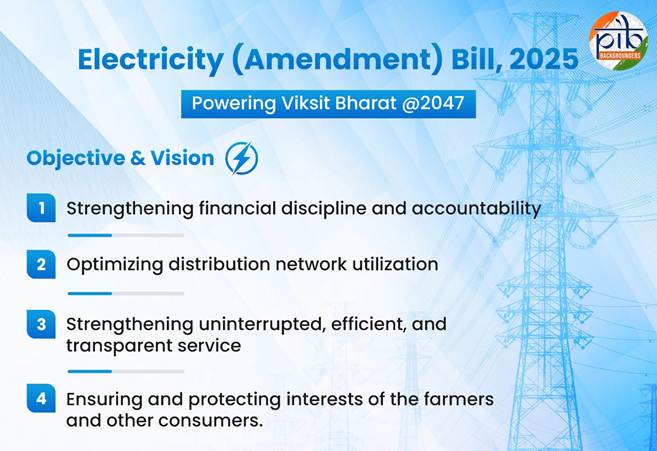
Electricity (Amendment) Bill, 2025 Introduced to Transform Power Sector
What’s the News?
- The Union Government has introduced the Electricity (Amendment) Bill, 2025, aimed at dismantling the long-standing monopoly in power distribution and enhancing financial viability in the sector.
- The Bill introduces competition by allowing multiple distribution companies (DISCOMs) to operate in the same area and enables direct power procurement for industries to boost competitiveness.
- It aligns with the vision of Viksit Bharat @2047, aiming to create a future-ready, financially sustainable, and consumer-centric electricity ecosystem.
Key Pillars of the Bill
1. Competition and Consumer Choice
- Multiple Licensees: The Bill shifts from a monopoly model to a competitive one, allowing multiple distribution licensees (public and private) to operate in the same geographical area using shared infrastructure.
- Network Access: It adopts a model similar to the Inter-State Transmission System (ISTS), where the network is shared, and users pay regulated "wheeling charges" fixed by State Commissions.
- Universal Service Obligation (USO): While USO ensures non-discriminatory supply to all, regulators can exempt licensees from this obligation for large open-access consumers (over 1 MW) to foster efficiency.
2. Tariff and Subsidy Rationalisation
- Cost-Reflective Tariffs: The Bill mandates tariffs that reflect the actual cost of supply to ensure the financial health of the sector.
- Direct Subsidies: Cross-subsidies (where industries pay more to subsidize others) for Manufacturing, Railways, and Metros are to be eliminated within 5 years. Instead, subsidies for farmers and the poor will be provided directly and transparently under Section 65 of the Act.
3. Regulatory and Structural Strengthening
- Electricity Council: A new Electricity Council will be established to facilitate Centre-State coordination and policy consensus.
- Suo Moto Powers: State Electricity Regulatory Commissions (SERCs) are empowered to determine tariffs suo moto (on their own) if utilities delay filing petitions, ensuring timely updates.
- Sustainability: The Bill defines Energy Storage Systems (ESS) and strengthens Renewable Purchase Obligations (RPO) with stricter penalties for non-compliance.
Additional Info
- Constitutional Status: Electricity is a subject in the Concurrent List (Entry 38) of the Seventh Schedule, enabling both Centre and States to legislate
- Electricity Act, 2003: The 2025 Bill amends the 2003 Act, which originally replaced three older laws (1910, 1948, 1998) to consolidate laws relating to generation, transmission, and distribution.
- Electric Line Authority: The Bill aligns the powers of the Electric Line Authority with the Telegraph Authority under the Indian Telegraph Act, 1885, to streamline compensation and dispute resolution for infrastructure works.
Sources
ITBP to Deploy 10 All-Women Border Outposts Along India-China LAC

What’s the News?
- The Indo-Tibetan Border Police (ITBP) has announced the establishment of 10 all-women Border Outposts (BOPs) along the Line of Actual Control (LAC) with China.
- This initiative is part of the force’s strategic "forwardisation" plan, aimed at enhancing border visibility and operational reach following the 2020 military standoff.
- The first two all-women posts will be operationalised in Lukung (Ladakh) and Thangi (Himachal Pradesh), with eight more to follow in other sectors.
Operational & Strategic Context
- Forwardisation Plan:
- Total forward-deployed BOPs increased from 180 to 215 as of November 2025.
- 41 additional forward bases planned in near future.
- Infrastructure Augmentation:
- 7 new ITBP battalions and 1 sector headquarters sanctioned in 2023 (~9,400 personnel added).
- Enhances supervision, logistical reach, and rapid response capability in remote sectors.
- High-Altitude Deployment:
- ITBP posts operate between 9,000–14,000 ft—exposed to sub-zero temperatures, hypoxia, and terrain challenges.
- Female personnel will undergo same rigorous acclimatisation and combat training as male counterparts.
All-Women BOPs: Significance & Design
- Pioneering Role: First dedicated female combat detachments along the entire LAC, marking a shift from support roles to frontline border guarding.
- Training & Capability Building:
- ITBP training institutes restructured with 5 new skilling modules, including:
- Mountain warfare
- Tactical survival
- Medical emergency response
- Snow & avalanche rescue
- High-altitude mobility
- ITBP training institutes restructured with 5 new skilling modules, including:
- Symbolic & Strategic Value:
- Strengthens India’s soft power narrative on gender equity in security architecture.
- Aligns with National Security Strategy (NSS) draft (2023) emphasis on “inclusive human security”.
Additional Info
- About Indo-Tibetan Border Police (ITBP):
- Established: October 24, 1962, in the wake of the Sino-Indian War.
- Mandate: Primary responsibility is to guard the 3,488 km India-China border (from Karakoram Pass in Ladakh to Jachep La in Arunachal Pradesh).
- Operational Context: Posts are located at altitudes ranging from 9,000 to 18,800 feet, where temperatures can drop to minus 45 degrees Celsius.
- Women in ITBP:
- Combat Officers: The force inducted its first two women combat officers (Assistant Commandants) in August 2021.
- Constabulary: Women have been serving in constable ranks for longer, but their deployment was traditionally limited to internal security or rear-area duties. This move marks a significant shift towards frontline combat roles.
- Related Government Initiatives:
- Vibrant Villages Programme (VVP):
- A Centrally Sponsored Scheme to develop 2,967 villages in 46 border blocks across 19 districts aimed at reversing out-migration and enhancing border security.
- The ITBP plays a key role in this by providing security and aiding in community development, often acting as the first responders in these remote areas.
- Vibrant Villages Programme (VVP):
Sources
International Day for the Elimination of Violence Against Women 2025 & Launch of Nayi Chetna 4.0

What’s the News?
- The International Day for the Elimination of Violence against Women was observed globally on November 25, 2025, marking the start of the "16 Days of Activism" against gender-based violence.
- Aligning with this observance, the Government of India launched "Nayi Chetna 4.0", a national campaign to combat gender-based violence and promote women's empowerment.
- The global focus for 2025 highlights the urgent need to address digital violence, while India's domestic campaign emphasizes grassroots community action.
Global Theme & Significance
- 2025 Theme: "UNiTE! Invest to Prevent Violence against Women and Girls" with a specific focus on "Ending Digital Violence Against All Women and Girls".
- Key Statistics: UN data highlights that violence against women remains a pervasive human rights violation, with one woman or girl killed every 10 minutes by an intimate partner or family member globally.
- 16 Days of Activism: The day initiates a global campaign that runs until December 10 (Human Rights Day), mobilizing governments and civil society.
Nayi Chetna 4.0 Campaign (India)
- Launch Details: Launched by Union Minister of Rural Development Shivraj Singh Chouhan and Minister of Women and Child Development Annapurna Devi in New Delhi.
- Objective: To create a "Jan Andolan" (people's movement) against gender-based violence, focusing on "Pahal Badlaav Ki" (Initiative for Change).
- Implementation:
- Nodal Ministry: Ministry of Rural Development, implemented via the DAY-NRLM (National Rural Livelihoods Mission) network of Self-Help Groups (SHGs).
- Duration: The campaign will run from November 25 to December 23, 2025 across all States and Union Territories.
- Collaborative Approach: Involves convergence with 12 line ministries (including Home, Health, and Panchayati Raj) to ensure a "whole-of-government" approach.
Sources
India Ranks 36th in Global Commitment to Development Index 2025; Sweden Tops List
What’s the News?
- India has been ranked 36th out of 38 major economies in the Commitment to Development Index (CDI) 2025, released by the Center for Global Development (CGD).
- While India performed poorly in Trade and Development Finance, it secured a top-tier position in the Environment category, ranking 8th globally due to its low per-capita emissions.
- Sweden topped the index for the second consecutive time, followed by Germany and Norway.
Global Rankings & Key Trends
- Top Performers:
- Rank 1: Sweden (Leader in Environment, strong in Finance and Health).
- Rank 2: Germany
- Rank 3: Norway
- Global Decline: The report highlights a "retreat" by wealthy nations in supporting global development. Key concerning trends include:
- Decreased Development Finance: 21 nations provided less finance relative to their income compared to previous years.
- Rising Militarization: Military spending has surged (global total hit $2.7 trillion), often at the expense of foreign aid and peacekeeping.
- Trade Barriers: Increasing tariffs and subsidies in rich nations are hindering exports from poorer countries.
India’s Performance Breakdown
- Overall Rank: 36th (among 38 countries).
- Income-Adjusted Rank: 29th (When adjusted for income level, India performs better than its raw score suggests).
- Sector-wise Performance:
- Strengths:
- Environment (8th): High score driven by low greenhouse gas emissions per capita and strong climate commitments.
- Security (31st): While ranked lower overall, India was noted for its significant contributions to UN Peacekeeping missions.
- Weaknesses:
- Trade (38th - Last): Ranked lowest due to high tariffs and barriers that restrict imports from other developing nations.
- Development Finance (38th - Last): Ranked last for transparency and the volume of finance provided relative to its economic size.
- Other Areas: Investment (31st), Migration (36th), and Technology (31st) also saw low scores, indicating restrictive policies on FDI and migration.
- Strengths:
Additional Info
- About Commitment to Development Index (CDI):
- Published by the Center for Global Development (CGD), a non-profit think tank based in Washington, D.C. and London.
- Objective: To measure how well wealthy and emerging nations support development in poorer countries "beyond just aid".
- 8 Components: It evaluates countries on:
- Development Finance (Quantity and quality of aid)
- Investment (Policies encouraging healthy investment)
- Migration (Openness to migrants and refugees)
- Trade (Openness to goods/services from poor nations)
- Environment (Climate policies and emissions)
- Health (Support for global health innovations)
- Security (Peacekeeping and arms control)
- Technology (Support for R&D and knowledge sharing)
- Significance of Income-Adjusted Rank:
- The CDI acknowledges that richer countries have more capacity to help. The Income-Adjusted score compares a country's performance relative to its Gross National Income (GNI).
- India's jump from 36th (overall) to 29th (adjusted) suggests it is "punching above its weight" in certain areas despite having fewer resources than Western nations.
Sources
November 2025
29 November 202528 November 202527 November 202526 November 202525 November 202524 November 202522 November 202521 November 202520 November 202519 November 202518 November 202517 November 202515 November 202514 November 202513 November 202512 November 202511 November 202510 November 202508 November 202507 November 202506 November 202505 November 202504 November 202503 November 202501 November 2025
Archive
October 2026
- 28 October 2026
- 27 October 2026
- 26 October 2026
- 24 October 2026
- 23 October 2026
- 22 October 2026
- 21 October 2026
- 20 October 2026
- 19 October 2026
- 17 October 2026
- 16 October 2026
- 15 October 2026
- 14 October 2026
- 13 October 2026
- 12 October 2026
- 10 October 2026
- 09 October 2026
- 08 October 2026
- 07 October 2026
- 06 October 2026
- 05 October 2026
- 03 October 2026
- 02 October 2026
- 01 October 2026
September 2026
- 30 September 2026
- 29 September 2026
- 28 September 2026
- 26 September 2026
- 25 September 2026
- 24 September 2026
- 23 September 2026
- 22 September 2026
- 21 September 2026
- 19 September 2026
- 18 September 2026
- 17 September 2026
- 16 September 2026
- 15 September 2026
- 12 September 2026
- 11 September 2026
- 10 September 2026
- 09 September 2026
- 08 September 2026
- 07 September 2026
- 05 September 2026
- 04 September 2026
- 03 September 2026
- 02 September 2026
- 01 September 2026
August 2026
- 31 August 2026
- 29 August 2026
- 27 August 2026
- 26 August 2026
- 25 August 2026
- 24 August 2026
- 22 August 2026
- 21 August 2026
- 20 August 2026
- 19 August 2026
- 18 August 2026
- 17 August 2026
- 14 August 2026
- 13 August 2026
- 12 August 2026
- 11 August 2026
- 10 August 2026
- 08 August 2026
- 07 August 2026
- 06 August 2026
- 05 August 2026
- 04 August 2026
- 03 August 2026
- 01 August 2026
July 2026
- 31 July 2026
- 30 July 2026
- 29 July 2026
- 28 July 2026
- 27 July 2026
- 25 July 2026
- 23 July 2026
- 22 July 2026
- 21 July 2026
- 20 July 2026
- 18 July 2026
- 17 July 2026
- 15 July 2026
- 14 July 2026
- 13 July 2026
- 11 July 2026
- 10 July 2026
- 09 July 2026
- 08 July 2026
- 07 July 2026
- 06 July 2026
- 04 July 2026
- 03 July 2026
- 02 July 2026
- 01 July 2026
June 2026
May 2026
April 2026
March 2026
- 31 March 2026
- 30 March 2026
- 28 March 2026
- 27 March 2026
- 26 March 2026
- 25 March 2026
- 24 March 2026
- 23 March 2026
- 21 March 2026
- 20 March 2026
- 19 March 2026
- 18 March 2026
- 17 March 2026
- 16 March 2026
- 14 March 2026
- 13 March 2026
- 12 March 2026
- 11 March 2026
- 10 March 2026
- 09 March 2026
- 07 March 2026
- 06 March 2026
- 05 March 2026
- 03 March 2026
- 02 March 2026
February 2026
- 28 February 2026
- 27 February 2026
- 26 February 2026
- 25 February 2026
- 24 February 2026
- 23 February 2026
- 21 February 2026
- 20 February 2026
- 19 February 2026
- 18 February 2026
- 17 February 2026
- 16 February 2026
- 13 February 2026
- 12 February 2026
- 11 February 2026
- 10 February 2026
- 09 February 2026
- 07 February 2026
- 06 February 2026
- 05 February 2026
- 04 February 2026
- 03 February 2026
- 02 February 2026
January 2026
- 31 January 2026
- 30 January 2026
- 29 January 2026
- 28 January 2026
- 27 January 2026
- 26 January 2026
- 24 January 2026
- 23 January 2026
- 22 January 2026
- 21 January 2026
- 20 January 2026
- 19 January 2026
- 16 January 2026
- 15 January 2026
- 14 January 2026
- 13 January 2026
- 12 January 2026
- 10 January 2026
- 09 January 2026
- 08 January 2026
- 07 January 2026
- 06 January 2026
- 05 January 2026
- 03 January 2026
- 02 January 2026
- 01 January 2026
December 2025
- 31 December 2025
- 30 December 2025
- 29 December 2025
- 27 December 2025
- 26 December 2025
- 24 December 2025
- 23 December 2025
- 22 December 2025
- 20 December 2025
- 19 December 2025
- 18 December 2025
- 17 December 2025
- 16 December 2025
- 15 December 2025
- 13 December 2025
- 12 December 2025
- 11 December 2025
- 10 December 2025
- 09 December 2025
- 08 December 2025
- 05 December 2025
- 04 December 2025
- 03 December 2025
- 02 December 2025
November 2025
- 29 November 2025
- 28 November 2025
- 27 November 2025
- 26 November 2025
- 25 November 2025
- 24 November 2025
- 22 November 2025
- 21 November 2025
- 20 November 2025
- 19 November 2025
- 18 November 2025
- 17 November 2025
- 15 November 2025
- 14 November 2025
- 13 November 2025
- 12 November 2025
- 11 November 2025
- 10 November 2025
- 08 November 2025
- 07 November 2025
- 06 November 2025
- 05 November 2025
- 04 November 2025
- 03 November 2025
- 01 November 2025
October 2025
- 31 October 2025
- 30 October 2025
- 29 October 2025
- 28 October 2025
- 27 October 2025
- 25 October 2025
- 24 October 2025
- 23 October 2025
- 22 October 2025
- 21 October 2025
- 20 October 2025
- 18 October 2025
- 17 October 2025
- 16 October 2025
- 15 October 2025
- 14 October 2025
- 13 October 2025
- 11 October 2025
- 10 October 2025
- 09 October 2025
- 08 October 2025
- 07 October 2025
- 06 October 2025
- 04 October 2025
- 03 October 2025
- 02 October 2025
- 01 October 2025
September 2025
- 30 September 2025
- 29 September 2025
- 27 September 2025
- 26 September 2025
- 25 September 2025
- 24 September 2025
- 23 September 2025
- 22 September 2025
- 20 September 2025
- 19 September 2025
- 18 September 2025
- 17 September 2025
- 16 September 2025
- 15 September 2025
- 13 September 2025
- 12 September 2025
- 11 September 2025
- 10 September 2025
- 09 September 2025
- 08 September 2025
- 06 September 2025
- 05 September 2025
- 04 September 2025
- 03 September 2025
- 02 September 2025
- 01 September 2025
August 2025
- 30 August 2025
- 29 August 2025
- 28 August 2025
- 27 August 2025
- 26 August 2025
- 25 August 2025
- 23 August 2025
- 22 August 2025
- 21 August 2025
- 20 August 2025
- 19 August 2025
- 18 August 2025
- 16 August 2025
- 14 August 2025
- 13 August 2025
- 12 August 2025
- 11 August 2025
- 08 August 2025
- 07 August 2025
- 06 August 2025
- 05 August 2025
- 04 August 2025
- 02 August 2025
- 01 August 2025
July 2025
- 31 July 2025
- 30 July 2025
- 29 July 2025
- 28 July 2025
- 26 July 2025
- 25 July 2025
- 24 July 2025
- 23 July 2025
- 22 July 2025
- 21 July 2025
- 19 July 2025
- 18 July 2025
- 17 July 2025
- 16 July 2025
- 15 July 2025
- 12 July 2025
- 11 July 2025
- 10 July 2025
- 09 July 2025
- 07 July 2025
- 05 July 2025
- 04 July 2025
- 03 July 2025
- 02 July 2025
- 01 July 2025
June 2025
- 30 June 2025
- 28 June 2025
- 27 June 2025
- 26 June 2025
- 25 June 2025
- 24 June 2025
- 23 June 2025
- 21 June 2025
- 20 June 2025
- 19 June 2025
- 18 June 2025
- 17 June 2025
- 16 June 2025
- 14 June 2025
- 13 June 2025
- 12 June 2025
- 11 June 2025
- 10 June 2025
- 09 June 2025
- 07 June 2025
- 06 June 2025
- 05 June 2025
- 04 June 2025
- 03 June 2025
- 02 June 2025
May 2025
April 2025
- 30 April 2025
- 29 April 2025
- 28 April 2025
- 26 April 2025
- 25 April 2025
- 24 April 2025
- 23 April 2025
- 22 April 2025
- 21 April 2025
- 19 April 2025
- 18 April 2025
- 17 April 2025
- 16 April 2025
- 15 April 2025
- 14 April 2025
- 12 April 2025
- 11 April 2025
- 10 April 2025
- 09 April 2025
- 08 April 2025
- 07 April 2025
- 05 April 2025
- 04 April 2025
- 03 April 2025
- 02 April 2025
- 01 April 2025
March 2025
- 31 March 2025
- 29 March 2025
- 28 March 2025
- 27 March 2025
- 26 March 2025
- 25 March 2025
- 24 March 2025
- 22 March 2025
- 21 March 2025
- 20 March 2025
- 19 March 2025
- 18 March 2025
- 17 March 2025
- 15 March 2025
- 13 March 2025
- 12 March 2025
- 11 March 2025
- 10 March 2025
- 08 March 2025
- 07 March 2025
- 06 March 2025
- 05 March 2025
- 04 March 2025
- 03 March 2025
- 01 March 2025
February 2025
- 28 February 2025
- 27 February 2025
- 26 February 2025
- 25 February 2025
- 24 February 2025
- 22 February 2025
- 21 February 2025
- 20 February 2025
- 19 February 2025
- 18 February 2025
- 17 February 2025
- 15 February 2025
- 14 February 2025
- 13 February 2025
- 12 February 2025
- 11 February 2025
- 10 February 2025
- 08 February 2025
- 07 February 2025
- 06 February 2025
- 05 February 2025
- 04 February 2025
- 03 February 2025
- 01 February 2025
January 2025
- 31 January 2025
- 30 January 2025
- 29 January 2025
- 28 January 2025
- 27 January 2025
- 25 January 2025
- 24 January 2025
- 23 January 2025
- 22 January 2025
- 21 January 2025
- 20 January 2025
- 18 January 2025
- 17 January 2025
- 16 January 2025
- 15 January 2025
- 14 January 2025
- 13 January 2025
- 11 January 2025
- 10 January 2025
- 09 January 2025
- 08 January 2025
- 07 January 2025
- 06 January 2025
- 04 January 2025
- 03 January 2025
- 02 January 2025
- 01 January 2025