
Current Affairs
Stay updated with the latest national and international events.
22 July 2026
Centre Reserves 50% CAPF and Assam Rifles Vacancies for Ex-Agniveers

What’s the News?
The Union Government has created a separate Ex-Agniveer recruitment category for the posts of Constable (General Duty) in the Central Armed Police Forces and Rifleman in the Assam Rifles.
Under the new framework, 50% of vacancies in these posts will be reserved for Ex-Agniveers. Eligible candidates will also receive upper-age relaxation and exemption from the written and physical recruitment tests. A dedicated wing has been established under the Ministry of Home Affairs to coordinate their transition to these security forces.
Recruitment Benefits
- Reservation: 50% of vacancies in:
- Constable (General Duty) posts in CAPFs
- Rifleman posts in Assam Rifles
- Upper-age relaxation:
- Three years for Ex-Agniveers generally
- Five years for candidates from the first Agniveer batch
- Exemptions from:
- Written examination
- Physical Standards Test
- Physical Efficiency Test
- Administrative mechanism: A dedicated Ex-Agniveer wing under the Ministry of Home Affairs will coordinate recruitment and post-service progression.
Exam clarification: The official formulation provides a three-year relaxation generally and a five-year relaxation for the first batch. It does not explicitly provide a cumulative eight-year relaxation.
Scope of the Quota
The 50% reservation applies specifically to the newly created Ex-Agniveer category for Constable (GD) and Rifleman recruitment. It should not be interpreted as a 50% quota across every rank or specialised post in the CAPFs.
The relevant forces include the BSF, CISF, CRPF, ITBP and SSB, while the Assam Rifles has been separately identified for Rifleman recruitment. These forces function under the administrative framework of the Ministry of Home Affairs.
Previous Provision
An earlier recruitment framework had provided 10% reservation for Ex-Agniveers, along with age relaxation and exemption from physical tests. The new policy substantially expands the quota for the specified posts and also introduces exemption from the written examination.
Agnipath Scheme
- The Agnipath Scheme provides short-term recruitment into the Army, Navy and Air Force.
- Agniveers serve for a period of four years, including training.
- After completing the engagement:
- Up to 25% may be selected for enrolment in the regular armed forces, subject to merit and organisational requirements.
- The remaining personnel leave military service and may pursue employment in government, security or private-sector organisations.
- The CAPF–Assam Rifles quota seeks to utilise their military training, discipline and operational experience in internal-security roles.
Additional Info
- Implementing ministry: Ministry of Home Affairs
- Announcement mechanism: Written reply in the Lok Sabha
- Minister concerned: Minister of State for Home Affairs Nityanand Rai
- Present status:
- The first Agniveer batch has not completed its full term of engagement.
- Consequently, recruitment under the new category has not yet commenced.
- Detailed merit-ranking and selection procedures are expected to be specified through recruitment rules or notifications.
- Constitutional context:
- Article 16 provides for equality of opportunity in public employment.
- The Ex-Agniveer quota is a service-specific recruitment preference based on prior military engagement and should not be confused with vertical social reservations such as SC, ST, OBC or EWS quotas.
Sources
Maharashtra Approves India’s First AI-Powered Bird Sanctuary
What’s the News?
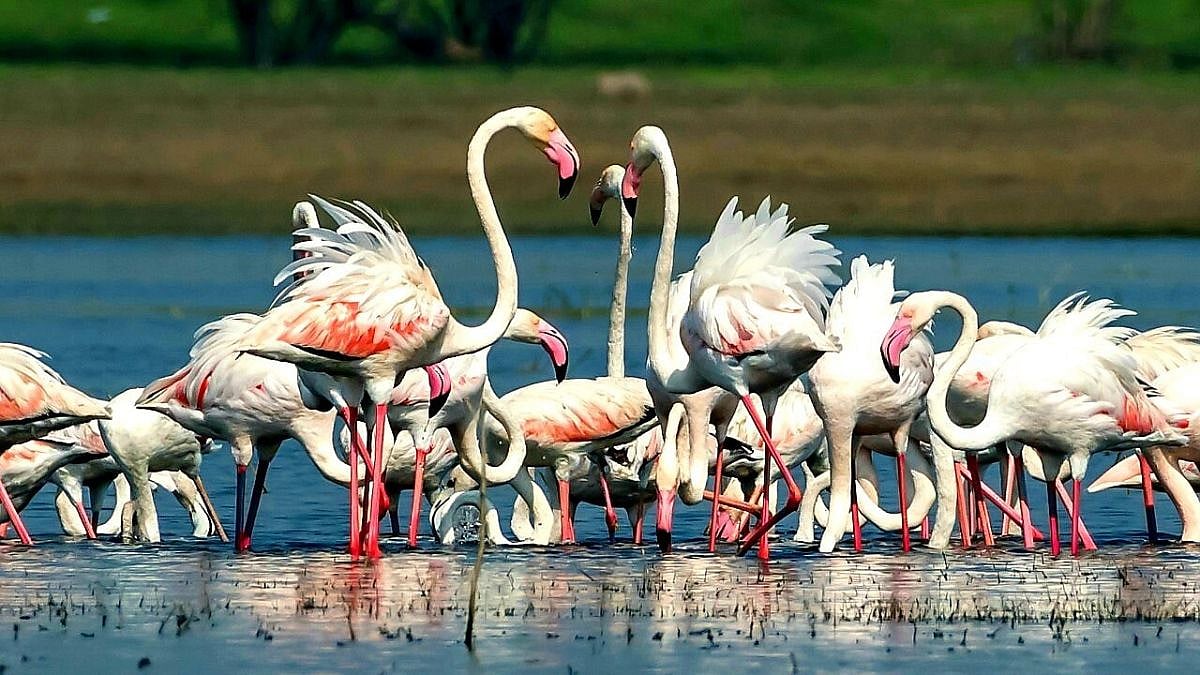
Maharashtra has approved the development of India’s first AI-powered bird sanctuary at the Thane Creek Flamingo Sanctuary in the Mumbai metropolitan region.
The ₹45-crore project, also referred to as the Bhandup Bird Park or Eco-Nature Park, will combine artificial intelligence-based bird monitoring with habitat conservation, environmental education and controlled eco-tourism facilities.
AI-Powered Bird Monitoring?
The proposed centre will use:
- AI-enabled cameras
- Acoustic sensors
- Automated image and sound recognition
- Real-time species identification
- Migration and movement tracking
- Centralised biodiversity databases and digital analytics
The system will monitor birds across an approximately 1.5-km stretch or radius. It can identify species from photographs and calls, reducing dependence on manual surveys and limiting disturbance to birds.
The collected data can support:
- Bird-population estimation
- Detection of changes in nesting and migratory behaviour
- Habitat-restoration planning
- Identification of illegal activity or habitat disturbance
- Assessment of climate-change impacts on wetland species
Bhandup Bird Park?
- Project area: Approximately 20.09 hectares along the Thane Creek shoreline
- Physical infrastructure: About 0.35 hectares
- Mangrove nature trail: Approximately 2.16 km
- Project allocation: ₹45 crore
- Funding: Special fund of the District Planning Committee
Proposed visitor facilities include observation towers, viewing decks, birdwatching points, interpretation centres, educational exhibits and nature trails. Most of the project area will remain dedicated to ecological and habitat-related functions.
Thane Creek Flamingo Sanctuary
Thane Creek Flamingo Sanctuary lies along the eastern edge of Mumbai and Navi Mumbai. It is known for large seasonal congregations of Greater Flamingos and Lesser Flamingos, along with shorebirds, herons, egrets and kingfishers.
The sanctuary supports more than 200 bird species and forms part of the Central Asian Flyway, a major migration route connecting breeding grounds in Eurasia with wintering areas in the Indian subcontinent.
Additional Info
- Ramsar Site
- Thane Creek is designated as a Wetland of International Importance.
- Ramsar site number: 2490
- Ramsar-site area: Approximately 6,521 hectares
- The notified flamingo sanctuary accounts for around 1,690 hectares of this area.
- Ramsar Convention
- An intergovernmental treaty adopted in Ramsar, Iran, in 1971.
- It promotes the conservation and “wise use” of wetlands.
- India became a contracting party in 1982.
- Central Asian Flyway
- One of the world’s major migratory-bird flyways.
- It covers routes between northern Eurasia and the Indian Ocean region.
- India is a critical wintering and stopover region within the flyway.
- Importance of Mangroves
- Protect coastlines from erosion and storm surges.
- Store significant quantities of “blue carbon”.
- Provide breeding and nursery habitats for fish and other aquatic species.
- Support feeding and roosting sites for resident and migratory birds.
Sources
NCBS Compiles India’s Largest Tree-Inventory Meta-Dataset
What’s the News?
Researchers led by the National Centre for Biological Sciences (NCBS) have compiled INvenTree-meta, the largest meta-dataset of tree-inventory studies conducted in India.
It consolidates geographically referenced information from 465 peer-reviewed studies, covering over 4,650 hectares across India’s forest biomes. The initiative seeks to improve India’s representation in global studies on forests, biodiversity, carbon storage and climate change.
INvenTree-meta?
INvenTree stands for the INdia Tree Inventory Network. It is a collaborative network that brings together tree-inventory information collected by researchers across India.
INvenTree-meta contains metadata on:
- Locations of forest-inventory plots
- Area and period of sampling
- Forest and vegetation types
- Tree-measurement methodologies
- Availability of the underlying datasets
- Institutions and researchers associated with the studies
It primarily covers geolocated, plot-based inventories of multispecies tree communities undertaken between 1991 and 2023.
Findings
- Studies compiled: 465
- Total sampled area: Approximately 4,653.64 hectares
- Median area per study: Around 2 hectares
- Studies without openly accessible data: About 73.33%
- Share of sampled area represented by inaccessible data: Approximately 83.43%
- Corresponding authors based in India: Around 82.8%
- Studies having all authors affiliated with Indian institutions: Approximately 73.33%
The findings indicate that India does not necessarily lack forest research. The principal constraint is the limited accessibility and standardisation of existing data.
Major Data Gaps
Despite extensive research in tropical moist and dry forests, several biodiversity-rich areas remain relatively under-sampled:
- Northern Western Ghats
- Northeastern India
- Western Himalayas
- Nicobar Islands
Parts of eastern and northeastern India experiencing rapid forest loss also lack adequate long-term ecological data. This limits the assessment of biodiversity decline, carbon-stock changes and ecosystem responses to climate change.
Why is it Significant?
Harmonising scattered datasets can help researchers:
- Estimate forest biomass and carbon-storage capacity
- Compare tree diversity across regions
- Study the effects of climate change and human activity
- Identify priority areas for ecological surveys
- Develop baselines for forest restoration
- Integrate Indian forests into regional and global ecological models
- Improve evidence-based forest and biodiversity management
Indian forest data are particularly important because the country contains diverse ecosystems with a long history of human–nature interaction.
Additional Info
- National Centre for Biological Sciences
- Located in Bengaluru.
- It is a research centre of the Tata Institute of Fundamental Research.
- It undertakes fundamental and interdisciplinary biological research, including ecology and evolution.
- FAIR Data Principles
- INvenTree promotes forest data that are:
- Findable
- Accessible
- Interoperable
- Reusable
- FAIR does not necessarily require unrestricted public access; it requires clearly documented, standardised and reusable data-management systems.
- INvenTree promotes forest data that are:
- Meta-dataset
- A meta-dataset is a structured compilation containing information about several individual datasets.
- INvenTree-meta maps existing studies and their characteristics; it does not automatically provide unrestricted access to every study’s primary tree-level data.
- Related Sustainable Development Goals
- SDG 13: Climate Action
- SDG 15: Life on Land
- Publication
- The research, titled “Harmonizing Distributed Tree Inventory Datasets Across India Can Fill Critical Gaps in Tropical Ecology,” was published in the journal Biotropica.
Sources
National Flag Adoption Day Commemorates Adoption of the Tiranga
What’s the News?
India observes National Flag Adoption Day, also referred to as National Flag Day, on 22 July. It commemorates the Constituent Assembly’s adoption of the present Indian National Flag on 22 July 1947, shortly before Independence.
Jawaharlal Nehru moved the resolution concerning the National Flag, which the Constituent Assembly adopted with acclamation. The observance highlights the Tiranga’s connection with India’s freedom struggle, sovereignty, constitutional values and national unity.
Present National Flag
- Design: Three equal horizontal bands:
- Deep saffron at the top
- White in the middle
- Dark green at the bottom
- Ashoka Chakra:
- Navy-blue wheel in the centre of the white band
- Contains 24 spokes
- Its design is based on the wheel appearing on the abacus of the Sarnath Lion Capital of Ashoka
- Proportion: Ratio of length to height is 3:2.
- The Chakra replaced the spinning wheel or Charkha used in the earlier nationalist flag.
Evolution During the Freedom Movement
- 1906 – Calcutta Flag
- An early nationalist tricolour was hoisted at Parsee Bagan Square in Calcutta during the Swadeshi and Boycott movement.
- 1907 – Bhikaji Cama’s Flag
- Madam Bhikaji Cama displayed a modified nationalist flag in Europe, drawing international attention to India’s struggle against colonial rule.
- 1917 – Home Rule Flag
- Annie Besant and Bal Gangadhar Tilak used another flag during the Home Rule Movement to represent the demand for self-government.
- 1921 – Pingali Venkayya’s Design
- Pingali Venkayya presented a flag design to Mahatma Gandhi at the Congress session in Bezwada, now Vijayawada.
- A spinning wheel was incorporated to represent progress and economic self-reliance.
- 1931 – Congress Tricolour
- The Indian National Congress formally adopted a saffron-white-green tricolour containing the Charkha.
- It became the immediate precursor of the present National Flag.
- 1947 – Present Tiranga
- The Constituent Assembly retained the tricolour but replaced the Charkha with the Ashoka Chakra.
Flag Code of India
The Flag Code of India, 2002 consolidates the laws, conventions and instructions governing the display of the National Flag by citizens, private organisations, educational institutions and government bodies.
Key provisions include:
- Citizens may display the National Flag on all days and occasions, subject to its dignity and honour.
- The flag may be of any size, but its 3:2 ratio must be maintained.
- The 2021 amendment permitted polyester and machine-made flags, in addition to hand-spun or handwoven cotton, wool, silk and khadi flags.
- Under the 2022 amendment, a flag displayed in the open or at a citizen’s house may be flown during the day and night.
- A damaged or dishevelled flag must not be displayed.
- The flag must not:
- Touch the ground, floor or water
- Be displayed with saffron at the bottom
- Be dipped in salute to any person or object
- Carry lettering or inscriptions
- Be used as drapery or as a covering for vehicles and buildings
Constitutional and Legal Provisions
- Article 51A(a)
- It is a Fundamental Duty of every citizen to abide by the Constitution and respect its ideals, institutions, the National Flag and the National Anthem.
- Prevention of Insults to National Honour Act, 1971
- Section 2 prohibits burning, mutilating, defacing, destroying, trampling upon or otherwise showing disrespect to the National Flag.
- Violation is punishable with imprisonment extending to three years, a fine or both.
- A second or subsequent conviction carries imprisonment of at least one year.
- Union of India v. Naveen Jindal
- The Supreme Court held that respectfully flying the National Flag is a form of expression protected under Article 19(1)(a).
- The right is qualified and remains subject to reasonable restrictions, statutory laws and the dignity of the flag.
Additional Info
- National Flag Adoption Day: 22 July
- Adoption year: 1947
- Moved in the Constituent Assembly by: Jawaharlal Nehru
- Original design associated with: Pingali Venkayya
- Ashoka Chakra: 24 spokes
- Flag ratio: 3:2
- Regulating ministry: Ministry of Home Affairs
- Do not confuse it with:
- Armed Forces Flag Day, observed on 7 December to support serving personnel, veterans and their dependants.
World Brain Day 2026 Focuses on Universal Access to Brain Healthcare

What’s the News?
World Brain Day is observed annually on 22 July to promote awareness of neurological conditions and the importance of brain health.
The 2026 theme is “Brain Health: Access for All.” It highlights inequalities in access to timely diagnosis, specialist consultation, medicines, rehabilitation and community-based neurological services.
“Brain Health: Access for All”?
The theme calls for neurological healthcare to be available irrespective of a person’s income, location or social background.
The campaign is based on five core principles:
- Equity: Brain healthcare should be accessible to everyone.
- Early intervention: Timely diagnosis and treatment can prevent disability.
- Prevention: Modifiable risks should be addressed throughout life.
- Local access: Primary and community healthcare systems should provide care closer to patients.
- Policy action: Awareness must result in measurable improvements in healthcare delivery.
Major barriers include:
- Shortage of neurologists and trained health workers
- High treatment and diagnostic costs
- Long waiting periods
- Limited rehabilitation services
- Stigma and poor public awareness
- Unequal rural–urban distribution of healthcare infrastructure
Low-income countries have approximately 227 times fewer neurologists per capita than high-income countries.
Global Neurological Burden
- More than 3.4 billion people, representing over 40% of the global population, live with neurological conditions.
- Neurological disorders are the world’s leading cause of ill health and disability.
- Around 70% of the neurological and neurodevelopmental disease burden occurs in low- and middle-income countries.
- Major contributors include:
- Stroke
- Neonatal encephalopathy
- Migraine
- Alzheimer’s disease and other dementias
- Diabetic neuropathy
- Meningitis
- Epilepsy
- Neurological complications of premature birth
World Federation of Neurology
The World Federation of Neurology, or WFN, organises World Brain Day.
- Established: 22 July 1957
- Place of establishment: Brussels, Belgium
- First World Brain Day: 2014
- Objective: To promote neurological education, research, advocacy and equitable access to brain healthcare
- Membership: 126 national neurological member societies
- International status: A non-state actor in official relations with the World Health Organization
The observance is held on 22 July because the WFN was established on the same date.
India’s Policy Relevance
- National Programme for Prevention and Control of Non-Communicable Diseases
- Earlier known as NPCDCS.
- Includes prevention and management of cardiovascular diseases and stroke.
- Supports population-based screening of persons aged 30 years and above for major NCD risk factors such as hypertension and diabetes.
- These conditions are important modifiable risk factors for stroke and cognitive decline.
- Primary Healthcare
- Strengthening primary-care institutions can support early identification, referral and long-term management of neurological conditions.
- Community-level care is particularly important where neurologists and specialised centres are limited.
- Universal Health Coverage
- The 2026 theme supports the integration of neurological diagnosis, treatment, medicines and rehabilitation into universal health coverage.
WHO Global Action Plan
The World Health Assembly adopted the Intersectoral Global Action Plan on Epilepsy and Other Neurological Disorders 2022–2031, commonly called IGAP.
Its objectives include:
- Increasing policy priority for neurological disorders
- Providing timely diagnosis, treatment and rehabilitation
- Promoting brain health and preventing neurological conditions
- Strengthening research, data and information systems
- Improving the participation and quality of life of affected persons
- Developing integrated neurological services through primary healthcare
Protecting Brain Health
Important preventive measures include:
- Regular physical activity
- Adequate and regular sleep
- Balanced nutrition
- Control of hypertension, diabetes and obesity
- Avoidance of tobacco and harmful alcohol consumption
- Prevention of head injuries
- Vaccination and control of neuroinfections
- Continued learning and social interaction
- Early medical attention for seizures, memory loss, persistent headaches or movement difficulties
Sudden facial weakness, arm weakness or speech difficulty may indicate a stroke and require immediate emergency care.
Additional Info
- Date: 22 July
- 2026 theme: Brain Health: Access for All
- Organising body: World Federation of Neurology
- First observed: 2014
- Related SDG: SDG 3—Good Health and Well-being
Sources
France Adopts Social Media Ban for Children Under 15

What’s the News?
The French Parliament has definitively adopted legislation prohibiting children below 15 years from accessing social media. France has become the first European Union country to establish such a nationwide minimum age for social-network access.
The restrictions will be implemented in phases: children below 15 will be barred from creating new accounts from the beginning of the new school year, while platforms will receive four additional months to remove or disable existing underage accounts.
Key Provisions
- Minimum age: Social-media access prohibited below 15 years.
- New accounts: Platforms cannot permit under-15 users to open accounts from 1 September 2026.
- Existing accounts: Underage accounts must be removed or disabled by January 2027.
- Age assurance: Platforms must introduce reliable age-verification mechanisms.
- Advertising: Direct or indirect promotion of social-media services specifically targeting minors is prohibited.
- Warning requirement: Promotion of covered platforms must carry a warning indicating that they are dangerous for children below 15.
- School phones: The legislation also extends restrictions on mobile-phone use to French high schools.
Platforms Covered
The prohibition broadly covers online services that enable:
- Social interaction between users
- Public dissemination of content
- Participation in online communities
- Algorithm-driven social-media feeds
Major platforms such as Instagram, TikTok, Facebook and Snapchat fall within the intended scope.
The ban does not apply to:
- Collaborative online encyclopaedias such as Wikipedia
- Educational or scientific directories
- Platforms used for developing and sharing open-source software
Why Was the Ban Introduced?
France has linked excessive social-media use with:
- Reduced attention and self-esteem
- Cyberbullying
- Exposure to self-harm, suicide and drug-related content
- Addictive design features such as infinite scrolling
- Algorithmic amplification of extreme or disturbing material
French users aged 12–17 years reportedly spend an average of approximately 1 hour and 21 minutes per day on TikTok alone. Around 90% of people in this age group use smartphones daily to access the internet.
Digital Majority
“Digital majority” refers to the minimum age at which an individual can independently access certain digital services or consent to the processing of personal data.
France’s model establishes a digital-access threshold of 15 years for social media. Unlike a parental-consent framework, the final legislation creates a general prohibition for children below the threshold.
The prohibition is directed primarily at platform access arrangements. Children violating the restriction will not themselves face punishment.
EU Digital Services Act
The French measure must operate consistently with the European Union’s Digital Services Act, or DSA.
- Officially known as Regulation (EU) 2022/2065
- Requires platforms accessible to minors to provide a high level of privacy, safety and security
- Prohibits profiling-based advertising when a platform knows with reasonable certainty that the user is a minor
- Requires major platforms to assess and mitigate systemic risks
- Supports privacy-preserving age-assurance systems
Some special enforcement powers proposed for France’s national regulator were removed from the final compromise to avoid duplication or conflict with EU law. The European Commission will therefore retain an important role in determining platform compliance.
Additional Info
- France
- Capital: Paris
- President: Emmanuel Macron
- Currency: Euro
- Member of the European Union and permanent member of the UN Security Council
- Global comparison
- Australia introduced the world’s first nationwide social-media restriction of this type.
- Australia’s threshold is 16 years, while France has fixed it at 15 years.
- France is the first EU member to adopt a nationwide under-15 prohibition.
- India comparison
- Under the Digital Personal Data Protection Act, 2023, a child is a person below 18 years.
- Data fiduciaries must obtain verifiable parental consent before processing a child’s personal data.
- The DPDP Rules, 2025 provide the operational mechanism for such consent, subject to limited exemptions for areas such as healthcare, education and real-time safety.
- India’s framework regulates children’s data processing; it does not impose a general statutory ban on social-media access below a specified age.
Sources
July 2026
Archive
October 2026
- 28 October 2026
- 27 October 2026
- 26 October 2026
- 24 October 2026
- 23 October 2026
- 22 October 2026
- 21 October 2026
- 20 October 2026
- 19 October 2026
- 17 October 2026
- 16 October 2026
- 15 October 2026
- 14 October 2026
- 13 October 2026
- 12 October 2026
- 10 October 2026
- 09 October 2026
- 08 October 2026
- 07 October 2026
- 06 October 2026
- 05 October 2026
- 03 October 2026
- 02 October 2026
- 01 October 2026
September 2026
- 30 September 2026
- 29 September 2026
- 28 September 2026
- 26 September 2026
- 25 September 2026
- 24 September 2026
- 23 September 2026
- 22 September 2026
- 21 September 2026
- 19 September 2026
- 18 September 2026
- 17 September 2026
- 16 September 2026
- 15 September 2026
- 12 September 2026
- 11 September 2026
- 10 September 2026
- 09 September 2026
- 08 September 2026
- 07 September 2026
- 05 September 2026
- 04 September 2026
- 03 September 2026
- 02 September 2026
- 01 September 2026
August 2026
- 31 August 2026
- 29 August 2026
- 27 August 2026
- 26 August 2026
- 25 August 2026
- 24 August 2026
- 22 August 2026
- 21 August 2026
- 20 August 2026
- 19 August 2026
- 18 August 2026
- 17 August 2026
- 14 August 2026
- 13 August 2026
- 12 August 2026
- 11 August 2026
- 10 August 2026
- 08 August 2026
- 07 August 2026
- 06 August 2026
- 05 August 2026
- 04 August 2026
- 03 August 2026
- 01 August 2026
July 2026
- 31 July 2026
- 30 July 2026
- 29 July 2026
- 28 July 2026
- 27 July 2026
- 25 July 2026
- 23 July 2026
- 22 July 2026
- 21 July 2026
- 20 July 2026
- 18 July 2026
- 17 July 2026
- 15 July 2026
- 14 July 2026
- 13 July 2026
- 11 July 2026
- 10 July 2026
- 09 July 2026
- 08 July 2026
- 07 July 2026
- 06 July 2026
- 04 July 2026
- 03 July 2026
- 02 July 2026
- 01 July 2026
June 2026
May 2026
April 2026
March 2026
- 31 March 2026
- 30 March 2026
- 28 March 2026
- 27 March 2026
- 26 March 2026
- 25 March 2026
- 24 March 2026
- 23 March 2026
- 21 March 2026
- 20 March 2026
- 19 March 2026
- 18 March 2026
- 17 March 2026
- 16 March 2026
- 14 March 2026
- 13 March 2026
- 12 March 2026
- 11 March 2026
- 10 March 2026
- 09 March 2026
- 07 March 2026
- 06 March 2026
- 05 March 2026
- 03 March 2026
- 02 March 2026
February 2026
- 28 February 2026
- 27 February 2026
- 26 February 2026
- 25 February 2026
- 24 February 2026
- 23 February 2026
- 21 February 2026
- 20 February 2026
- 19 February 2026
- 18 February 2026
- 17 February 2026
- 16 February 2026
- 13 February 2026
- 12 February 2026
- 11 February 2026
- 10 February 2026
- 09 February 2026
- 07 February 2026
- 06 February 2026
- 05 February 2026
- 04 February 2026
- 03 February 2026
- 02 February 2026
January 2026
- 31 January 2026
- 30 January 2026
- 29 January 2026
- 28 January 2026
- 27 January 2026
- 26 January 2026
- 24 January 2026
- 23 January 2026
- 22 January 2026
- 21 January 2026
- 20 January 2026
- 19 January 2026
- 16 January 2026
- 15 January 2026
- 14 January 2026
- 13 January 2026
- 12 January 2026
- 10 January 2026
- 09 January 2026
- 08 January 2026
- 07 January 2026
- 06 January 2026
- 05 January 2026
- 03 January 2026
- 02 January 2026
- 01 January 2026
December 2025
- 31 December 2025
- 30 December 2025
- 29 December 2025
- 27 December 2025
- 26 December 2025
- 24 December 2025
- 23 December 2025
- 22 December 2025
- 20 December 2025
- 19 December 2025
- 18 December 2025
- 17 December 2025
- 16 December 2025
- 15 December 2025
- 13 December 2025
- 12 December 2025
- 11 December 2025
- 10 December 2025
- 09 December 2025
- 08 December 2025
- 05 December 2025
- 04 December 2025
- 03 December 2025
- 02 December 2025
November 2025
- 29 November 2025
- 28 November 2025
- 27 November 2025
- 26 November 2025
- 25 November 2025
- 24 November 2025
- 22 November 2025
- 21 November 2025
- 20 November 2025
- 19 November 2025
- 18 November 2025
- 17 November 2025
- 15 November 2025
- 14 November 2025
- 13 November 2025
- 12 November 2025
- 11 November 2025
- 10 November 2025
- 08 November 2025
- 07 November 2025
- 06 November 2025
- 05 November 2025
- 04 November 2025
- 03 November 2025
- 01 November 2025
October 2025
- 31 October 2025
- 30 October 2025
- 29 October 2025
- 28 October 2025
- 27 October 2025
- 25 October 2025
- 24 October 2025
- 23 October 2025
- 22 October 2025
- 21 October 2025
- 20 October 2025
- 18 October 2025
- 17 October 2025
- 16 October 2025
- 15 October 2025
- 14 October 2025
- 13 October 2025
- 11 October 2025
- 10 October 2025
- 09 October 2025
- 08 October 2025
- 07 October 2025
- 06 October 2025
- 04 October 2025
- 03 October 2025
- 02 October 2025
- 01 October 2025
September 2025
- 30 September 2025
- 29 September 2025
- 27 September 2025
- 26 September 2025
- 25 September 2025
- 24 September 2025
- 23 September 2025
- 22 September 2025
- 20 September 2025
- 19 September 2025
- 18 September 2025
- 17 September 2025
- 16 September 2025
- 15 September 2025
- 13 September 2025
- 12 September 2025
- 11 September 2025
- 10 September 2025
- 09 September 2025
- 08 September 2025
- 06 September 2025
- 05 September 2025
- 04 September 2025
- 03 September 2025
- 02 September 2025
- 01 September 2025
August 2025
- 30 August 2025
- 29 August 2025
- 28 August 2025
- 27 August 2025
- 26 August 2025
- 25 August 2025
- 23 August 2025
- 22 August 2025
- 21 August 2025
- 20 August 2025
- 19 August 2025
- 18 August 2025
- 16 August 2025
- 14 August 2025
- 13 August 2025
- 12 August 2025
- 11 August 2025
- 08 August 2025
- 07 August 2025
- 06 August 2025
- 05 August 2025
- 04 August 2025
- 02 August 2025
- 01 August 2025
July 2025
- 31 July 2025
- 30 July 2025
- 29 July 2025
- 28 July 2025
- 26 July 2025
- 25 July 2025
- 24 July 2025
- 23 July 2025
- 22 July 2025
- 21 July 2025
- 19 July 2025
- 18 July 2025
- 17 July 2025
- 16 July 2025
- 15 July 2025
- 12 July 2025
- 11 July 2025
- 10 July 2025
- 09 July 2025
- 07 July 2025
- 05 July 2025
- 04 July 2025
- 03 July 2025
- 02 July 2025
- 01 July 2025
June 2025
- 30 June 2025
- 28 June 2025
- 27 June 2025
- 26 June 2025
- 25 June 2025
- 24 June 2025
- 23 June 2025
- 21 June 2025
- 20 June 2025
- 19 June 2025
- 18 June 2025
- 17 June 2025
- 16 June 2025
- 14 June 2025
- 13 June 2025
- 12 June 2025
- 11 June 2025
- 10 June 2025
- 09 June 2025
- 07 June 2025
- 06 June 2025
- 05 June 2025
- 04 June 2025
- 03 June 2025
- 02 June 2025
May 2025
April 2025
- 30 April 2025
- 29 April 2025
- 28 April 2025
- 26 April 2025
- 25 April 2025
- 24 April 2025
- 23 April 2025
- 22 April 2025
- 21 April 2025
- 19 April 2025
- 18 April 2025
- 17 April 2025
- 16 April 2025
- 15 April 2025
- 14 April 2025
- 12 April 2025
- 11 April 2025
- 10 April 2025
- 09 April 2025
- 08 April 2025
- 07 April 2025
- 05 April 2025
- 04 April 2025
- 03 April 2025
- 02 April 2025
- 01 April 2025
March 2025
- 31 March 2025
- 29 March 2025
- 28 March 2025
- 27 March 2025
- 26 March 2025
- 25 March 2025
- 24 March 2025
- 22 March 2025
- 21 March 2025
- 20 March 2025
- 19 March 2025
- 18 March 2025
- 17 March 2025
- 15 March 2025
- 13 March 2025
- 12 March 2025
- 11 March 2025
- 10 March 2025
- 08 March 2025
- 07 March 2025
- 06 March 2025
- 05 March 2025
- 04 March 2025
- 03 March 2025
- 01 March 2025
February 2025
- 28 February 2025
- 27 February 2025
- 26 February 2025
- 25 February 2025
- 24 February 2025
- 22 February 2025
- 21 February 2025
- 20 February 2025
- 19 February 2025
- 18 February 2025
- 17 February 2025
- 15 February 2025
- 14 February 2025
- 13 February 2025
- 12 February 2025
- 11 February 2025
- 10 February 2025
- 08 February 2025
- 07 February 2025
- 06 February 2025
- 05 February 2025
- 04 February 2025
- 03 February 2025
- 01 February 2025
January 2025
- 31 January 2025
- 30 January 2025
- 29 January 2025
- 28 January 2025
- 27 January 2025
- 25 January 2025
- 24 January 2025
- 23 January 2025
- 22 January 2025
- 21 January 2025
- 20 January 2025
- 18 January 2025
- 17 January 2025
- 16 January 2025
- 15 January 2025
- 14 January 2025
- 13 January 2025
- 11 January 2025
- 10 January 2025
- 09 January 2025
- 08 January 2025
- 07 January 2025
- 06 January 2025
- 04 January 2025
- 03 January 2025
- 02 January 2025
- 01 January 2025