
Current Affairs
Stay updated with the latest national and international events.
21 October 2026
India Ranks Third in Ipsos Quality of Care Perception Index 2026
What’s the News?
India secured 3rd rank among 32 surveyed countries in the Ipsos Quality of Care Perception Index 2026, behind Malaysia and Singapore, as highlighted in the Ipsos Health Service Report 2026. The report found that 68% of Indian respondents positively rated healthcare quality, reflecting strong public confidence and accessibility, although affordability remains a major concern.
Ipsos Quality of Care Perception Index 2026?
- Released by: Ipsos, a global market research and public opinion research organisation.
- Survey Coverage: 22,528 adults across 32 countries, conducted through the Global Advisor online platform.
- Top Rankings:
- Malaysia – 1st
- Singapore – 2nd
- India – 3rd
- Assessment Parameters: Public satisfaction with healthcare, trust in treatment, access to doctors and pharmacies, and equality in healthcare services.
- Nature: A perception-based index measuring public opinion rather than actual clinical outcomes or healthcare performance.
Findings for India
- Healthcare Quality: 68% positively rated healthcare services, while 64% trusted the healthcare system to provide appropriate treatment.
- Healthcare Accessibility:
- 73% reported ease in obtaining doctor's appointments, the highest among the 32 countries.
- 81% reported easy access to pharmacies.
- Future Outlook: 54% expected healthcare quality to improve, compared with the global average of 31%.
- Affordability Concerns:
- 74% believed many people could not afford good healthcare.
- 42% identified treatment costs as a major healthcare challenge.
- Other Challenges: Poor treatment quality (36%), inadequate cleanliness (28%) and patient safety concerns (25%).
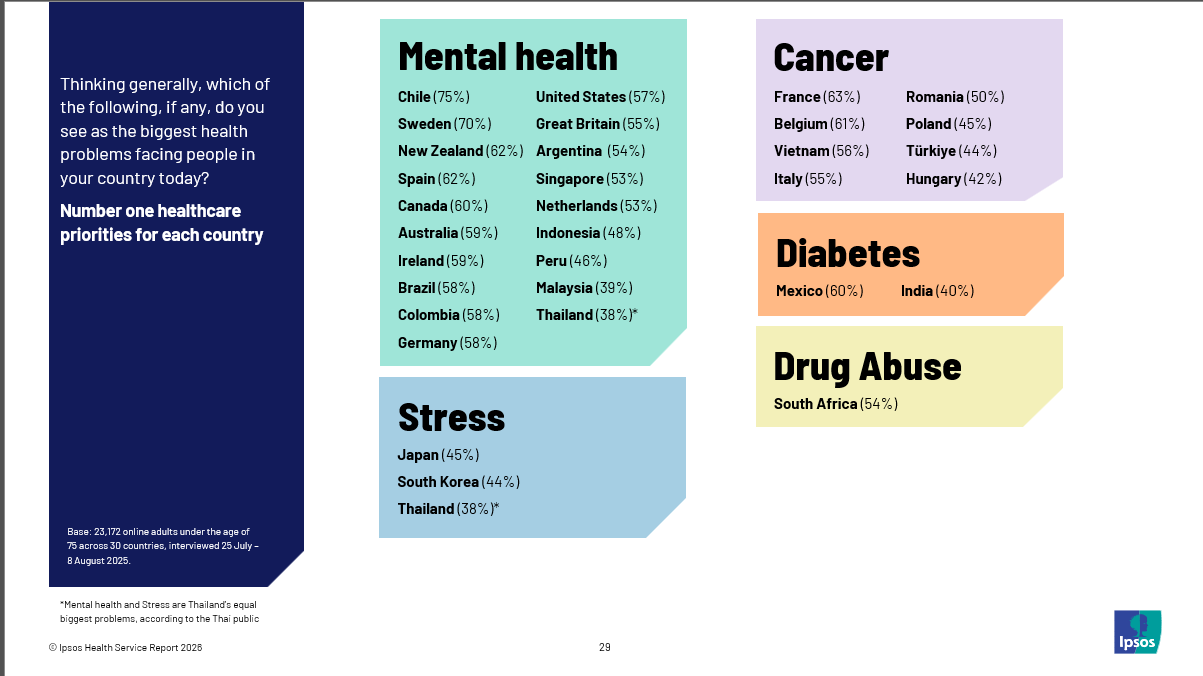
- Major Health Priorities: Diabetes (40%), mental health (37%), stress (33%), obesity (20%) and drug abuse (14%).
Additional Info
- Constitutional Provisions:
- Article 21: Right to life, judicially interpreted to include the right to health.
- Article 47: Directs the State to improve public health.
- Seventh Schedule, State List (Entry 6): Public health, sanitation, hospitals and dispensaries.
- Related Government Initiatives:
- Ayushman Bharat PM-JAY: Provides health cover of ₹5 lakh per eligible family annually for secondary and tertiary hospitalisation.
- Ayushman Arogya Mandirs: Provide comprehensive primary healthcare services.
- Comparison with GBD Study:
- India's rank was 145th among 195 countries and territories in the Global Burden of Disease 2016 Healthcare Access and Quality Index.
- Unlike the Ipsos perception-based ranking, the GBD assessment uses mortality-based indicators to evaluate healthcare access and quality.
- Survey Limitation: The Indian online sample disproportionately represents more urban, educated and affluent sections of the population.
Sources
Three Indian Sites Added to UNESCO World Heritage Tentative List

What’s the News?
Three Indian sites have been added to the UNESCO World Heritage Tentative List, increasing India's total to 81 tentative sites. These include two natural sites in the Andaman and Nicobar Islands and one cultural site in Chhattisgarh. The Archaeological Survey of India (ASI) prepared the heritage documentation, while India's Permanent Delegation to UNESCO announced the additions.
Three Newly Added Sites
1. Karst-Mud-Volcano Complex of Baratang
- Location: Baratang Island, Andaman and Nicobar Islands.
- Category: Natural heritage.
- Features:
- Contains limestone caves featuring stalactites and stalagmites.
- Exhibits non-magmatic mud volcanism, locally called Jalki, releasing mud, water and gases such as methane.
- Its mud volcanoes became active again in 2025 after nearly two decades of dormancy.
- Formed due to tectonic activity associated with the subduction of the Indian Plate beneath the Burma microplate.
2. Andaman Subduction Volcanoes
- Location: Barren Island and Narcondam Island, Andaman and Nicobar Islands.
- Category: Natural heritage.
- Features:
- Barren Island: India's only confirmed active volcano, with recorded eruptions since 1787.
- Narcondam Island: A dormant volcanic island, home to the endemic Narcondam hornbill.
- Both belong to the Burma–Andaman–Java subduction system, extending approximately 5,000 km.
- Represent different stages of volcanic activity and ecological succession.
3. Sirpur Cultural and Archaeological Landscape
- Location: Mahasamund district, Chhattisgarh, on the eastern bank of the Mahanadi River.
- Category: Cultural heritage.
- Historical Significance:
- Known as Shripur or Sripura, it was an ancient capital of Dakshina Kosala.
- Flourished under the Sharabhapuriya and Panduvamshi dynasties.
- Contains archaeological remains dating from the 5th to 12th centuries CE.
- Major Monuments:
- Lakshmana Temple: A 7th-century brick temple dedicated to Lord Vishnu.
- Gandheshwar Temple: Associated with Shaivite traditions.
- Anandprabhu Kuti Vihara and Swastik Vihara: Buddhist monastic complexes.
- Reflects Hindu, Buddhist and Jain cultural traditions and early medieval urban planning.
Additional Info
- UNESCO World Heritage Convention:
- Adopted in 1972 to protect cultural and natural heritage of Outstanding Universal Value (OUV).
- India ratified the Convention in 1977.
- The World Heritage Committee, comprising 21 elected States Parties, decides on World Heritage inscriptions.
- UNESCO Tentative List:
- An inventory of properties a country intends to nominate for World Heritage status.
- Inclusion is a mandatory prerequisite for nomination but does not confer World Heritage Site status.
- India's UNESCO Heritage Status (2026):
- Tentative List: 81 sites.
- Inscribed World Heritage Sites: 45 (37 cultural, 7 natural and 1 mixed).
- Latest inscription: Ancient Buddhist Site of Sarnath, Uttar Pradesh (2026).
Sources
eMudhra Revokes Eight Weak Intermediate CA Certificates Following Security Flaw

What’s the News?
Bengaluru-based eMudhra Limited, a digital certification services provider, revoked eight intermediate Certificate Authority (CA) certificates after a security researcher discovered weak cryptographic private keys. The vulnerability could allow attackers to forge trusted digital certificates, impersonate legitimate websites and intercept encrypted communications. Major technology companies, including Google, Mozilla, Apple and Microsoft, initiated protective measures.
What Caused the Security Flaw?
- Origin: A flaw during a Key Generation Ceremony (KGC) conducted in April 2025.
- Technical Issue:
- A faulty key wrap/unwrap process generated weak private keys alongside secure ones.
- The affected keys used P-384 elliptic-curve cryptography but lacked sufficient randomness.
- Some private keys had extremely small values, including 4, 56 and 115, making them easily recoverable.
- Detection Failure: The flaw remained undetected for approximately 18 months, despite two independent audit cycles.
- Security Risks: Could enable fraudulent HTTPS certificates, website impersonation, man-in-the-middle attacks and interception of sensitive information.
Response and Impact
- Certificate Revocation: eMudhra revoked all eight affected intermediate CAs and initiated security reviews.
- Browser Protection:
- Mozilla: Blocked affected certificates through Firefox's OneCRL system.
- Google: Blocked vulnerable certificate keys through Chrome's CRLSet mechanism.
- Browser root programmes also distrusted the affected emSign ECC Root CA – G3.
- Operational Impact:
- Seven affected intermediate CAs were never deployed in production.
- The remaining CA had not issued any end-entity certificates.
- eMudhra stated that its root private keys, infrastructure and customer data were not compromised.
- India's Digital Signature Certificate (DSC) and eSign services remained unaffected.
Additional Info
Certificate Authority (CA):
- A trusted organisation that issues digital certificates verifying the identity of websites and other entities.
- Root CA: Highest authority in a certificate trust hierarchy.
- Intermediate CA: Issues certificates under the authority of a Root CA.
Public Key Infrastructure (PKI):
- A framework using public and private cryptographic keys, digital certificates and CAs to establish secure digital communications.
Transport Layer Security (TLS):
- A cryptographic protocol securing communication between web browsers and servers.
- Its predecessor is Secure Sockets Layer (SSL).
Related Indian Authorities:
- CERT-In: National nodal agency for responding to cybersecurity incidents under Section 70B of the Information Technology Act, 2000.
- Controller of Certifying Authorities (CCA): Regulates certifying authorities issuing Digital Signature Certificates in India under the Ministry of Electronics and Information Technology (MeitY).
Sources
CCO’s SUVIKALP Initiative Wins SKOCH Gold Award 2026
What’s the News?
The Coal Controller Organisation (CCO), under the Ministry of Coal, received the SKOCH Gold Award 2026 for its indigenous SUVIKALP Mine Repurposing Tool in the “Digital Operational Efficiency – Data Driven Decision Making” category. The initiative promotes scientific mine closure and sustainable reuse of mined-out land through data-driven planning.
SUVIKALP Initiative?
- Developed by: Coal Controller Organisation (CCO), Ministry of Coal.
- Objective: Transform closed and abandoned coal mines into productive assets while promoting environmental restoration, livelihood generation and sustainable regional development.
- Features:
- Evaluates and ranks mine repurposing projects using four criteria: technical, environmental, social and economic.
- Supports transparent, evidence-based selection of suitable post-mining projects.
- Facilitates alternative land uses, including tourism, livelihood activities and ecological restoration.
PRISM Implementation Model?
- Full Form: Post-Mining Repurposing Implementation Strategy Model.
- Purpose: Provides implementation guidance after suitable mine repurposing projects are identified.
- Components:
- Project concepts and implementation strategies.
- Case studies and sample Detailed Project Reports (DPRs).
- Tender documents and information on relevant implementing agencies.
SUVIKALP Samvaad Webinar Series
- Organised by: Coal Controller Organisation.
- Total: 12 thematic webinars conducted for knowledge-sharing and capacity-building.
- Participants: Coal companies, government officials, technical experts and academic institutions.
- Major Themes:
- RECLAIM and L.I.V.E.S. frameworks.
- Community engagement and livelihood diversification.
- Tourism development and innovative uses of abandoned mine voids.
- Financing mechanisms and international best practices for mine transitions.
Additional Info
Coal Controller Organisation (CCO):
- Functions under the Ministry of Coal, Government of India.
- Performs regulatory and statistical functions related to India's coal sector.
SKOCH Awards:
- Presented by the SKOCH Group.
- Recognise excellence in governance, technology, innovation and initiatives delivering public value.
RECLAIM Framework:
- Full Form: Reach Out, Envision, Co-create, Localize, Act, Integrate and Maintain.
- Developed to facilitate community engagement in mine closure and rehabilitation of mining-affected regions.
Sources
CBDT Introduces Form 173A for Tax Exemptions on Government Securities
What’s the News?
The Central Board of Direct Taxes (CBDT) has introduced Form 173A under the Income-tax (Seventh Amendment) Rules, 2026, making it mandatory for eligible taxpayers to furnish information while claiming income-tax exemptions on interest and capital gains from government securities. The amendment introduces Rule 281A under the Income-tax Rules, 2026, to standardise reporting and improve tax compliance.
Form 173A?
- Notified by: CBDT, Ministry of Finance, through Notification No. 137/2026.
- Legal Basis: Rule 281A, read with Schedule IV (Entries 13D and 13E) of the Income-tax Act, 2025.
- Purpose: Enables specified investors to claim exemptions on:
- Interest earned from government securities.
- Capital gains arising from their sale, exchange or transfer.
- Eligible Entities:
- Entry 13D: Foreign Institutional Investors (FIIs), as defined under the Income-tax Act.
- Entry 13E: Bank for International Settlements (BIS).
- The exemption is not available automatically to all government securities investors.
Reporting Requirements
Part A – Investor Information:
- Name, country of residence, address and Permanent Account Number (PAN).
- Tax Identification Number (TIN), SEBI registration number as FPI/FII, tax year and contact details.
- TIN and SEBI registration details are optional for BIS.
Part B – Securities and Income Details:
- International Securities Identification Number (ISIN), security type and tenor.
- Opening holdings as of 1 April and closing holdings as of 31 March.
- Value of purchases and proceeds from sales during the tax year.
- Gross interest received/accrued and capital gains earned.
- Financial amounts are generally reported in Indian rupees.
Government Securities Covered?
- Treasury Bills (T-Bills): Short-term Central Government debt instruments with maturities of 91, 182 and 364 days.
- Fixed-Rate Bonds: Government securities carrying a predetermined coupon rate.
- Floating-Rate Bonds: Securities with periodically reset interest rates.
- State Development Loans (SDLs): Debt securities issued by State Governments.
Additional Info
Central Board of Direct Taxes (CBDT):
- Statutory body under the Central Boards of Revenue Act, 1963.
- Functions under the Department of Revenue, Ministry of Finance.
- Responsible for administration of direct taxes in India.
Bank for International Settlements (BIS):
- Established in 1930.
- Headquarters: Basel, Switzerland.
- Promotes international monetary and financial cooperation and serves as a bank for central banks.
Government Securities Act, 2006:
- Section 2(f) defines government securities.
- Provides the statutory framework governing government securities in India.
Sources
World Iodine Deficiency Day 2026 Observed on 21 October

What’s the News?
World Iodine Deficiency Day 2026, also known as Global Iodine Deficiency Disorders Prevention Day, was observed on 21 October to raise awareness about the importance of iodine in human health and the prevention of iodine deficiency disorders (IDDs). India's Ministry of Health and Family Welfare (MoHFW) emphasised the consumption of adequately iodised salt in moderation to prevent thyroid disorders and developmental disabilities.
World Iodine Deficiency Day?
- Observed On: 21 October annually.
- Objective: Promote adequate iodine intake, prevent iodine deficiency disorders and raise awareness about maternal and child health.
- Significance:
- Iodine is an essential micronutrient required for producing thyroid hormones, particularly thyroxine (T4) and triiodothyronine (T3).
- These hormones regulate metabolism, physical growth and brain development.
- Iodine deficiency during pregnancy can cause irreversible neurological damage to the developing foetus.
Iodine Deficiency Disorders (IDDs)?
- Major Causes: Inadequate dietary iodine intake, consumption of non-iodised salt and low iodine content in soil and food.
- Major Health Impacts:
- Goitre: Abnormal enlargement of the thyroid gland.
- Hypothyroidism: Reduced thyroid hormone production, causing fatigue, weight gain and other symptoms.
- Maternal and Child Health: Increased risk of miscarriage, stillbirth and impaired foetal brain development.
- Children: Impaired cognitive development, learning difficulties and growth retardation.
- Prevention:
- Regular consumption of adequately iodised salt without increasing total salt intake.
- Intake of iodine-rich foods such as seafood, dairy products and eggs.
- Monitoring iodine nutrition among vulnerable populations, particularly pregnant women and children.
National Iodine Deficiency Disorders Control Programme (NIDDCP)?
- Launched: 1962 as the National Goitre Control Programme (NGCP).
- Renamed: National Iodine Deficiency Disorders Control Programme in 1992.
- Nodal Ministry: Ministry of Health and Family Welfare.
- Major Targets:
- Reduce IDD prevalence to below 5%.
- Achieve 100% household consumption of adequately iodised salt containing at least 15 parts per million (ppm) iodine.
- Components:
- District-level surveys and resurveys every five years.
- Promotion and monitoring of iodised salt consumption.
- Laboratory testing of salt iodine content and urinary iodine excretion.
- Public awareness and health education activities.
Additional Info
India's Progress:
- According to NFHS-5 (2019–21), 94.3% of Indian households used adequately iodised salt, compared with 49.3% in NFHS-2 (1998–99).
- Salt testing conducted during April–December 2024 found 93.3% of samples adequately iodised using the volumetric testing method.
Related Regulatory Measures:
- Food Safety and Standards Authority of India (FSSAI): Regulates iodised salt quality under food safety standards.
- Universal Salt Iodisation (USI): A public health strategy promoting iodine fortification of edible salt to prevent IDDs.
Important Organisation:
- UNICEF: Supports universal salt iodisation and improved maternal and child nutrition globally.
Sources
China Imposes Export Restrictions on Tunnel Boring Machines

What’s the News?
China's Ministry of Commerce (MOFCOM) and General Administration of Customs announced new export controls on Tunnel Boring Machines (TBMs) and associated equipment, effective from November 2026. The restrictions require exporters to obtain government licences for specified machinery and technologies, potentially affecting India's metro rail, high-speed railway, highway and strategic border infrastructure projects.
China's New Export Restrictions?
- Implementing Authority: Ministry of Commerce (MOFCOM), China.
- Objective: Safeguard national security and regulate exports of dual-use technologies.
- Equipment Covered:
- Full-face Tunnel Boring Machines (TBMs) and specialised components.
- Walking excavators used in difficult terrain.
- Plateau-type wet shotcrete machines designed for altitudes above 3,000 metres.
- Related remanufacturing technologies and specified dredging equipment.
- Provisions:
- Exporters must obtain licences under China's Export Control Law and dual-use export regulations.
- Controlled products require customs declarations and technical verification.
- These measures constitute export licensing restrictions, not a blanket export ban.
Tunnel Boring Machines (TBMs)?
- Definition: Large, specialised machines used to excavate tunnels through soil and rock while maintaining a consistent tunnel diameter.
- Working Mechanism:
- A rotating cutterhead excavates soil or rock.
- Excavated material is removed through conveyor systems.
- Tunnel lining segments are installed to stabilise the excavated passage.
- Major Applications: Metro rail networks, railway tunnels, underground highways, hydropower projects and strategic infrastructure.
- Advantages: Greater excavation precision, reduced surface disturbance and improved safety compared with conventional drilling and blasting in suitable geological conditions.
Impact on India
Infrastructure Projects:
- Mumbai–Ahmedabad High-Speed Rail Corridor: India's first bullet train project, spanning approximately 508 km, including a planned 7-km undersea tunnel section.
- Metro Networks: Potential delays in underground tunnelling projects dependent on imported TBMs.
- Border Infrastructure: Possible supply constraints for specialised tunnelling equipment used in Himalayan connectivity projects.
Dependence on China:
- China accounts for an estimated 70% of the global TBM market.
- China exported approximately US$793 million worth of tunnelling machinery in 2025.
- India previously experienced delays in receiving TBMs manufactured in China by German engineering company Herrenknecht.
Strategic Concerns:
- Increased risks of procurement delays and higher project costs.
- Dependence on foreign technology for critical infrastructure.
- The actual impact will depend on China's implementation of its licensing requirements.
India's Domestic Manufacturing Efforts
Bharat Earth Movers Limited (BEML):
- Pursuing indigenous TBM development, beginning with a proposed prototype of approximately 6.5 metres in diameter.
- Plans to develop machines with diameters ranging from approximately 6 to 16.5 metres.
Herrenknecht India:
- Established a TBM assembly facility in Chennai in 2007.
- Manufactured 10 TBMs for Chennai Metro Phase II during 2022–23, with approximately 60% of components sourced from Indian suppliers.
Additional Info
Dual-Use Technology:
- Refers to goods, software and technologies with both civilian and military applications.
- Such items may be subject to export controls for national security and non-proliferation purposes.
New Austrian Tunnelling Method (NATM):
- Uses sequential excavation, rock bolts, shotcrete and geological monitoring to construct tunnels.
- Used in India's Sela Tunnel (Arunachal Pradesh) and Zojila Tunnel (Jammu & Kashmir–Ladakh connectivity) projects.
- Provides an alternative to TBMs where geological and project conditions favour conventional excavation.
Sources
October 2026
Archive
October 2026
- 28 October 2026
- 27 October 2026
- 26 October 2026
- 24 October 2026
- 23 October 2026
- 22 October 2026
- 21 October 2026
- 20 October 2026
- 19 October 2026
- 17 October 2026
- 16 October 2026
- 15 October 2026
- 14 October 2026
- 13 October 2026
- 12 October 2026
- 10 October 2026
- 09 October 2026
- 08 October 2026
- 07 October 2026
- 06 October 2026
- 05 October 2026
- 03 October 2026
- 02 October 2026
- 01 October 2026
September 2026
- 30 September 2026
- 29 September 2026
- 28 September 2026
- 26 September 2026
- 25 September 2026
- 24 September 2026
- 23 September 2026
- 22 September 2026
- 21 September 2026
- 19 September 2026
- 18 September 2026
- 17 September 2026
- 16 September 2026
- 15 September 2026
- 12 September 2026
- 11 September 2026
- 10 September 2026
- 09 September 2026
- 08 September 2026
- 07 September 2026
- 05 September 2026
- 04 September 2026
- 03 September 2026
- 02 September 2026
- 01 September 2026
August 2026
- 31 August 2026
- 29 August 2026
- 27 August 2026
- 26 August 2026
- 25 August 2026
- 24 August 2026
- 22 August 2026
- 21 August 2026
- 20 August 2026
- 19 August 2026
- 18 August 2026
- 17 August 2026
- 14 August 2026
- 13 August 2026
- 12 August 2026
- 11 August 2026
- 10 August 2026
- 08 August 2026
- 07 August 2026
- 06 August 2026
- 05 August 2026
- 04 August 2026
- 03 August 2026
- 01 August 2026
July 2026
- 31 July 2026
- 30 July 2026
- 29 July 2026
- 28 July 2026
- 27 July 2026
- 25 July 2026
- 23 July 2026
- 22 July 2026
- 21 July 2026
- 20 July 2026
- 18 July 2026
- 17 July 2026
- 15 July 2026
- 14 July 2026
- 13 July 2026
- 11 July 2026
- 10 July 2026
- 09 July 2026
- 08 July 2026
- 07 July 2026
- 06 July 2026
- 04 July 2026
- 03 July 2026
- 02 July 2026
- 01 July 2026
June 2026
May 2026
April 2026
March 2026
- 31 March 2026
- 30 March 2026
- 28 March 2026
- 27 March 2026
- 26 March 2026
- 25 March 2026
- 24 March 2026
- 23 March 2026
- 21 March 2026
- 20 March 2026
- 19 March 2026
- 18 March 2026
- 17 March 2026
- 16 March 2026
- 14 March 2026
- 13 March 2026
- 12 March 2026
- 11 March 2026
- 10 March 2026
- 09 March 2026
- 07 March 2026
- 06 March 2026
- 05 March 2026
- 03 March 2026
- 02 March 2026
February 2026
- 28 February 2026
- 27 February 2026
- 26 February 2026
- 25 February 2026
- 24 February 2026
- 23 February 2026
- 21 February 2026
- 20 February 2026
- 19 February 2026
- 18 February 2026
- 17 February 2026
- 16 February 2026
- 13 February 2026
- 12 February 2026
- 11 February 2026
- 10 February 2026
- 09 February 2026
- 07 February 2026
- 06 February 2026
- 05 February 2026
- 04 February 2026
- 03 February 2026
- 02 February 2026
January 2026
- 31 January 2026
- 30 January 2026
- 29 January 2026
- 28 January 2026
- 27 January 2026
- 26 January 2026
- 24 January 2026
- 23 January 2026
- 22 January 2026
- 21 January 2026
- 20 January 2026
- 19 January 2026
- 16 January 2026
- 15 January 2026
- 14 January 2026
- 13 January 2026
- 12 January 2026
- 10 January 2026
- 09 January 2026
- 08 January 2026
- 07 January 2026
- 06 January 2026
- 05 January 2026
- 03 January 2026
- 02 January 2026
- 01 January 2026
December 2025
- 31 December 2025
- 30 December 2025
- 29 December 2025
- 27 December 2025
- 26 December 2025
- 24 December 2025
- 23 December 2025
- 22 December 2025
- 20 December 2025
- 19 December 2025
- 18 December 2025
- 17 December 2025
- 16 December 2025
- 15 December 2025
- 13 December 2025
- 12 December 2025
- 11 December 2025
- 10 December 2025
- 09 December 2025
- 08 December 2025
- 05 December 2025
- 04 December 2025
- 03 December 2025
- 02 December 2025
November 2025
- 29 November 2025
- 28 November 2025
- 27 November 2025
- 26 November 2025
- 25 November 2025
- 24 November 2025
- 22 November 2025
- 21 November 2025
- 20 November 2025
- 19 November 2025
- 18 November 2025
- 17 November 2025
- 15 November 2025
- 14 November 2025
- 13 November 2025
- 12 November 2025
- 11 November 2025
- 10 November 2025
- 08 November 2025
- 07 November 2025
- 06 November 2025
- 05 November 2025
- 04 November 2025
- 03 November 2025
- 01 November 2025
October 2025
- 31 October 2025
- 30 October 2025
- 29 October 2025
- 28 October 2025
- 27 October 2025
- 25 October 2025
- 24 October 2025
- 23 October 2025
- 22 October 2025
- 21 October 2025
- 20 October 2025
- 18 October 2025
- 17 October 2025
- 16 October 2025
- 15 October 2025
- 14 October 2025
- 13 October 2025
- 11 October 2025
- 10 October 2025
- 09 October 2025
- 08 October 2025
- 07 October 2025
- 06 October 2025
- 04 October 2025
- 03 October 2025
- 02 October 2025
- 01 October 2025
September 2025
- 30 September 2025
- 29 September 2025
- 27 September 2025
- 26 September 2025
- 25 September 2025
- 24 September 2025
- 23 September 2025
- 22 September 2025
- 20 September 2025
- 19 September 2025
- 18 September 2025
- 17 September 2025
- 16 September 2025
- 15 September 2025
- 13 September 2025
- 12 September 2025
- 11 September 2025
- 10 September 2025
- 09 September 2025
- 08 September 2025
- 06 September 2025
- 05 September 2025
- 04 September 2025
- 03 September 2025
- 02 September 2025
- 01 September 2025
August 2025
- 30 August 2025
- 29 August 2025
- 28 August 2025
- 27 August 2025
- 26 August 2025
- 25 August 2025
- 23 August 2025
- 22 August 2025
- 21 August 2025
- 20 August 2025
- 19 August 2025
- 18 August 2025
- 16 August 2025
- 14 August 2025
- 13 August 2025
- 12 August 2025
- 11 August 2025
- 08 August 2025
- 07 August 2025
- 06 August 2025
- 05 August 2025
- 04 August 2025
- 02 August 2025
- 01 August 2025
July 2025
- 31 July 2025
- 30 July 2025
- 29 July 2025
- 28 July 2025
- 26 July 2025
- 25 July 2025
- 24 July 2025
- 23 July 2025
- 22 July 2025
- 21 July 2025
- 19 July 2025
- 18 July 2025
- 17 July 2025
- 16 July 2025
- 15 July 2025
- 12 July 2025
- 11 July 2025
- 10 July 2025
- 09 July 2025
- 07 July 2025
- 05 July 2025
- 04 July 2025
- 03 July 2025
- 02 July 2025
- 01 July 2025
June 2025
- 30 June 2025
- 28 June 2025
- 27 June 2025
- 26 June 2025
- 25 June 2025
- 24 June 2025
- 23 June 2025
- 21 June 2025
- 20 June 2025
- 19 June 2025
- 18 June 2025
- 17 June 2025
- 16 June 2025
- 14 June 2025
- 13 June 2025
- 12 June 2025
- 11 June 2025
- 10 June 2025
- 09 June 2025
- 07 June 2025
- 06 June 2025
- 05 June 2025
- 04 June 2025
- 03 June 2025
- 02 June 2025
May 2025
April 2025
- 30 April 2025
- 29 April 2025
- 28 April 2025
- 26 April 2025
- 25 April 2025
- 24 April 2025
- 23 April 2025
- 22 April 2025
- 21 April 2025
- 19 April 2025
- 18 April 2025
- 17 April 2025
- 16 April 2025
- 15 April 2025
- 14 April 2025
- 12 April 2025
- 11 April 2025
- 10 April 2025
- 09 April 2025
- 08 April 2025
- 07 April 2025
- 05 April 2025
- 04 April 2025
- 03 April 2025
- 02 April 2025
- 01 April 2025
March 2025
- 31 March 2025
- 29 March 2025
- 28 March 2025
- 27 March 2025
- 26 March 2025
- 25 March 2025
- 24 March 2025
- 22 March 2025
- 21 March 2025
- 20 March 2025
- 19 March 2025
- 18 March 2025
- 17 March 2025
- 15 March 2025
- 13 March 2025
- 12 March 2025
- 11 March 2025
- 10 March 2025
- 08 March 2025
- 07 March 2025
- 06 March 2025
- 05 March 2025
- 04 March 2025
- 03 March 2025
- 01 March 2025
February 2025
- 28 February 2025
- 27 February 2025
- 26 February 2025
- 25 February 2025
- 24 February 2025
- 22 February 2025
- 21 February 2025
- 20 February 2025
- 19 February 2025
- 18 February 2025
- 17 February 2025
- 15 February 2025
- 14 February 2025
- 13 February 2025
- 12 February 2025
- 11 February 2025
- 10 February 2025
- 08 February 2025
- 07 February 2025
- 06 February 2025
- 05 February 2025
- 04 February 2025
- 03 February 2025
- 01 February 2025
January 2025
- 31 January 2025
- 30 January 2025
- 29 January 2025
- 28 January 2025
- 27 January 2025
- 25 January 2025
- 24 January 2025
- 23 January 2025
- 22 January 2025
- 21 January 2025
- 20 January 2025
- 18 January 2025
- 17 January 2025
- 16 January 2025
- 15 January 2025
- 14 January 2025
- 13 January 2025
- 11 January 2025
- 10 January 2025
- 09 January 2025
- 08 January 2025
- 07 January 2025
- 06 January 2025
- 04 January 2025
- 03 January 2025
- 02 January 2025
- 01 January 2025