
Current Affairs
Stay updated with the latest national and international events.
20 February 2026
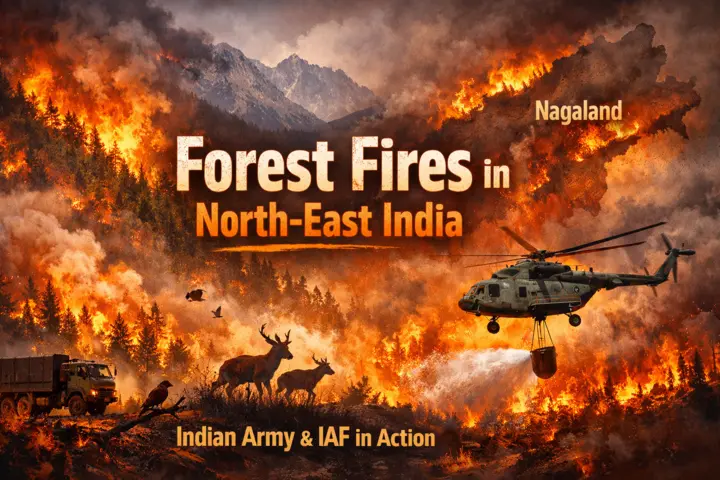
Surge in Forest Fires Across North-East India
What's the News?
- Massive forest fires have been reported across Arunachal Pradesh and Nagaland, causing significant ecological damage.
- The blaze in Walong, Arunachal Pradesh, has persisted for several days, prompting urgent intervention.
- The Indian Army and Indian Air Force (IAF) have intensified operations to control the flames and prevent further spread.
- Local communities and biodiversity hotspots face immediate threats due to smoke inhalation and habitat loss.
Impact and Scale of the Fires?
- Geographic Reach: Large-scale blazes have been reported in Anjaw and Lohit districts of Arunachal Pradesh and the high-altitude grasslands of Nagaland.
- Ecological Damage: The fires threaten biodiversity-rich zones, including habitats of endangered species and critical carbon sinks.
- Operational Challenges: Difficult terrain, steep slopes, and high wind speeds have hampered manual firefighting efforts, necessitating aerial intervention.
- Casualties and Displacement: While primarily affecting forest land, the smoke has caused respiratory concerns in nearby settlements and forced the evacuation of certain border outposts.
Drivers of Forest Fires in the Northeast?
- Climate Factors: Prolonged dry spells, higher-than-average temperatures, and the absence of pre-monsoon showers have turned forest floors into tinderboxes.
- Anthropogenic Activities: Traditional Jhum (Shifting) Cultivation, where land is cleared by burning, remains a significant contributor when fires spread uncontrollably.
- Biomass Accumulation: The accumulation of dry pine needles and leaf litter during the winter season acts as highly inflammable fuel.
Ecological Significance of the Region:
- The Northeast falls under the Indo-Burma Biodiversity Hotspot.
- Dzukou Valley is famous for the endemic Dzukou Lily and is a critical trekking destination that faces recurring fire threats.
Forest Fire Statistics (FSI Data):
- According to the Forest Survey of India (FSI):
- Over 36% of India's forest cover is prone to forest fires.
- North-East states consistently record high incidences of fire due to slash-and-burn agriculture (Jhum cultivation).
- Mizoram, Nagaland, and Manipur are often classified as highly prone zones.
Sources
PM Modi Unveils 'MANAV' Vision at India AI Impact Summit 2026

What's the News?
- The Prime Minister addressed the AI Impact Summit 2026 held in New Delhi.
- Unveiled the MANAV Vision, a strategic framework for Artificial Intelligence governance and development.
- The summit operated under the theme "Develop in India, Develop for the World".
- The initiative emphasizes human-centric AI, ethical deployment, and leveraging technology for global public good.
The MANAV Vision
The centerpiece of Modi's address was the M.A.N.A.V. framework—Manav meaning "human" in Hindi—outlining five pillars for ethical AI development:
| Letter | Principle | Meaning |
|---|---|---|
| M | Moral and Ethical Systems | AI must be built on ethical guidelines with fairness, transparency, and human oversight |
| A | Accountable Governance | Transparent rules and robust oversight mechanisms |
| N | National Sovereignty | Data belongs to those who generate it; securing digital infrastructure and indigenous AI capabilities |
| A | Accessible and Inclusive | AI must be a multiplier, not a monopoly—democratized for the Global South |
| V | Valid and Legitimate | AI systems must be lawful, verifiable, and trustworthy |
Highlights of the AI Impact Summit 2026
- AI for All: Emphasis on using AI to provide personalized education and precision farming for India's 1.4 billion citizens.
- Economic Impact: A target to add $967 billion to the Indian economy through AI-led interventions by 2035.
- Data Sovereignty: Focus on the National Data Governance Policy to ensure that data generated in India is used primarily for the benefit of Indian citizens.
- Skill Development: A massive scale-up of the IndiaAI Mission to train 10 million youth in AI-related disciplines over the next five years.
Additional Info
- Related Government Initiatives:
- IndiaAI Mission: An umbrella program with an outlay of over ₹10,000 crore to build a comprehensive AI ecosystem.
- AIRAWAT (AI Research, Analytics and Knowledge Assimilation Platform): India’s cloud computing platform for AI research, ranked among the world’s top supercomputers.
- Global Partnership on Artificial Intelligence (GPAI): An international initiative where India has played a leading role in advocating for "Responsible AI."
- Constitutional and Ethical Context:
- Right to Privacy: Recognized as a Fundamental Right under Article 21 (Puttaswamy Judgment), which the M.A.N.A.V. vision seeks to uphold in the digital age.
- Directive Principles (DPSP): Aligns with Article 38, promoting the welfare of the people by securing a social order where social, economic, and political justice inform all institutions.
Sources
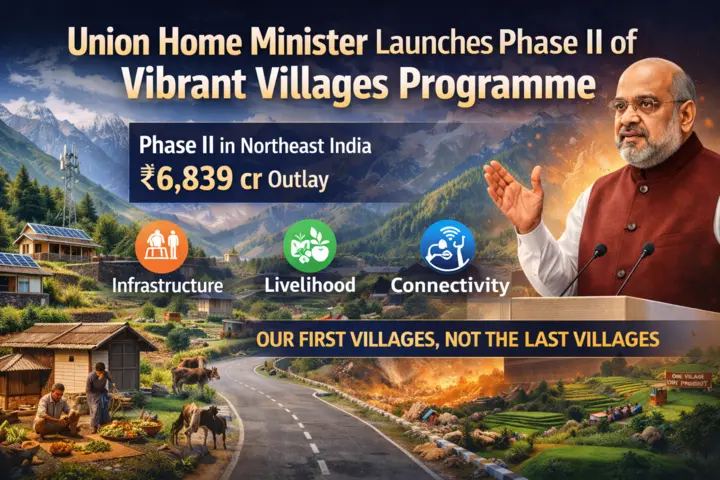
Union Home Minister Launches Phase II of Vibrant Villages Programme
What’s the News?
- Union Home Minister Amit Shah launched the second phase of the Vibrant Villages Programme (VVP-II) during a ceremony in the Cachar district of Assam.
- The initiative marks a strategic shift to include border areas in Northeast India, specifically focusing on strengthening infrastructure and stopping migration from remote frontier villages.
- A total outlay of ₹6,839 crore has been allocated for the program, which views border villages not as the "last villages" of India, but as the "first villages."
What is Vibrant Villages Programme-II (VVP-II)?
- Objective: To improve the quality of life for people living in identified border villages by providing comprehensive developmental interventions.
- Focus Areas:
- Infrastructure: Building all-weather roads, providing 24/7 electricity through solar/wind energy, and ensuring functional tap water connections.
- Livelihood: Promoting "One Village One Product" (OVOP) and developing sustainable eco-tourism circuits.
- Connectivity: Enhancing mobile and internet connectivity in "shadow areas" (regions with no signal).
- Expansion: While Phase I primarily focused on the northern borders (Himachal Pradesh, Uttarakhand, Arunachal Pradesh, Sikkim, and Ladakh), VVP-II significantly integrates more regions in Assam and other Northeastern border belts.
Geographic Scope
The programme extends across 15 States and 2 Union Territories, targeting borders with:
- Bangladesh (primary focus given launch location in Assam)
- Nepal
- Myanmar
- Bhutan
- Pakistan
This represents a major expansion from VVP-I, which focused exclusively on northern borders (China/Tibet-facing regions).
Four Core Infrastructure Themes:
- All-weather road connectivity (via PMGSY-IV)
- Telecom connectivity (via Digital Bharat Nidhi)
- Television connectivity (via BIND scheme)
- Electrification (via RDSS)
Strategic Village Identification: 1,954 villages have been identified for intensive development, selected based on their strategic importance and vulnerability to out-migration.
Historical Context
The programme builds on India's evolving border development strategy:
- 1986-87: Border Area Development Programme (BADP) launched to fill infrastructure gaps
- 2023: VVP-I introduced for northern borders to reverse out-migration
- 2026: VVP-II expands the model to all other international land borders with area-specific strategies
Sources
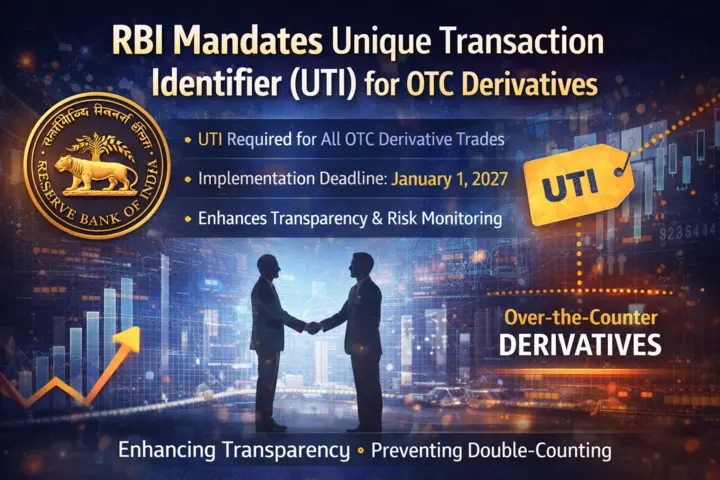
RBI Mandates Unique Transaction Identifier (UTI) for OTC Derivatives
What’s the News?
- The Reserve Bank of India (RBI) has issued a revised directive mandating the use of a Unique Transaction Identifier (UTI) for all Over-the-Counter (OTC) derivative transactions.
- The implementation deadline for this framework has been set for January 1, 2027, providing financial institutions additional time to align their reporting systems with global standards.
- The move aims to enhance transparency, improve risk monitoring, and prevent the double-counting of trades in the derivatives market.
What is UTI?
The Unique Transaction Identifier is a globally recognized key data element for reporting OTC derivative transactions, designed to enable policymakers to aggregate and monitor market-wide exposures. While the Legal Entity Identifier (LEI) uniquely identifies counterparties, the UTI acts as a single reference number for each transaction, allowing regulators to obtain a comprehensive view of the OTC derivatives market.
Scope of Application
The mandate applies to all transactions in OTC markets for:
- Rupee interest rate derivatives
- Forward contracts in government securities
- Foreign currency derivatives
- Foreign currency interest rate derivatives
- Credit derivatives
All these are currently reported to the Trade Repository managed by Clearing Corporation of India Limited (CCIL-TR).
Implementation Details
| Aspect | Specification |
|---|---|
| Effective Date | January 1, 2027 (deferred from April 1, 2026) |
| Applicability | Only to transactions entered into on or after January 1, 2027 |
| Retroactivity | Outstanding contracts prior to implementation date exempt |
| UTI Structure | Maximum 52 characters comprising LEI of generating entity + unique identifier |
| Reporting Window | Five business days from transaction date (extended from proposed two days) |
Operational Framework
Waterfall Mechanism: The RBI retained the proposed hierarchy for UTI generation, setting out the order of entities responsible for generating the identifier. While some stakeholders suggested mandating electronic trading platforms (ETPs) to generate UTIs, the regulator declined to prescribe a single entity, maintaining flexibility.
Temporary UTI Provision: Market participants may generate and report a temporary UTI to the trade repository if the final UTI is not available from the counterparty at the time of reporting.
Multi-Jurisdictional Trades: For transactions reportable in multiple jurisdictions where there is no earlier foreign reporting deadline, the UTI-generating entity may be mutually agreed upon by counterparties. A similar provision applies to trades reportable only in India.
Lifecycle Events:
- Modifications to contract details → Treated as updates (no new UTI required)
- Novation resulting in new reportable derivative contract → Fresh UTI required
Vendor Restrictions
The RBI explicitly prohibited delegation of UTI generation to vendors where the LEI embedded in the UTI would be that of the vendor, ensuring accountability remains with the actual trading entities.
Sources
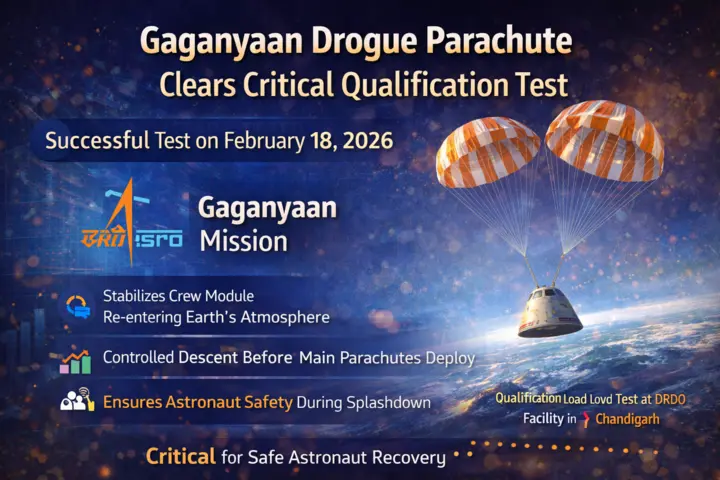
Gaganyaan Drogue Parachute Clears Critical Qualification Test
What’s the News?
India's human spaceflight programme achieved a major milestone on February 18, 2026, with the successful qualification-level load test of the Drogue Parachute for the Gaganyaan mission, conducted at DRDO's specialized testing facility in Chandigarh.
Drogue Parachute System
- Functionality:
- Deploys after the Crew Module re-enters the Earth's atmosphere.
- Stabilizes the module and reduces initial velocity before Main Parachutes deploy.
- Prevents oscillation and ensures a controlled descent.
- Testing Parameters:
- Qualification Load Test: Verifies the parachute's ability to withstand maximum expected forces.
- Simulates high-altitude and high-speed conditions encountered during spaceflight.
- Strategic Importance:
- Critical component of the Crew Module Recovery System.
- Failure in this system could jeopardize astronaut safety during splashdown.
Gaganyaan Mission Overview
- Objective:
- Demonstrate India's capability for Human Spaceflight.
- Launch astronauts into Low Earth Orbit (LEO).
- Mission Profile:
- Orbit: Approximately 400 km above Earth.
- Duration: 3 days for the crewed mission.
- Crew: 3 Indian Air Force pilots (selected as Gagannauts).
- Recovery Mechanism:
- Crew Module splashes down in the Indian Ocean.
- Involves a sequence of parachutes: Drogue, Pilot, and Main Parachutes.
- Supported by Indian Navy and Indian Coast Guard for retrieval.
Components:
- Crew Module (CM): Pressurized habitat for astronauts.
- Service Module (SM): Contains propulsion and support systems.
- Crew Escape System (CES): To pull the crew to safety in case of a launch pad or ascent phase emergency.
Complete Deceleration System Architecture:
| Stage | Component | Quantity | Function |
|---|---|---|---|
| 1 | Apex Cover Separation Parachutes | 2 | Remove protective cover |
| 2 | Drogue Parachutes | 2 | Stabilize & reduce velocity at high altitude |
| 3 | Pilot Parachutes | 3 | Extract main parachutes |
| 4 | Main Parachutes | 3 | Final deceleration for safe landing |
Sequence of Recovery:
- Step 1: Deployment of two Drogue Parachutes to stabilize the module.
- Step 2: Deployment of Pilot Parachutes.
- Step 3: Deployment of three Main Parachutes to ensure a safe splashdown speed of less than 8.5 meters/second.
Sources
World Day of Social Justice 2026

What’s the News?
- World Day of Social Justice is observed annually on February 20 to promote international efforts in tackling issues such as poverty, exclusion, gender inequality, unemployment, and social protection.
- The United Nations (UN) and the International Labour Organization (ILO) lead the global observance to advocate for a "Social Contract" that ensures fairness and dignity for all.
- The 2026 Theme is: "Bridging Gaps, Building Alliances: A Global Call for Social Justice", focusing on international cooperation to fix systemic inequalities.
Four Pillars of Social Justice
- Human Rights:
- Ensuring fundamental freedoms and dignity for all individuals.
- Protects against discrimination based on caste, gender, or religion.
- Labour Rights:
- Promotes fair wages, safe working conditions, and rights of workers.
- Aligns with International Labour Organization (ILO) conventions.
- Social Protection:
- Provides security against life risks such as old age, sickness, and unemployment.
- Includes pensions, healthcare, and unemployment benefits.
- Social Dialogue:
- Encourages negotiation between governments, employers, and workers.
- Fosters consensus on economic and social policies.
Additional Info
- Historical Context:
- UNGA Resolution: Proclaimed by the United Nations in 2007 (Resolution 62/10).
- First Observance: First observed globally in 2009.
- World Summit for Social Development: Held in Copenhagen (1995), laid the groundwork for global social justice commitments.
- Constitutional Provisions (India):
- Preamble:
- Secures Justice (Social, Economic, and Political) to all citizens.
- Fundamental Rights:
- Article 14: Equality before law and equal protection of laws.
- Article 15: Prohibition of discrimination on grounds of religion, race, caste, sex, or place of birth.
- Article 16: Equality of opportunity in matters of public employment.
- Directive Principles of State Policy (DPSP):
- Article 38: State to secure a social order for the promotion of welfare of the people.
- Article 39: Equal means of livelihood and equal pay for equal work.
- Article 41: Right to work, to education, and to public assistance.
- Preamble:
Sources
February 2026
Archive
October 2026
- 28 October 2026
- 27 October 2026
- 26 October 2026
- 24 October 2026
- 23 October 2026
- 22 October 2026
- 21 October 2026
- 20 October 2026
- 19 October 2026
- 17 October 2026
- 16 October 2026
- 15 October 2026
- 14 October 2026
- 13 October 2026
- 12 October 2026
- 10 October 2026
- 09 October 2026
- 08 October 2026
- 07 October 2026
- 06 October 2026
- 05 October 2026
- 03 October 2026
- 02 October 2026
- 01 October 2026
September 2026
- 30 September 2026
- 29 September 2026
- 28 September 2026
- 26 September 2026
- 25 September 2026
- 24 September 2026
- 23 September 2026
- 22 September 2026
- 21 September 2026
- 19 September 2026
- 18 September 2026
- 17 September 2026
- 16 September 2026
- 15 September 2026
- 12 September 2026
- 11 September 2026
- 10 September 2026
- 09 September 2026
- 08 September 2026
- 07 September 2026
- 05 September 2026
- 04 September 2026
- 03 September 2026
- 02 September 2026
- 01 September 2026
August 2026
- 31 August 2026
- 29 August 2026
- 27 August 2026
- 26 August 2026
- 25 August 2026
- 24 August 2026
- 22 August 2026
- 21 August 2026
- 20 August 2026
- 19 August 2026
- 18 August 2026
- 17 August 2026
- 14 August 2026
- 13 August 2026
- 12 August 2026
- 11 August 2026
- 10 August 2026
- 08 August 2026
- 07 August 2026
- 06 August 2026
- 05 August 2026
- 04 August 2026
- 03 August 2026
- 01 August 2026
July 2026
- 31 July 2026
- 30 July 2026
- 29 July 2026
- 28 July 2026
- 27 July 2026
- 25 July 2026
- 23 July 2026
- 22 July 2026
- 21 July 2026
- 20 July 2026
- 18 July 2026
- 17 July 2026
- 15 July 2026
- 14 July 2026
- 13 July 2026
- 11 July 2026
- 10 July 2026
- 09 July 2026
- 08 July 2026
- 07 July 2026
- 06 July 2026
- 04 July 2026
- 03 July 2026
- 02 July 2026
- 01 July 2026
June 2026
May 2026
April 2026
March 2026
- 31 March 2026
- 30 March 2026
- 28 March 2026
- 27 March 2026
- 26 March 2026
- 25 March 2026
- 24 March 2026
- 23 March 2026
- 21 March 2026
- 20 March 2026
- 19 March 2026
- 18 March 2026
- 17 March 2026
- 16 March 2026
- 14 March 2026
- 13 March 2026
- 12 March 2026
- 11 March 2026
- 10 March 2026
- 09 March 2026
- 07 March 2026
- 06 March 2026
- 05 March 2026
- 03 March 2026
- 02 March 2026
February 2026
- 28 February 2026
- 27 February 2026
- 26 February 2026
- 25 February 2026
- 24 February 2026
- 23 February 2026
- 21 February 2026
- 20 February 2026
- 19 February 2026
- 18 February 2026
- 17 February 2026
- 16 February 2026
- 13 February 2026
- 12 February 2026
- 11 February 2026
- 10 February 2026
- 09 February 2026
- 07 February 2026
- 06 February 2026
- 05 February 2026
- 04 February 2026
- 03 February 2026
- 02 February 2026
January 2026
- 31 January 2026
- 30 January 2026
- 29 January 2026
- 28 January 2026
- 27 January 2026
- 26 January 2026
- 24 January 2026
- 23 January 2026
- 22 January 2026
- 21 January 2026
- 20 January 2026
- 19 January 2026
- 16 January 2026
- 15 January 2026
- 14 January 2026
- 13 January 2026
- 12 January 2026
- 10 January 2026
- 09 January 2026
- 08 January 2026
- 07 January 2026
- 06 January 2026
- 05 January 2026
- 03 January 2026
- 02 January 2026
- 01 January 2026
December 2025
- 31 December 2025
- 30 December 2025
- 29 December 2025
- 27 December 2025
- 26 December 2025
- 24 December 2025
- 23 December 2025
- 22 December 2025
- 20 December 2025
- 19 December 2025
- 18 December 2025
- 17 December 2025
- 16 December 2025
- 15 December 2025
- 13 December 2025
- 12 December 2025
- 11 December 2025
- 10 December 2025
- 09 December 2025
- 08 December 2025
- 05 December 2025
- 04 December 2025
- 03 December 2025
- 02 December 2025
November 2025
- 29 November 2025
- 28 November 2025
- 27 November 2025
- 26 November 2025
- 25 November 2025
- 24 November 2025
- 22 November 2025
- 21 November 2025
- 20 November 2025
- 19 November 2025
- 18 November 2025
- 17 November 2025
- 15 November 2025
- 14 November 2025
- 13 November 2025
- 12 November 2025
- 11 November 2025
- 10 November 2025
- 08 November 2025
- 07 November 2025
- 06 November 2025
- 05 November 2025
- 04 November 2025
- 03 November 2025
- 01 November 2025
October 2025
- 31 October 2025
- 30 October 2025
- 29 October 2025
- 28 October 2025
- 27 October 2025
- 25 October 2025
- 24 October 2025
- 23 October 2025
- 22 October 2025
- 21 October 2025
- 20 October 2025
- 18 October 2025
- 17 October 2025
- 16 October 2025
- 15 October 2025
- 14 October 2025
- 13 October 2025
- 11 October 2025
- 10 October 2025
- 09 October 2025
- 08 October 2025
- 07 October 2025
- 06 October 2025
- 04 October 2025
- 03 October 2025
- 02 October 2025
- 01 October 2025
September 2025
- 30 September 2025
- 29 September 2025
- 27 September 2025
- 26 September 2025
- 25 September 2025
- 24 September 2025
- 23 September 2025
- 22 September 2025
- 20 September 2025
- 19 September 2025
- 18 September 2025
- 17 September 2025
- 16 September 2025
- 15 September 2025
- 13 September 2025
- 12 September 2025
- 11 September 2025
- 10 September 2025
- 09 September 2025
- 08 September 2025
- 06 September 2025
- 05 September 2025
- 04 September 2025
- 03 September 2025
- 02 September 2025
- 01 September 2025
August 2025
- 30 August 2025
- 29 August 2025
- 28 August 2025
- 27 August 2025
- 26 August 2025
- 25 August 2025
- 23 August 2025
- 22 August 2025
- 21 August 2025
- 20 August 2025
- 19 August 2025
- 18 August 2025
- 16 August 2025
- 14 August 2025
- 13 August 2025
- 12 August 2025
- 11 August 2025
- 08 August 2025
- 07 August 2025
- 06 August 2025
- 05 August 2025
- 04 August 2025
- 02 August 2025
- 01 August 2025
July 2025
- 31 July 2025
- 30 July 2025
- 29 July 2025
- 28 July 2025
- 26 July 2025
- 25 July 2025
- 24 July 2025
- 23 July 2025
- 22 July 2025
- 21 July 2025
- 19 July 2025
- 18 July 2025
- 17 July 2025
- 16 July 2025
- 15 July 2025
- 12 July 2025
- 11 July 2025
- 10 July 2025
- 09 July 2025
- 07 July 2025
- 05 July 2025
- 04 July 2025
- 03 July 2025
- 02 July 2025
- 01 July 2025
June 2025
- 30 June 2025
- 28 June 2025
- 27 June 2025
- 26 June 2025
- 25 June 2025
- 24 June 2025
- 23 June 2025
- 21 June 2025
- 20 June 2025
- 19 June 2025
- 18 June 2025
- 17 June 2025
- 16 June 2025
- 14 June 2025
- 13 June 2025
- 12 June 2025
- 11 June 2025
- 10 June 2025
- 09 June 2025
- 07 June 2025
- 06 June 2025
- 05 June 2025
- 04 June 2025
- 03 June 2025
- 02 June 2025
May 2025
April 2025
- 30 April 2025
- 29 April 2025
- 28 April 2025
- 26 April 2025
- 25 April 2025
- 24 April 2025
- 23 April 2025
- 22 April 2025
- 21 April 2025
- 19 April 2025
- 18 April 2025
- 17 April 2025
- 16 April 2025
- 15 April 2025
- 14 April 2025
- 12 April 2025
- 11 April 2025
- 10 April 2025
- 09 April 2025
- 08 April 2025
- 07 April 2025
- 05 April 2025
- 04 April 2025
- 03 April 2025
- 02 April 2025
- 01 April 2025
March 2025
- 31 March 2025
- 29 March 2025
- 28 March 2025
- 27 March 2025
- 26 March 2025
- 25 March 2025
- 24 March 2025
- 22 March 2025
- 21 March 2025
- 20 March 2025
- 19 March 2025
- 18 March 2025
- 17 March 2025
- 15 March 2025
- 13 March 2025
- 12 March 2025
- 11 March 2025
- 10 March 2025
- 08 March 2025
- 07 March 2025
- 06 March 2025
- 05 March 2025
- 04 March 2025
- 03 March 2025
- 01 March 2025
February 2025
- 28 February 2025
- 27 February 2025
- 26 February 2025
- 25 February 2025
- 24 February 2025
- 22 February 2025
- 21 February 2025
- 20 February 2025
- 19 February 2025
- 18 February 2025
- 17 February 2025
- 15 February 2025
- 14 February 2025
- 13 February 2025
- 12 February 2025
- 11 February 2025
- 10 February 2025
- 08 February 2025
- 07 February 2025
- 06 February 2025
- 05 February 2025
- 04 February 2025
- 03 February 2025
- 01 February 2025
January 2025
- 31 January 2025
- 30 January 2025
- 29 January 2025
- 28 January 2025
- 27 January 2025
- 25 January 2025
- 24 January 2025
- 23 January 2025
- 22 January 2025
- 21 January 2025
- 20 January 2025
- 18 January 2025
- 17 January 2025
- 16 January 2025
- 15 January 2025
- 14 January 2025
- 13 January 2025
- 11 January 2025
- 10 January 2025
- 09 January 2025
- 08 January 2025
- 07 January 2025
- 06 January 2025
- 04 January 2025
- 03 January 2025
- 02 January 2025
- 01 January 2025