
Current Affairs
Stay updated with the latest national and international events.
18 October 2025
Global Forest Finance Must Triple by 2030: UNEP’s State of Finance for Forests 2025 Report
What’s the News?
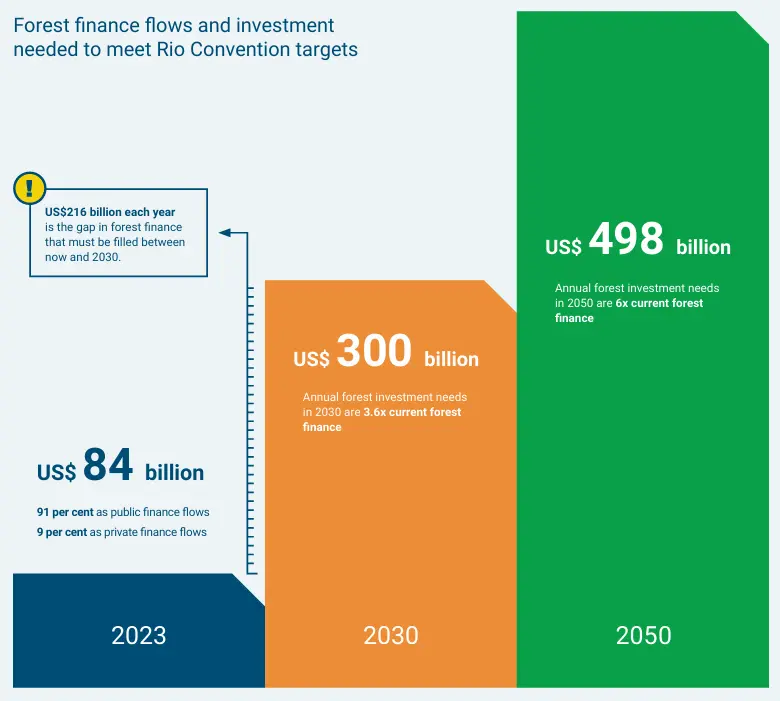
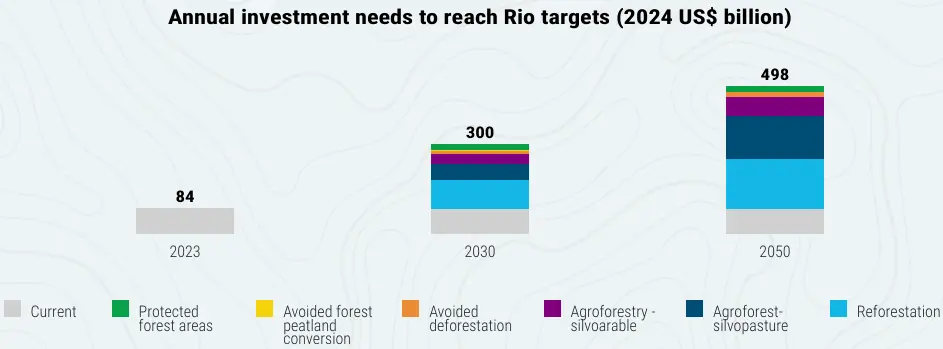
- The United Nations Environment Programme (UNEP) has released the first State of Finance for Forests (SFF) 2025 Report, warning that global investments in forests must triple—from US$84 billion in 2023 to US$300 billion annually by 2030—to meet climate, biodiversity, and land restoration targets.
- The report highlights severe underfunding, low private sector engagement, and persistent harmful financial flows undermining forest conservation globally and in India.
Key Global Findings
- Severe funding gap:
- Current annual investment: US$84 billion (91% public, 9% private).
- Required by 2030: US$300 billion—a US$216 billion shortfall.
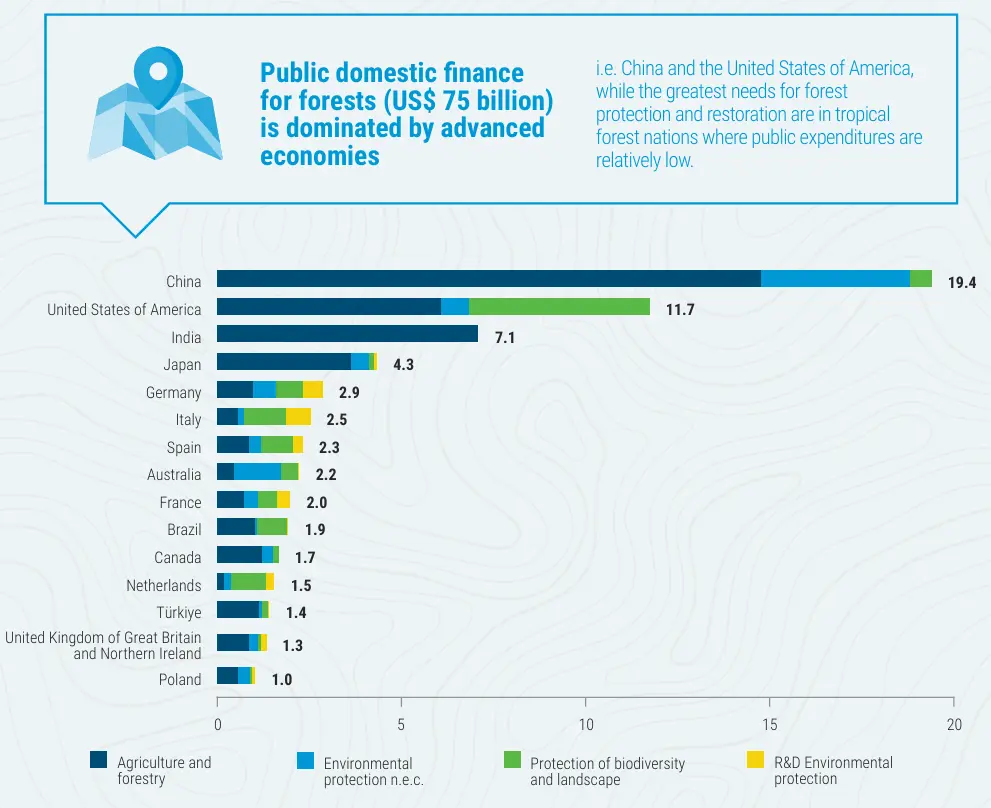
- Public finance dominance:
- Led by China and the U.S.; tropical forest nations contribute only 17% of domestic spending.
- Private sector under-engagement:
- Only US$7.6 billion from private sources, mostly via certified commodity chains (39%) and impact investing (23%).
- High-risk tropical commodities causing 97% of global deforestation receive minimal investment.
- Harmful financial flows:
- US$1.8 trillion in bank financing to deforestation-linked firms in 2023—far exceeding green investments.
India-Specific Trends
- Public-led forest finance:
- Dominated by schemes like CAMPA and Green India Mission.
- Domestic spending over 30 times higher than international aid received—demonstrating strong national commitment.
- Minimal private participation:
- Negligible involvement in carbon markets or biodiversity credits.
- Equity and community focus:
- Emerging emphasis on community-led restoration and gender-inclusive financing, though access remains limited (<0.5% of international funds reach local actors).
Recommendations
- Triple forest investments by 2030 via blended finance, carbon pricing, and subsidy reforms.
- Redirect harmful subsidies (e.g., US$700 billion in agriculture subsidies) toward nature-positive incentives.
- Mobilize private capital through green bonds, biodiversity credits, and transparent frameworks.
- Empower local communities and women with direct financing channels.
- Strengthen data systems to track forest finance and integrate forests into national climate finance strategies.
Sources
India’s Elephant Population Estimated at 22,446 in First DNA-Based Census
What’s the News?
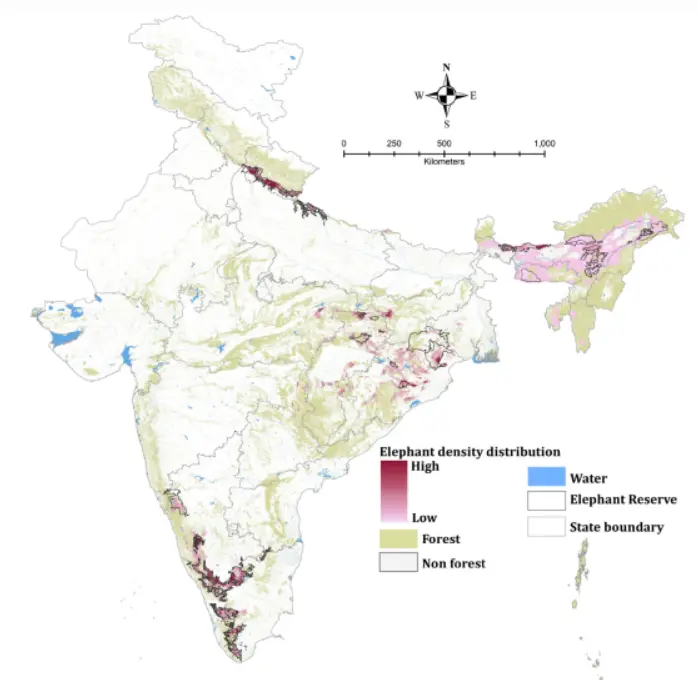
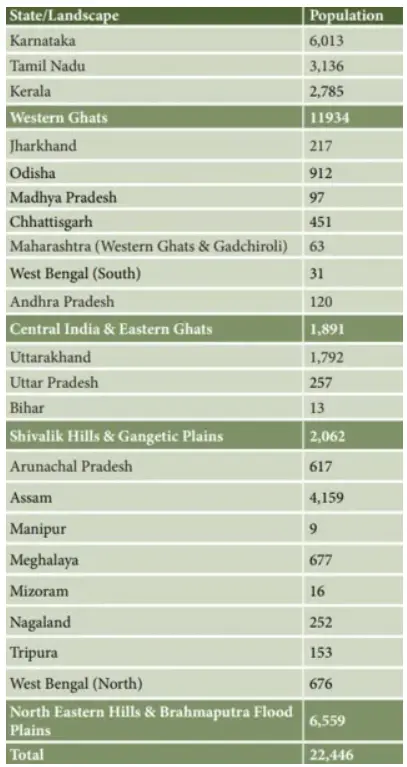
- The Synchronous All India Elephant Estimation (SAIEE) 2021–25, India’s first DNA-based national elephant census, has estimated the country’s wild Asian elephant (Elephas maximus indicus) population at 22,446 individuals.
- Conducted by the Wildlife Institute of India (WII) under the Union Ministry of Environment, Forest and Climate Change (MoEFCC), the survey introduces a genetic mark–recapture methodology, establishing a new scientific baseline for future monitoring.
Key Findings of SAIEE 2025
- National population:
- Estimated at 22,446 (95% confidence interval: 18,255–26,645).
- Not directly comparable to the 2017 figure of 27,312 due to methodological shift.
- Regional distribution:
- Western Ghats: 11,934 (53% of total)
- North Eastern Hills & Brahmaputra floodplains: 6,559
- Shivalik Hills & Gangetic Plains: 2,062
- Central India & Eastern Ghats: 1,891.
- Top states:
- Karnataka (6,013), Assam (4,159), Tamil Nadu (3,136), Kerala (2,785), Uttarakhand (1,792), Odisha (912).
Conservation Challenges Identified
- Habitat fragmentation:
- Caused by linear infrastructure (railways, highways, power lines), mining, and agricultural expansion.
- Western Ghats: Farmland fencing and plantations disrupt corridors.
- Central India: Mining in Odisha and Jharkhand forces elephants to migrate—Chhattisgarh’s population rose by 82.6% due to influx from disturbed habitats.
- Human–elephant conflict:
- Central India, though home to <10% of elephants, accounts for ~45% of human fatalities from elephant encounters.
- New elephant colonies in Madhya Pradesh (Sanjay Dubri, Bandhavgarh) and Maharashtra’s Gadchiroli increase crop raids and property damage.
- Data gaps:
- Northeastern states faced limited field coverage due to terrain and security constraints.
Recommendations
- Treat 2025 estimate as new baseline for all future assessments.
- Restore and secure elephant corridors through inter-state coordination.
- Institutionalize genetic monitoring in national wildlife surveys.
- Scale up community-based conflict mitigation and early-warning systems.
- Integrate elephant landscape planning into infrastructure and mining clearances.
Additional Info
- Legal & Policy Framework:
- Project Elephant (1992): Provides financial and technical support for conservation; currently covers 32 Elephant Reserves across 14 states.
- Wildlife (Protection): Lists Asian elephant in Schedule I, granting highest protection.
- IUCN Status: Endangered since 1986; India hosts >60% of global population.
- Methodological Shift:
- SAIEE 2025 aligned with All India Tiger Estimation protocols, using dung DNA sampling and camera traps for individual identification—enhancing accuracy over earlier indirect methods.
- Landscape Significance:
- Brahmagiri–Nilgiri–Eastern Ghats block hosts India’s largest sub-population, spanning 5 Elephant Reserves (Mysuru, Nilgiri, Wayanad, Nilambur, Coimbatore).
Sources
India Elected Co-Chair of UN-GGIM Asia-Pacific Committee for 2025–2028

What’s the News?
- India has been elected Co-Chair of the United Nations Global Geospatial Information Management for Asia and the Pacific (UN-GGIM-AP) for a three-year term (2025–2028).
- The country will be represented by Hitesh Kumar S. Makwana, IAS, Surveyor General of India, reflecting its growing leadership in global geospatial governance and regional data cooperation.
About UN-GGIM-AP
- Mandate:
- One of five regional committees under the UN Committee of Experts on Global Geospatial Information Management (UN-GGIM).
- Promotes secure, interoperable, and standardized geospatial data for sustainable development.
- Membership:
- Represents 56 countries in the Asia-Pacific region through their National Geospatial Information Agencies (NGIAs).
- Key Focus Areas:
- Capacity building, policy harmonization, and technology transfer in geospatial domains.
- Supports implementation of global frameworks like the 2030 Agenda for Sustainable Development, Sendai Framework, and Paris Agreement through spatial data.
In what ways has India contributed to global geospatial information management before being elected as co-chair?
India has made significant contributions to global geospatial information management even before its election as Co-Chair of UN-GGIM-AP (2025–2028).
- National Geospatial Policy 2022:
- Introduced a liberalized framework for geospatial data, removing prior restrictions and encouraging private sector participation.
- Aimed to position India as a global hub for geospatial innovation and services.
- Digital Public Infrastructure (DPI) with Geospatial Layer:
- Developed platforms like Bhuvan (ISRO’s geo-portal), VEDAS (Visualization of Earth observation Data and Archival System), and MOSDAC for open-access satellite data.
- Integrated geospatial tech into flagship schemes:
- SVAMITVA – Uses drones to map rural land parcels for property rights.
- PM GatiShakti – A national master plan using GIS for multi-modal infrastructure planning across 16 ministries.
- International Capacity Building:
- Through ISRO and Survey of India, India has trained officials from Africa, ASEAN, and Indo-Pacific nations in remote sensing and geospatial applications.
- Shared satellite data and disaster mapping support during regional crises (e.g., Nepal earthquake, Sri Lanka floods).
- Standards and Interoperability Leadership:
- Actively participated in UN-GGIM global and regional forums, contributing to discussions on geospatial standards, metadata frameworks, and SDG monitoring.
- Hosted technical working groups under UN-GGIM-AP, including on geospatial standards and SDG indicators.
- Institutional Strengthening:
- Survey of India modernized its operations with digital mapping, drone surveys, and AI-based analytics.
- Launched Bhuvan Panchayat V3.0 to support decentralized planning using high-resolution geospatial data.
Sources
IUCN Declares Fossil Fuels a Direct Threat to Nature, Backs Global Phase-Out Treaty

What’s the News?
- At its World Conservation Congress in Abu Dhabi (October 2025), the International Union for Conservation of Nature (IUCN) adopted Motion 042, becoming the first multilateral environmental body to explicitly name fossil fuel production and combustion as a direct driver of biodiversity loss and climate breakdown.
- The motion calls for a just and equitable global phase-out of fossil fuels and endorses the development of a Fossil Fuel Non-Proliferation Treaty.
Key Provisions of Motion 042
- Explicit recognition: Identifies coal, oil, and gas extraction and use—not just emissions—as core threats to ecosystems and species.
- Global phase-out demand: Urges all governments to halt new fossil fuel projects, end subsidies, and transition equitably away from fossil fuel dependence.
- Support for a Fossil Fuel Non-Prolroliferation Treaty: Aims to establish a legally binding global framework to manage fossil fuel supply, complementing the Paris Agreement’s demand-side focus.
- Centering Indigenous rights: Co-sponsored by Indigenous groups and civil society, the motion affirms that “there is no conservation without Indigenous rights”.
Significance & Implications
- Unification of agendas: Bridges the climate and biodiversity crises, recognizing that nature-based solutions alone cannot offset fossil fuel-driven damage.
- Momentum for COP30: Builds pressure ahead of COP30 in Belém, Brazil (2025), urging leaders to move beyond vague net-zero pledges to concrete supply-side action.
- Moral and policy influence: Though not legally binding, IUCN resolutions carry significant weight in shaping international environmental law, national policies, and multilateral negotiations.
- Precedent-setting: Marks a paradigm shift from targeting emissions to confronting the root cause—fossil fuel production—aligning conservation with climate justice.
examples of countries that have successfully reduced their reliance on fossil fuels
1. Denmark
- Renewable electricity: Over 80% of electricity comes from wind and solar (2024).
- Coal phase-out: Committed to ending coal use by 2030.
- Offshore wind leadership: Home to Ørsted, a global leader in offshore wind energy, which transformed from a fossil-fuel utility to 100% renewable generation.
- Policy enablers: Long-term energy agreements across political parties, carbon taxes, and community ownership models.
2. Costa Rica
- Electricity generation: Over 98% renewable for more than a decade—primarily hydropower (70%), plus geothermal, wind, and biomass.
- Fossil fuel use: Still relies on oil for transport (≈70% of final energy), but actively pursuing electrification.
- National Decarbonization Plan (2019): Aims for net-zero emissions by 2050, with full transport electrification and green hydrogen development.
3. Germany
- Coal exit: Passed Coal Phase-Out Act (2020) to shut all coal plants by 2038 (accelerated to 2030 in some states).
- Energiewende (Energy Transition):
- Renewables supplied 52% of electricity in 2023.
- Phased out nuclear power in 2023 while reducing coal dependence.
- Challenges: Still uses natural gas, especially post-Russia-Ukraine war, but investing heavily in green hydrogen and grid modernization.
4. Uruguay
- Rapid transition: Went from <10% renewables (2007) to >95% renewable electricity by 2020—mostly wind, hydro, and biomass.
- Mechanisms:
- Long-term power purchase agreements (PPAs) with private developers.
- Stable regulatory framework and public-private partnerships.
- Result: Cut electricity emissions by ~90% in 15 years without major subsidies.
5. Norway
- Electric transport leader: 80% of new car sales in 2023 were battery electric vehicles (BEVs), driven by:
- Tax exemptions, toll waivers, and charging infrastructure.
- Electricity: 96% hydropower.
- Paradox: Still a major oil and gas exporter, but uses sovereign wealth fund (from fossil revenues) to invest in global green tech.
Additional Info
- About IUCN:
- Founded in 1948, it is the world’s largest environmental network, comprising over 1,400 member organizations, including 200+ government agencies and 800+ NGOs.
- Maintains the IUCN Red List of Threatened Species, the global standard for extinction risk.
- Fossil Fuel Non-Proliferation Treaty Initiative:
- Proposed by Pacific Island nations and civil society, it seeks to:
- End new exploration and production,
- Phase out existing production equitably,
- Support a just transition for workers and communities.
- Currently backed by over 80 countries at the UN level, though not yet adopted as a formal treaty.
- Proposed by Pacific Island nations and civil society, it seeks to:
- Contextual Relevance for India:
- India is not a sponsor of Motion 042.
- Balances energy security (coal accounts for ~70% of electricity) with renewable expansion (500 GW non-fossil target by 2030).
- Faces growing scrutiny on coal mine expansions in biodiversity-rich zones (e.g., Hasdeo Aranya, Eastern Ghats).
Sources
India and Brazil Agree to Expand India–Mercosur Trade Pact

What’s the News?
- India and Brazil have agreed to substantially expand the scope of the existing India–Mercosur Preferential Trade Agreement (PTA), aiming to transform it into a comprehensive trade and economic partnership.
- The decision was taken during a meeting between Commerce and Industry Minister Piyush Goyal and Brazilian Vice President Geraldo Alckmin in October 2025.
- Both sides target $20 billion in bilateral merchandise trade by 2030, up from $12.19 billion in 2024–25.
Key Features of the Agreement
- Current PTA limitations:
- In force since June 1, 2009.
- Covers only 450 tariff lines, offering limited market access.
- Expansion roadmap:
- Establish a technical dialogue and convene the Joint Administration Committee at the earliest.
- Negotiations to be concluded within one year of launch.
- Scope to include both tariff and non-tariff measures, covering goods, services, and economic cooperation.
- Private sector role:
- Active involvement of industry stakeholders encouraged to shape negotiations
Strategic and Economic Significance
- Brazil’s role:
- Largest trading partner of India in Latin America and the Caribbean (LAC).
- Key supplier of soybeans, crude oil, gold, and fertilizers; major market for Indian pharmaceuticals, auto parts, and IT services.
- Mercosur bloc:
- Comprises Brazil, Argentina, Paraguay, and Uruguay—a combined market of 295 million people and $430 billion GDP.
- Offers India a strategic gateway to South American markets under a unified framework.
- Broader cooperation:
- Both nations plan a digital partnership in artificial intelligence (AI) and high-performance computing.
- Double Taxation Avoidance Agreement (DTAA) to enhance investment predictability.
Additional Info
- India’s LAC Engagement:
- Part of India’s “Look West” policy to diversify trade beyond traditional partners.
- LAC region accounted for ~2.5% of India’s total trade in 2024; expansion aims to raise this share significantly.
- Trade Composition (2024–25):
- Indian exports: Pharmaceuticals ($1.8B), vehicles ($1.2B), machinery, textiles.
- Imports from Brazil: Crude oil ($3.1B), soybeans ($2.4B), gold ($1.7B), iron ore.
Sources
India and South Korea Conduct First-Ever Bilateral Naval Exercise in Busan

What’s the News?
India and the Republic of Korea (RoK) conducted their first-ever bilateral naval exercise in October 2025 at Busan Naval Base, marking a strategic milestone in Indo-Pacific maritime cooperation. The exercise involved the Indian Navy’s stealth frigate INS Sahyadri and the ROKS Gyeongnam of the Republic of Korea Navy (RoKN). This inaugural drill underscores deepening defence ties and shared commitment to a free, open, and secure Indo-Pacific.
Key Features of the Exercise
- Phases:
- Harbour phase: Cross-deck visits, professional exchanges, joint training sessions, and sports events.
- Sea phase: Focused on tactical maneuvers, communication drills, and coordinated operations to enhance interoperability.
- Participating assets:
- INS Sahyadri: Indigenous Shivalik-class stealth frigate, commissioned in 2012, part of the Eastern Fleet (Visakhapatnam).
- ROKS Gyeongnam: Advanced Daegu-class frigate of the RoKN.
- Strategic context:
- Conducted during INS Sahyadri’s operational deployment to the South China Sea and Indo-Pacific.
- Reflects years of planning and growing alignment on maritime security, freedom of navigation, and rules-based order.
Strategic Significance
- Indo-Pacific alignment:
- Both nations are key partners in the Indo-Pacific Oceans Initiative (IPOI) and support ASEAN centrality.
- Exercise reinforces India’s Act East Policy and South Korea’s Indo-Pacific Strategy (2022).
- Defence industrial synergy:
- Complements ongoing talks on defence technology collaboration, including potential co-development under India’s iCET (India–US initiative with RoK interest).
- Regional stability:
- Signals coordinated response to maritime challenges, including unregulated fishing, piracy, and strategic assertiveness in critical sea lanes.
Additional Info
- India–RoK Defence Relations:
- Defence Dialogue institutionalized in 2005; elevated to Joint Defence Committee level.
- Mutual Logistics Support Arrangement (MLSA) under discussion to enable port calls and refueling.
- Naval Modernization:
- INS Sahyadri: Built under Indian Navy’s indigenous warship program, symbolizing Aatmanirbhar Bharat in defence.
- RoKN: Rapidly modernizing with KDX-III destroyers and submarine capabilities, aligning with regional security needs.
- Broader Framework:
- Exercise aligns with India’s SAGAR (Security and Growth for All in the Region) doctrine.
- South Korea is a Major Defence Partner for India, with bilateral trade exceeding $25 billion (2024), including in electronics, shipbuilding, and green tech.
Sources
October 2025
31 October 202530 October 202529 October 202528 October 202527 October 202525 October 202524 October 202523 October 202522 October 202521 October 202520 October 202518 October 202517 October 202516 October 202515 October 202514 October 202513 October 202511 October 202510 October 202509 October 202508 October 202507 October 202506 October 202504 October 202503 October 202502 October 202501 October 2025
Archive
October 2026
- 27 October 2026
- 26 October 2026
- 24 October 2026
- 23 October 2026
- 22 October 2026
- 21 October 2026
- 20 October 2026
- 19 October 2026
- 17 October 2026
- 16 October 2026
- 15 October 2026
- 14 October 2026
- 13 October 2026
- 12 October 2026
- 10 October 2026
- 09 October 2026
- 08 October 2026
- 07 October 2026
- 06 October 2026
- 05 October 2026
- 03 October 2026
- 02 October 2026
- 01 October 2026
September 2026
- 30 September 2026
- 29 September 2026
- 28 September 2026
- 26 September 2026
- 25 September 2026
- 24 September 2026
- 23 September 2026
- 22 September 2026
- 21 September 2026
- 19 September 2026
- 18 September 2026
- 17 September 2026
- 16 September 2026
- 15 September 2026
- 12 September 2026
- 11 September 2026
- 10 September 2026
- 09 September 2026
- 08 September 2026
- 07 September 2026
- 05 September 2026
- 04 September 2026
- 03 September 2026
- 02 September 2026
- 01 September 2026
August 2026
- 31 August 2026
- 29 August 2026
- 27 August 2026
- 26 August 2026
- 25 August 2026
- 24 August 2026
- 22 August 2026
- 21 August 2026
- 20 August 2026
- 19 August 2026
- 18 August 2026
- 17 August 2026
- 14 August 2026
- 13 August 2026
- 12 August 2026
- 11 August 2026
- 10 August 2026
- 08 August 2026
- 07 August 2026
- 06 August 2026
- 05 August 2026
- 04 August 2026
- 03 August 2026
- 01 August 2026
July 2026
- 31 July 2026
- 30 July 2026
- 29 July 2026
- 28 July 2026
- 27 July 2026
- 25 July 2026
- 23 July 2026
- 22 July 2026
- 21 July 2026
- 20 July 2026
- 18 July 2026
- 17 July 2026
- 15 July 2026
- 14 July 2026
- 13 July 2026
- 11 July 2026
- 10 July 2026
- 09 July 2026
- 08 July 2026
- 07 July 2026
- 06 July 2026
- 04 July 2026
- 03 July 2026
- 02 July 2026
- 01 July 2026
June 2026
May 2026
April 2026
March 2026
- 31 March 2026
- 30 March 2026
- 28 March 2026
- 27 March 2026
- 26 March 2026
- 25 March 2026
- 24 March 2026
- 23 March 2026
- 21 March 2026
- 20 March 2026
- 19 March 2026
- 18 March 2026
- 17 March 2026
- 16 March 2026
- 14 March 2026
- 13 March 2026
- 12 March 2026
- 11 March 2026
- 10 March 2026
- 09 March 2026
- 07 March 2026
- 06 March 2026
- 05 March 2026
- 03 March 2026
- 02 March 2026
February 2026
- 28 February 2026
- 27 February 2026
- 26 February 2026
- 25 February 2026
- 24 February 2026
- 23 February 2026
- 21 February 2026
- 20 February 2026
- 19 February 2026
- 18 February 2026
- 17 February 2026
- 16 February 2026
- 13 February 2026
- 12 February 2026
- 11 February 2026
- 10 February 2026
- 09 February 2026
- 07 February 2026
- 06 February 2026
- 05 February 2026
- 04 February 2026
- 03 February 2026
- 02 February 2026
January 2026
- 31 January 2026
- 30 January 2026
- 29 January 2026
- 28 January 2026
- 27 January 2026
- 26 January 2026
- 24 January 2026
- 23 January 2026
- 22 January 2026
- 21 January 2026
- 20 January 2026
- 19 January 2026
- 16 January 2026
- 15 January 2026
- 14 January 2026
- 13 January 2026
- 12 January 2026
- 10 January 2026
- 09 January 2026
- 08 January 2026
- 07 January 2026
- 06 January 2026
- 05 January 2026
- 03 January 2026
- 02 January 2026
- 01 January 2026
December 2025
- 31 December 2025
- 30 December 2025
- 29 December 2025
- 27 December 2025
- 26 December 2025
- 24 December 2025
- 23 December 2025
- 22 December 2025
- 20 December 2025
- 19 December 2025
- 18 December 2025
- 17 December 2025
- 16 December 2025
- 15 December 2025
- 13 December 2025
- 12 December 2025
- 11 December 2025
- 10 December 2025
- 09 December 2025
- 08 December 2025
- 05 December 2025
- 04 December 2025
- 03 December 2025
- 02 December 2025
November 2025
- 29 November 2025
- 28 November 2025
- 27 November 2025
- 26 November 2025
- 25 November 2025
- 24 November 2025
- 22 November 2025
- 21 November 2025
- 20 November 2025
- 19 November 2025
- 18 November 2025
- 17 November 2025
- 15 November 2025
- 14 November 2025
- 13 November 2025
- 12 November 2025
- 11 November 2025
- 10 November 2025
- 08 November 2025
- 07 November 2025
- 06 November 2025
- 05 November 2025
- 04 November 2025
- 03 November 2025
- 01 November 2025
October 2025
- 31 October 2025
- 30 October 2025
- 29 October 2025
- 28 October 2025
- 27 October 2025
- 25 October 2025
- 24 October 2025
- 23 October 2025
- 22 October 2025
- 21 October 2025
- 20 October 2025
- 18 October 2025
- 17 October 2025
- 16 October 2025
- 15 October 2025
- 14 October 2025
- 13 October 2025
- 11 October 2025
- 10 October 2025
- 09 October 2025
- 08 October 2025
- 07 October 2025
- 06 October 2025
- 04 October 2025
- 03 October 2025
- 02 October 2025
- 01 October 2025
September 2025
- 30 September 2025
- 29 September 2025
- 27 September 2025
- 26 September 2025
- 25 September 2025
- 24 September 2025
- 23 September 2025
- 22 September 2025
- 20 September 2025
- 19 September 2025
- 18 September 2025
- 17 September 2025
- 16 September 2025
- 15 September 2025
- 13 September 2025
- 12 September 2025
- 11 September 2025
- 10 September 2025
- 09 September 2025
- 08 September 2025
- 06 September 2025
- 05 September 2025
- 04 September 2025
- 03 September 2025
- 02 September 2025
- 01 September 2025
August 2025
- 30 August 2025
- 29 August 2025
- 28 August 2025
- 27 August 2025
- 26 August 2025
- 25 August 2025
- 23 August 2025
- 22 August 2025
- 21 August 2025
- 20 August 2025
- 19 August 2025
- 18 August 2025
- 16 August 2025
- 14 August 2025
- 13 August 2025
- 12 August 2025
- 11 August 2025
- 08 August 2025
- 07 August 2025
- 06 August 2025
- 05 August 2025
- 04 August 2025
- 02 August 2025
- 01 August 2025
July 2025
- 31 July 2025
- 30 July 2025
- 29 July 2025
- 28 July 2025
- 26 July 2025
- 25 July 2025
- 24 July 2025
- 23 July 2025
- 22 July 2025
- 21 July 2025
- 19 July 2025
- 18 July 2025
- 17 July 2025
- 16 July 2025
- 15 July 2025
- 12 July 2025
- 11 July 2025
- 10 July 2025
- 09 July 2025
- 07 July 2025
- 05 July 2025
- 04 July 2025
- 03 July 2025
- 02 July 2025
- 01 July 2025
June 2025
- 30 June 2025
- 28 June 2025
- 27 June 2025
- 26 June 2025
- 25 June 2025
- 24 June 2025
- 23 June 2025
- 21 June 2025
- 20 June 2025
- 19 June 2025
- 18 June 2025
- 17 June 2025
- 16 June 2025
- 14 June 2025
- 13 June 2025
- 12 June 2025
- 11 June 2025
- 10 June 2025
- 09 June 2025
- 07 June 2025
- 06 June 2025
- 05 June 2025
- 04 June 2025
- 03 June 2025
- 02 June 2025
May 2025
April 2025
- 30 April 2025
- 29 April 2025
- 28 April 2025
- 26 April 2025
- 25 April 2025
- 24 April 2025
- 23 April 2025
- 22 April 2025
- 21 April 2025
- 19 April 2025
- 18 April 2025
- 17 April 2025
- 16 April 2025
- 15 April 2025
- 14 April 2025
- 12 April 2025
- 11 April 2025
- 10 April 2025
- 09 April 2025
- 08 April 2025
- 07 April 2025
- 05 April 2025
- 04 April 2025
- 03 April 2025
- 02 April 2025
- 01 April 2025
March 2025
- 31 March 2025
- 29 March 2025
- 28 March 2025
- 27 March 2025
- 26 March 2025
- 25 March 2025
- 24 March 2025
- 22 March 2025
- 21 March 2025
- 20 March 2025
- 19 March 2025
- 18 March 2025
- 17 March 2025
- 15 March 2025
- 13 March 2025
- 12 March 2025
- 11 March 2025
- 10 March 2025
- 08 March 2025
- 07 March 2025
- 06 March 2025
- 05 March 2025
- 04 March 2025
- 03 March 2025
- 01 March 2025
February 2025
- 28 February 2025
- 27 February 2025
- 26 February 2025
- 25 February 2025
- 24 February 2025
- 22 February 2025
- 21 February 2025
- 20 February 2025
- 19 February 2025
- 18 February 2025
- 17 February 2025
- 15 February 2025
- 14 February 2025
- 13 February 2025
- 12 February 2025
- 11 February 2025
- 10 February 2025
- 08 February 2025
- 07 February 2025
- 06 February 2025
- 05 February 2025
- 04 February 2025
- 03 February 2025
- 01 February 2025
January 2025
- 31 January 2025
- 30 January 2025
- 29 January 2025
- 28 January 2025
- 27 January 2025
- 25 January 2025
- 24 January 2025
- 23 January 2025
- 22 January 2025
- 21 January 2025
- 20 January 2025
- 18 January 2025
- 17 January 2025
- 16 January 2025
- 15 January 2025
- 14 January 2025
- 13 January 2025
- 11 January 2025
- 10 January 2025
- 09 January 2025
- 08 January 2025
- 07 January 2025
- 06 January 2025
- 04 January 2025
- 03 January 2025
- 02 January 2025
- 01 January 2025