
Current Affairs
Stay updated with the latest national and international events.
18 July 2026
NMCG Proposes Separate Framework for Rejuvenating Small Rivers

What’s the News?
The National Mission for Clean Ganga (NMCG) has prepared a draft Small River Rejuvenation (SRR) Framework for restoring India’s smaller rivers.
The framework recognises that small rivers differ from major river systems in their catchment size, seasonal flow, groundwater dependence and pollution sources. It therefore prioritises river-specific scientific planning, nature-based solutions, decentralised implementation and community stewardship, instead of relying mainly on large engineering projects.
Why a Separate Strategy?
Small rivers generally have:
- Localised catchments that respond rapidly to land-use changes.
- Seasonal flows dependent on rainfall and shallow aquifers.
- Pollution from village drains, municipal waste, agricultural runoff and local dumping.
- Greater vulnerability to encroachment, channel modification and disruption of natural connectivity.
Consequently, interventions designed for major rivers—such as large sewage-treatment plants, barrages and centralised infrastructure—may not adequately address their ecological and hydrological conditions.
Small River Rejuvenation Framework
The draft proposes a basin- and river-specific planning process covering:
- Scientific studies: Hydrology, hydrogeology, ecology, water quality and land-use assessment.
- GIS mapping: Catchment boundaries, drainage networks, encroachments and land-use changes.
- Detailed Project Reports: Site-specific interventions, costs, implementation schedules and monitoring indicators.
- Pollution abatement: Control of liquid waste, solid waste and pollution at source.
- Ecological restoration: Recovery of riparian vegetation, aquatic habitats and river connectivity.
- Channel improvement: Restoration of the natural river channel without unnecessary concretisation.
- Public–river connection: Community participation in maintenance, monitoring and protection.
Rural and Urban Approach
Rural Small Rivers
The framework prioritises:
- Restoration of natural longitudinal and lateral connectivity.
- Catchment treatment through soil conservation and vegetation.
- Local water-storage and groundwater-recharge structures.
- Decentralised management of sanitation, greywater and agricultural runoff.
Urban Small Rivers
The focus is on:
- Maintaining continuous or adequate environmental flow.
- Preventing sewage from entering stormwater drains and rivers.
- Managing urban runoff through constructed wetlands, permeable surfaces and vegetated drainage systems.
- Replacing hard-engineered riverbanks, where feasible, with bioengineering and nature-based restoration.
Funding and Governance
The framework favours convergence of existing Central and State schemes rather than creating standalone, capital-intensive projects.
Implementation would require coordination among water resources, rural development, urban development, sanitation, agriculture and forest departments. Gram Panchayats, Urban Local Bodies and riverbank communities are expected to undertake routine maintenance and local monitoring.
Suggested performance indicators include:
- Improvement in seasonal baseflow.
- Reduction in Biochemical Oxygen Demand (BOD) and faecal-coliform levels.
- Restoration of riparian vegetation.
- Improvement in aquatic-habitat connectivity.
- Reduction in direct discharge of sewage and solid waste.
Additional Info
- National Mission for Clean Ganga
- Functions under the Department of Water Resources, River Development and Ganga Rejuvenation, Ministry of Jal Shakti.
- Implements the Namami Gange Programme.
- Its river-management approach is based on:
- Nirmal Dhara: Unpolluted or clean flow.
- Aviral Dhara: Continuous and adequate flow.
- Constitutional Linkages
- State List, Entry 17: Water, irrigation, canals, drainage and embankments.
- Union List, Entry 56: Regulation and development of inter-State rivers when Parliament declares it expedient in the public interest.
- Article 48A: Directs the State to protect and improve the environment.
- Article 51A(g): Makes protection of the natural environment a Fundamental Duty.
- Panchayats and Urban Local Bodies have relevant responsibilities relating to water management, sanitation, watershed development and environmental protection under the Eleventh and Twelfth Schedules.
Sources
India Launches Its First Hydrogen-Powered Train
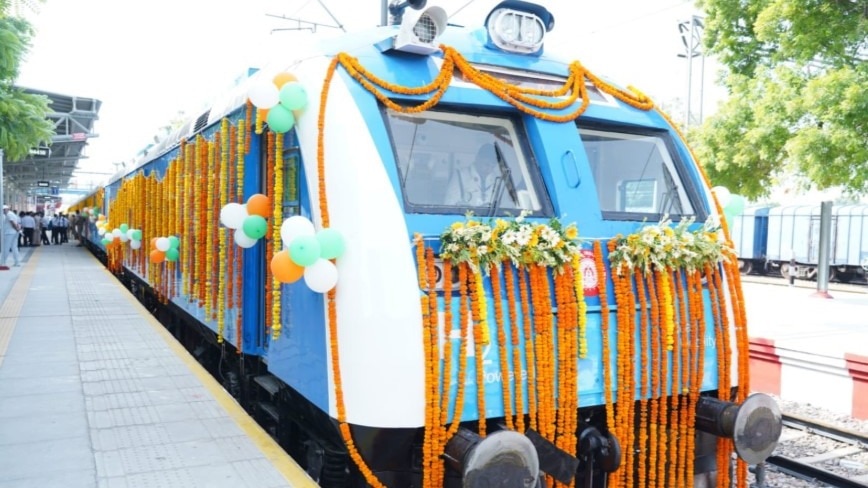
What’s the News?
Prime Minister Narendra Modi flagged off India’s first hydrogen-powered passenger train from Jind, Haryana. The indigenously developed train will operate on the Jind–Sonipat section of Northern Railway.
The launch places India among a small group of countries operating hydrogen-powered trains and demonstrates the technology’s potential for clean rail transport, particularly on non-electrified or low-density routes. Commercial operations are to commence separately after an announcement by Northern Railway.
Hydrogen Train: Key Features
- Route: Jind–Sonipat, Haryana
- Distance: 89 km
- Travel time: Around two hours
- Configuration: 10 coaches
- Eight passenger coaches
- Two driving power cars
- Passenger capacity: Up to 2,600
- Propulsion: 3,200 horsepower, equivalent to approximately 2,400 kW
- Operational speed: 75 kmph
- Design speed: 110 kmph
- Service plan: Two round trips covering about 356 km daily
- Hydrogen consumption: Around 300 kg per day
- Stops: 14 intermediate halts, or 16 stations including Jind and Sonipat terminals.
How Does a Hydrogen Train Work?
The train uses hydrogen fuel cells instead of diesel combustion or continuous electricity from overhead wires.
- Hydrogen stored onboard reacts electrochemically with oxygen from the atmosphere.
- The fuel cell produces electricity that powers the traction motors.
- Batteries store surplus electricity and provide additional power during acceleration.
- The direct by-products are water vapour and heat, with no tailpipe carbon-dioxide emissions.
The train does not require continuous overhead electrification because electricity is generated onboard. However, its overall lifecycle emissions depend on how the hydrogen is produced; renewable-energy-based green hydrogen provides the maximum climate benefit.
Storage and Safety System
The train carries 440 kg of hydrogen at 350-bar pressure, divided equally between its two driving power cars.
- Refuelling time: Around four hours
- Jind storage facility: Capacity of approximately 3,000 kg
- Onboard safety equipment:
- 15 hydrogen-leak detectors
- Seven heat detectors
- Three flame detectors
- Automatic shutdown during a detected leak
- Ventilation fans and CCTV surveillance
Hydrogen is highly flammable; therefore, storage, ventilation, leak detection and emergency isolation systems are central to safe operation.
Indigenous Development
The train was designed, engineered and integrated in India using indigenous technology.
- Developed by the Integral Coach Factory, Chennai.
- Created by replacing the diesel propulsion system of a Diesel Electric Multiple Unit with a hydrogen-electric propulsion system.
- Supports the objectives of Make in India and Atmanirbhar Bharat.
- Each driving power car has a 1,200-kW fuel-cell propulsion system.
Hydrogen for Heritage
The project is associated with Indian Railways’ Hydrogen for Heritage initiative.
- It seeks to introduce hydrogen-fuel-cell trains, particularly on heritage and environmentally sensitive routes.
- Indian Railways has provided for 35 hydrogen train-set rakes comprising 210 coaches.
- The estimated provision is ₹80 crore per rake, amounting to approximately ₹2,800 crore for the trainsets.
- Hydrogen trains can replace diesel traction on routes where full electrification is technically difficult or economically inefficient.
Additional Info
- National Green Hydrogen Mission
- Nodal ministry: Ministry of New and Renewable Energy.
- Approved with an outlay of ₹19,744 crore.
- Target: At least 5 million metric tonnes of green-hydrogen production annually by 2030.
- Associated renewable-energy capacity: Approximately 125 GW.
- Expected outcomes:
- More than ₹8 lakh crore in investment.
- Over six lakh jobs.
- Nearly 50 million metric tonnes of annual greenhouse-gas abatement.
- Green Hydrogen
- Produced through water electrolysis using renewable electricity.
- It is an energy carrier, not a primary source of energy.
- Its environmental advantage depends on renewable electricity, water availability, efficient storage and transport infrastructure.
Sources
RBI Financial Stability Report Highlights Strong Banking Resilience
What’s the News?
The Reserve Bank of India’s latest Financial Stability Report (FSR) has assessed India’s financial system as resilient, supported by stronger bank and non-bank balance sheets, adequate capital and liquidity buffers, improving asset quality and stable profitability.
However, it has flagged risks from geopolitical tensions, supply-chain disruptions, volatile energy prices, elevated global public debt, stretched asset valuations and leveraged non-bank financial intermediaries.
Banking Sector Performance
Scheduled Commercial Banks recorded broad-based improvement:
- Credit growth: 14.5% year-on-year
- Gross NPA ratio: 1.8%, a multi-decadal low
- Annual slippage ratio: 1.2%
- Provisioning Coverage Ratio: 75.6%
- Profit after tax: ₹4,05,268 crore
- CRAR: 17.7%, a multi-decadal high
- CET1 ratio: 15.3%
- Liquidity Coverage Ratio: 124.2%
- Net Stable Funding Ratio: 122.1%
Public-sector banks continued to record faster credit growth than private-sector banks. Agriculture had the highest sectoral GNPA ratio at 5.1% and accounted for 37.2% of total bank GNPAs.
Stress-Test Results
RBI’s macro stress tests covered 46 major Scheduled Commercial Banks.
- Baseline scenario
- CRAR may decline from 17.5% to 15.6%.
- GNPA ratio may rise from 1.8% to 1.9%.
- No bank is projected to breach the minimum CRAR requirement.
- More adverse scenario
- Aggregate CRAR may decline to 13%.
- GNPA ratio may increase to 4.1%.
- Two banks may fall below the minimum CRAR requirement of 9%.
All banks are expected to maintain their CET1 ratios above the regulatory minimum of 5.5% under the tested macroeconomic scenarios.
NBFC Sector
Non-Banking Financial Companies remained financially sound, with healthy capitalisation, profitability and improving asset quality.
- Aggregate NBFC credit growth moderated to 16.6%.
- Profit after tax grew by 11.8%.
- Retail credit growth was led mainly by gold loans and other retail loans.
- Under the baseline stress scenario:
- GNPA ratio may rise from 2.4% to 2.8%.
- CRAR may decline from 22.3% to 20.8%.
- Seven NBFCs may fall below the minimum capital requirement of 15%. The concentration of NBFC lending and their dependence on banks and financial markets remain important channels for transmitting financial shocks.
Major Risks Identified
- Geopolitical risks: Conflicts can raise crude-oil prices, disrupt supply chains and increase exchange-rate volatility.
- Global public debt: High refinancing requirements and rising bond yields may create instability.
- Stretched asset valuations: An abrupt correction in AI-related and other highly valued equities may spill over into Indian markets.
- Non-bank financial intermediaries: High leverage and interconnectedness can amplify market shocks.
- Gold-loan growth: Rapid expansion requires monitoring of collateral valuation, loan-to-value ratios and borrower repayment capacity.
- Financial interconnectedness: Increasing bilateral exposure among banks, NBFCs, mutual funds and insurers may create contagion channels.
Financial Stability Report
- It is a half-yearly publication of the RBI, generally issued in June and December.
- It incorporates inputs from all major financial-sector regulators.
- It assesses:
- Macrofinancial risks
- Banking and NBFC resilience
- Asset quality and capital adequacy
- Liquidity and profitability
- Stress-test outcomes
- Financial-market interconnectedness
- Regulatory developments
- It represents the collective assessment of the FSDC Sub-Committee on risks to India’s financial system.
Additional Info
-
Financial Stability and Development Council
- Established in 2010.
- Apex, non-statutory body under the Ministry of Finance.
- Chaired by the Union Finance Minister.
- Members include:
- RBI Governor
- Heads of SEBI, IRDAI, PFRDA and IBBI
- Finance Ministry officials
- Chief Economic Adviser
- Functions:
- Financial stability
- Inter-regulatory coordination
- Macroprudential supervision
- Financial inclusion and literacy
- Financial-sector development
-
FSDC Sub-Committee
- Chaired by the RBI Governor.
- Reviews systemic risks and coordinates among financial regulators.
- Provides inputs for the Financial Stability Report.
-
Key Terms
- GNPA ratio: Gross non-performing assets as a percentage of gross advances.
- CRAR: Capital available with a bank relative to its risk-weighted assets.
- CET1: Highest-quality regulatory capital, primarily equity and disclosed reserves.
- LCR: Ability to meet short-term liquidity stress using high-quality liquid assets.
- NSFR: Availability of stable funding for longer-term assets and activities.
- PCR: Provisions maintained as a proportion of gross NPAs.
Sources
Vikram-1 Becomes India’s First Privately Developed Orbital Rocket

What’s the News?
Skyroot Aerospace successfully launched Vikram-1, India’s first privately developed orbital-class rocket, from the Satish Dhawan Space Centre, Sriharikota.
Under Mission Aagaman, the launch vehicle placed multiple domestic and international technology-demonstration payloads into a nearly 450-km Low Earth Orbit. The achievement made India the third country, after the United States and China, to demonstrate private-sector orbital launch capability.
Vikram-1?
Vikram-1 is a small-satellite launch vehicle developed by Hyderabad-based Skyroot Aerospace.
- Configuration: Four-stage launch vehicle
- Propulsion:
- Three solid-fuel stages
- One liquid-fuel orbital adjustment module
- Payload capacity: Up to 350 kg to Low Earth Orbit
- Target orbit: Around 450 km altitude at 60° inclination
- Structure: All-carbon composite construction
- Technology: 3D-printed liquid engine
- Purpose: Rapid, customised and on-demand deployment of small satellites
- Name: Honours Dr Vikram Sarabhai, regarded as the father of India’s space programme.
Mission Aagaman
Mission Aagaman was the maiden orbital test flight of Vikram-1.
It validated critical systems such as:
- Propulsion and stage separation
- Avionics and telemetry
- Guidance, navigation and control
- In-flight structural performance
- Payload separation and orbital injection
The rocket injected its payloads into orbit within approximately 15–20 minutes of liftoff.
Major Payloads
- SCOPE: Skyroot’s in-house satellite.
- SOLARAS S3: Technology-demonstration satellite of Grahaa Space.
- DCUBED payload: Demonstration of space technologies.
- Embrace: Cosmoserve Space’s robotic arm designed to capture orbital debris.
- Symbolic payloads:
- Cosmic Bloom micro-art installation.
- An 18-karat gold miniature rocket depicting C.V. Raman, Vikram Sarabhai and A.P.J. Abdul Kalam.
- A handwritten “Vande Mataram” postcard from the Prime Minister.
Why Is It Significant?
- Private orbital capability: Indian private companies can now develop vehicles capable of placing satellites in stable Earth orbit.
- Small-satellite market: Vikram-1 targets the expanding demand for dedicated launches of small satellites.
- Reduced dependence: Domestic startups will not have to depend entirely on ISRO or foreign launch providers.
- Responsive launches: On-demand services can reduce waiting periods associated with rideshare missions.
- Commercial competitiveness: It strengthens India’s position in the global commercial launch-services market.
- Strategic capability: Indigenous launch systems support communication, Earth observation, navigation, disaster management and national security applications.
- Technology validation: The mission demonstrated private-sector capability in advanced materials, propulsion, avionics and precision orbital deployment.
Vikram-1 vs Vikram-S
- Vikram-S
- Skyroot’s first rocket.
- Undertook a suborbital technology-demonstration mission called Mission Prarambh.
- Crossed the boundary of space but was not designed to place satellites in orbit.
- Vikram-1
- An orbital-class launch vehicle.
- Accelerates payloads to sufficient horizontal velocity to remain in a stable Earth orbit.
- Can undertake commercial satellite-launch missions.
Space-Sector Reforms
The launch reflects the implementation of the Indian Space Policy, 2023, which permits non-government entities to undertake end-to-end activities across the space value chain.
Institutional Roles
- IN-SPACe
- Single-window agency for promoting, authorising and supervising private space activities.
- Facilitates private access to ISRO infrastructure and technical facilities.
- ISRO
- India’s national space agency.
- Primarily focuses on research, advanced technologies and strategic or scientific missions.
- NewSpace India Limited
- Central Public Sector Enterprise under the Department of Space.
- Commercialises ISRO-developed technologies, products and launch services.
- Department of Space
- Formulates space policy and oversees India’s institutional space ecosystem.
Additional Info
- Orbital launch
- Places a payload into a stable trajectory around Earth.
- Requires sufficient horizontal velocity to prevent the payload from falling back immediately.
- Suborbital launch
- Reaches space but does not achieve the velocity required for orbit.
- The vehicle or payload subsequently returns to Earth.
- Low Earth Orbit
- Generally extends up to about 2,000 km above Earth.
- Commonly used for Earth-observation, communication, scientific and technology-demonstration satellites.
- Satish Dhawan Space Centre
- Located at Sriharikota in Andhra Pradesh.
- India’s principal operational spaceport.
Sources
India Commissions First Geothermal Wells in Puga Valley

What’s the News?
India commissioned its first and deepest twin geothermal wells at Puga Valley in eastern Ladakh. The two wells, executed by the ONGC Energy Centre, have each been drilled to a depth of 1,000 metres at an altitude exceeding 14,000 feet.
The wells will support reservoir assessment and the development of India’s first 1 MW demonstration-scale geothermal power project. The power plant itself is yet to become operational.
Puga Geothermal Project?
- Location: Puga Valley, eastern Ladakh
- Implementing agency: ONGC Energy Centre
- Number of wells: Two
- Depth: 1,000 metres each
- Project altitude: More than 14,000 feet
- Recorded temperature: 135°C at a depth of 400 metres
- Proposed plant: 1 MW pilot geothermal power project
- Purpose of the wells:
- Evaluate the geothermal reservoir.
- Measure temperature and fluid-flow characteristics.
- Finalise power-plant design.
- Assess the feasibility of larger commercial projects.
The second well was completed in just over a month despite high-altitude weather, intense geothermal activity and complex subsurface conditions. Further testing is underway to evaluate temperatures and reservoir performance at greater depths.
Project Partnership
The project is based on a tripartite agreement involving:
- Ladakh Administration
- Ladakh Autonomous Hill Development Council–Leh
- ONGC Energy Centre
Work had slowed after the earlier Memorandum of Understanding expired. The agreement was subsequently renewed for another five years, allowing drilling and project-development activities to resume.
How Does Geothermal Power Work?
Geothermal energy uses heat stored beneath the Earth’s surface.
- Surface water, rain or snowmelt enters fractures in underground rocks.
- The water is heated by hot rocks and geothermal reservoirs.
- Hot water or steam is brought to the surface through a production well.
- Its heat drives a turbine directly or heats a secondary fluid with a lower boiling point.
- The cooled geothermal fluid can be reinjected underground to maintain reservoir pressure and reduce environmental impact.
Common geothermal power technologies include:
- Dry-steam plants: Steam directly rotates the turbine.
- Flash-steam plants: High-pressure hot water is converted into steam.
- Binary-cycle plants: Geothermal water heats a secondary working fluid, which powers the turbine.
Why Puga Valley?
Puga Valley lies within the tectonically active Himalayan geothermal province. Its hot springs, sulphur deposits, steam vents and high subsurface temperatures indicate significant geothermal activity.
The movement and collision of the Indian and Eurasian plates have created faults and fractures through which heated underground fluids can circulate.
Additional Info
- Geothermal Potential in India
- The Geological Survey of India has identified several geothermal provinces.
- India’s tentative theoretical geothermal potential is estimated at approximately 10 GW.
- Important geothermal locations include:
- Puga and Chumathang—Ladakh
- Manikaran—Himachal Pradesh
- Tapovan—Uttarakhand
- Tattapani—Chhattisgarh
- Cambay Basin—Gujarat
- Bakreswar—West Bengal
- Andaman and Nicobar Islands
- National Policy on Geothermal Energy
- Issued by the Ministry of New and Renewable Energy.
- Seeks to create a framework for:
- Geothermal resource assessment and mapping.
- Electricity generation and direct-heat applications.
- Research, pilot projects and technology development.
- Private-sector investment and international cooperation.
- Advantages
- Available throughout the day and year.
- Requires relatively limited surface land.
- Can provide both electricity and direct heat.
- Generally has a high capacity-utilisation factor.
- Limitations
- High initial exploration and drilling costs.
- Geographically site-specific.
- Risk of corrosive geothermal fluids and mineral scaling.
- Possible release of underground gases.
- Poorly managed extraction may induce minor seismicity or deplete local reservoir pressure.
Sources
Gujarat Tops NITI Aayog’s First Investment Friendliness Index
What’s the News?
NITI Aayog released the inaugural Investment Friendliness Index (IFI) 2026, assessing how effectively States and Union Territories create an environment capable of attracting and retaining private investment.
Gujarat ranked first, followed by Maharashtra and Tamil Nadu. Goa and Odisha completed the group of five “Top Performers”. The index seeks to promote evidence-based reforms and competitive federalism among subnational governments.
Investment Friendliness Index?
The IFI is a comprehensive assessment of the investment ecosystem across all 28 States and eight Union Territories.
It measures conditions influencing domestic and foreign private investment, including infrastructure availability, regulatory predictability, economic performance, resources, governance and fiscal capacity.
- Scoring scale: 0–100
- Total indicators: 84
- 62 secondary-data indicators
- 22 investor-perception indicators
- Investor survey: 1,850 investors
- Responses received: 2,503
- Stakeholder inputs: 165 stakeholders
- Peer groups:
- Large States
- Hilly and North-Eastern States
- City States and Union Territories
Leading States
| Rank | State/UT | Score |
|---|---|---|
| 1 | Gujarat | 56.6 |
| 2 | Maharashtra | 53.7 |
| 3 | Tamil Nadu | 53.3 |
| 4 | Goa | 53.1 |
| 5 | Odisha | 52.4 |
Peer-Group Leaders
- Large States: Gujarat, Maharashtra and Tamil Nadu
- Hilly and North-Eastern States: Uttarakhand, Assam and Himachal Pradesh
- City States and UTs: Goa, Delhi and Chandigarh
Performance Categories
States and UTs were divided into four performance groups:
- Top Performers: Score above 50
- Five States
- Frontrunners: Score from 45 to 50
- 15 States and UTs
- Emerging Performers: Score of at least 40 but below 45
- Eight States and UTs
- Aspiring States: Score below 40
- Eight States and UTs
The categorisation is intended to identify reform priorities rather than merely produce an overall ranking.
Eight Assessment Pillars
| Pillar | Weight |
|---|---|
| Infrastructure | 25% |
| Business climate | 20% |
| Resources | 15% |
| Regulatory ease | 12% |
| Government policy | 10% |
| Financial health | 7% |
| Institutional environment | 6% |
| Environmental resilience | 5% |
The pillars examine factors such as logistics, energy, digital connectivity, industrial infrastructure, economic performance, innovation, human and natural resources, approvals, legal compliance, fiscal position, governance and climate-related risks.
Why Did the Top States Perform Well?
- Gujarat
- Efficient port operations and low turnaround time.
- Reliable and competitive power supply.
- Strong regulatory ease, financial health and government policy environment.
- Maharashtra
- High private-equity and venture-capital investment.
- Strong economic indicators and business climate.
- Highest number of Atal Tinkering Labs.
- Tamil Nadu
- Strong manufacturing and export ecosystem.
- Efficient port infrastructure.
- Nearly 100% conversion of investment memoranda of understanding into projects.
Investment Context
- India’s total investment reached 29.9% of GDP in FY2024-25, compared with a decadal average of 29.1%.
- Government and public-sector capital expenditure grew by 13.9% during FY2021-22 to FY2023-24.
- Household capital expenditure, mainly real estate, grew by 13.4%.
- Private capital expenditure grew more slowly at 8.7%.
- Maharashtra, Karnataka, Gujarat, Delhi and Tamil Nadu collectively attract approximately 85% of India’s FDI inflows.
- The North-Eastern States collectively receive less than 1%, indicating substantial regional concentration.
Additional Info
- Significance of the IFI
- Helps investors compare State-level business conditions.
- Provides States with indicator-specific reform priorities.
- Encourages competitive and cooperative federalism.
- Supports the objective of mobilising private capital for Viksit Bharat@2047.
- Highlights regional disparities in infrastructure and investment flows.
- NITI Aayog
- Full form: National Institution for Transforming India.
- Established through a Union Cabinet resolution.
- It is neither a constitutional nor a statutory body.
- The Prime Minister serves as its Chairperson.
- It promotes cooperative federalism and provides policy inputs to Union and State governments.
Sources
72nd National Film Awards Announced; Article 370 Wins Best Feature Film

What’s the News?
The Ministry of Information and Broadcasting announced the 72nd National Film Awards, recognising films certified by the Central Board of Film Certification during 2024.
Article 370 won Best Feature Film, while Rajkumar Periasamy received Best Direction for Amaran. Mammootty and Kartik Aaryan jointly won Best Actor, while Yami Gautam received Best Actress. The winners were selected by an 11-member feature-film jury chaired by filmmaker Jayaraj.
Major Awards
| Category | Winner |
|---|---|
| Best Feature Film | Article 370 |
| Best Direction | Rajkumar Periasamy — Amaran |
| Best Actor | Mammootty — Bramayugam; Kartik Aaryan — Chandu Champion |
| Best Actress | Yami Gautam — Article 370 |
| Best Supporting Actor | Sanjay Mishra — Bhakshak |
| Best Supporting Actress | Sachana Namidass — Maharaja; Ropashree Varkady — Mithya |
| Best Debut Film of a Director | Randeep Hooda — Swatantrya Veer Savarkar |
| Best Popular Film Providing Wholesome Entertainment | Kalki 2898 AD |
| Best Children’s Film | 35 – Chinna Katha Kaadu |
| Best Film Promoting National, Social and Environmental Values | Captain Miller |
Technical and Creative Awards
- Best Cinematography: Shehnad Jalal — Bramayugam
- Best Original Screenplay: Sukumar — Pushpa: The Rule–Part 2
- Best Adapted Screenplay: Yogesh Deshpande — Swargandharva Sudhir Phadke
- Best Dialogue: Venky Atluri — Lucky Baskhar
- Best Editing: R. Kalaivannan — Amaran
- Best Production Design: Nitin Zihani Choudhary — Kalki 2898 AD
- Best Music Direction—Songs: Shashwat Sachdev — Article 370
- Best Background Music: G.V. Prakash Kumar — Amaran
- Best Lyrics: Manoj Muntashir — “Jaane Do” from Maidaan
- Best Choreography: Vijay Ganguly — “Aaj Ki Raat” from Stree 2
- Best Action Direction: Anl Arasu — Maharaja
Best Films by Language
| Language | Film |
|---|---|
| Hindi | Srikanth |
| Tamil | Raayan |
| Telugu | Committee Kurrollu |
| Malayalam | Feminichi Fathima |
| Kannada | Mithya |
| Marathi | Mukkam Post Bombilwadi |
| Bengali | Chalchitra Ekhon |
| Assamese | Juiphool |
| Gujarati | Maaran |
| Odia | Lahari |
| Manipuri | Sunita |
| Konkani | Mog Asum |
Dholi won Best Garhwali Film and IMBU won Best Tulu Film under languages not specified in the Constitution’s Eighth Schedule.
Non-Feature Films and Writing on Cinema
- Best Non-Feature Film: Bhangaar
- Best Documentary: Ram-Nami
- Best Short Film: Hamsafar
- Best Animation Film: Touched as Water
- Best Non-Feature Film Promoting Social and Environmental Values: Piplantri: A Tale of Eco Feminism
- Best Non-Feature Film Direction: Aanand L. Rai — Statue of Unity–Ekta Ka Prateek
- Best Film Critic: Sanjeev Shrivastava
- Best Book on Cinema: K. Pradeep Kumar Shetty’s Kannada book on the political and philosophical dimensions of Kannada cinema.
National Film Awards
- Instituted in 1954, initially as the State Awards for Films.
- Conferred annually by the Government of India through the Ministry of Information and Broadcasting.
- Managed by the National Film Development Corporation since 2021.
- Major divisions:
- Feature films
- Non-feature films
- Writing and criticism on cinema
- Dadasaheb Phalke Award
- Awards seek to promote:
- Aesthetic and technical excellence
- Socially relevant cinema
- India’s linguistic and cultural diversity
- National unity and integrity
- Swarna Kamal: Golden Lotus, generally awarded in major film and direction categories.
- Rajat Kamal: Silver Lotus, generally awarded for acting, technical and language-specific categories.
Additional Info
- Central Board of Film Certification
- Statutory body under the Ministry of Information and Broadcasting.
- Regulates the public exhibition of films under the Cinematograph Act, 1952.
- Films considered for this edition were required to have received CBFC certification during 2024.
- Constitutional Link
- The Eighth Schedule currently recognises 22 languages.
- National Film Awards separately recognise films in languages included in the Eighth Schedule and films in other Indian languages.
Sources
July 2026
Archive
October 2026
- 27 October 2026
- 26 October 2026
- 24 October 2026
- 23 October 2026
- 22 October 2026
- 21 October 2026
- 20 October 2026
- 19 October 2026
- 17 October 2026
- 16 October 2026
- 15 October 2026
- 14 October 2026
- 13 October 2026
- 12 October 2026
- 10 October 2026
- 09 October 2026
- 08 October 2026
- 07 October 2026
- 06 October 2026
- 05 October 2026
- 03 October 2026
- 02 October 2026
- 01 October 2026
September 2026
- 30 September 2026
- 29 September 2026
- 28 September 2026
- 26 September 2026
- 25 September 2026
- 24 September 2026
- 23 September 2026
- 22 September 2026
- 21 September 2026
- 19 September 2026
- 18 September 2026
- 17 September 2026
- 16 September 2026
- 15 September 2026
- 12 September 2026
- 11 September 2026
- 10 September 2026
- 09 September 2026
- 08 September 2026
- 07 September 2026
- 05 September 2026
- 04 September 2026
- 03 September 2026
- 02 September 2026
- 01 September 2026
August 2026
- 31 August 2026
- 29 August 2026
- 27 August 2026
- 26 August 2026
- 25 August 2026
- 24 August 2026
- 22 August 2026
- 21 August 2026
- 20 August 2026
- 19 August 2026
- 18 August 2026
- 17 August 2026
- 14 August 2026
- 13 August 2026
- 12 August 2026
- 11 August 2026
- 10 August 2026
- 08 August 2026
- 07 August 2026
- 06 August 2026
- 05 August 2026
- 04 August 2026
- 03 August 2026
- 01 August 2026
July 2026
- 31 July 2026
- 30 July 2026
- 29 July 2026
- 28 July 2026
- 27 July 2026
- 25 July 2026
- 23 July 2026
- 22 July 2026
- 21 July 2026
- 20 July 2026
- 18 July 2026
- 17 July 2026
- 15 July 2026
- 14 July 2026
- 13 July 2026
- 11 July 2026
- 10 July 2026
- 09 July 2026
- 08 July 2026
- 07 July 2026
- 06 July 2026
- 04 July 2026
- 03 July 2026
- 02 July 2026
- 01 July 2026
June 2026
May 2026
April 2026
March 2026
- 31 March 2026
- 30 March 2026
- 28 March 2026
- 27 March 2026
- 26 March 2026
- 25 March 2026
- 24 March 2026
- 23 March 2026
- 21 March 2026
- 20 March 2026
- 19 March 2026
- 18 March 2026
- 17 March 2026
- 16 March 2026
- 14 March 2026
- 13 March 2026
- 12 March 2026
- 11 March 2026
- 10 March 2026
- 09 March 2026
- 07 March 2026
- 06 March 2026
- 05 March 2026
- 03 March 2026
- 02 March 2026
February 2026
- 28 February 2026
- 27 February 2026
- 26 February 2026
- 25 February 2026
- 24 February 2026
- 23 February 2026
- 21 February 2026
- 20 February 2026
- 19 February 2026
- 18 February 2026
- 17 February 2026
- 16 February 2026
- 13 February 2026
- 12 February 2026
- 11 February 2026
- 10 February 2026
- 09 February 2026
- 07 February 2026
- 06 February 2026
- 05 February 2026
- 04 February 2026
- 03 February 2026
- 02 February 2026
January 2026
- 31 January 2026
- 30 January 2026
- 29 January 2026
- 28 January 2026
- 27 January 2026
- 26 January 2026
- 24 January 2026
- 23 January 2026
- 22 January 2026
- 21 January 2026
- 20 January 2026
- 19 January 2026
- 16 January 2026
- 15 January 2026
- 14 January 2026
- 13 January 2026
- 12 January 2026
- 10 January 2026
- 09 January 2026
- 08 January 2026
- 07 January 2026
- 06 January 2026
- 05 January 2026
- 03 January 2026
- 02 January 2026
- 01 January 2026
December 2025
- 31 December 2025
- 30 December 2025
- 29 December 2025
- 27 December 2025
- 26 December 2025
- 24 December 2025
- 23 December 2025
- 22 December 2025
- 20 December 2025
- 19 December 2025
- 18 December 2025
- 17 December 2025
- 16 December 2025
- 15 December 2025
- 13 December 2025
- 12 December 2025
- 11 December 2025
- 10 December 2025
- 09 December 2025
- 08 December 2025
- 05 December 2025
- 04 December 2025
- 03 December 2025
- 02 December 2025
November 2025
- 29 November 2025
- 28 November 2025
- 27 November 2025
- 26 November 2025
- 25 November 2025
- 24 November 2025
- 22 November 2025
- 21 November 2025
- 20 November 2025
- 19 November 2025
- 18 November 2025
- 17 November 2025
- 15 November 2025
- 14 November 2025
- 13 November 2025
- 12 November 2025
- 11 November 2025
- 10 November 2025
- 08 November 2025
- 07 November 2025
- 06 November 2025
- 05 November 2025
- 04 November 2025
- 03 November 2025
- 01 November 2025
October 2025
- 31 October 2025
- 30 October 2025
- 29 October 2025
- 28 October 2025
- 27 October 2025
- 25 October 2025
- 24 October 2025
- 23 October 2025
- 22 October 2025
- 21 October 2025
- 20 October 2025
- 18 October 2025
- 17 October 2025
- 16 October 2025
- 15 October 2025
- 14 October 2025
- 13 October 2025
- 11 October 2025
- 10 October 2025
- 09 October 2025
- 08 October 2025
- 07 October 2025
- 06 October 2025
- 04 October 2025
- 03 October 2025
- 02 October 2025
- 01 October 2025
September 2025
- 30 September 2025
- 29 September 2025
- 27 September 2025
- 26 September 2025
- 25 September 2025
- 24 September 2025
- 23 September 2025
- 22 September 2025
- 20 September 2025
- 19 September 2025
- 18 September 2025
- 17 September 2025
- 16 September 2025
- 15 September 2025
- 13 September 2025
- 12 September 2025
- 11 September 2025
- 10 September 2025
- 09 September 2025
- 08 September 2025
- 06 September 2025
- 05 September 2025
- 04 September 2025
- 03 September 2025
- 02 September 2025
- 01 September 2025
August 2025
- 30 August 2025
- 29 August 2025
- 28 August 2025
- 27 August 2025
- 26 August 2025
- 25 August 2025
- 23 August 2025
- 22 August 2025
- 21 August 2025
- 20 August 2025
- 19 August 2025
- 18 August 2025
- 16 August 2025
- 14 August 2025
- 13 August 2025
- 12 August 2025
- 11 August 2025
- 08 August 2025
- 07 August 2025
- 06 August 2025
- 05 August 2025
- 04 August 2025
- 02 August 2025
- 01 August 2025
July 2025
- 31 July 2025
- 30 July 2025
- 29 July 2025
- 28 July 2025
- 26 July 2025
- 25 July 2025
- 24 July 2025
- 23 July 2025
- 22 July 2025
- 21 July 2025
- 19 July 2025
- 18 July 2025
- 17 July 2025
- 16 July 2025
- 15 July 2025
- 12 July 2025
- 11 July 2025
- 10 July 2025
- 09 July 2025
- 07 July 2025
- 05 July 2025
- 04 July 2025
- 03 July 2025
- 02 July 2025
- 01 July 2025
June 2025
- 30 June 2025
- 28 June 2025
- 27 June 2025
- 26 June 2025
- 25 June 2025
- 24 June 2025
- 23 June 2025
- 21 June 2025
- 20 June 2025
- 19 June 2025
- 18 June 2025
- 17 June 2025
- 16 June 2025
- 14 June 2025
- 13 June 2025
- 12 June 2025
- 11 June 2025
- 10 June 2025
- 09 June 2025
- 07 June 2025
- 06 June 2025
- 05 June 2025
- 04 June 2025
- 03 June 2025
- 02 June 2025
May 2025
April 2025
- 30 April 2025
- 29 April 2025
- 28 April 2025
- 26 April 2025
- 25 April 2025
- 24 April 2025
- 23 April 2025
- 22 April 2025
- 21 April 2025
- 19 April 2025
- 18 April 2025
- 17 April 2025
- 16 April 2025
- 15 April 2025
- 14 April 2025
- 12 April 2025
- 11 April 2025
- 10 April 2025
- 09 April 2025
- 08 April 2025
- 07 April 2025
- 05 April 2025
- 04 April 2025
- 03 April 2025
- 02 April 2025
- 01 April 2025
March 2025
- 31 March 2025
- 29 March 2025
- 28 March 2025
- 27 March 2025
- 26 March 2025
- 25 March 2025
- 24 March 2025
- 22 March 2025
- 21 March 2025
- 20 March 2025
- 19 March 2025
- 18 March 2025
- 17 March 2025
- 15 March 2025
- 13 March 2025
- 12 March 2025
- 11 March 2025
- 10 March 2025
- 08 March 2025
- 07 March 2025
- 06 March 2025
- 05 March 2025
- 04 March 2025
- 03 March 2025
- 01 March 2025
February 2025
- 28 February 2025
- 27 February 2025
- 26 February 2025
- 25 February 2025
- 24 February 2025
- 22 February 2025
- 21 February 2025
- 20 February 2025
- 19 February 2025
- 18 February 2025
- 17 February 2025
- 15 February 2025
- 14 February 2025
- 13 February 2025
- 12 February 2025
- 11 February 2025
- 10 February 2025
- 08 February 2025
- 07 February 2025
- 06 February 2025
- 05 February 2025
- 04 February 2025
- 03 February 2025
- 01 February 2025
January 2025
- 31 January 2025
- 30 January 2025
- 29 January 2025
- 28 January 2025
- 27 January 2025
- 25 January 2025
- 24 January 2025
- 23 January 2025
- 22 January 2025
- 21 January 2025
- 20 January 2025
- 18 January 2025
- 17 January 2025
- 16 January 2025
- 15 January 2025
- 14 January 2025
- 13 January 2025
- 11 January 2025
- 10 January 2025
- 09 January 2025
- 08 January 2025
- 07 January 2025
- 06 January 2025
- 04 January 2025
- 03 January 2025
- 02 January 2025
- 01 January 2025