
Current Affairs
Stay updated with the latest national and international events.
17 October 2026
ISRO Successfully Completes Gaganyaan Crew–Service Module Separation Tests
What’s the News?
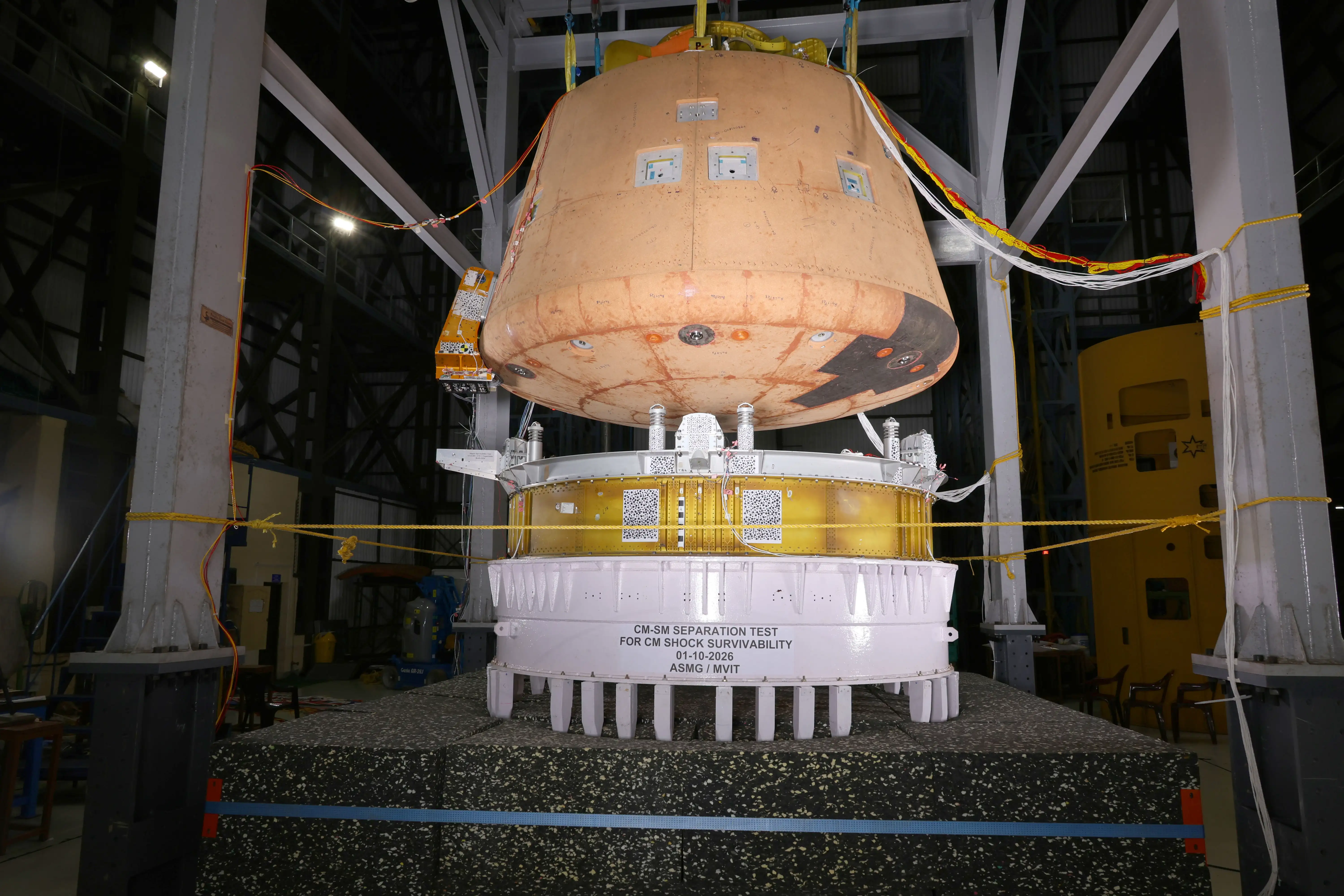
- The Indian Space Research Organisation (ISRO) has successfully completed a series of Crew Module (CM)–Service Module (SM) separation tests under the Gaganyaan Programme.
- The tests were conducted at the Vikram Sarabhai Space Centre (VSSC), Thiruvananthapuram, Kerala.
- They validated a critical separation mechanism ahead of Gaganyaan’s first uncrewed mission (G1), targeted for launch in 2026.
Gaganyaan Orbital Module?
- The Orbital Module comprises two major components:
- Crew Module (CM): A habitable, pressurised capsule designed to accommodate astronauts and safely return them to Earth.
- Service Module (SM): Provides essential support functions, including propulsion, power and other spacecraft services.
- Both modules remain connected during launch and orbital operations through a separation system and electrical and fluid umbilical connections.
- Before atmospheric re-entry, the Crew Module separates from the Service Module using precisely sequenced pyrotechnic devices and jettisoning mechanisms.
Highlights of the Separation Tests
- Test Setup: A specially instrumented facility at VSSC simulated the integrated CM–SM assembly and separation sequence.
- Major Validations:
- Successful severing of electrical and fluid umbilical connections.
- Structural reliability and shock-survivability of critical Crew Module subsystems.
- Systems Evaluated:
- Avionics and Inertial Navigation Systems.
- Thermal Protection System (TPS) in the aft and conical heat shields.
- Crew Module Deployable Umbilical Shield.
- Pyrotechnic devices associated with the Crew Module Uprighting System and Thermal & Humidity Control System.
- Significance: The tests strengthened confidence in the separation system required for safe Crew Module re-entry during the upcoming G1 mission.
Additional Info
- Gaganyaan Programme:
- Objective: Demonstrate India's indigenous human spaceflight capability.
- Planned crew: 3 astronauts.
- Target orbit: 400 km Low Earth Orbit (LEO).
- Mission duration: 3 days.
- Recovery: Safe splashdown in Indian sea waters.
- Launch vehicle: Human-Rated LVM3 (HLVM3).
- Human Space Flight Centre (HSFC):
- Lead ISRO centre responsible for coordinating the Gaganyaan Programme and human spaceflight activities.
- Located in Bengaluru, Karnataka.
- Vikram Sarabhai Space Centre (VSSC):
- Located in Thiruvananthapuram, Kerala.
- Major ISRO centre responsible for launch vehicle development.
Sources
World Health Summit 2026 Held in Berlin with Major Global Health Commitments
What’s the News?
- The World Health Summit (WHS) 2026 was held in Berlin, Germany, bringing together policymakers, scientists, health experts and international organisations.
- The summit focused on strengthening global health systems, pandemic preparedness, health equity and sustainable healthcare financing.
- Its theme was “From Crisis to Resilience: Innovating for Health.”
- The summit attracted over 4,000 in-person participants from more than 130 countries, over 50,000 online participants and more than 400 speakers across 76 sessions.
Major Funding Commitments?
- €250 Million for Women's Health:
- The Government of Bangladesh and the European Investment Bank (EIB) announced plans for a €250 million initiative to improve women's healthcare, district hospitals and critical care services.
- US$100 Million for Stillbirth Prevention:
- The Gates Foundation and Wellcome Leap committed US$100 million to the Uzima Stillbirth Prevention Program.
- It aims to reduce stillbirth rates by 50% in selected countries within 10 years.
- €10 Million for Maternal and Child Health:
- Germany pledged €10 million to the Global Financing Facility's Sustainable Commodities Access Program.
- It aims to improve access to family planning and maternal, newborn and child health products.
Reports and Global Health Threats?
- Lancet Commission on 21st Century Global Threats to Health:
- Identified 17 major threats to global health.
- Highlighted the malicious use of Artificial Intelligence (AI) and nuclear conflict as two potential threats to human survival.
- Wellcome Global Monitor 2026:
- Based on more than 140,000 respondents across 140 countries.
- Reported a decline in public trust in science compared with pre-COVID-19 levels.
- State of the World's Emotional Health 2026:
- Released by Gallup in partnership with WHS.
- Highlighted the relationship between social media use and emotional well-being, varying by age, usage duration and location.
- Global Preparedness Monitoring Board (GPMB):
- Presented its final report, Getting Ahead of Pandemic Risk: Insights from 8 Years of Global Preparedness Monitoring.
Additional Info
- World Health Summit (WHS):
- Established: 2009.
- Annual venue: Berlin, Germany.
- Organiser: WHS Foundation GmbH, a wholly owned subsidiary of Charité – Universitätsmedizin Berlin.
- Nature: International multi-stakeholder platform for global health cooperation.
- It is distinct from the World Health Assembly (WHA), the decision-making body of the World Health Organization (WHO).
- Six Central Themes of WHS 2026:
- Global Health Architecture.
- Pandemic Prevention, Preparedness and Response.
- Health Equity for Women, Children and Youth.
- Future-Ready Health Systems.
- Conflict and Health.
- Environmental Drivers of Health.
- Next WHS Regional Meeting:
- Host: Hong Kong, China.
- Theme: “Health Across Borders.”
- Organiser: Li Ka Shing Faculty of Medicine, University of Hong Kong.
Sources
International Day for the Eradication of Poverty 2026 Observed with Focus on Safe Housing

What’s the News?
- The International Day for the Eradication of Poverty was observed globally on 17 October 2026 to raise awareness about poverty, inequality, social exclusion and human dignity.
- The 2026 theme/focus is “Safe Homes for All,” under the broader 2026–2028 theme “United for Peace and Human Rights.”
- The United Nations emphasised access to safe, adequate and affordable housing as an essential component of poverty eradication and human rights.
Theme 2026: Safe Homes for All?
- The theme highlights the connection between housing insecurity, poverty and social exclusion.
- It identifies three major priorities:
- Housing as a Human Right: Recognising adequate and affordable housing as essential for a dignified standard of living.
- Inclusive Policymaking: Involving people experiencing poverty in designing, implementing and evaluating housing policies.
- Resource Mobilisation: Strengthening public financing and investments to ensure safe, accessible and affordable homes.
- The theme aligns with the Doha Political Declaration, adopted at the Second World Summit for Social Development in 2025.
Global Poverty and Housing Statistics
- 826 million people: Estimated to be living in extreme poverty globally in 2026, representing approximately 10% of the world's population.
- US$3 per day: International extreme poverty threshold, measured in 2021 purchasing power parity (PPP).
- 2.8 billion people: Experience some form of housing inadequacy or insecurity worldwide.
- 3.8 billion people: Remain without any form of social protection.
Additional Info
- Historical Background:
- First observed through a public gathering on 17 October 1987, when approximately 100,000 people assembled at Trocadéro, Paris, France.
- Officially recognised by the United Nations General Assembly (UNGA) through Resolution 47/196 in 1992.
- First official UN observance: 1993.
- Related Sustainable Development Goals (SDGs):
- SDG 1: No Poverty.
- SDG 10: Reduced Inequalities.
- SDG 11: Sustainable Cities and Communities.
- SDG 16: Peace, Justice and Strong Institutions.
- Related Indian Initiatives:
- Pradhan Mantri Awas Yojana–Urban 2.0 (PMAY-U 2.0): Aims to provide housing assistance to 1 crore urban families over five years (2024–2029).
- Pradhan Mantri Awaas Yojana–Gramin (PMAY-G): Provision for 2 crore additional rural houses during FY 2024–25 to 2028–29.
Sources
China Proposes Export Controls on 40 Advanced AI, Solar and Biotechnology Technologies

What’s the News?
- China's Ministry of Commerce and Ministry of Science and Technology have jointly proposed new export controls on 40 advanced technologies across Artificial Intelligence (AI), biotechnology and solar energy.
- The draft revision to China's Catalogue of Technologies Prohibited and Restricted from Export proposes:
- 14 technologies: Complete export prohibition.
- 26 technologies: Export restrictions.
- The move aims to safeguard national security, prevent technological misuse and regulate the overseas transfer of sensitive technologies.
Technologies Covered?
The proposed controls cover three major sectors:
- Artificial Intelligence (AI) – 23 Technologies:
- Includes large AI models, intelligent agents, computing clusters and information-processing technologies.
- Proposes banning technologies capable of generating or modifying malicious computer code.
- Covers selected AI-assisted cybersecurity technologies and models trained on sensitive Chinese data.
- Solar Energy (Photovoltaics) – 12 Technologies:
- Covers polysilicon production, silicon wafer manufacturing and advanced solar-cell manufacturing.
- Proposes banning selected perovskite and tandem solar-cell module manufacturing technologies.
- Proposes restrictions on polysilicon engineering technologies for production lines with an annual capacity of 30,000 tonnes or more.
- Biotechnology – 5 Technologies:
- Covers cell and gene therapy platforms, small nucleic-acid medicines and pathogen-related technologies.
Export Control Framework?
- Pre-Export Registration: Exporters must temporarily register overseas transfers involving listed technologies, including ongoing transactions.
- Technology Transfers: Controls extend to intellectual property transfers, overseas licensing and changes in foreign ownership or control.
- Exemptions: Technologies already publicly available through open-source platforms or academic publications are generally excluded.
- Public Consultation: The draft remains open for public feedback until November 2026, before finalisation.
Additional Info
- Export Controls:
- Government regulations restricting or prohibiting the transfer of specified goods, software or technologies to foreign recipients.
- Used for national security, strategic technology protection and preventing potential misuse.
- Significance for India:
- Proposed solar technology restrictions could affect Indian manufacturers seeking advanced Chinese production technologies.
- Highlight the importance of domestic manufacturing under the Production Linked Incentive (PLI) Scheme for High Efficiency Solar PV Modules.
- Reinforce the relevance of indigenous technological capabilities under the IndiaAI Mission.
- Important Distinction:
- The proposed controls primarily concern specified technologies and associated transfers, rather than a blanket ban on exports of finished solar panels or AI services.
Sources
Scientists Identify Over 10,000 Faults on the Shrinking Moon

What’s the News?
- A new study published in The Planetary Science Journal has identified over 10,000 geologically young faults across the Moon's surface.
- The research was led by Thomas R. Watters, scientist emeritus at the Smithsonian's National Air and Space Museum, USA.
- Using images from NASA's Lunar Reconnaissance Orbiter Camera (LROC), scientists estimated that the Moon's radius has decreased by approximately 45 metres over the past 400–800 million years.
- The findings highlight potential moonquake risks for future lunar exploration missions, including NASA's Artemis programme.
Findings of the Study?
- Lunar Contraction:
- The Moon is gradually shrinking as its interior cools and contracts.
- Estimated contraction rate: 6–11 centimetres per million years, assuming a constant rate.
- This contraction creates compressional stress, resulting in faults and surface deformation.
- Fault Distribution:
- More than 8,900 lobate scarps and 2,000 small mare ridges were mapped.
- Faults occur across both lunar highlands and maria.
- Regions with thicker lunar crust generally have fewer faults, suggesting greater geological stability.
- Moonquake Risk:
- Movement along existing faults or formation of new faults can generate moonquakes.
- Unlike Earth, where about 90% of seismic activity is concentrated near tectonic plate boundaries, the Moon has a single-plate outer shell.
- Consequently, moonquakes can occur across different regions of the lunar surface.
What Are Lobate Scarps and Mare Ridges?
- Lobate Scarps:
- Curved, cliff-like formations produced by thrust faulting.
- Form when compressional forces push one section of the lunar crust over another.
- Mare Ridges:
- Raised geological structures found on the Moon's dark basaltic plains, known as lunar maria.
- Form due to compressional deformation of the lunar crust.
- Both features provide evidence of the Moon's relatively recent tectonic activity.
Implications for Future Lunar Missions?
- Fault-related moonquakes may threaten astronauts, landing systems and permanent lunar infrastructure.
- Seismic risk assessment is important when selecting landing sites for NASA's Artemis programme and other lunar missions.
- Regions with fewer faults and thicker crust may offer comparatively stable locations for future lunar bases.
Additional Info
- Lunar Reconnaissance Orbiter (LRO):
- Space agency: NASA (USA).
- Launched: 2009.
- Objective: Mapping the lunar surface, studying lunar geology and supporting future exploration missions.
- Its LROC instrument has captured millions of high-resolution lunar images.
- Thrust Fault:
- A reverse fault formed under compressional stress, where one rock block moves upward over another along a low-angle fault plane.
- Related Indian Mission:
- Chandrayaan-3: Successfully soft-landed near the lunar south polar region in 2023.
- Its Instrument for Lunar Seismic Activity (ILSA) measured vibrations and seismic events on the lunar surface.
Sources
October 2026
28 October 202627 October 202626 October 202624 October 202623 October 202622 October 202621 October 202620 October 202619 October 202617 October 202616 October 202615 October 202614 October 202613 October 202612 October 202610 October 202609 October 202608 October 202607 October 202606 October 202605 October 202603 October 202602 October 202601 October 2026
Archive
October 2026
- 28 October 2026
- 27 October 2026
- 26 October 2026
- 24 October 2026
- 23 October 2026
- 22 October 2026
- 21 October 2026
- 20 October 2026
- 19 October 2026
- 17 October 2026
- 16 October 2026
- 15 October 2026
- 14 October 2026
- 13 October 2026
- 12 October 2026
- 10 October 2026
- 09 October 2026
- 08 October 2026
- 07 October 2026
- 06 October 2026
- 05 October 2026
- 03 October 2026
- 02 October 2026
- 01 October 2026
September 2026
- 30 September 2026
- 29 September 2026
- 28 September 2026
- 26 September 2026
- 25 September 2026
- 24 September 2026
- 23 September 2026
- 22 September 2026
- 21 September 2026
- 19 September 2026
- 18 September 2026
- 17 September 2026
- 16 September 2026
- 15 September 2026
- 12 September 2026
- 11 September 2026
- 10 September 2026
- 09 September 2026
- 08 September 2026
- 07 September 2026
- 05 September 2026
- 04 September 2026
- 03 September 2026
- 02 September 2026
- 01 September 2026
August 2026
- 31 August 2026
- 29 August 2026
- 27 August 2026
- 26 August 2026
- 25 August 2026
- 24 August 2026
- 22 August 2026
- 21 August 2026
- 20 August 2026
- 19 August 2026
- 18 August 2026
- 17 August 2026
- 14 August 2026
- 13 August 2026
- 12 August 2026
- 11 August 2026
- 10 August 2026
- 08 August 2026
- 07 August 2026
- 06 August 2026
- 05 August 2026
- 04 August 2026
- 03 August 2026
- 01 August 2026
July 2026
- 31 July 2026
- 30 July 2026
- 29 July 2026
- 28 July 2026
- 27 July 2026
- 25 July 2026
- 23 July 2026
- 22 July 2026
- 21 July 2026
- 20 July 2026
- 18 July 2026
- 17 July 2026
- 15 July 2026
- 14 July 2026
- 13 July 2026
- 11 July 2026
- 10 July 2026
- 09 July 2026
- 08 July 2026
- 07 July 2026
- 06 July 2026
- 04 July 2026
- 03 July 2026
- 02 July 2026
- 01 July 2026
June 2026
May 2026
April 2026
March 2026
- 31 March 2026
- 30 March 2026
- 28 March 2026
- 27 March 2026
- 26 March 2026
- 25 March 2026
- 24 March 2026
- 23 March 2026
- 21 March 2026
- 20 March 2026
- 19 March 2026
- 18 March 2026
- 17 March 2026
- 16 March 2026
- 14 March 2026
- 13 March 2026
- 12 March 2026
- 11 March 2026
- 10 March 2026
- 09 March 2026
- 07 March 2026
- 06 March 2026
- 05 March 2026
- 03 March 2026
- 02 March 2026
February 2026
- 28 February 2026
- 27 February 2026
- 26 February 2026
- 25 February 2026
- 24 February 2026
- 23 February 2026
- 21 February 2026
- 20 February 2026
- 19 February 2026
- 18 February 2026
- 17 February 2026
- 16 February 2026
- 13 February 2026
- 12 February 2026
- 11 February 2026
- 10 February 2026
- 09 February 2026
- 07 February 2026
- 06 February 2026
- 05 February 2026
- 04 February 2026
- 03 February 2026
- 02 February 2026
January 2026
- 31 January 2026
- 30 January 2026
- 29 January 2026
- 28 January 2026
- 27 January 2026
- 26 January 2026
- 24 January 2026
- 23 January 2026
- 22 January 2026
- 21 January 2026
- 20 January 2026
- 19 January 2026
- 16 January 2026
- 15 January 2026
- 14 January 2026
- 13 January 2026
- 12 January 2026
- 10 January 2026
- 09 January 2026
- 08 January 2026
- 07 January 2026
- 06 January 2026
- 05 January 2026
- 03 January 2026
- 02 January 2026
- 01 January 2026
December 2025
- 31 December 2025
- 30 December 2025
- 29 December 2025
- 27 December 2025
- 26 December 2025
- 24 December 2025
- 23 December 2025
- 22 December 2025
- 20 December 2025
- 19 December 2025
- 18 December 2025
- 17 December 2025
- 16 December 2025
- 15 December 2025
- 13 December 2025
- 12 December 2025
- 11 December 2025
- 10 December 2025
- 09 December 2025
- 08 December 2025
- 05 December 2025
- 04 December 2025
- 03 December 2025
- 02 December 2025
November 2025
- 29 November 2025
- 28 November 2025
- 27 November 2025
- 26 November 2025
- 25 November 2025
- 24 November 2025
- 22 November 2025
- 21 November 2025
- 20 November 2025
- 19 November 2025
- 18 November 2025
- 17 November 2025
- 15 November 2025
- 14 November 2025
- 13 November 2025
- 12 November 2025
- 11 November 2025
- 10 November 2025
- 08 November 2025
- 07 November 2025
- 06 November 2025
- 05 November 2025
- 04 November 2025
- 03 November 2025
- 01 November 2025
October 2025
- 31 October 2025
- 30 October 2025
- 29 October 2025
- 28 October 2025
- 27 October 2025
- 25 October 2025
- 24 October 2025
- 23 October 2025
- 22 October 2025
- 21 October 2025
- 20 October 2025
- 18 October 2025
- 17 October 2025
- 16 October 2025
- 15 October 2025
- 14 October 2025
- 13 October 2025
- 11 October 2025
- 10 October 2025
- 09 October 2025
- 08 October 2025
- 07 October 2025
- 06 October 2025
- 04 October 2025
- 03 October 2025
- 02 October 2025
- 01 October 2025
September 2025
- 30 September 2025
- 29 September 2025
- 27 September 2025
- 26 September 2025
- 25 September 2025
- 24 September 2025
- 23 September 2025
- 22 September 2025
- 20 September 2025
- 19 September 2025
- 18 September 2025
- 17 September 2025
- 16 September 2025
- 15 September 2025
- 13 September 2025
- 12 September 2025
- 11 September 2025
- 10 September 2025
- 09 September 2025
- 08 September 2025
- 06 September 2025
- 05 September 2025
- 04 September 2025
- 03 September 2025
- 02 September 2025
- 01 September 2025
August 2025
- 30 August 2025
- 29 August 2025
- 28 August 2025
- 27 August 2025
- 26 August 2025
- 25 August 2025
- 23 August 2025
- 22 August 2025
- 21 August 2025
- 20 August 2025
- 19 August 2025
- 18 August 2025
- 16 August 2025
- 14 August 2025
- 13 August 2025
- 12 August 2025
- 11 August 2025
- 08 August 2025
- 07 August 2025
- 06 August 2025
- 05 August 2025
- 04 August 2025
- 02 August 2025
- 01 August 2025
July 2025
- 31 July 2025
- 30 July 2025
- 29 July 2025
- 28 July 2025
- 26 July 2025
- 25 July 2025
- 24 July 2025
- 23 July 2025
- 22 July 2025
- 21 July 2025
- 19 July 2025
- 18 July 2025
- 17 July 2025
- 16 July 2025
- 15 July 2025
- 12 July 2025
- 11 July 2025
- 10 July 2025
- 09 July 2025
- 07 July 2025
- 05 July 2025
- 04 July 2025
- 03 July 2025
- 02 July 2025
- 01 July 2025
June 2025
- 30 June 2025
- 28 June 2025
- 27 June 2025
- 26 June 2025
- 25 June 2025
- 24 June 2025
- 23 June 2025
- 21 June 2025
- 20 June 2025
- 19 June 2025
- 18 June 2025
- 17 June 2025
- 16 June 2025
- 14 June 2025
- 13 June 2025
- 12 June 2025
- 11 June 2025
- 10 June 2025
- 09 June 2025
- 07 June 2025
- 06 June 2025
- 05 June 2025
- 04 June 2025
- 03 June 2025
- 02 June 2025
May 2025
April 2025
- 30 April 2025
- 29 April 2025
- 28 April 2025
- 26 April 2025
- 25 April 2025
- 24 April 2025
- 23 April 2025
- 22 April 2025
- 21 April 2025
- 19 April 2025
- 18 April 2025
- 17 April 2025
- 16 April 2025
- 15 April 2025
- 14 April 2025
- 12 April 2025
- 11 April 2025
- 10 April 2025
- 09 April 2025
- 08 April 2025
- 07 April 2025
- 05 April 2025
- 04 April 2025
- 03 April 2025
- 02 April 2025
- 01 April 2025
March 2025
- 31 March 2025
- 29 March 2025
- 28 March 2025
- 27 March 2025
- 26 March 2025
- 25 March 2025
- 24 March 2025
- 22 March 2025
- 21 March 2025
- 20 March 2025
- 19 March 2025
- 18 March 2025
- 17 March 2025
- 15 March 2025
- 13 March 2025
- 12 March 2025
- 11 March 2025
- 10 March 2025
- 08 March 2025
- 07 March 2025
- 06 March 2025
- 05 March 2025
- 04 March 2025
- 03 March 2025
- 01 March 2025
February 2025
- 28 February 2025
- 27 February 2025
- 26 February 2025
- 25 February 2025
- 24 February 2025
- 22 February 2025
- 21 February 2025
- 20 February 2025
- 19 February 2025
- 18 February 2025
- 17 February 2025
- 15 February 2025
- 14 February 2025
- 13 February 2025
- 12 February 2025
- 11 February 2025
- 10 February 2025
- 08 February 2025
- 07 February 2025
- 06 February 2025
- 05 February 2025
- 04 February 2025
- 03 February 2025
- 01 February 2025
January 2025
- 31 January 2025
- 30 January 2025
- 29 January 2025
- 28 January 2025
- 27 January 2025
- 25 January 2025
- 24 January 2025
- 23 January 2025
- 22 January 2025
- 21 January 2025
- 20 January 2025
- 18 January 2025
- 17 January 2025
- 16 January 2025
- 15 January 2025
- 14 January 2025
- 13 January 2025
- 11 January 2025
- 10 January 2025
- 09 January 2025
- 08 January 2025
- 07 January 2025
- 06 January 2025
- 04 January 2025
- 03 January 2025
- 02 January 2025
- 01 January 2025