
Current Affairs
Stay updated with the latest national and international events.
15 January 2026
India’s Bioeconomy Surges to $165.7 Billion; Targets $300 Billion by 2030
What’s the News?
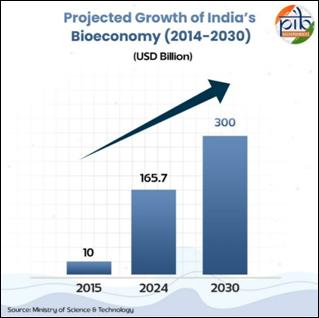
- India’s bioeconomy has witnessed a remarkable 16-fold rise over the past decade, growing from $10 billion in 2014 to $165.7 billion in 2024.
- The government has set an ambitious target to reach a $300 billion valuation by 2030, aiming to make the sector a cornerstone of India’s sustainable economic growth.
- Union Home Minister Amit Shah recently highlighted this surge, noting that the sector now contributes 4.25% to the national GDP.
- The growth is accompanied by a massive expansion in the startup ecosystem, with biotech startups increasing from fewer than 500 in 2014 to over 10,000 in 2025.
Performance of Sub-sectors (2024)
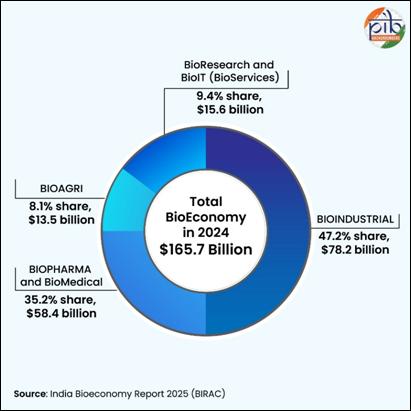
The Indian bioeconomy is driven by four primary segments, each contributing significantly to the overall valuation:
| Sub-sector | Market Share | Valuation ($ Billion) | Key Drivers |
|---|---|---|---|
| BioIndustrial | 47% | $78.2 | Biofuels, bioplastics, and enzymatic applications. |
| BioPharma | 35.2% | $58.4 | Global vaccine leadership and medical diagnostics. |
| BioResearch & IT | 9.4% | $15.6 | Bioinformatics and contract research services. |
| BioAgri | 8.1% | $13.5 | GM crops, bio-fertilizers, and precision farming. |
Sector Growth Projections
Government Initiatives Driving Growth
- BioE3 Policy (Biotechnology for Economy, Environment, and Employment):
- Approved by Union Cabinet in August 2024.
- Promotes regenerative biomanufacturing, bio-foundry clusters, and bio-AI hubs.
- Aligns with India’s net-zero emissions goal through circular bioeconomy models.
- National Biopharma Mission:
- Budget: $250 million (co-funded by World Bank).
- Supports 100+ projects across 150+ organizations, including 30 MSMEs.
- Established shared facilities for testing, validation, and manufacturing.
- Biotech-KISAN:
- Operates in 115 Aspirational Districts.
- Boosted farmer incomes by 40–50% in regions like Bastar (Chhattisgarh) through bio-fortified crops.
- Bioenergy Expansion:
- Ethanol blending in petrol rose from 1.53% (2014) to 15% (2024), targeting 20% by 2025.
- Saved ₹99,014 crore in forex, reduced CO₂ emissions by 51.9 million metric tons, and generated ₹1,45,930 crore for distillers and ₹87,558 crore for farmers.
- Second-generation ethanol refineries utilize crop residue (e.g., parali) and bamboo, reducing stubble burning.
Startup & Innovation Ecosystem
- Biotech startups surged from 50 in 2014 to over 11,000 in 2026.
- BIRAC (Biotechnology Industry Research Assistance Council) supports innovation via:
- Biotechnology Ignition Grant (BIG): Up to ₹50 lakh for early-stage startups.
- SEED Fund: ₹30 lakh equity for proof-of-concept stage.
- LEAP Fund: ₹100 lakh equity for commercialization-ready innovations.
- 95 bio-incubation centers nationwide foster entrepreneurship.
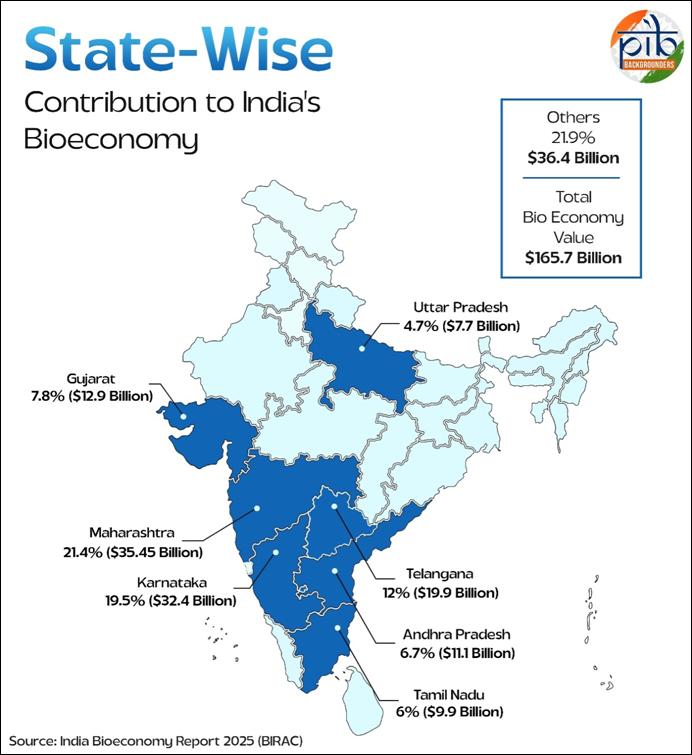
Contribution of Key States
Additional Info
- Regional Dominance: The Southern region leads with a 45.4% share ($75.2 billion), followed by the West (30.3%), North (18.5%), and East (5.8%).
- Nafithromycin: India's first indigenous antibiotic developed to treat respiratory diseases.
- BIRAC: The Biotechnology Industry Research Assistance Council (BIRAC), established in 2012, is the primary agency nurturing the biotech startup ecosystem.
- One Health Mission: A strategy that addresses diseases spreading from animals to humans, integrating human, animal, and environmental health.
- BSL-4 Facilities:
- High-security labs for handling dangerous pathogens (e.g., Ebola, Nipah).
- Second such facility launched in Gujarat (after Pune’s NIV), enhancing pandemic preparedness and supporting the One Health Mission.
Sources
UGC Notifies 2026 Regulations to Combat Caste Bias in Higher Education
What’s the News?
- The University Grants Commission (UGC) has notified the UGC (Promotion of Equity in Higher Education Institutions) Regulations, 2026, replacing the 2012 framework.
- The regulations mandate all Higher Education Institutions (HEIs)—including central, state, and deemed-to-be universities—to establish formal mechanisms like Equity Committees and Equal Opportunity Centres (EOCs) to address caste-based discrimination.
- Notably, the final version explicitly includes Other Backward Classes (OBCs) under the ambit of caste-based discrimination, a major shift from the initial draft.
- The notification follows directives from the Supreme Court, issued during hearings of petitions by the mothers of Rohith Vemula and Payal Tadvi, who died by suicide due to alleged caste harassment.
Key Provisions of the 2026 Regulations
- Expanded Definition of Caste-Based Discrimination:
- Explicitly includes Scheduled Castes (SCs), Scheduled Tribes (STs), and Other Backward Classes (OBCs)—addressing criticism of the earlier draft that excluded OBCs.
- Defines discrimination as “any unfair, differential, or biased treatment” based on caste, tribe, religion, gender, disability, or place of birth, whether explicit or implicit.
- Institutional Mechanisms:
- Equal Opportunity Centre (EOC): Mandatory in every HEI; provides academic, social, and financial support to disadvantaged groups and handles complaints.
- Equity Committee: Chaired by the institution head; must include representatives from SCs, STs, OBCs, persons with disabilities, and women; meets at least twice a year and resolves complaints within 15 working days.
- Equity Helpline: 24/7 toll-free helpline for reporting distress related to discrimination.
- Equity Squads & Ambassadors: Mobile squads for campus surveillance and designated ambassadors in departments/hostels to act as grievance nodal points.
- Monitoring & Reporting:
- HEIs must submit bi-annual and annual reports on demographic composition, dropout rates, and complaint status.
- UGC will constitute a national-level oversight committee with civil society and professional body representatives to review implementation.
Penalties for Non-Compliance
- Institutions violating the regulations may face:
- Debarment from UGC schemes
- Ban on offering degree, online, or distance programmes
- Removal from the UGC list under Sections 2(f) and 12B of the UGC Act, 1956.
Additional Info
- Expanded Definition: Discrimination is now defined as any unfair or biased treatment based on religion, race, caste, gender, place of birth, or disability.
- Omission of "False Complaints" Clause: The UGC dropped a controversial draft proposal that suggested fining students for "false" complaints, to ensure victims are not deterred from speaking out.
- Constitutional Linkages:
- Article 14: Right to equality
- Article 15: Prohibition of discrimination on grounds of religion, race, caste, sex, or place of birth
- Article 21: Right to life with dignity
Sources
NITI Aayog Releases Export Preparedness Index (EPI) 2024
What’s the News?
- NITI Aayog has released the fourth edition of the Export Preparedness Index (EPI) 2024, which evaluates the export readiness and performance of Indian States and Union Territories (UTs).
- Maharashtra has emerged as the top-performing state in the Large States category, overtaking Tamil Nadu, which led the 2022 ranking.
- In the Small States, North-Eastern States & UTs category, Uttarakhand secured the first position, followed by Jammu and Kashmir.
- The report, released by NITI Aayog CEO B.V.R. Subrahmanyam, aligns with India's goal of reaching $1 trillion in merchandise exports by 2030 and the broader vision of Viksit Bharat @2047.
Structure & Objectives of EPI 2024
- Four Pillars (with 13 sub-pillars and 70 indicators):
- Export Infrastructure: Ports, logistics, digital connectivity
- Business Ecosystem: Ease of doing business, MSME support, financial access
- Policy & Governance: State export policies, institutional mechanisms
- Export Performance: Merchandise and services exports, diversification
- Key Objectives:
- Strengthen subnational export ecosystems
- Promote regional balance and employment generation
- Support India’s goal of $1 trillion in merchandise exports by 2030
- Align with Viksit Bharat @2047 vision
- Classification System:
- States/UTs grouped into Large States, Small States, North Eastern States, and UTs
- Within each group, categorized as Leaders, Challengers, or Aspirers for peer benchmarking
Key Enhancements in 2024 Edition
- New dimensions added:
- Macroeconomic stability
- Cost competitiveness
- Human capital development
- MSME integration into global value chains
- District-level focus: Encourages place-based export strategies leveraging local clusters (e.g., agri-processing, handicrafts, electronics)
- Uses official data from Central Ministries, State Governments, and public institutions
State Rankings and Categories
States are grouped and classified to ensure a fair comparative assessment based on their geography and economic structure:
Top 5 Performers: Large States
| Rank | State | Score |
|---|---|---|
| 1 | Maharashtra | 68.01 |
| 2 | Tamil Nadu | |
| 3 | Gujarat | |
| 4 | Uttar Pradesh | |
| 5 | Andhra Pradesh |
Top 5 Performers: Small States, NE States & UTs
| Rank | State/UT | Highlights |
|---|---|---|
| 1 | Uttarakhand | Topped through its Export and Logistics Policy and ODOP initiatives. |
| 2 | Jammu & Kashmir | Made a massive leap from 17th (2022) to 2nd position. |
| 3 | Nagaland | Showed steady progress beyond traditional hubs. |
| 4 | Dadra & Nagar Haveli and Daman & Diu | |
| 5 | Goa |
Sources
Crocodile Population Records Rise in Odisha’s Similipal National Park

What’s the News?
- The latest Crocodile Census (2026) in Odisha’s Similipal National Park has recorded a significant rise in the population of Mugger crocodiles.
- The census report indicates that the population has increased to 84, reversing a two-year downward trend in the park's river systems.
- Forest officials attribute this recovery to intensive conservation measures, including the release of hatchery-bred crocodiles into the wild to bolster natural numbers.
- The survey was conducted across major water bodies within the park, specifically targeting the Khairi, Deo, and West Deo rivers.
Census Findings & Population Dynamics
The 2026 census provides a detailed breakdown of the crocodile demographics within the reserve, showing a healthy distribution across age groups:
- Total Count: The population rose to 84, up from 81 recorded in the previous census and 78 in 2024.
- Demographic Breakdown:
- Adults: 29 individuals.
- Sub-adults: 27 individuals.
- Juveniles: 28 individuals.
- Geographic Distribution: The highest concentration was observed in the Deo River, followed by the Khairi River, which serve as primary habitats for the species within the park.
Population Trend (2021–2026)
- 2021: 81
- 2022: 83
- 2023: 86 (peak)
- 2024: 82
- 2025: 81
- 2026: 84 (recovery begins)
Conservation Mechanisms
- Ramatirtha Crocodile Breeding Centre:
- Established for ex-situ conservation of Mugger crocodiles (Crocodylus palustris)
- Regularly releases hatchlings into natural water bodies within Similipal
- Habitat Protection:
- Focus on maintaining ecological integrity of rivers and wetlands
- Monitoring of human-wildlife conflict zones
- Community Involvement:
- Local participation in monitoring and reporting
- Awareness programmes to reduce anthropogenic threats
Additional Info
- Similipal National Park:
- Located in the Mayurbhanj district of Odisha, it is the 7th largest national park in India.
- It was formally designated as a Tiger Reserve in 1956 and became part of the UNESCO World Network of Biosphere Reserves in 2009.
- It is the only habitat in the world to house melanistic (black) tigers in the wild.
- The Mugger Crocodile:
- Also known as the Marsh Crocodile, it is native to freshwater habitats across the Indian subcontinent.
- IUCN Status: Vulnerable.
- Wildlife Protection Act, 1972: Listed under Schedule I, providing it the highest level of legal protection in India.
- Project Crocodile: Launched in 1975 with support from the United Nations Development Programme (UNDP), it aimed to save three Indian crocodilian species: the Gharial, the Saltwater Crocodile, and the Mugger.
Sources
Odisha to Launch India's First Chronic Kidney Disease (CKD) Registry

What’s the News?
- Odisha is set to become the first state in India to implement a comprehensive Chronic Kidney Disease (CKD) Registry.
- The initiative, expected to roll out by March 2026, aims to establish a structured, state-wide database to track prevalence, enable early detection, and support long-term disease management.
- This move follows the observation of a rising burden of kidney diseases in the state, with official data recording nearly 20,000 cases and over 4,700 deaths in the last three years.
- The registry will fill a critical gap in public health data, as nearly 90% of CKD patients are currently in early stages and often remain undocumented until they require dialysis.
Institutional Framework
The state has established a multi-layered governance structure to oversee the planning and implementation of the registry:
- State Task Force: A 12-member body chaired by the Chief Secretary of Odisha to direct the initiative.
- Technical Sub-Committee: A 17-member working group comprising experts from AIIMS, the Indian Council of Medical Research (ICMR), and state health institutions.
- Cross-Sectoral Collaboration: The committee includes representatives from the Pollution Control Board and departments handling drinking water, geology, and rural governance to investigate environmental risk factors.
- Digital Infrastructure: The National Informatics Centre (NIC) is developing dedicated, web-based software to capture real-time data from all healthcare levels, from Primary Health Centres (PHCs) to medical colleges.
Key Objectives & Strategy
The registry is designed to transition from reactive treatment to proactive disease management:
- Early Detection: By tracking patients in early stages, the state aims to slow disease progression and reduce the need for expensive treatments like dialysis.
- Hotspot Mapping: The government will conduct surveys to identify block-level hotspots and investigate environmental causes like contaminated drinking water or soil.
- Standardised Protocol: A uniform protocol will be established for investigating CKD clusters and analysing disease burden to guide targeted interventions.
- Addressing CKDu: The registry will focus on CKD of unknown origin (CKDu), which currently accounts for roughly 40% of cases in the state.
Disease Burden in Odisha
According to recent state health reports and surveys:
- Prevalence: CKD affects approximately 14% of Odisha's population above the age of 15.
- Leading Causes: Diabetes and hypertension are responsible for about 60% of total cases.
- Districts at Risk: Regions like Sambalpur, Cuttack, Koraput, and Ganjam have reported significantly higher case counts and mortality rates.
- Healthcare Capacity: Odisha currently operates 70 dialysis centres with over 500 machines, providing free treatment under the National Dialysis Programme.
Sources
Israel Withdraws from Seven International Bodies Following US Exit

What’s the News?
- Israel’s Foreign Minister Gideon Sa'ar has announced the immediate severing of ties with seven international organisations, primarily including United Nations (UN) agencies.
- The decision follows a strategic review triggered by the United States’ recent withdrawal from 66 international organisations and treaties.
- The move is aimed at bodies that the Israeli government describes as having "persistent bias," "politicisation," and "hostility" toward the state.
The Seven Organisations and Specific Concerns
The withdrawal targets specific bodies cited for administrative inefficiency or perceived political bias:
- Office of the Special Representative for Children and Armed Conflict: Severed after the agency included the Israel Defense Forces (IDF) in its "blacklist" of violators, alongside groups like ISIS and Boko Haram.
- UN Entity for Gender Equality and the Empowerment of Women (UN Women): Withdrawn due to allegations that the body ignored cases of sexual violence committed against Israeli women during recent conflicts.
- UN Conference on Trade and Development (UNCTAD) & UN Economic and Social Commission for Western Asia (ESCWA): Cited for issuing what Israel termed "virulent anti-Israel reports" over several years.
- UN Alliance of Civilizations (UNAOC): Accused of being used as a platform for attacks against Israel and for excluding Israeli participation in its dialogues.
- UN Energy: Labelled a "wasteful organisation" reflecting the "excessive and inefficient bureaucracy" of the UN system.
- Global Forum on Migration and Development (GFMD): Withdrawn on the grounds that it erodes the ability of sovereign nations to enforce their own immigration laws.
Additional Info
- UNRWA Legislation:
- This withdrawal occurs alongside domestic legislation in Israel that bans the UN Relief and Works Agency (UNRWA) from operating within its territory.
- The Knesset (Israel's Parliament) recently passed amendments to cut off water, electricity, and communications from UNRWA facilities.
- International Law Context:
- Article 105 of the UN Charter: Governs the privileges and immunities of the UN and its officials, which has been a point of contention regarding the legal status of agencies within host countries.
- Standard of Conduct for the International Civil Service: UN staff are mandated to maintain neutrality and not express public convictions on controversial matters, a standard Israel claims has been violated.
Sources
January 2026
Archive
October 2026
- 27 October 2026
- 26 October 2026
- 24 October 2026
- 23 October 2026
- 22 October 2026
- 21 October 2026
- 20 October 2026
- 19 October 2026
- 17 October 2026
- 16 October 2026
- 15 October 2026
- 14 October 2026
- 13 October 2026
- 12 October 2026
- 10 October 2026
- 09 October 2026
- 08 October 2026
- 07 October 2026
- 06 October 2026
- 05 October 2026
- 03 October 2026
- 02 October 2026
- 01 October 2026
September 2026
- 30 September 2026
- 29 September 2026
- 28 September 2026
- 26 September 2026
- 25 September 2026
- 24 September 2026
- 23 September 2026
- 22 September 2026
- 21 September 2026
- 19 September 2026
- 18 September 2026
- 17 September 2026
- 16 September 2026
- 15 September 2026
- 12 September 2026
- 11 September 2026
- 10 September 2026
- 09 September 2026
- 08 September 2026
- 07 September 2026
- 05 September 2026
- 04 September 2026
- 03 September 2026
- 02 September 2026
- 01 September 2026
August 2026
- 31 August 2026
- 29 August 2026
- 27 August 2026
- 26 August 2026
- 25 August 2026
- 24 August 2026
- 22 August 2026
- 21 August 2026
- 20 August 2026
- 19 August 2026
- 18 August 2026
- 17 August 2026
- 14 August 2026
- 13 August 2026
- 12 August 2026
- 11 August 2026
- 10 August 2026
- 08 August 2026
- 07 August 2026
- 06 August 2026
- 05 August 2026
- 04 August 2026
- 03 August 2026
- 01 August 2026
July 2026
- 31 July 2026
- 30 July 2026
- 29 July 2026
- 28 July 2026
- 27 July 2026
- 25 July 2026
- 23 July 2026
- 22 July 2026
- 21 July 2026
- 20 July 2026
- 18 July 2026
- 17 July 2026
- 15 July 2026
- 14 July 2026
- 13 July 2026
- 11 July 2026
- 10 July 2026
- 09 July 2026
- 08 July 2026
- 07 July 2026
- 06 July 2026
- 04 July 2026
- 03 July 2026
- 02 July 2026
- 01 July 2026
June 2026
May 2026
April 2026
March 2026
- 31 March 2026
- 30 March 2026
- 28 March 2026
- 27 March 2026
- 26 March 2026
- 25 March 2026
- 24 March 2026
- 23 March 2026
- 21 March 2026
- 20 March 2026
- 19 March 2026
- 18 March 2026
- 17 March 2026
- 16 March 2026
- 14 March 2026
- 13 March 2026
- 12 March 2026
- 11 March 2026
- 10 March 2026
- 09 March 2026
- 07 March 2026
- 06 March 2026
- 05 March 2026
- 03 March 2026
- 02 March 2026
February 2026
- 28 February 2026
- 27 February 2026
- 26 February 2026
- 25 February 2026
- 24 February 2026
- 23 February 2026
- 21 February 2026
- 20 February 2026
- 19 February 2026
- 18 February 2026
- 17 February 2026
- 16 February 2026
- 13 February 2026
- 12 February 2026
- 11 February 2026
- 10 February 2026
- 09 February 2026
- 07 February 2026
- 06 February 2026
- 05 February 2026
- 04 February 2026
- 03 February 2026
- 02 February 2026
January 2026
- 31 January 2026
- 30 January 2026
- 29 January 2026
- 28 January 2026
- 27 January 2026
- 26 January 2026
- 24 January 2026
- 23 January 2026
- 22 January 2026
- 21 January 2026
- 20 January 2026
- 19 January 2026
- 16 January 2026
- 15 January 2026
- 14 January 2026
- 13 January 2026
- 12 January 2026
- 10 January 2026
- 09 January 2026
- 08 January 2026
- 07 January 2026
- 06 January 2026
- 05 January 2026
- 03 January 2026
- 02 January 2026
- 01 January 2026
December 2025
- 31 December 2025
- 30 December 2025
- 29 December 2025
- 27 December 2025
- 26 December 2025
- 24 December 2025
- 23 December 2025
- 22 December 2025
- 20 December 2025
- 19 December 2025
- 18 December 2025
- 17 December 2025
- 16 December 2025
- 15 December 2025
- 13 December 2025
- 12 December 2025
- 11 December 2025
- 10 December 2025
- 09 December 2025
- 08 December 2025
- 05 December 2025
- 04 December 2025
- 03 December 2025
- 02 December 2025
November 2025
- 29 November 2025
- 28 November 2025
- 27 November 2025
- 26 November 2025
- 25 November 2025
- 24 November 2025
- 22 November 2025
- 21 November 2025
- 20 November 2025
- 19 November 2025
- 18 November 2025
- 17 November 2025
- 15 November 2025
- 14 November 2025
- 13 November 2025
- 12 November 2025
- 11 November 2025
- 10 November 2025
- 08 November 2025
- 07 November 2025
- 06 November 2025
- 05 November 2025
- 04 November 2025
- 03 November 2025
- 01 November 2025
October 2025
- 31 October 2025
- 30 October 2025
- 29 October 2025
- 28 October 2025
- 27 October 2025
- 25 October 2025
- 24 October 2025
- 23 October 2025
- 22 October 2025
- 21 October 2025
- 20 October 2025
- 18 October 2025
- 17 October 2025
- 16 October 2025
- 15 October 2025
- 14 October 2025
- 13 October 2025
- 11 October 2025
- 10 October 2025
- 09 October 2025
- 08 October 2025
- 07 October 2025
- 06 October 2025
- 04 October 2025
- 03 October 2025
- 02 October 2025
- 01 October 2025
September 2025
- 30 September 2025
- 29 September 2025
- 27 September 2025
- 26 September 2025
- 25 September 2025
- 24 September 2025
- 23 September 2025
- 22 September 2025
- 20 September 2025
- 19 September 2025
- 18 September 2025
- 17 September 2025
- 16 September 2025
- 15 September 2025
- 13 September 2025
- 12 September 2025
- 11 September 2025
- 10 September 2025
- 09 September 2025
- 08 September 2025
- 06 September 2025
- 05 September 2025
- 04 September 2025
- 03 September 2025
- 02 September 2025
- 01 September 2025
August 2025
- 30 August 2025
- 29 August 2025
- 28 August 2025
- 27 August 2025
- 26 August 2025
- 25 August 2025
- 23 August 2025
- 22 August 2025
- 21 August 2025
- 20 August 2025
- 19 August 2025
- 18 August 2025
- 16 August 2025
- 14 August 2025
- 13 August 2025
- 12 August 2025
- 11 August 2025
- 08 August 2025
- 07 August 2025
- 06 August 2025
- 05 August 2025
- 04 August 2025
- 02 August 2025
- 01 August 2025
July 2025
- 31 July 2025
- 30 July 2025
- 29 July 2025
- 28 July 2025
- 26 July 2025
- 25 July 2025
- 24 July 2025
- 23 July 2025
- 22 July 2025
- 21 July 2025
- 19 July 2025
- 18 July 2025
- 17 July 2025
- 16 July 2025
- 15 July 2025
- 12 July 2025
- 11 July 2025
- 10 July 2025
- 09 July 2025
- 07 July 2025
- 05 July 2025
- 04 July 2025
- 03 July 2025
- 02 July 2025
- 01 July 2025
June 2025
- 30 June 2025
- 28 June 2025
- 27 June 2025
- 26 June 2025
- 25 June 2025
- 24 June 2025
- 23 June 2025
- 21 June 2025
- 20 June 2025
- 19 June 2025
- 18 June 2025
- 17 June 2025
- 16 June 2025
- 14 June 2025
- 13 June 2025
- 12 June 2025
- 11 June 2025
- 10 June 2025
- 09 June 2025
- 07 June 2025
- 06 June 2025
- 05 June 2025
- 04 June 2025
- 03 June 2025
- 02 June 2025
May 2025
April 2025
- 30 April 2025
- 29 April 2025
- 28 April 2025
- 26 April 2025
- 25 April 2025
- 24 April 2025
- 23 April 2025
- 22 April 2025
- 21 April 2025
- 19 April 2025
- 18 April 2025
- 17 April 2025
- 16 April 2025
- 15 April 2025
- 14 April 2025
- 12 April 2025
- 11 April 2025
- 10 April 2025
- 09 April 2025
- 08 April 2025
- 07 April 2025
- 05 April 2025
- 04 April 2025
- 03 April 2025
- 02 April 2025
- 01 April 2025
March 2025
- 31 March 2025
- 29 March 2025
- 28 March 2025
- 27 March 2025
- 26 March 2025
- 25 March 2025
- 24 March 2025
- 22 March 2025
- 21 March 2025
- 20 March 2025
- 19 March 2025
- 18 March 2025
- 17 March 2025
- 15 March 2025
- 13 March 2025
- 12 March 2025
- 11 March 2025
- 10 March 2025
- 08 March 2025
- 07 March 2025
- 06 March 2025
- 05 March 2025
- 04 March 2025
- 03 March 2025
- 01 March 2025
February 2025
- 28 February 2025
- 27 February 2025
- 26 February 2025
- 25 February 2025
- 24 February 2025
- 22 February 2025
- 21 February 2025
- 20 February 2025
- 19 February 2025
- 18 February 2025
- 17 February 2025
- 15 February 2025
- 14 February 2025
- 13 February 2025
- 12 February 2025
- 11 February 2025
- 10 February 2025
- 08 February 2025
- 07 February 2025
- 06 February 2025
- 05 February 2025
- 04 February 2025
- 03 February 2025
- 01 February 2025
January 2025
- 31 January 2025
- 30 January 2025
- 29 January 2025
- 28 January 2025
- 27 January 2025
- 25 January 2025
- 24 January 2025
- 23 January 2025
- 22 January 2025
- 21 January 2025
- 20 January 2025
- 18 January 2025
- 17 January 2025
- 16 January 2025
- 15 January 2025
- 14 January 2025
- 13 January 2025
- 11 January 2025
- 10 January 2025
- 09 January 2025
- 08 January 2025
- 07 January 2025
- 06 January 2025
- 04 January 2025
- 03 January 2025
- 02 January 2025
- 01 January 2025