
Current Affairs
Stay updated with the latest national and international events.
14 October 2025
Centre Unveils ₹6.42 Lakh Crore Master Plan to Harness Brahmaputra Hydropower

What’s the News?
- The Union Government has announced a ₹6.42 lakh crore master plan to develop 65 GW of hydropower capacity in the Brahmaputra River basin, primarily across Arunachal Pradesh and Assam.
- The initiative aims to counter strategic concerns arising from China’s upstream dam projects on the Yarlung Tsangpo (Brahmaputra’s upper course) while boosting clean energy generation and regional development.
Brahmaputra Basin Hydropower Strategy
- Objective: Evacuate 65 GW of hydroelectric power through a phased development of 11 major projects in Arunachal Pradesh and Assam.
- Estimated Investment: ₹6.42 lakh crore, making it one of India’s largest infrastructure undertakings in the Northeast.
- Strategic Rationale:
- Mitigate risks from China’s mega-dam projects (e.g., 60 GW planned on Yarlung Tsangpo), which could affect downstream water flow.
- Strengthen India’s energy security and support net-zero commitments by leveraging non-fossil fuel sources.
- Key Projects: Include the 10 GW Siang Upper Hydroelectric Project, 3,097 MW Dibang Multipurpose Project, and 2,880 MW Subansiri Lower Hydroelectric Project.
Additional Info
- River Nomenclature & Geography:
- Known as Yarlung Tsangpo in Tibet (China), Siang/Dihang in Arunachal Pradesh, and Brahmaputra in Assam.
- Originates near Mount Kailash in Tibet Autonomous Region (China), flows ~2,900 km through India and Bangladesh before emptying into the Bay of Bengal.

- No Bilateral Water-Sharing Treaty:
- Unlike India–Bangladesh (Ganges Water Treaty, 1996), India and China have no formal treaty on sharing Brahmaputra waters.
- Only a 2002 Memorandum of Understanding (MoU) for hydrological data sharing during monsoon (May 15–Oct 15) to aid flood forecasting in India.
- Chinese Dam Projects – Key Concerns:
- China has constructed multiple dams on the Yarlung Tsangpo, including:
- Zangmu Dam (510 MW, operational since 2015)
- Dagu, Jiexu, and Jiequ run-of-the-river projects
- Plans for a mega-dam (~60 GW) near Medog County (Great Bend area), potentially the world’s largest hydropower project, announced in 2020–21.
- Indian concerns: Reduced dry-season flow, ecological disruption, and strategic leverage over downstream water security.
- China has constructed multiple dams on the Yarlung Tsangpo, including:
- Strategic & Geopolitical Dimensions:
- Water infrastructure in Tibet viewed by India as part of China’s “water hegemony” strategy in South Asia.
- Brahmaputra basin overlaps with disputed India–China border areas (e.g., Arunachal Pradesh, claimed by China as “South Tibet”).
- Hydropower projects often co-located with military infrastructure, raising dual-use concerns.
- India’s Response & Policy Measures:
- Data monitoring: Central Water Commission (CWC) and India Meteorological Department (IMD) track flow changes.
- Diplomatic engagement: Regular discussions under India–China Expert Level Mechanism (ELM) on transboundary rivers (since 2006).
- Domestic development: Accelerated hydropower projects in Arunachal Pradesh (e.g., 65 GW master plan) to assert riparian rights and preempt upstream control.
- Environmental & Regional Impacts:
- Brahmaputra carries ~30% of India’s total river water but contributes only ~5% of current hydropower capacity.
- Northeast states fear ecological degradation, landslides, and displacement from large dams.
- Bangladesh also downstream; India shares data with Dhaka, adding a trilateral dimension.
- Legal & Institutional Context:
- UN Watercourses Convention (1997): Neither India nor China is a signatory.
- India adheres to the principle of “prior appropriation” and riparian rights under customary international law.
- National Security Council (NSC) includes water security in strategic assessments related to China.
World Standards Day 2025: Spotlight on Global Cooperation for Sustainable Development

What’s the News?
- World Standards Day is observed globally on October 14, 2025, with the theme “A Shared Vision for a Better World: Spotlight on SDG 17 – Partnerships for the Goals”.
- The day honors the collaborative work of experts from international standard-setting bodies—ISO (International Organization for Standardization), IEC (International Electrotechnical Commission), and ITU (International Telecommunication Union)—in developing technical standards that underpin safety, innovation, and global trade.
Significance of Standards in Global Development
- Standards as Enablers of SDGs: International standards provide measurable frameworks to achieve the United Nations Sustainable Development Goals (SDGs), particularly SDG 17, which emphasizes multi-stakeholder partnerships for technology transfer, capacity building, and systemic coherence.
- Economic & Safety Impact: Standards ensure product safety, interoperability, and quality, facilitating smooth cross-border trade and protecting public health—especially critical in sectors like healthcare, energy, and digital infrastructure.
- Inclusive Innovation: By harmonizing technical specifications globally, standards reduce trade barriers and enable developing countries to integrate into global value chains.
Key Institutional Framework
- Founding Milestone: Originated from a 1946 London conference of 25 nations that led to the creation of ISO in 1947.
- Standard Development Process: Involves multi-year consensus-building—proposal, technical committee review, draft circulation, and voting by national members—ensuring transparency and technical rigor.
- National Participation: In India, the Bureau of Indian Standards (BIS) acts as the national member to ISO and IEC, aligning domestic standards with global benchmarks.
Constitutional & Policy Linkages:
- Article 51(c): Encourages international cooperation, including adherence to global norms and standards.
- Make in India & PLI Schemes: Rely on conformity to international standards to enhance export competitiveness.
- National Standards Strategy (Draft): Aims to increase India’s participation in global standard-setting bodies to protect domestic industry interests.
Sources
IUCN Releases 2025 World Heritage Outlook: Climate Change Emerges as Top Threat to Natural Sites
What’s the News?
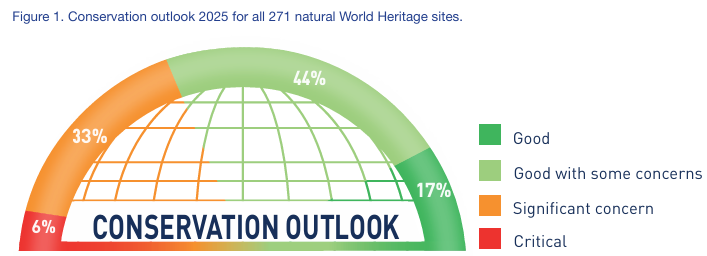
- The International Union for Conservation of Nature (IUCN) has released the 2025 World Heritage Outlook, its latest global assessment of the conservation status of all 271 natural and mixed World Heritage sites across 115 countries.
- The report identifies climate change as the single greatest threat to these sites, surpassing traditional pressures like infrastructure development and illegal logging.
Key Findings of the 2025 Outlook
- Climate Change Dominates Threat Landscape:
- Affects over 60% of natural World Heritage sites, including iconic locations like the Great Barrier Reef (Australia), Sundarbans (India/Bangladesh), and Kilimanjaro National Park (Tanzania).
- Manifests through coral bleaching, glacial melt, altered fire regimes, and species migration.
- Conservation Outlook Ratings:
- Positive Trends:
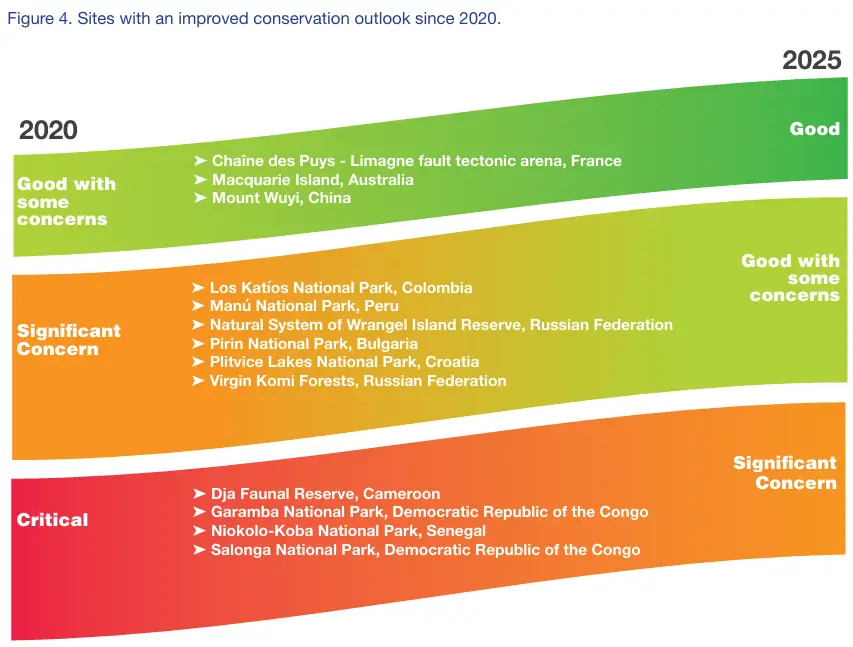
- 85 sites show improved conservation outlook since 2020 due to stronger governance, community involvement, and anti-poaching measures.
- India’s Kaziranga and Western Ghats maintain “Good” status with effective management frameworks.
Methodology & Global Significance
- Independent Assessment: Conducted every 3–5 years by IUCN’s World Heritage Team and World Commission on Protected Areas (WCPA), using scientific data, field reports, and stakeholder inputs.
- Coverage: Encompasses 231 natural and 40 mixed sites, protecting over 470 million hectares—equivalent to 8% of global protected terrestrial and marine areas.
- Policy Alignment: Supports implementation of the Kunming-Montreal Global Biodiversity Framework (2022), particularly Target 3 (30x30: protect 30% of land and sea by 2030).
Additional Info
- India’s Natural World Heritage Sites (7):
- Natural: Kaziranga, Manas, Keoladeo, Sundarbans, Nanda Devi & Valley of Flowers, Western Ghats
- Mixed: Khangchendzonga National Park
- Threats: Sundarbans faces sea-level rise and salinity intrusion; Western Ghats contend with fragmentation and invasive species.
- Institutional Framework:
- UNESCO World Heritage Convention (1972): Governs site designation; IUCN serves as official advisory body on natural sites.
- National Responsibility: Site management lies with State Parties; India’s Ministry of Environment, Forest and Climate Change (MoEF&CC) coordinates with National Board for Wildlife (NBWL).
- Constitutional Link:
- Article 48A (DPSP): Directs the State to protect and improve the environment.
- Article 51A(g): Imposes fundamental duty on citizens to preserve natural heritage.
Download Full Official Report by IUCN
Sources
NITI Aayog Unveils Strategy for Deep-Sea Fisheries to Advance India’s Blue Economy

What’s the News?
- NITI Aayog has released a comprehensive report titled “India’s Blue Economy – Strategy for Harnessing Deep-Sea and Offshore Fisheries”, outlining a three-phase roadmap to develop India’s underutilized deep-sea fisheries sector.
- The strategy aims to promote sustainable, inclusive, and scientific exploitation of marine resources beyond the 12-nautical-mile (nmi) territorial waters, within India’s Exclusive Economic Zone (EEZ) of 200 nmi.
Key Challenges in Current Deep-Sea Fisheries
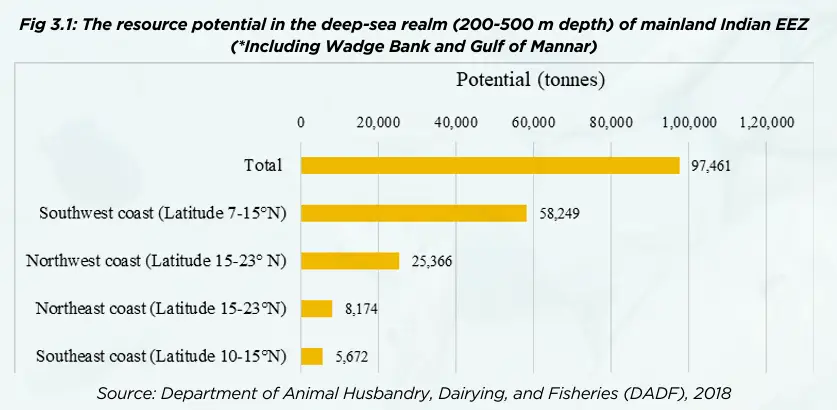
- Underdeveloped Sector: Despite an estimated 7.16 million tonnes (MT) of fishable resources in India’s EEZ, deep-sea fishing remains largely untapped.
- Limited Global Presence: Only 4 Indian-flagged vessels operate in international high seas, compared to 1,883 from Sri Lanka and 1,216 from Iran.
- Regulatory Gaps: No dedicated legal framework governs fishing beyond 12 nmi, enabling Illegal, Unreported, and Unregulated (IUU) fishing and jurisdictional ambiguity.
- Infrastructure & Cost Barriers: High operational costs, lack of mother vessels, cold-chain logistics, and processing facilities hinder scalability.
- Data Deficiency: Absence of real-time stock assessments and ecosystem monitoring limits evidence-based management.
NITI Aayog’s Three-Phase Roadmap
- Foundation Phase (Short-term):
- Enact a Deep-Sea Fisheries Act to regulate activities beyond 12 nmi.
- Establish a National Deep-Sea Fisheries Authority for unified oversight.
- Scaling Phase (Medium-term):
- Modernise fleet with 50–100 deep-sea vessels under public-private partnerships.
- Develop deep-sea fishing hubs at key ports (e.g., Kochi, Visakhapatnam, Paradip).
- Leadership Phase (Long-term):
- Position India as a global leader in sustainable high-seas fisheries.
- Integrate AI, satellite monitoring, and blockchain for traceability and compliance.
Additional Info
- Constitutional & Policy Context:
- Entry 2(a), Concurrent List: “Fisheries” is a shared subject, enabling central legislation for EEZ.
- Pradhan Mantri Matsya Sampada Yojana (PMMSY): Complements this strategy with ₹20,050 crore outlay (2020–25) for infrastructure and value chains.
- UNCLOS (1982): India’s EEZ rights under Articles 55–75 provide legal basis for resource management.
- Global Benchmarks:
- China: Operates >2,600 distant-water vessels with state subsidies.
- New Zealand: Uses Individual Transferable Quotas (ITQs) for sustainable stock management.
- Sustainability Safeguards:
- Mandate Environmental Impact Assessments (EIAs) for deep-sea projects.
- Adopt precautionary approach and ecosystem-based fisheries management (EBFM) principles.
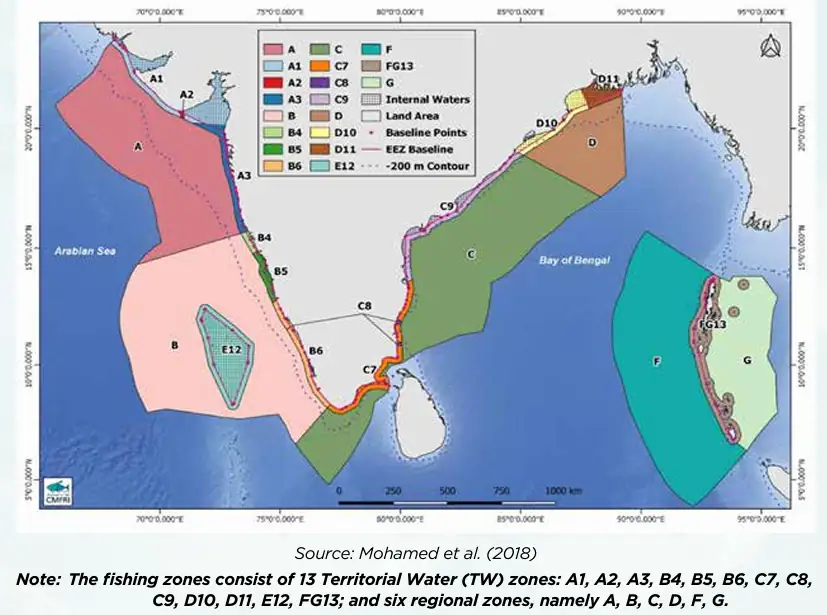
Fishing Zones
Download Full official PDF by NITI Aayog here
Sources
Government Launches DLC Campaign 4.0: Largest-Ever Drive for Digital Life Certificates
What’s the News?
- The Department of Pension & Pensioners’ Welfare (DoPPW) will conduct the 4th Nationwide Digital Life Certificate (DLC) Campaign from November 1 to 30, 2025, targeting the generation of 2 crore DLCs—the largest such drive to date.
- The campaign, branded DLC 4.0, will span 2,000 districts and sub-divisional headquarters, with special focus on face authentication technology and doorstep services for elderly and disabled pensioners.
Key Features of DLC Campaign 4.0
- Target: Generate 2 crore DLCs nationwide, surpassing the 1.62 crore achieved in DLC 3.0 (2024).
- Technology:
- Face authentication (Aadhaar-based) as primary mode, eliminating need for biometric devices.
- Over 50 lakh pensioners used face authentication in 2024; expanded rollout in 2025.
- Doorstep Services:
- India Post Payments Bank (IPPB) deploying 1.8 lakh postmen and Gramin Dak Sewaks equipped with mobile devices for on-site DLC generation.
- Services available to all pensioners, irrespective of bank or pension type.
- Physical Camps:
- 19 pension-disbursing banks organizing camps in over 300 cities.
- Special home/hospital visits for aged, sick, or differently-abled pensioners.
Institutional Collaboration & Outreach
- Partners:
- UIDAI and Ministry of Electronics & IT (MeitY) for tech infrastructure.
- 57 Pensioners’ Welfare Associations for local coordination.
- Awareness Drive: Multi-channel campaign via TV, radio, SMS, and social media to inform beneficiaries about submission options.
- Universal Access: Ensures pension continuity for central government, state government, and PSU pensioners.
Additional Info
- Legal & Policy Context:
- Rule 8 of CCS (Pension) Rules, 1972: Mandates annual submission of life certificate by November 30 for uninterrupted pension.
- Jeevan Pramaan Portal: Launched in 2014; over 12 crore DLCs generated cumulatively as of 2025.
- Constitutional Link:
- Article 309: Empowers Parliament to regulate pension conditions for government employees.
- Digital India & Ease of Living: DLC aligns with broader governance digitization under National e-Governance Plan (NeGP).
Sources
October 2025
31 October 202530 October 202529 October 202528 October 202527 October 202525 October 202524 October 202523 October 202522 October 202521 October 202520 October 202518 October 202517 October 202516 October 202515 October 202514 October 202513 October 202511 October 202510 October 202509 October 202508 October 202507 October 202506 October 202504 October 202503 October 202502 October 202501 October 2025
Archive
October 2026
- 27 October 2026
- 26 October 2026
- 24 October 2026
- 23 October 2026
- 22 October 2026
- 21 October 2026
- 20 October 2026
- 19 October 2026
- 17 October 2026
- 16 October 2026
- 15 October 2026
- 14 October 2026
- 13 October 2026
- 12 October 2026
- 10 October 2026
- 09 October 2026
- 08 October 2026
- 07 October 2026
- 06 October 2026
- 05 October 2026
- 03 October 2026
- 02 October 2026
- 01 October 2026
September 2026
- 30 September 2026
- 29 September 2026
- 28 September 2026
- 26 September 2026
- 25 September 2026
- 24 September 2026
- 23 September 2026
- 22 September 2026
- 21 September 2026
- 19 September 2026
- 18 September 2026
- 17 September 2026
- 16 September 2026
- 15 September 2026
- 12 September 2026
- 11 September 2026
- 10 September 2026
- 09 September 2026
- 08 September 2026
- 07 September 2026
- 05 September 2026
- 04 September 2026
- 03 September 2026
- 02 September 2026
- 01 September 2026
August 2026
- 31 August 2026
- 29 August 2026
- 27 August 2026
- 26 August 2026
- 25 August 2026
- 24 August 2026
- 22 August 2026
- 21 August 2026
- 20 August 2026
- 19 August 2026
- 18 August 2026
- 17 August 2026
- 14 August 2026
- 13 August 2026
- 12 August 2026
- 11 August 2026
- 10 August 2026
- 08 August 2026
- 07 August 2026
- 06 August 2026
- 05 August 2026
- 04 August 2026
- 03 August 2026
- 01 August 2026
July 2026
- 31 July 2026
- 30 July 2026
- 29 July 2026
- 28 July 2026
- 27 July 2026
- 25 July 2026
- 23 July 2026
- 22 July 2026
- 21 July 2026
- 20 July 2026
- 18 July 2026
- 17 July 2026
- 15 July 2026
- 14 July 2026
- 13 July 2026
- 11 July 2026
- 10 July 2026
- 09 July 2026
- 08 July 2026
- 07 July 2026
- 06 July 2026
- 04 July 2026
- 03 July 2026
- 02 July 2026
- 01 July 2026
June 2026
May 2026
April 2026
March 2026
- 31 March 2026
- 30 March 2026
- 28 March 2026
- 27 March 2026
- 26 March 2026
- 25 March 2026
- 24 March 2026
- 23 March 2026
- 21 March 2026
- 20 March 2026
- 19 March 2026
- 18 March 2026
- 17 March 2026
- 16 March 2026
- 14 March 2026
- 13 March 2026
- 12 March 2026
- 11 March 2026
- 10 March 2026
- 09 March 2026
- 07 March 2026
- 06 March 2026
- 05 March 2026
- 03 March 2026
- 02 March 2026
February 2026
- 28 February 2026
- 27 February 2026
- 26 February 2026
- 25 February 2026
- 24 February 2026
- 23 February 2026
- 21 February 2026
- 20 February 2026
- 19 February 2026
- 18 February 2026
- 17 February 2026
- 16 February 2026
- 13 February 2026
- 12 February 2026
- 11 February 2026
- 10 February 2026
- 09 February 2026
- 07 February 2026
- 06 February 2026
- 05 February 2026
- 04 February 2026
- 03 February 2026
- 02 February 2026
January 2026
- 31 January 2026
- 30 January 2026
- 29 January 2026
- 28 January 2026
- 27 January 2026
- 26 January 2026
- 24 January 2026
- 23 January 2026
- 22 January 2026
- 21 January 2026
- 20 January 2026
- 19 January 2026
- 16 January 2026
- 15 January 2026
- 14 January 2026
- 13 January 2026
- 12 January 2026
- 10 January 2026
- 09 January 2026
- 08 January 2026
- 07 January 2026
- 06 January 2026
- 05 January 2026
- 03 January 2026
- 02 January 2026
- 01 January 2026
December 2025
- 31 December 2025
- 30 December 2025
- 29 December 2025
- 27 December 2025
- 26 December 2025
- 24 December 2025
- 23 December 2025
- 22 December 2025
- 20 December 2025
- 19 December 2025
- 18 December 2025
- 17 December 2025
- 16 December 2025
- 15 December 2025
- 13 December 2025
- 12 December 2025
- 11 December 2025
- 10 December 2025
- 09 December 2025
- 08 December 2025
- 05 December 2025
- 04 December 2025
- 03 December 2025
- 02 December 2025
November 2025
- 29 November 2025
- 28 November 2025
- 27 November 2025
- 26 November 2025
- 25 November 2025
- 24 November 2025
- 22 November 2025
- 21 November 2025
- 20 November 2025
- 19 November 2025
- 18 November 2025
- 17 November 2025
- 15 November 2025
- 14 November 2025
- 13 November 2025
- 12 November 2025
- 11 November 2025
- 10 November 2025
- 08 November 2025
- 07 November 2025
- 06 November 2025
- 05 November 2025
- 04 November 2025
- 03 November 2025
- 01 November 2025
October 2025
- 31 October 2025
- 30 October 2025
- 29 October 2025
- 28 October 2025
- 27 October 2025
- 25 October 2025
- 24 October 2025
- 23 October 2025
- 22 October 2025
- 21 October 2025
- 20 October 2025
- 18 October 2025
- 17 October 2025
- 16 October 2025
- 15 October 2025
- 14 October 2025
- 13 October 2025
- 11 October 2025
- 10 October 2025
- 09 October 2025
- 08 October 2025
- 07 October 2025
- 06 October 2025
- 04 October 2025
- 03 October 2025
- 02 October 2025
- 01 October 2025
September 2025
- 30 September 2025
- 29 September 2025
- 27 September 2025
- 26 September 2025
- 25 September 2025
- 24 September 2025
- 23 September 2025
- 22 September 2025
- 20 September 2025
- 19 September 2025
- 18 September 2025
- 17 September 2025
- 16 September 2025
- 15 September 2025
- 13 September 2025
- 12 September 2025
- 11 September 2025
- 10 September 2025
- 09 September 2025
- 08 September 2025
- 06 September 2025
- 05 September 2025
- 04 September 2025
- 03 September 2025
- 02 September 2025
- 01 September 2025
August 2025
- 30 August 2025
- 29 August 2025
- 28 August 2025
- 27 August 2025
- 26 August 2025
- 25 August 2025
- 23 August 2025
- 22 August 2025
- 21 August 2025
- 20 August 2025
- 19 August 2025
- 18 August 2025
- 16 August 2025
- 14 August 2025
- 13 August 2025
- 12 August 2025
- 11 August 2025
- 08 August 2025
- 07 August 2025
- 06 August 2025
- 05 August 2025
- 04 August 2025
- 02 August 2025
- 01 August 2025
July 2025
- 31 July 2025
- 30 July 2025
- 29 July 2025
- 28 July 2025
- 26 July 2025
- 25 July 2025
- 24 July 2025
- 23 July 2025
- 22 July 2025
- 21 July 2025
- 19 July 2025
- 18 July 2025
- 17 July 2025
- 16 July 2025
- 15 July 2025
- 12 July 2025
- 11 July 2025
- 10 July 2025
- 09 July 2025
- 07 July 2025
- 05 July 2025
- 04 July 2025
- 03 July 2025
- 02 July 2025
- 01 July 2025
June 2025
- 30 June 2025
- 28 June 2025
- 27 June 2025
- 26 June 2025
- 25 June 2025
- 24 June 2025
- 23 June 2025
- 21 June 2025
- 20 June 2025
- 19 June 2025
- 18 June 2025
- 17 June 2025
- 16 June 2025
- 14 June 2025
- 13 June 2025
- 12 June 2025
- 11 June 2025
- 10 June 2025
- 09 June 2025
- 07 June 2025
- 06 June 2025
- 05 June 2025
- 04 June 2025
- 03 June 2025
- 02 June 2025
May 2025
April 2025
- 30 April 2025
- 29 April 2025
- 28 April 2025
- 26 April 2025
- 25 April 2025
- 24 April 2025
- 23 April 2025
- 22 April 2025
- 21 April 2025
- 19 April 2025
- 18 April 2025
- 17 April 2025
- 16 April 2025
- 15 April 2025
- 14 April 2025
- 12 April 2025
- 11 April 2025
- 10 April 2025
- 09 April 2025
- 08 April 2025
- 07 April 2025
- 05 April 2025
- 04 April 2025
- 03 April 2025
- 02 April 2025
- 01 April 2025
March 2025
- 31 March 2025
- 29 March 2025
- 28 March 2025
- 27 March 2025
- 26 March 2025
- 25 March 2025
- 24 March 2025
- 22 March 2025
- 21 March 2025
- 20 March 2025
- 19 March 2025
- 18 March 2025
- 17 March 2025
- 15 March 2025
- 13 March 2025
- 12 March 2025
- 11 March 2025
- 10 March 2025
- 08 March 2025
- 07 March 2025
- 06 March 2025
- 05 March 2025
- 04 March 2025
- 03 March 2025
- 01 March 2025
February 2025
- 28 February 2025
- 27 February 2025
- 26 February 2025
- 25 February 2025
- 24 February 2025
- 22 February 2025
- 21 February 2025
- 20 February 2025
- 19 February 2025
- 18 February 2025
- 17 February 2025
- 15 February 2025
- 14 February 2025
- 13 February 2025
- 12 February 2025
- 11 February 2025
- 10 February 2025
- 08 February 2025
- 07 February 2025
- 06 February 2025
- 05 February 2025
- 04 February 2025
- 03 February 2025
- 01 February 2025
January 2025
- 31 January 2025
- 30 January 2025
- 29 January 2025
- 28 January 2025
- 27 January 2025
- 25 January 2025
- 24 January 2025
- 23 January 2025
- 22 January 2025
- 21 January 2025
- 20 January 2025
- 18 January 2025
- 17 January 2025
- 16 January 2025
- 15 January 2025
- 14 January 2025
- 13 January 2025
- 11 January 2025
- 10 January 2025
- 09 January 2025
- 08 January 2025
- 07 January 2025
- 06 January 2025
- 04 January 2025
- 03 January 2025
- 02 January 2025
- 01 January 2025