
Current Affairs
Stay updated with the latest national and international events.
05 November 2025
Swachh Survekshan 2025: Madurai Ranked Dirtiest City, Indore Cleanest for 8th Time
What’s the News?
- The Ministry of Housing and Urban Affairs (MoHUA) has released the Swachh Survekshan 2025 report, the 9th edition of the annual urban cleanliness survey.
- Madurai, Tamil Nadu, was ranked as the dirtiest city among those with a population of over 10 lakh (one million).
- Indore, Madhya Pradesh, retained its title as India's cleanest city for the eighth consecutive time, followed by Surat (Gujarat) and Navi Mumbai (Maharashtra) in the "Million Plus" category.
Key Rankings (Population > 10 Lakh)
- Top 3 Cleanest Cities:
- Indore (Madhya Pradesh)
- Surat (Gujarat)
- Navi Mumbai (Maharashtra)
- Bottom 10 Dirtiest Cities (Ranked from worst):
- Madurai (Tamil Nadu)
- Ludhiana (Punjab)
- Chennai (Tamil Nadu)
- Ranchi (Jharkhand)
- Bengaluru (Karnataka)
- Dhanbad (Jharkhand)
- Faridabad (Haryana)
- Greater Mumbai (Maharashtra)
- Srinagar (Jammu & Kashmir)
- Delhi
Analysis of Low-Ranked Cities
- The report highlights that several major metropolitan areas, including Bengaluru, Chennai, and Delhi, performed poorly, indicating significant challenges in urban sanitation despite their economic status.
- Madurai's low score (4,823 out of 12,500) was attributed to extremely poor performance in key parameters:
- Waste generation vs. processing (4% score)
- Cleanliness of public toilets (3% score)
- Source segregation (26% score)
- Remediation of dumpsites (25% score)
- Common challenges for underperforming cities include unplanned urban expansion, weak enforcement of sanitation bylaws, and inadequate waste segregation at the source.
Additional Info
- About Swachh Survekshan:
- It is an annual assessment conducted as part of the Swachh Bharat Mission (Urban).
- It is considered the world's largest urban sanitation and cleanliness survey.
- It evaluates cities on parameters like solid waste management, citizen feedback, hygiene levels, and innovation in sanitation.
- New Developments in 2025 Survey:
- Introduction of a new category called the 'Super Swachh League' to recognize cities with exceptional performance.
- Cities are now categorized by population size (e.g., <1 lakh, 1-10 lakh, >10 lakh) to ensure a fair and level playing field.
- A new school-level assessment was launched to promote cleanliness values among the youth.
- Related Government Initiatives:
- The government has launched a "Swachh City Partnership", where top-performing cities will mentor underperforming ones.
- An "Accelerated Dumpsite Remediation" program was also announced to help cities clear legacy waste and reclaim urban land.
Sources
UN Adopts Doha Declaration at Second World Summit for Social Development
What’s the News?
- World leaders and government representatives have adopted the Doha Declaration at the Second World Summit for Social Development.
- The declaration aims to renew and strengthen the global commitment to social development, addressing failures and gaps in progress since the first summit in Copenhagen in 1995.
- The United Nations General Assembly President emphasized that the declaration is a "promise to our people" to prioritize human dignity, eradicate poverty, and combat inequality.
Key Focus Areas of the Doha Declaration
- Renewed Commitments: The declaration reaffirms the goals of the 1995 Copenhagen Declaration, focusing on:
- Poverty eradication
- Full and productive employment and decent work for all
- Social inclusion
- Addressing Modern Challenges: It calls for action on new and emerging challenges that hinder social progress, including:
- The impacts of the COVID-19 pandemic
- Climate change
- Digital divides
- Geopolitical conflicts
- Strengthening Multilateralism: The summit stressed the need for a "revitalized multilateralism" and strengthened international cooperation to finance and achieve social development goals.
- Inclusive Policies: Member States committed to creating people-centered policies, strengthening social protection systems, and investing in education, health, and decent job creation.
India's Initiatives and Improvements on Social Development
- India’s success: 248 million people lifted from multidimensional poverty (2011–2023); poverty down to 2.3% (2022–23).
- Progress driven by PM Garib Kalyan Anna Yojana, PM Awas Yojana, Jan Dhan Yojana.
- Social protection coverage rose from 19% (2015) to 64.3% (2025) — over 940 million beneficiaries, verified by ILO.
- Achieved through JAM Trinity (Jan Dhan–Aadhaar–Mobile) for transparent delivery
Additional Info
- First World Summit for Social Development (1995):
- Held in Copenhagen, Denmark.
- It was the largest gathering of world leaders at the time.
- It established a consensus to put people at the center of development, resulting in the Copenhagen Declaration and Programme of Action.
- UN Commission for Social Development (CSocD):
- This is the key UN body responsible for monitoring and implementing the outcomes of the Social Summit.
- It operates under the UN Economic and Social Council (ECOSOC).
- Link to SDGs: The summit's goals are intrinsically linked to the 2030 Agenda for Sustainable Development, particularly:
- SDG 1 (No Poverty)
- SDG 8 (Decent Work and Economic Growth)
- SDG 10 (Reduced Inequalities)
Sources
India's Retirement Index Score Rises to 48 Amid Growth in Early Planning

What’s the News?
- India's retirement readiness has improved, with the India Retirement Index Score (IRIS) rising to 48 (on a 100-point scale), up from 44 in 2022.
- The findings are from the fifth edition of the India Retirement Index Study (IRIS 5.0), conducted by Max Life Insurance in partnership with Kantar.
- The study assesses retirement preparedness based on financial, health, and emotional readiness.
- A significant shift in mindset is visible, as 50% of urban Indians now believe retirement planning should begin as soon as one starts earning.
Key Findings from IRIS 5.
- Improved Financial and Health Preparedness:
- Financial Confidence: While financial confidence remains stable, awareness about the required retirement corpus is still low. 70% of respondents believe ₹1 crore would be sufficient for a comfortable retirement.
- Health Readiness: Health preparedness has seen the sharpest gain, improving from 41 in 2022 to 46 in 2025. This is driven by increased physical activity, more frequent preventive health checks, and a rise in health insurance ownership (now at 50%, up from 43%).
- Emotional Preparedness:
- Concerns: Emotional preparedness remains a priority, with 71% of respondents fearing loneliness and 72% expecting financial dependence on family.
- Women and Gig Workers: Women have a slightly higher retirement preparedness score (49) compared to men (48). Gig workers show growing financial independence but weaker health engagement.
- Regional Variations:
- East Zone: Leads in overall preparedness, balanced across finance, health, and emotion.
- North Zone: Shows the highest health recovery post-COVID, with an 11-point increase in the Health Index.
- West Zone: Demonstrates strong financial momentum, driven by increased investments in stocks and real estate.
- South Zone: Reflects a balanced wellbeing profile with improvements in health sentiment and emotional resilience.
Segment Spotlight
- Gig Workers:
- IRIS Index Score: 47
- Financial Independence: Growing financial independence but weaker health engagement.
- Concerns: 74% worry about meeting family’s basic needs, and many lack access to structured retirement or health benefits.
- Return Migrants:
- IRIS Index Score: 48
- Financial Confidence: Higher due to earlier urban exposure.
- Health Neglect: 52% haven’t had preventive health checks in three years.
- Women:
- IRIS Index Score: 49
- Health Optimism: Stronger health optimism and rising fitness focus.
- Financial Instruments: 8% less likely to invest in risk-based financial instruments.
- Loneliness: Report higher levels of loneliness (74%).
Awareness vs. Preparedness Gap
- Product Awareness: The average number of known financial products has risen to 11.6 in 2025 from 8.7 in 2022.
- Preparedness Gap: Only 37% of respondents have achieved at least 25% of their target corpus, indicating a significant gap between awareness and actual preparedness.
NPS & Workplace Benefits
- National Pension System (NPS):
- Awareness: Increased to 66% (up from 59%).
- Ownership: Stable at approximately 17% due to complexity and the need for guidance.
- Employee Provident Fund (EPF):
- Common Benefit: Cited by 69% of respondents.
- Preferred Add-Ons: Regular health check-ups (55%) and medical or hospitalization coverage (49%).
Health & Prevention
- Physical Activity: 81% of respondents engage in regular physical activity, up 5 points since 2022.
- Preventive Check-Ups: Remain at 55%.
- Health Insurance Ownership: At 50%, up 7 points, signaling a growing focus on wellness and proactive health management.
Additional Info
- Background on IRIS:
- Annual Study: Conducted by Axis Max Life Insurance in partnership with Kantar.
- Assessment: Evaluates India’s readiness for a healthy, peaceful, and financially secure retirement across three indices: Financial, Health, and Emotional Preparedness.
- Survey Details: The fifth edition surveyed 2,242 respondents across 28 cities, including new segments such as gig workers.
Sources
World Tsunami Awareness Day 2025: Be Tsunami Ready, Invest in Tsunami Preparedness
What’s the News?
- World Tsunami Awareness Day (WTAD), observed annually on November 5, aims to promote resilience-building measures to protect lives, livelihoods, and economies from the devastating impacts of tsunamis.
- The 2025 theme, "Be Tsunami Ready: Invest in Tsunami Preparedness," emphasizes the importance of proactive measures, including risk assessment and infrastructure resilience, to safeguard coastal communities.
Coastal risk & global exposure
- More than 700 million people live in low-lying coastal areas or small island developing states and face tsunami threat.
- Tsunamis are rare but high-impact events: over the past century ~120 fatal tsunamis hit global coastlines, causing more than ~260 000 deaths.
- Climate change (sea level rise, warming oceans) and urban expansion increase vulnerability of coastal communities.
Preparedness and governance
- The day links directly to the Sendai Framework for Disaster Risk Reduction (2015-2030), especially Target G on early warnings.
- Key actions highlighted:
- Invest in early warning systems, evacuation mapping and drills.
- Promote regional interoperability of warning systems for cross-border hazards.
- Maintain continuous risk-communication and community awareness even in calm periods.
Additional Info
- Background on WTAD:
- Establishment: World Tsunami Awareness Day was established by the United Nations in 2015.
- Inspiration: The day draws inspiration from a Japanese story of a farmer who saved his village from an approaching tsunami by burning rice sheaves.
- Objective: To promote awareness, early warning, and disaster readiness globally.
- Why November 5:
- The date commemorates the day when a Japanese farmer saved his village from a tsunami by burning rice sheaves, alerting the villagers to seek higher ground.
- Japan: Global Leader in Preparedness:
- Japan, which suffered the 2011 Tohoku tsunami, is a leader in tsunami preparedness.
- Advanced early warning technologies and annual community drills set global standards.
Tsunami: Short Note
What is a Tsunami?
- A Tsunami (Japanese for "harbour wave") is a series of extremely long-wavelength ocean waves.
- They are not tidal waves, as their generation is not related to the gravitational pull of the moon or sun.
- They are caused by a large, sudden displacement of a massive volume of water, typically in an ocean or a large lake.
- In deep oceans, these waves travel at very high speeds (up to 800 km/h, like a jet plane) but have a low wave height (often less than 1 meter), making them unnoticeable to ships.
- As they approach shallow coastal waters, their speed decreases, but their wavelength is compressed, causing the wave height to increase dramatically (a process called shoaling).
Causes (Tsunamigenesis)
Tsunamis are generated by any event that displaces a large volume of water:
- Submarine Earthquakes (Most Common): The primary cause is vertical movement of the seafloor during a powerful, shallow-focus (less than 70km deep) undersea earthquake, particularly in subduction zones. The 2004 Indian Ocean tsunami was a prime example, caused by the Indian Plate subducting under the Burma Plate.
- Volcanic Eruptions: Explosive submarine eruptions or the collapse of a volcanic caldera (like Krakatoa in 1883) can displace huge amounts of water.
- Submarine Landslides: Large-scale landslides on the steep continental slope, often triggered by earthquakes, can also generate a tsunami.
- Meteorite Impacts: A large extraterrestrial object striking the ocean would cause a significant, though extremely rare, tsunami.
- Glacial Calving: The breaking off of massive icebergs from glaciers into the sea can generate localized tsunamis.
Sources
ECI Launches International Election Visitors’ Program 2025 in New Delhi
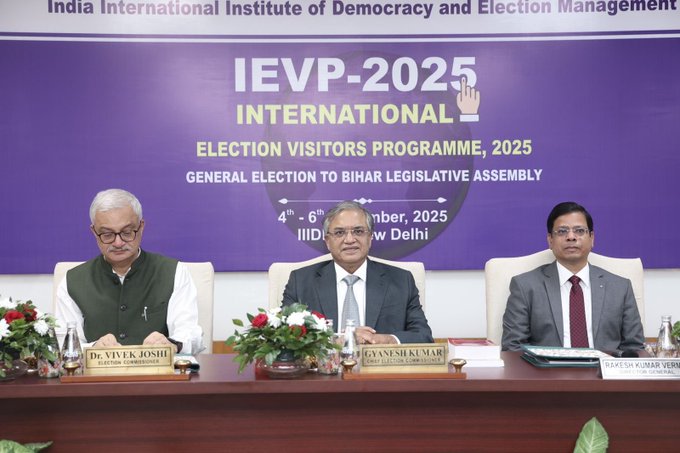
What’s the News?
- The Election Commission of India (ECI) has launched the International Election Visitors’ Program 2025 at the India International Institute for Democracy and Election Management in New Delhi.
- The program aims to foster international cooperation and engagement with election management bodies and international organizations.
- A total of 14 participants from seven countries—France, South Africa, Belgium, Indonesia, the Philippines, Thailand, and Colombia—will witness polling in the first phase of the Bihar Assembly Elections scheduled for November 6, 2025.
IEVP 2025 Key Details
- Objective: The IEVP is a flagship program for international cooperation, designed to showcase the strengths of India's electoral system and share best practices with other EMBs.
- Participating Nations: The 7 countries participating are France, South Africa, Belgium, Indonesia, the Philippines, Thailand, and Colombia.
- Delegate Activities:
- Participants will undertake a two-day tour of Bihar to observe the first phase of the Bihar Assembly Elections.
- They will witness polling preparations, visit Electronic Voting Machine (EVM) dispatch centres, and observe the polling process on election day.
- During the inauguration, delegates received a demonstration of EVMs and presentations on the preparation of electoral rolls and the overall conduct of elections in India.
Additional Info
- Election Commission of India (ECI):
- An autonomous constitutional authority responsible for administering Union and State election processes in India.
- The ECI operates under the authority of Article 324 of the Constitution of India.
- India International Institute for Democracy and Election Management (IIIDEM):
- An advanced training and resource centre of the ECI.
- It was established to promote democratic values and share India's electoral experiences and best practices with the world.
Sources
Lucknow Designated as UNESCO "Creative City of Gastronomy"

What’s the News?
- UNESCO has designated Lucknow, the capital of Uttar Pradesh, as a "Creative City of Gastronomy".
- The announcement was made by UNESCO Director-General Audrey Azoulay on World Cities Day (October 31).
- Lucknow is the second Indian city to receive this honour for gastronomy, following Hyderabad (which was designated in 2019).
- The inclusion is part of 58 new cities added to the UNESCO Creative Cities Network (UCCN).
Basis for Recognition
- Rich Culinary Heritage: The designation is a global recognition of Lucknow's centuries-old and distinguished culinary heritage, particularly its Awadhi cuisine.
- Awadhi Cuisine:
- This cuisine, influenced by Mughal, Persian, and Central Asian cooking, was nurtured by the Nawabs of Awadh.
- It is renowned for its sophisticated and subtle use of spices and signature slow-cooking techniques like "dum pukht" (art of cooking over a slow fire in a sealed pot).
- Iconic dishes highlighted in the city's nomination dossier include Galouti Kebabs, Awadhi Biryani, Nihari, Sheermal, and Makhan Malai.
- Cultural Significance: The city's nomination dossier presented its food as an instrument of cultural diplomacy and social harmony, reflecting the "Ganga-Jamuni tehzeeb" (a syncretic culture) that defines the city.
Additional Info
- UNESCO Creative Cities Network (UCCN):
- Launched in 2004, the UCCN aims to promote cooperation among cities that have recognized culture and creativity as strategic drivers for sustainable urban development.
- The network covers eight creative fields: Crafts and Folk Art, Design, Film, Gastronomy, Literature, Media Arts, Music, and (newly added) Architecture.
- With the 2025 additions, the UCCN now includes 408 cities in over 100 countries.
- Indian cities in UCCN include:
- Jaipur – Crafts and Folk Art
- Varanasi – Music
- Chennai – Music
- Hyderabad – Gastronomy
- Mumbai – Film
- Srinagar – Crafts and Folk Art
- Lucknow – Gastronomy (2025)
Sources
November 2025
29 November 202528 November 202527 November 202526 November 202525 November 202524 November 202522 November 202521 November 202520 November 202519 November 202518 November 202517 November 202515 November 202514 November 202513 November 202512 November 202511 November 202510 November 202508 November 202507 November 202506 November 202505 November 202504 November 202503 November 202501 November 2025
Archive
October 2026
- 28 October 2026
- 27 October 2026
- 26 October 2026
- 24 October 2026
- 23 October 2026
- 22 October 2026
- 21 October 2026
- 20 October 2026
- 19 October 2026
- 17 October 2026
- 16 October 2026
- 15 October 2026
- 14 October 2026
- 13 October 2026
- 12 October 2026
- 10 October 2026
- 09 October 2026
- 08 October 2026
- 07 October 2026
- 06 October 2026
- 05 October 2026
- 03 October 2026
- 02 October 2026
- 01 October 2026
September 2026
- 30 September 2026
- 29 September 2026
- 28 September 2026
- 26 September 2026
- 25 September 2026
- 24 September 2026
- 23 September 2026
- 22 September 2026
- 21 September 2026
- 19 September 2026
- 18 September 2026
- 17 September 2026
- 16 September 2026
- 15 September 2026
- 12 September 2026
- 11 September 2026
- 10 September 2026
- 09 September 2026
- 08 September 2026
- 07 September 2026
- 05 September 2026
- 04 September 2026
- 03 September 2026
- 02 September 2026
- 01 September 2026
August 2026
- 31 August 2026
- 29 August 2026
- 27 August 2026
- 26 August 2026
- 25 August 2026
- 24 August 2026
- 22 August 2026
- 21 August 2026
- 20 August 2026
- 19 August 2026
- 18 August 2026
- 17 August 2026
- 14 August 2026
- 13 August 2026
- 12 August 2026
- 11 August 2026
- 10 August 2026
- 08 August 2026
- 07 August 2026
- 06 August 2026
- 05 August 2026
- 04 August 2026
- 03 August 2026
- 01 August 2026
July 2026
- 31 July 2026
- 30 July 2026
- 29 July 2026
- 28 July 2026
- 27 July 2026
- 25 July 2026
- 23 July 2026
- 22 July 2026
- 21 July 2026
- 20 July 2026
- 18 July 2026
- 17 July 2026
- 15 July 2026
- 14 July 2026
- 13 July 2026
- 11 July 2026
- 10 July 2026
- 09 July 2026
- 08 July 2026
- 07 July 2026
- 06 July 2026
- 04 July 2026
- 03 July 2026
- 02 July 2026
- 01 July 2026
June 2026
May 2026
April 2026
March 2026
- 31 March 2026
- 30 March 2026
- 28 March 2026
- 27 March 2026
- 26 March 2026
- 25 March 2026
- 24 March 2026
- 23 March 2026
- 21 March 2026
- 20 March 2026
- 19 March 2026
- 18 March 2026
- 17 March 2026
- 16 March 2026
- 14 March 2026
- 13 March 2026
- 12 March 2026
- 11 March 2026
- 10 March 2026
- 09 March 2026
- 07 March 2026
- 06 March 2026
- 05 March 2026
- 03 March 2026
- 02 March 2026
February 2026
- 28 February 2026
- 27 February 2026
- 26 February 2026
- 25 February 2026
- 24 February 2026
- 23 February 2026
- 21 February 2026
- 20 February 2026
- 19 February 2026
- 18 February 2026
- 17 February 2026
- 16 February 2026
- 13 February 2026
- 12 February 2026
- 11 February 2026
- 10 February 2026
- 09 February 2026
- 07 February 2026
- 06 February 2026
- 05 February 2026
- 04 February 2026
- 03 February 2026
- 02 February 2026
January 2026
- 31 January 2026
- 30 January 2026
- 29 January 2026
- 28 January 2026
- 27 January 2026
- 26 January 2026
- 24 January 2026
- 23 January 2026
- 22 January 2026
- 21 January 2026
- 20 January 2026
- 19 January 2026
- 16 January 2026
- 15 January 2026
- 14 January 2026
- 13 January 2026
- 12 January 2026
- 10 January 2026
- 09 January 2026
- 08 January 2026
- 07 January 2026
- 06 January 2026
- 05 January 2026
- 03 January 2026
- 02 January 2026
- 01 January 2026
December 2025
- 31 December 2025
- 30 December 2025
- 29 December 2025
- 27 December 2025
- 26 December 2025
- 24 December 2025
- 23 December 2025
- 22 December 2025
- 20 December 2025
- 19 December 2025
- 18 December 2025
- 17 December 2025
- 16 December 2025
- 15 December 2025
- 13 December 2025
- 12 December 2025
- 11 December 2025
- 10 December 2025
- 09 December 2025
- 08 December 2025
- 05 December 2025
- 04 December 2025
- 03 December 2025
- 02 December 2025
November 2025
- 29 November 2025
- 28 November 2025
- 27 November 2025
- 26 November 2025
- 25 November 2025
- 24 November 2025
- 22 November 2025
- 21 November 2025
- 20 November 2025
- 19 November 2025
- 18 November 2025
- 17 November 2025
- 15 November 2025
- 14 November 2025
- 13 November 2025
- 12 November 2025
- 11 November 2025
- 10 November 2025
- 08 November 2025
- 07 November 2025
- 06 November 2025
- 05 November 2025
- 04 November 2025
- 03 November 2025
- 01 November 2025
October 2025
- 31 October 2025
- 30 October 2025
- 29 October 2025
- 28 October 2025
- 27 October 2025
- 25 October 2025
- 24 October 2025
- 23 October 2025
- 22 October 2025
- 21 October 2025
- 20 October 2025
- 18 October 2025
- 17 October 2025
- 16 October 2025
- 15 October 2025
- 14 October 2025
- 13 October 2025
- 11 October 2025
- 10 October 2025
- 09 October 2025
- 08 October 2025
- 07 October 2025
- 06 October 2025
- 04 October 2025
- 03 October 2025
- 02 October 2025
- 01 October 2025
September 2025
- 30 September 2025
- 29 September 2025
- 27 September 2025
- 26 September 2025
- 25 September 2025
- 24 September 2025
- 23 September 2025
- 22 September 2025
- 20 September 2025
- 19 September 2025
- 18 September 2025
- 17 September 2025
- 16 September 2025
- 15 September 2025
- 13 September 2025
- 12 September 2025
- 11 September 2025
- 10 September 2025
- 09 September 2025
- 08 September 2025
- 06 September 2025
- 05 September 2025
- 04 September 2025
- 03 September 2025
- 02 September 2025
- 01 September 2025
August 2025
- 30 August 2025
- 29 August 2025
- 28 August 2025
- 27 August 2025
- 26 August 2025
- 25 August 2025
- 23 August 2025
- 22 August 2025
- 21 August 2025
- 20 August 2025
- 19 August 2025
- 18 August 2025
- 16 August 2025
- 14 August 2025
- 13 August 2025
- 12 August 2025
- 11 August 2025
- 08 August 2025
- 07 August 2025
- 06 August 2025
- 05 August 2025
- 04 August 2025
- 02 August 2025
- 01 August 2025
July 2025
- 31 July 2025
- 30 July 2025
- 29 July 2025
- 28 July 2025
- 26 July 2025
- 25 July 2025
- 24 July 2025
- 23 July 2025
- 22 July 2025
- 21 July 2025
- 19 July 2025
- 18 July 2025
- 17 July 2025
- 16 July 2025
- 15 July 2025
- 12 July 2025
- 11 July 2025
- 10 July 2025
- 09 July 2025
- 07 July 2025
- 05 July 2025
- 04 July 2025
- 03 July 2025
- 02 July 2025
- 01 July 2025
June 2025
- 30 June 2025
- 28 June 2025
- 27 June 2025
- 26 June 2025
- 25 June 2025
- 24 June 2025
- 23 June 2025
- 21 June 2025
- 20 June 2025
- 19 June 2025
- 18 June 2025
- 17 June 2025
- 16 June 2025
- 14 June 2025
- 13 June 2025
- 12 June 2025
- 11 June 2025
- 10 June 2025
- 09 June 2025
- 07 June 2025
- 06 June 2025
- 05 June 2025
- 04 June 2025
- 03 June 2025
- 02 June 2025
May 2025
April 2025
- 30 April 2025
- 29 April 2025
- 28 April 2025
- 26 April 2025
- 25 April 2025
- 24 April 2025
- 23 April 2025
- 22 April 2025
- 21 April 2025
- 19 April 2025
- 18 April 2025
- 17 April 2025
- 16 April 2025
- 15 April 2025
- 14 April 2025
- 12 April 2025
- 11 April 2025
- 10 April 2025
- 09 April 2025
- 08 April 2025
- 07 April 2025
- 05 April 2025
- 04 April 2025
- 03 April 2025
- 02 April 2025
- 01 April 2025
March 2025
- 31 March 2025
- 29 March 2025
- 28 March 2025
- 27 March 2025
- 26 March 2025
- 25 March 2025
- 24 March 2025
- 22 March 2025
- 21 March 2025
- 20 March 2025
- 19 March 2025
- 18 March 2025
- 17 March 2025
- 15 March 2025
- 13 March 2025
- 12 March 2025
- 11 March 2025
- 10 March 2025
- 08 March 2025
- 07 March 2025
- 06 March 2025
- 05 March 2025
- 04 March 2025
- 03 March 2025
- 01 March 2025
February 2025
- 28 February 2025
- 27 February 2025
- 26 February 2025
- 25 February 2025
- 24 February 2025
- 22 February 2025
- 21 February 2025
- 20 February 2025
- 19 February 2025
- 18 February 2025
- 17 February 2025
- 15 February 2025
- 14 February 2025
- 13 February 2025
- 12 February 2025
- 11 February 2025
- 10 February 2025
- 08 February 2025
- 07 February 2025
- 06 February 2025
- 05 February 2025
- 04 February 2025
- 03 February 2025
- 01 February 2025
January 2025
- 31 January 2025
- 30 January 2025
- 29 January 2025
- 28 January 2025
- 27 January 2025
- 25 January 2025
- 24 January 2025
- 23 January 2025
- 22 January 2025
- 21 January 2025
- 20 January 2025
- 18 January 2025
- 17 January 2025
- 16 January 2025
- 15 January 2025
- 14 January 2025
- 13 January 2025
- 11 January 2025
- 10 January 2025
- 09 January 2025
- 08 January 2025
- 07 January 2025
- 06 January 2025
- 04 January 2025
- 03 January 2025
- 02 January 2025
- 01 January 2025