
Current Affairs
Stay updated with the latest national and international events.
01 May 2026
India Retained on USTR's Priority Watch List for IPR Concerns

What's the News?
The United States Trade Representative (USTR) has once again placed India on its "Priority Watch List" in the annual Special 301 Report for 2026, citing persistent shortcomings in the protection and enforcement of Intellectual Property (IP) rights. India is among six countries flagged in this category, alongside China, Russia, Indonesia, Chile, and Venezuela. The report specifically highlighted that "India remains one of the world’s most challenging major economies with respect to the protection and enforcement of IP."
Understanding the Special 301 Report
- What is it? It's an annual review by the USTR that assesses the IP protection and enforcement regimes of over 100 US trading partners.
- Categorization: Countries are placed into tiers: Priority Foreign Country (the most severe), Priority Watch List, or Watch List.
- Purpose: The report serves as a key policy tool, applying pressure on nations to strengthen their legal frameworks and enforcement mechanisms related to patents, copyrights, trademarks, and trade secrets. The 2026 report evaluated over 100 trading partners to identify those not meeting US IP standards.
Why India Remains on the Priority Watch List
US concerns about India's IP regime are multifaceted and long-standing. Key issues flagged include:
- Patent Hurdles: The Indian Patents Act is frequently criticized for posing challenges to patent applications, particularly from US pharmaceutical companies, and for allowing too much flexibility to the government.
- Data Protection: Concerns persist over the lack of an effective system to protect against the unfair commercial use and unauthorized disclosure of test data for pharmaceuticals and agricultural chemicals.
- Market Access & Tariffs: High customs duties on IP-intensive products like information and communications technology (ICT), solar energy equipment, medical devices, and capital goods are a major irritant.
- Enforcement Weakness: The report flags weak enforcement of copyrights and trademarks, coupled with high levels of counterfeiting.
- Inconsistent Progress: While acknowledging India's steps to strengthen its IP regime, the USTR noted "a lack of progress" on several long-standing concerns and inconsistent implementation.
Implications for India-US Trade & Diplomacy
Placement on the Priority Watch List is a significant diplomatic signal, falling just short of immediate punitive action.
- No Immediate Sanctions: Being on the list does not automatically trigger sanctions.
- Heightened Scrutiny & Negotiations: It indicates a problem with IP protection and market access, leading to intensified bilateral engagement. The USTR stated it will engage with India, including through Bilateral Trade Agreement negotiations. This placement can influence trade talks and pressure India for reforms.
- Risk of Escalation: If concerns persist and are not resolved, it can lead to further investigations. In extreme cases, issues can escalate into trade disputes under Section 301 of the US Trade Act of 1974, which empowers the US to take action against unfair trade practices.
- Tariff Context: The report comes amid renewed US scrutiny of Indian tariffs on IP-intensive goods, aligning with broader trade friction points.
Global Context and India's Position
- Six countries are on the 2026 Priority Watch List: Chile, China, India, Indonesia, Russia, and Venezuela. These nations will face intensive engagement from the USTR in the coming year.
- Vietnam was elevated to the most severe category, Priority Foreign Country, for the first time in thirteen years. This triggers a 30-day period for the USTR to decide on a formal Section 301 investigation.
- Other Movements: Argentina and Mexico were moved off the Priority Watch List to the less severe Watch List due to improvements. The European Union was added to the Watch List over concerns about geographical indications and pharmaceutical legislation. The Watch List now includes 19 trading partners.
Additional Info
- Legal & Policy Framework in India:
- National IPR Policy 2016: The primary policy aimed at promoting a "Creative India; Innovative India" by streamlining IP processes and increasing awareness.
- Department for Promotion of Industry and Internal Trade (DPIIT): The nodal agency for IPR-related matters under the Ministry of Commerce and Industry.
- Cell for IPR Promotion and Management (CIPAM): Tasked with effectively implementing the National IPR Policy.
- Relevant Statutes:
- The Patents Act, 1970: Governs the grant and regulation of patents; amended in 2005 to include product patents for pharmaceuticals.
- The Copyright Act, 1957: Protects original literary, dramatic, musical, and artistic works.
- The Trademarks Act, 1999: Provides for registration and better protection of trademarks.
- Global Context:
- TRIPS Agreement: An international legal agreement between all member nations of the WTO that sets minimum standards for many forms of intellectual property regulation.
- WIPO: The World Intellectual Property Organization, a specialized agency of the United Nations, which India joined in 1975.
Sources:
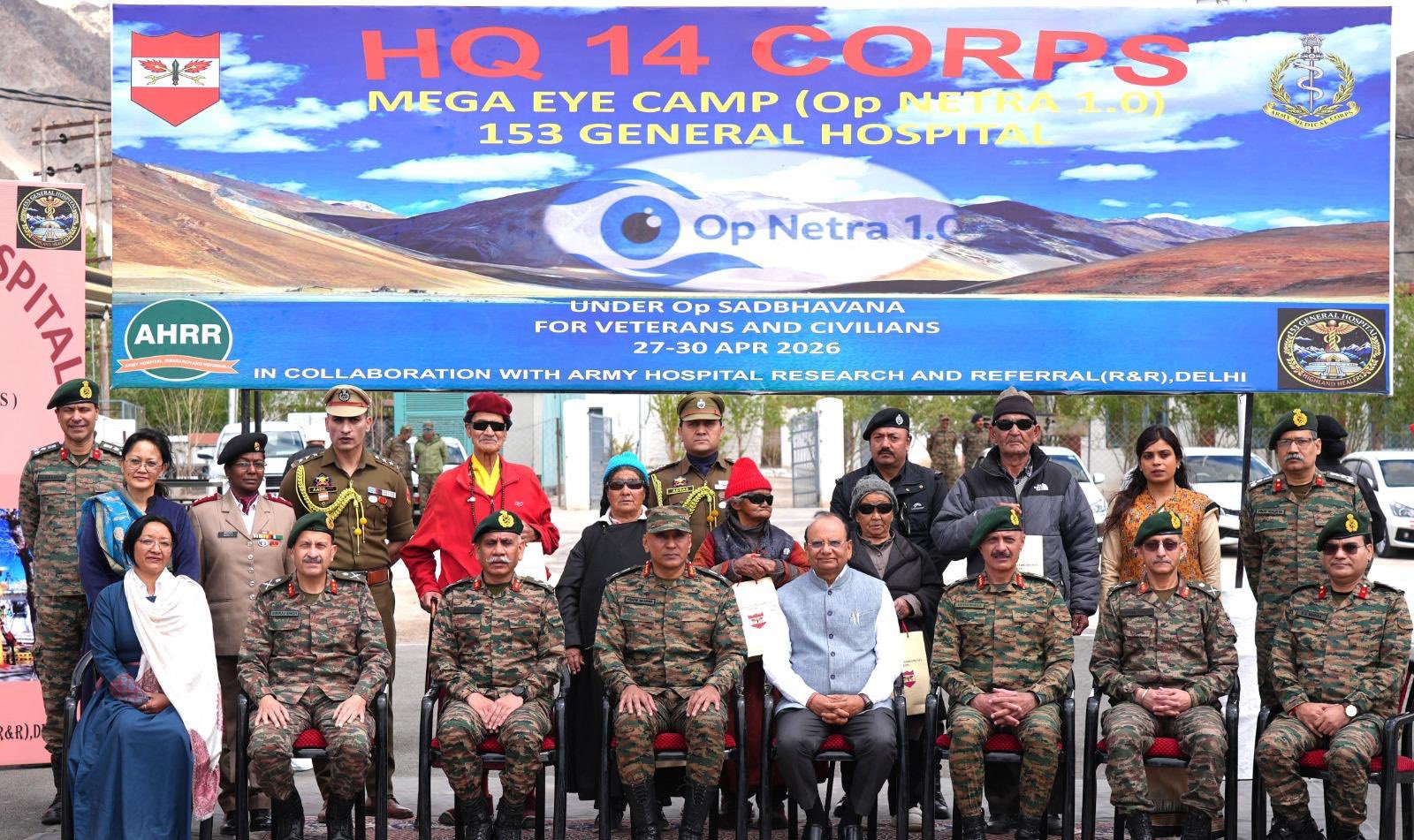
Indian Army Conducts "Op Netra 1.0" Mega Eye Camp in High-Altitude Ladakh
What's the News?
The Indian Army successfully concluded "Op Netra 1.0", a landmark four-day Advanced Surgical Eye Camp at 153 General Hospital in Leh, Ladakh. The high-altitude humanitarian mission provided advanced ophthalmic care to remote communities, screening 950 patients from seven districts and performing 214 specialized surgeries.
What is Op Netra 1.0?
- Nature of Initiative: Op Netra 1.0 was an Advanced Surgical Eye Camp conducted by the Indian Army under the leadership of the Director General, Armed Forces Medical Services (DGAFMS) — Surg Vice Adm Arti Sarin, the first woman to hold that position.
- Primary Aim: To deliver high-end ophthalmic medical care and humanitarian outreach to citizens in remote, high-altitude regions, ensuring geographical barriers do not prevent access to essential healthcare services.
- Venue: 153 General Hospital, Leh — a key military medical facility of the Fire & Fury Corps (14 Corps), which inaugurated and supervised the camp under Lt Gen Hitesh Bhalla, General Officer Commanding, 14 Corps.
Features and Data
- Wide Outreach: Screened 950 patients from seven districts of Ladakh, including extremely remote border areas such as Chushul, Hanle, Demchok, Durbuk, Turtuk, Zanskar, and Drass, where access to specialized healthcare is severely limited.
- Specialized Surgeries: Performed 214 procedures, comprising:
- 197 complex cataract surgeries
- 10 vitreo-retinal interventions
- Other advanced procedures including Pterygium Excision, IOL Repositioning
- Advanced Techniques: Deployed cutting-edge ophthalmic procedures:
- Glued Intraocular Lens (IOL) implantation — for complex cataract cases
- Minimally Invasive Glaucoma Surgery (MIGS) — a modern approach to glaucoma management
- Vitrectomy — a delicate retinal surgery
- IOL Repositioning and Pterygium Excision
- Humanitarian Impact: Restored sight to 15 completely visually impaired patients, significantly impacting their quality of life.
- Surgical Leadership: The operations were led by Brigadier Sanjay Kumar Mishra, Head of Ophthalmology at Army Hospital (Research & Referral), Delhi
Op Netra App
- What is it? A key milestone of the mission was the launch of the indigenously developed Op Netra App by 153 General Hospital.
- Features & Purpose:
- Enables end-to-end digitization of patient records for streamlined camp workflow
- Uses QR code-based identification for patient management and safety
- Automates surgical scheduling, ensuring operational efficiency in a high-volume, high-altitude setting
- Enhances diagnostic accuracy and ensures 100% accuracy in patient safety
- Significance: Represents a stride towards technological self-reliance, leveraging home-grown innovation to solve complex problems in challenging environments.
Inter-Service Coordination and Logistics
- The mission was enabled by the Indian Air Force (IAF) through the airlift of advanced medical equipment to the high-altitude setting, ensuring the standard of care matched the highest benchmarks.
- Serves as a premier example of civil-military liaison, demonstrating seamless collaboration between the armed forces, government leadership, and the Union Territory of Ladakh administration.
Nationwide Context: A Series of Eye Camps
- Op Netra 1.0 is part of a larger nationwide initiative, building on the success of Operation Drishti conducted in November 2025 at Command Hospital, Northern Command, Udhampur, which screened over 2,000 patients and performed 400+ surgeries.
- Subsequent camps were organized in Dehradun, Jaipur, Bagdogra, Gorakhpur, Bhuj, and Lakshadweep — spanning from desert frontiers to tropical islands.
- Cumulative Impact: The series has delivered over 2,500 sight-restoring surgeries across India since November 2025.
Sources:
QS Executive MBA Rankings 2026

What's the News?
The QS Executive MBA Rankings 2026 have been released, evaluating business schools on parameters such as career outcomes, employer reputation, diversity, executive profile, and thought leadership. IIM Bengaluru has retained its position as India's highest-ranked business school, placed 64th globally in the Executive MBA category. It remains the only Indian institution to feature in the global top 100.
India's Performance
- IIM Bengaluru's Ranking & Metrics:
- Secured 64th position globally, though it slipped from its previous year's rank of 50th.
- Showed strong domain-specific performance, ranking 42nd globally in Employer Reputation and 47th globally in Career Outcomes.
- Measures like diversity and executive profile continue to be areas with significant room for improvement.
- Other Indian Institutes: A total of seven Indian business schools are featured in the rankings. India is the second-most represented country in the Asia-Pacific region after China. The other ranked institutions are:
- Indian School of Business (ISB)
- IIM Kozhikode
- IIM Indore
- Institute of Management Technology (IMT) Ghaziabad
- Woxsen School of Business
- IIM Ranchi (debuted in the rankings this year).
- India's Gap: While India has high overall representation (7 institutes), only one is in the top 100. In contrast, China has 4 of its 8 ranked institutes in the top 100, and Singapore has all 3 in this elite bracket.
Global & Asia-Pacific Leaders
- Global Top 3:
- University of Oxford (Saïd Business School)
- HEC Paris
- MIT Sloan.
- Asia-Pacific (APAC) Top Performers:
- The region featured 35 business schools from 14 countries.
- Leading schools include National University of Singapore Business School (14th globally) and Melbourne Business School (29th globally).
Additional Info
- QS Rankings: An annual publication by Quacquarelli Symonds that evaluates universities and business schools worldwide. For Executive MBA programmes, the methodology weighs five indicators:
- Career Outcomes: Salary uplift and promotions.
- Employer Reputation: Perception of recruiters.
- Thought Leadership: Research output and academic influence.
- Executive Profile: Seniority and experience level of participants.
- Diversity: Gender and international representation.
- IIM Bengaluru (IIM-B): A premier public business school and an Institute of National Importance, known for its flagship Post Graduate Programme in Management (PGP) and executive education.
- Related Government Initiative: The National Institutional Ranking Framework (NIRF) by the Ministry of Education is India's domestic equivalent for ranking higher education institutions.
Sources
Lebanon Accuses Israel of Ecocide

What’s the News?
- Lebanon has formally accused Israel of committing "ecocide" due to the profound and long-term environmental damage inflicted during military operations between 2023 and 2024.
- This accusation, made by Lebanon's Environment Minister, is based on a detailed report highlighting the "severe, widespread, or long-term damage" to the country's ecosystems.
- This development occurs amid a growing international push, led by Pacific Island nations and supported by several European countries, to recognize ecocide as a standalone international crime under the Rome Statute of the International Criminal Court (ICC).
Understanding Ecocide
- What is Ecocide?
- The term refers to the most extreme forms of environmental destruction caused by human action. It is defined as "unlawful or wanton acts committed with the knowledge that there is a substantial likelihood of severe and either widespread or long-term damage to the environment being caused by those acts".
- The concept was coined in 1970 by biologist Arthur W. Galston to describe the ecological devastation caused by the use of Agent Orange during the Vietnam War.
- Ecocide vs. Existing International Law
- Anthropocentric vs. Ecocentric: Current laws are anthropocentric, viewing environmental damage as collateral to human harm. Ecocide is eco-centric, recognizing the environment itself as a victim worthy of direct protection.
- Peacetime Application: A key distinction is that ecocide would apply during both war and peace. Currently, the ICC can only prosecute environmental damage as a war crime if it occurs during active conflict and is disproportionate.
- Criminal vs. Civil Liability: Traditional international law treats cross-border environmental harm as a civil tort between states. The ecocide movement seeks to establish individual criminal liability for perpetrators.
Lebanon's Ecocide Allegations Against Israel
- The Accusation: Lebanon's Environment Minister Tamara el Zein stated that the "scale and intentionality of the damage... constitute what must be recognised as an act of ecocide" in the foreword to a 106-page government report.
- Key Data on Environmental Damage: The report, covering military operations from October 2023 to December 2024, documented extensive harm:
- Forest Cover: Damage to 5,000 hectares of forest.
- Agriculture: Destruction of $118 million in physical agriculture assets and $586 million in lost agricultural production. A total of 2,154 hectares of orchards (including 814 hectares of olive groves) were destroyed.
- Soil & Air Contamination: Soils were found with phosphorus concentrations up to 1,858 parts per million. Widespread air pollution included toxic compounds like dioxins.
- Total Cost: The monetary cost is estimated at $25 billion for damages, economic losses, and recovery needs.
- Broader Context: Critics argue this mirrors actions in Gaza, where an estimated 38-48% of tree cover and farmland was destroyed, and groundwater was contaminated by munitions.
The Legal and Enforcement Challenge
- Limitations of the Rome Statute: The ICC can only prosecute environmental damage as a war crime under a narrow set of conditions, requiring proof of disproportionate and intentional harm during an active war. Major peacetime ecological destruction currently has no pathway for international criminal prosecution.
- Jurisdictional Hurdles: The ICC cannot prosecute states that are not parties to the Rome Statute, such as Israel and Lebanon, unless there is a UN Security Council referral, which is subject to political vetoes.
- Supermajority Requirement: Amending the Rome Statute to include ecocide as a fifth international crime (alongside genocide, crimes against humanity, war crimes, and the crime of aggression) requires a two-thirds majority vote from all member states.
- Momentum for Change: In a significant step, Vanuatu, Fiji, and Samoa have formally proposed that the ICC recognize ecocide as an international crime. The Stop Ecocide International panel proposed a legal definition in 2021 to aid its inclusion in the Rome Statute.
India's Position on Ecocide
- Not a Party to the ICC: India has neither signed nor ratified the Rome Statute of the International Criminal Court. Therefore, it is not a party to the court's jurisdiction.
- Domestic Legal Status: The term 'ecocide' has been referenced in some Indian court judgments, but it has not been formally incorporated into Indian law.
- Policy Approach: India supports environmental protection through its participation in global agreements like the United Nations Framework Convention on Climate Change (UNFCCC) and the Convention on International Trade in Endangered Species of Wild Fauna and Flora (CITES). However, it has not taken concrete steps to enact a standalone ecocide law.
Additional Info
- Historical Context
- Vietnam War (1970): The term 'ecocide' was coined to describe the use of Agent Orange, which destroyed rainforests and caused long-term health defects.
- First Codification (1990): Vietnam became the first country to codify ecocide in its domestic law following its experience with wartime herbicides.
- Key Organizations
- Stop Ecocide International: A leading global advocacy network working to make ecocide an international crime.
- International Union for Conservation of Nature (IUCN): Recognized the crime of ecocide in 2025 but cannot enforce it.
- Conflict and Environment Observatory (CEOBS): An organization that studies the environmental impact of war and supports accountability.
- Related International Frameworks
- Rome Statute of the ICC: The treaty that established the International Criminal Court. It currently lists four core international crimes.
- ENMOD Convention (1977): The Convention on the Prohibition of Military or Any Other Hostile Use of Environmental Modification Techniques prohibits the hostile use of environmental modification.
- Article 8(2)(b)(iv): The specific provision of the Rome Statute that criminalizes intentional attacks that cause "widespread, long-term and severe damage to the natural environment" during warfare.
Sources
Atlantic Ocean's Critical Current System Could Weaken by 59% by 2100

What’s the News?
New research has warned that the Atlantic Meridional Overturning Circulation (AMOC) — a vast system of ocean currents acting as a global climate conveyor belt — could weaken by up to 59% by 2100. This is significantly more severe than previous estimates. Scientists caution that the collapse of this system could have catastrophic consequences for global weather, with particularly grave implications for the Indian summer monsoon, agriculture, and food security.
Understanding the Atlantic Meridional Overturning Circulation (AMOC)
- What is it? The AMOC is a major system of ocean currents in the Atlantic Ocean that functions like a massive, invisible conveyor belt, distributing heat and regulating climate across the globe .
- How it Works:
- Surface Flow: Warm, salty water from the tropics flows northward towards Greenland .
- Cooling and Sinking: As it reaches the freezing Arctic, the water cools, becomes dense, and sinks several kilometers into the deep ocean .
- Deep Water Return: This cold water then drifts back south as a deep-water current .
- Upwelling: Eventually, the water rises back to the surface to warm up, completing a cycle that takes about 1,000 years .
- Key Functions:
- Heat Distribution: It is the primary reason Europe enjoys a relatively mild climate compared to other regions at similar latitudes .
- Rainfall Regulation: It heavily influences global rainfall patterns, including those in Africa, the Americas, and Asia .
- Carbon and Nutrient Cycling: It transports carbon and nutrients through the marine ecosystem by sinking surface water into the deep ocean .
Why is the AMOC Slowing Down?
- The Problem: Freshwater Influx: Human-induced climate change is causing an accelerated melting of the Greenland ice sheet and increased rainfall. This dumps massive amounts of freshwater into the North Atlantic .
- The Mechanism: Freshwater is lighter and less salty than seawater, making it harder to sink. This acts as a brake on the entire circulation system, as the sinking motion is a crucial engine for the AMOC .
- New Research vs. Old Estimates:
- Previous estimates had projected a relatively modest slowdown of the AMOC.
- However, a new study by Dr. Valentin Portmann that combines real-world observations with climate models projects a much sharper decline. It estimates that the AMOC could weaken by 42% to 58% (with a potential of up to 59%) by 2100 .
- This new finding significantly reduces the uncertainty and suggests that the most pessimistic climate models are, in fact, the most realistic .
Impact of a Weakening AMOC on India
For India, a slowdown or collapse of the AMOC is a direct threat to its water and food security, given its reliance on the monsoon .
- Weakening of the Indian Summer Monsoon:
- The AMOC transports heat from the Southern to the Northern Hemisphere. A slowdown traps more heat in the south, altering the fundamental temperature gradient that drives global atmospheric circulation .
- This disruption weakens the large-scale north-south temperature gradient and regional land-sea thermal contrast, which in turn weakens the monsoon circulation over South Asia .
- Crucially, a weakened AMOC pulls the planet's tropical rain belt southward, away from the Indian subcontinent . This results in shorter wet seasons and longer dry spells .
- Palaeoclimate Evidence: Historical data from 133,000 years ago shows that a past collapse of the AMOC caused a dramatic decrease in the intensity of the Indian summer monsoon .
The El Niño Connection
The impacts are magnified through a dangerous link with the El Niño phenomenon in the Pacific Ocean.
- Mechanism: A sluggish AMOC traps heat in the Southern Hemisphere and leaves the North Pacific cooler. This disrupts the delicate temperature balance that drives the El Niño-Southern Oscillation (ENSO) .
- Consequence: Studies suggest a weakened AMOC will make El Niño events more extreme and unpredictable . For India, El Niño is already associated with suppressed monsoon rainfall, leading to compound climate risks of extreme droughts and erratic floods .
Additional Info
- Definition of 'Climate Tipping Point': A critical threshold beyond which a system reorganizes, often abruptly and irreversibly. The AMOC is one of the major identified global climate tipping points.
- Related International Bodies:
- Intergovernmental Panel on Climate Change (IPCC): The UN body for assessing the science related to climate change. Its reports have previously projected an AMOC decline but considered a collapse before 2100 unlikely, a view now being challenged by newer research .
- India's Domestic Climate Framework:
- National Action Plan on Climate Change (NAPCC): India's comprehensive framework for climate action, which includes the National Water Mission and National Mission for Sustainable Agriculture, both crucial for building resilience against monsoon variability.
- Ministry of Earth Sciences (MoES): The nodal body for climate change science in India. It published the first-ever "Assessment of Climate Change over the Indian Region" report, which details projected changes in the monsoon .
Sources
May 2026
Archive
October 2026
- 28 October 2026
- 27 October 2026
- 26 October 2026
- 24 October 2026
- 23 October 2026
- 22 October 2026
- 21 October 2026
- 20 October 2026
- 19 October 2026
- 17 October 2026
- 16 October 2026
- 15 October 2026
- 14 October 2026
- 13 October 2026
- 12 October 2026
- 10 October 2026
- 09 October 2026
- 08 October 2026
- 07 October 2026
- 06 October 2026
- 05 October 2026
- 03 October 2026
- 02 October 2026
- 01 October 2026
September 2026
- 30 September 2026
- 29 September 2026
- 28 September 2026
- 26 September 2026
- 25 September 2026
- 24 September 2026
- 23 September 2026
- 22 September 2026
- 21 September 2026
- 19 September 2026
- 18 September 2026
- 17 September 2026
- 16 September 2026
- 15 September 2026
- 12 September 2026
- 11 September 2026
- 10 September 2026
- 09 September 2026
- 08 September 2026
- 07 September 2026
- 05 September 2026
- 04 September 2026
- 03 September 2026
- 02 September 2026
- 01 September 2026
August 2026
- 31 August 2026
- 29 August 2026
- 27 August 2026
- 26 August 2026
- 25 August 2026
- 24 August 2026
- 22 August 2026
- 21 August 2026
- 20 August 2026
- 19 August 2026
- 18 August 2026
- 17 August 2026
- 14 August 2026
- 13 August 2026
- 12 August 2026
- 11 August 2026
- 10 August 2026
- 08 August 2026
- 07 August 2026
- 06 August 2026
- 05 August 2026
- 04 August 2026
- 03 August 2026
- 01 August 2026
July 2026
- 31 July 2026
- 30 July 2026
- 29 July 2026
- 28 July 2026
- 27 July 2026
- 25 July 2026
- 23 July 2026
- 22 July 2026
- 21 July 2026
- 20 July 2026
- 18 July 2026
- 17 July 2026
- 15 July 2026
- 14 July 2026
- 13 July 2026
- 11 July 2026
- 10 July 2026
- 09 July 2026
- 08 July 2026
- 07 July 2026
- 06 July 2026
- 04 July 2026
- 03 July 2026
- 02 July 2026
- 01 July 2026
June 2026
May 2026
April 2026
March 2026
- 31 March 2026
- 30 March 2026
- 28 March 2026
- 27 March 2026
- 26 March 2026
- 25 March 2026
- 24 March 2026
- 23 March 2026
- 21 March 2026
- 20 March 2026
- 19 March 2026
- 18 March 2026
- 17 March 2026
- 16 March 2026
- 14 March 2026
- 13 March 2026
- 12 March 2026
- 11 March 2026
- 10 March 2026
- 09 March 2026
- 07 March 2026
- 06 March 2026
- 05 March 2026
- 03 March 2026
- 02 March 2026
February 2026
- 28 February 2026
- 27 February 2026
- 26 February 2026
- 25 February 2026
- 24 February 2026
- 23 February 2026
- 21 February 2026
- 20 February 2026
- 19 February 2026
- 18 February 2026
- 17 February 2026
- 16 February 2026
- 13 February 2026
- 12 February 2026
- 11 February 2026
- 10 February 2026
- 09 February 2026
- 07 February 2026
- 06 February 2026
- 05 February 2026
- 04 February 2026
- 03 February 2026
- 02 February 2026
January 2026
- 31 January 2026
- 30 January 2026
- 29 January 2026
- 28 January 2026
- 27 January 2026
- 26 January 2026
- 24 January 2026
- 23 January 2026
- 22 January 2026
- 21 January 2026
- 20 January 2026
- 19 January 2026
- 16 January 2026
- 15 January 2026
- 14 January 2026
- 13 January 2026
- 12 January 2026
- 10 January 2026
- 09 January 2026
- 08 January 2026
- 07 January 2026
- 06 January 2026
- 05 January 2026
- 03 January 2026
- 02 January 2026
- 01 January 2026
December 2025
- 31 December 2025
- 30 December 2025
- 29 December 2025
- 27 December 2025
- 26 December 2025
- 24 December 2025
- 23 December 2025
- 22 December 2025
- 20 December 2025
- 19 December 2025
- 18 December 2025
- 17 December 2025
- 16 December 2025
- 15 December 2025
- 13 December 2025
- 12 December 2025
- 11 December 2025
- 10 December 2025
- 09 December 2025
- 08 December 2025
- 05 December 2025
- 04 December 2025
- 03 December 2025
- 02 December 2025
November 2025
- 29 November 2025
- 28 November 2025
- 27 November 2025
- 26 November 2025
- 25 November 2025
- 24 November 2025
- 22 November 2025
- 21 November 2025
- 20 November 2025
- 19 November 2025
- 18 November 2025
- 17 November 2025
- 15 November 2025
- 14 November 2025
- 13 November 2025
- 12 November 2025
- 11 November 2025
- 10 November 2025
- 08 November 2025
- 07 November 2025
- 06 November 2025
- 05 November 2025
- 04 November 2025
- 03 November 2025
- 01 November 2025
October 2025
- 31 October 2025
- 30 October 2025
- 29 October 2025
- 28 October 2025
- 27 October 2025
- 25 October 2025
- 24 October 2025
- 23 October 2025
- 22 October 2025
- 21 October 2025
- 20 October 2025
- 18 October 2025
- 17 October 2025
- 16 October 2025
- 15 October 2025
- 14 October 2025
- 13 October 2025
- 11 October 2025
- 10 October 2025
- 09 October 2025
- 08 October 2025
- 07 October 2025
- 06 October 2025
- 04 October 2025
- 03 October 2025
- 02 October 2025
- 01 October 2025
September 2025
- 30 September 2025
- 29 September 2025
- 27 September 2025
- 26 September 2025
- 25 September 2025
- 24 September 2025
- 23 September 2025
- 22 September 2025
- 20 September 2025
- 19 September 2025
- 18 September 2025
- 17 September 2025
- 16 September 2025
- 15 September 2025
- 13 September 2025
- 12 September 2025
- 11 September 2025
- 10 September 2025
- 09 September 2025
- 08 September 2025
- 06 September 2025
- 05 September 2025
- 04 September 2025
- 03 September 2025
- 02 September 2025
- 01 September 2025
August 2025
- 30 August 2025
- 29 August 2025
- 28 August 2025
- 27 August 2025
- 26 August 2025
- 25 August 2025
- 23 August 2025
- 22 August 2025
- 21 August 2025
- 20 August 2025
- 19 August 2025
- 18 August 2025
- 16 August 2025
- 14 August 2025
- 13 August 2025
- 12 August 2025
- 11 August 2025
- 08 August 2025
- 07 August 2025
- 06 August 2025
- 05 August 2025
- 04 August 2025
- 02 August 2025
- 01 August 2025
July 2025
- 31 July 2025
- 30 July 2025
- 29 July 2025
- 28 July 2025
- 26 July 2025
- 25 July 2025
- 24 July 2025
- 23 July 2025
- 22 July 2025
- 21 July 2025
- 19 July 2025
- 18 July 2025
- 17 July 2025
- 16 July 2025
- 15 July 2025
- 12 July 2025
- 11 July 2025
- 10 July 2025
- 09 July 2025
- 07 July 2025
- 05 July 2025
- 04 July 2025
- 03 July 2025
- 02 July 2025
- 01 July 2025
June 2025
- 30 June 2025
- 28 June 2025
- 27 June 2025
- 26 June 2025
- 25 June 2025
- 24 June 2025
- 23 June 2025
- 21 June 2025
- 20 June 2025
- 19 June 2025
- 18 June 2025
- 17 June 2025
- 16 June 2025
- 14 June 2025
- 13 June 2025
- 12 June 2025
- 11 June 2025
- 10 June 2025
- 09 June 2025
- 07 June 2025
- 06 June 2025
- 05 June 2025
- 04 June 2025
- 03 June 2025
- 02 June 2025
May 2025
April 2025
- 30 April 2025
- 29 April 2025
- 28 April 2025
- 26 April 2025
- 25 April 2025
- 24 April 2025
- 23 April 2025
- 22 April 2025
- 21 April 2025
- 19 April 2025
- 18 April 2025
- 17 April 2025
- 16 April 2025
- 15 April 2025
- 14 April 2025
- 12 April 2025
- 11 April 2025
- 10 April 2025
- 09 April 2025
- 08 April 2025
- 07 April 2025
- 05 April 2025
- 04 April 2025
- 03 April 2025
- 02 April 2025
- 01 April 2025
March 2025
- 31 March 2025
- 29 March 2025
- 28 March 2025
- 27 March 2025
- 26 March 2025
- 25 March 2025
- 24 March 2025
- 22 March 2025
- 21 March 2025
- 20 March 2025
- 19 March 2025
- 18 March 2025
- 17 March 2025
- 15 March 2025
- 13 March 2025
- 12 March 2025
- 11 March 2025
- 10 March 2025
- 08 March 2025
- 07 March 2025
- 06 March 2025
- 05 March 2025
- 04 March 2025
- 03 March 2025
- 01 March 2025
February 2025
- 28 February 2025
- 27 February 2025
- 26 February 2025
- 25 February 2025
- 24 February 2025
- 22 February 2025
- 21 February 2025
- 20 February 2025
- 19 February 2025
- 18 February 2025
- 17 February 2025
- 15 February 2025
- 14 February 2025
- 13 February 2025
- 12 February 2025
- 11 February 2025
- 10 February 2025
- 08 February 2025
- 07 February 2025
- 06 February 2025
- 05 February 2025
- 04 February 2025
- 03 February 2025
- 01 February 2025
January 2025
- 31 January 2025
- 30 January 2025
- 29 January 2025
- 28 January 2025
- 27 January 2025
- 25 January 2025
- 24 January 2025
- 23 January 2025
- 22 January 2025
- 21 January 2025
- 20 January 2025
- 18 January 2025
- 17 January 2025
- 16 January 2025
- 15 January 2025
- 14 January 2025
- 13 January 2025
- 11 January 2025
- 10 January 2025
- 09 January 2025
- 08 January 2025
- 07 January 2025
- 06 January 2025
- 04 January 2025
- 03 January 2025
- 02 January 2025
- 01 January 2025