
Study OAS ·
Tar Balls Management Rules 2026
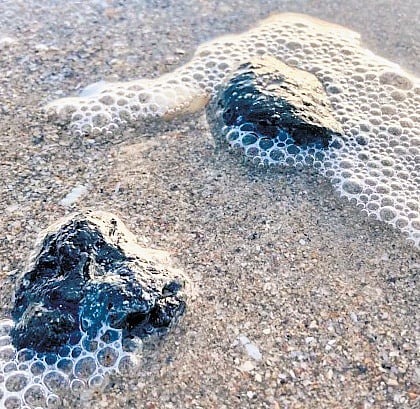
What's the News?
- Centre proposes Tar Balls Management Rules, 2026 — India's first dedicated regulatory framework to manage tar balls, the sticky, weathered residue from oil spills causing on-shore and off-shore marine pollution.
- Draft rules assign clear responsibilities to oil facility owners, state governments, district administrations, and central ministries for environmentally sound collection, transport, treatment, and disposal.
- Introduces polluter pays principle: Oil facility owners liable to pay environmental compensation for spills causing damage to ecology or public health.
- Proposes use of space technology (satellite, drones, sensor buoys) via National Remote Sensing Centre for oil spill surveillance and tar ball hotspot detection.
What are Tar Balls?
- Definition: Small, dark, sticky or hardened blobs of weathered crude oil formed through physical and chemical weathering of oil spills.
- Formation Process:
- Oil release from ships, offshore platforms, or natural seeps.
- Evaporation of lighter components.
- Emulsification with seawater forming thick mousse.
- Fragmentation by wind/waves into smaller pieces.
- Solidification into dense, sticky spheres.
- Composition:
- Heavy hydrocarbons (paraffins, aromatics).
- Asphaltenes (provide black color and sticky texture).
- Trapped sand, shells, seaweed, microplastics.
- Trace sulfur, nickel, and vanadium.
- Characteristics:
- Persistence: Highly resistant to degradation; remain in marine environment for extended periods.
- Size: Range from coin-sized to basketball-sized.
- Seasonality: Most prominent on India's western coast (Gujarat to Goa) during April-September due to south-westerly winds and currents.
Environmental and Economic Impact
Ecological Threats:
- Marine Life: Seabirds, fish, sea turtles mistake tar balls for food; ingestion causes internal poisoning; external coating impairs flight/swimming ability.
- Habitat Damage: Smothers coral reefs and seagrass beds.
- Toxicity: Contains heavy metals, trace elements, and persistent organic pollutants.
Economic Consequences:
- Tourism Impact: Accumulation on beaches reduces aesthetic value of coastal destinations (particularly affects Goa, Maharashtra, Karnataka, Gujarat).
- Fisheries: Contamination affects fishing industries along western coast.
Affected Regions:
- Primary Impact: Western coastal states—Maharashtra, Goa, Gujarat, Karnataka.
- Seasonal Pattern: Monsoon period (strong winds and currents drive tar balls ashore).
Institutional Framework & Responsibilities
- State Governments:
- Declare tar ball-induced coastal pollution as state disaster under Disaster Management Act, 2005.
- Establish State Level Crisis Management Groups under National Oil Spill Disaster Contingency Plan (NOS-DCP).
- District Administrations:
- Responsible for on-ground collection, handling, processing, and transport of tar balls from shorelines.
- Integrate tar ball management into District Disaster Management Plans.
- Indian Coast Guard (MoD):
- Implement NOS-DCP; conduct regular aerial/surface surveillance in Exclusive Economic Zone (EEZ).
- Deploy advanced tech: remotely operated vehicles (ROVs), automated underwater vehicles (AUVs) for underwater plume detection.
- Ministry of Petroleum & Natural Gas:
- Submit quarterly oil leakage/spill reports from offshore installations (within 500m radius) to ICG, state PCBs, and CPCB.
- Implement preventive measures at exploration facilities.
- Steering Committee: Multi-ministry body (7 ministries + CPCB/SPCBs) to advise coastal states/UTs on rule implementation.
Disposal & Resource Recovery Mechanism
- Repurposing as fuel: Tar balls with calorific value >1,500 kilo-calories/kg permitted for use as alternative fuel in cement kilns, subject to State PCB authorisation.
- Environmentally sound disposal: Mandates treatment/storage protocols to prevent secondary contamination during transport and processing.
- Compensation framework: Environmental compensation levied on defaulters equals actual loss/damage incurred by district administration for cleanup operations.
Timeline:
- Draft rules notified for stakeholder consultation (60-day comment period)
- Final rules to come into force one year from official gazette notification