
Study OAS ·
National Critical Mineral Mission 2025
Overview & Launch Details:
- Mission Launch:
- Launched in 2025 by the Government of India under the Ministry of Mines.
- Titled “National Critical Mineral Mission: Powering India’s Clean Energy Future”, the mission aims to establish a robust framework for self-reliance in the critical mineral sector.
- Strategic Importance:
- Critical minerals are essential inputs for clean energy technologies such as solar panels, wind turbines, electric vehicles (EVs), and energy storage systems.
- These minerals play a vital role in bolstering both economic development and national security by reducing supply chain vulnerabilities.
Key Objectives & Strategic Framework:
- Self-Reliance in Critical Minerals:
- Ensure long-term availability and processing of crucial minerals for India's clean energy transition.
- Secure the national critical mineral supply chain from both domestic and foreign sources.
- Promotion of Exploration & Innovation:
- The Geological Survey of India (GSI) is tasked with conducting 1,200 exploration projects during the period 2024-25 to 2030-31 to identify and develop deposits.
- Establish a Centre of Excellence on Critical Minerals (CECM) to regularly update the critical mineral list and guide future strategy.
- Regulatory & Financial Ecosystem Enhancements:
- A committee formed in November 2022 identified 30 critical minerals, out of which 24 have been included in Part D of Schedule I of the Mines and Minerals Development and Regulation Act, 1957 (MMDR Act).
- Inclusion in Part D grants the Central Government exclusive authority to auction mining leases and composite licenses for these minerals, streamlining regulatory processes.
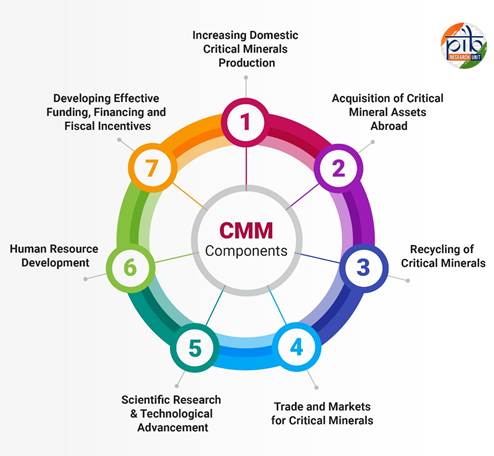
Key Features & Sectoral Impact:
- Essential Mineral Usage:
- Solar Energy: Minerals like silicon, tellurium, indium, and gallium are crucial for photovoltaic (PV) cells.
- Wind Energy: Rare earth elements such as dysprosium and neodymium are vital for wind turbine magnets.
- Electric Vehicles (EVs) & Energy Storage: Lithium, nickel, and cobalt are key for lithium-ion batteries.
- Economic and Strategic Objectives:
- Strengthen the global competitiveness of India’s mineral exploration, mining, beneficiation, processing, and recycling sectors.
- Enhance the value chain through improved infrastructure, technological advancements, R&D, and skill development.
- Foster innovation by integrating advanced digital tools and methodologies in mining operations.
Source