
Study OAS ·
India Semiconductor Mission 2.0
What's the News?
- The Union Budget 2026–27 announced India Semiconductor Mission (ISM) 2.0, marking a strategic shift from ecosystem creation to consolidation, technological depth, and global integration.
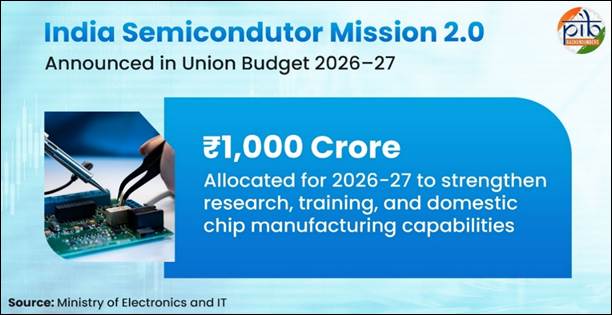
- A budgetary provision of ₹1,000 crore has been allocated for FY 2026–27 to support indigenous manufacturing of semiconductor equipment, full-stack Indian semiconductor IP development, and industry-led research centres.
- ISM 2.0 builds on the foundation of ISM 1.0 (approved in 2021 with ₹76,000 crore outlay), under which 10 projects worth ₹1.60 lakh crore have been approved across six states.
Mission Framework & Key Focus Areas
- Nodal Agency: India Semiconductor Mission (ISM), under the Ministry of Electronics & Information Technology (MeitY).
- Core Objectives:
- Indigenous Manufacturing: Local production of semiconductor equipment, chemicals, gases, and materials to reduce import dependence.
- Full-Stack IP Development: Promotion of end-to-end Indian semiconductor intellectual property for secure, globally competitive chip solutions.
- Research & Skills: Establishment of industry-led research and training centres to support applied R&D and advanced manufacturing skills.
- Supply Chain Resilience: Strengthening domestic and global semiconductor value chains amid geopolitical uncertainties.
- Financial Architecture:
- ISM 2.0 Allocation: ₹1,000 crore (FY 2026–27).
- Modified Programme for Semiconductor & Display Manufacturing: ₹8,000 crore total outlay for 2026–27.
- Projected Annual Targets:
- Semiconductor fabs: ₹4,000 crore investment; 1,500 jobs.
- ATMP/OSAT units: ₹11,000 crore investment; 3,000 jobs.
- Design Linked Incentive (DLI) Scheme: 10 IP cores; 200 design engineers.
Strategic Context & Market Outlook
- Market Growth Trajectory:
- Indian semiconductor market: $38 billion (2023) → $45–50 billion (2024–25) → $100–110 billion (projected by 2030).
- Target: 70–75% self-sufficiency in domestic chip demand by 2029; 3nm and 2nm technology nodes capability by 2035.
- Global Positioning:
- India aims to become a trusted, reliable partner in global semiconductor supply chains, reducing concentration risks (Taiwan produces ~90% of advanced chips).
- Aligns with global re-shoring trends: US CHIPS Act, EU Chips Act, and Japan's semiconductor revival initiatives.
- Policy Evolution:
- ISM 1.0 (2021): Focused on attracting fabs, ATMP/OSAT units, and design companies via fiscal incentives (up to 50% support).
- ISM 2.0 (2026): Emphasises technology depth, indigenous IP, equipment localisation, and talent pipeline development.
Design Ecosystem & Indigenous Innovation
- Design Linked Incentive (DLI) Scheme Achievements (as of Jan 2026):
- 24 semiconductor design startups supported; ₹430 crore venture capital attracted.
- 2.25 crore tool hours logged on national EDA platform; 67,000 students trained.
- 122 academic tape-outs; 56 chips fabricated at 180nm; 6 chips at advanced nodes (up to 12nm).
- 85 patents filed (75 academic, 10 startup).
- Indigenous Microprocessors:
- DHRUV64: Fully indigenous 64-bit processor by C-DAC under Microprocessor Development Programme.
- RISC-V Portfolio: SHAKTI, AJIT, VIKRAM, THEJAS processors developed under Digital India RISC-V (DIR-V) programme—eliminating licence costs via open-source architecture.
- Talent Development Initiatives:
- Chips to Startup Programme: EDA tool access across 397 universities/startups.
- SMART Lab (NIELIT Calicut): Targeting 1 lakh engineers; 62,000+ already trained.
- FutureSkills PRIME: MeitY-NASSCOM joint initiative for semiconductor skilling/reskilling.
Additional Info
- Historical Background:
- Semiconductor Policy Evolution: From Modified Special Incentive Package Scheme (M-SIPS, 2012) → Scheme for Promotion of Manufacturing of Electronic Components and Semiconductors (SPECS, 2020) → India Semiconductor Mission (2021).
- Key Milestones: Micron's $2.75 billion ATMP facility (Gujarat, 2023); Tata-PSMC fab project (₹91,000 crore, Assam, 2024).
- Related Initiatives & Organisations:
- Semiconductor Laboratory (SCL), Mohali: India's only pilot semiconductor fabrication facility.
- Centre for Development of Advanced Computing (C-DAC): Nodal agency for indigenous processor development.
- Electronic Development Fund (EDF): Supports innovation in electronics system design and manufacturing.
- Constitutional & Policy Linkages:
- Supports Article 51A(h) (Fundamental Duty: develop scientific temper) and Article 47 (public health via technology-enabled services).
- Aligns with National Electronics Policy 2019, National Strategy for Artificial Intelligence, and Panchamrit climate commitments (energy-efficient chips).
- Advances SDG 9 (Industry, Innovation, Infrastructure), SDG 8 (Decent Work), and SDG 17 (Partnerships for Goals).