
Study OAS ·
India Launches Its First Hydrogen-Powered Train
What’s the News?
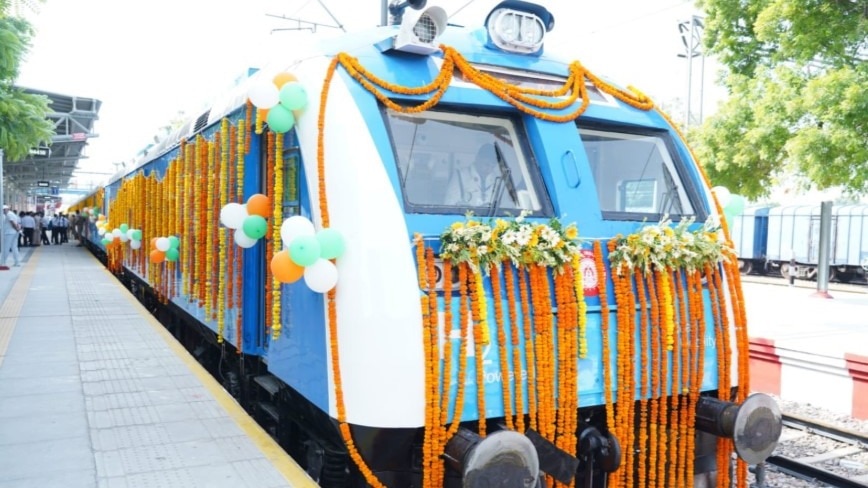
Prime Minister Narendra Modi flagged off India’s first hydrogen-powered passenger train from Jind, Haryana. The indigenously developed train will operate on the Jind–Sonipat section of Northern Railway.
The launch places India among a small group of countries operating hydrogen-powered trains and demonstrates the technology’s potential for clean rail transport, particularly on non-electrified or low-density routes. Commercial operations are to commence separately after an announcement by Northern Railway.
Hydrogen Train: Key Features
- Route: Jind–Sonipat, Haryana
- Distance: 89 km
- Travel time: Around two hours
- Configuration: 10 coaches
- Eight passenger coaches
- Two driving power cars
- Passenger capacity: Up to 2,600
- Propulsion: 3,200 horsepower, equivalent to approximately 2,400 kW
- Operational speed: 75 kmph
- Design speed: 110 kmph
- Service plan: Two round trips covering about 356 km daily
- Hydrogen consumption: Around 300 kg per day
- Stops: 14 intermediate halts, or 16 stations including Jind and Sonipat terminals.
How Does a Hydrogen Train Work?
The train uses hydrogen fuel cells instead of diesel combustion or continuous electricity from overhead wires.
- Hydrogen stored onboard reacts electrochemically with oxygen from the atmosphere.
- The fuel cell produces electricity that powers the traction motors.
- Batteries store surplus electricity and provide additional power during acceleration.
- The direct by-products are water vapour and heat, with no tailpipe carbon-dioxide emissions.
The train does not require continuous overhead electrification because electricity is generated onboard. However, its overall lifecycle emissions depend on how the hydrogen is produced; renewable-energy-based green hydrogen provides the maximum climate benefit.
Storage and Safety System
The train carries 440 kg of hydrogen at 350-bar pressure, divided equally between its two driving power cars.
- Refuelling time: Around four hours
- Jind storage facility: Capacity of approximately 3,000 kg
- Onboard safety equipment:
- 15 hydrogen-leak detectors
- Seven heat detectors
- Three flame detectors
- Automatic shutdown during a detected leak
- Ventilation fans and CCTV surveillance
Hydrogen is highly flammable; therefore, storage, ventilation, leak detection and emergency isolation systems are central to safe operation.
Indigenous Development
The train was designed, engineered and integrated in India using indigenous technology.
- Developed by the Integral Coach Factory, Chennai.
- Created by replacing the diesel propulsion system of a Diesel Electric Multiple Unit with a hydrogen-electric propulsion system.
- Supports the objectives of Make in India and Atmanirbhar Bharat.
- Each driving power car has a 1,200-kW fuel-cell propulsion system.
Hydrogen for Heritage
The project is associated with Indian Railways’ Hydrogen for Heritage initiative.
- It seeks to introduce hydrogen-fuel-cell trains, particularly on heritage and environmentally sensitive routes.
- Indian Railways has provided for 35 hydrogen train-set rakes comprising 210 coaches.
- The estimated provision is ₹80 crore per rake, amounting to approximately ₹2,800 crore for the trainsets.
- Hydrogen trains can replace diesel traction on routes where full electrification is technically difficult or economically inefficient.
Additional Info
- National Green Hydrogen Mission
- Nodal ministry: Ministry of New and Renewable Energy.
- Approved with an outlay of ₹19,744 crore.
- Target: At least 5 million metric tonnes of green-hydrogen production annually by 2030.
- Associated renewable-energy capacity: Approximately 125 GW.
- Expected outcomes:
- More than ₹8 lakh crore in investment.
- Over six lakh jobs.
- Nearly 50 million metric tonnes of annual greenhouse-gas abatement.
- Green Hydrogen
- Produced through water electrolysis using renewable electricity.
- It is an energy carrier, not a primary source of energy.
- Its environmental advantage depends on renewable electricity, water availability, efficient storage and transport infrastructure.