
Study OAS ·
India Develops First Indigenous Expendable Turbojet Engine
What’s the News?
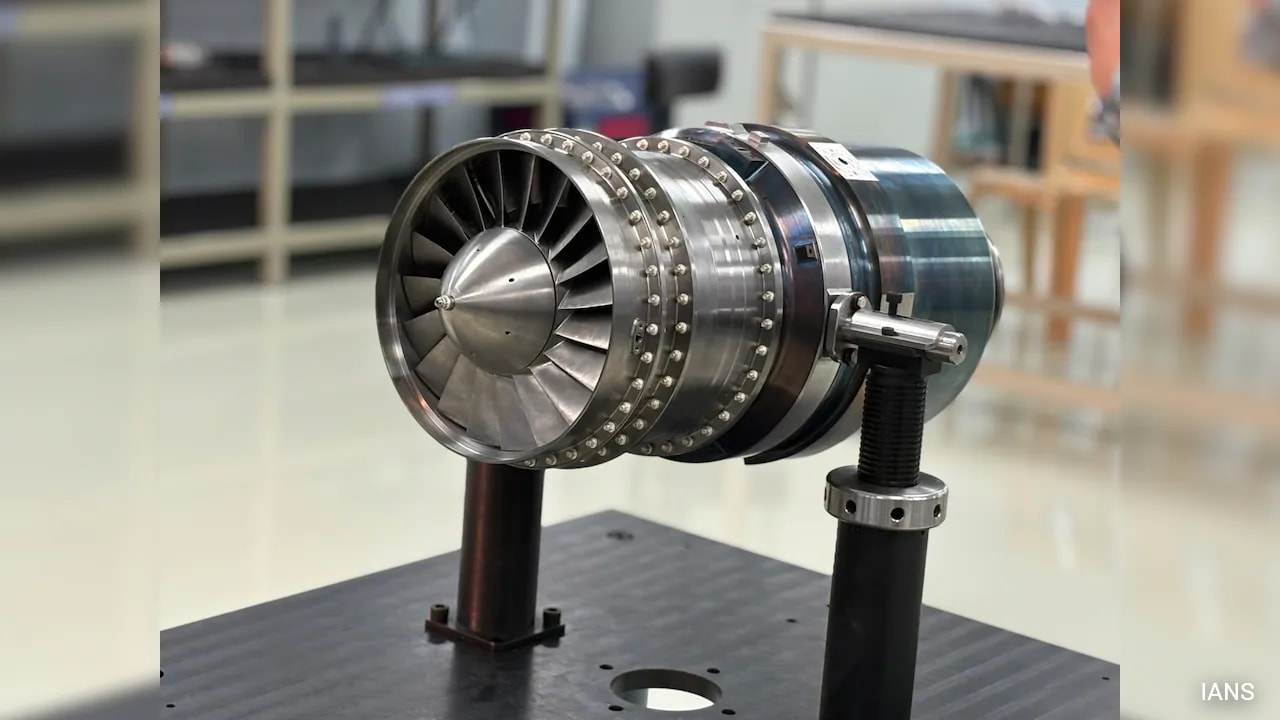
- India has successfully developed its first indigenous expendable turbojet engine in the 350-kg thrust class.
- The engine was designed by the Gas Turbine Research Establishment (GTRE), a laboratory of the Defence Research and Development Organisation.
- Hyderabad-based Azad Engineering was selected as the industry partner for its manufacturing and assembly.
- The engine has been realised and delivered to GTRE, demonstrating cooperation between India’s defence research establishment and private industry.
Expendable Turbojet Engine
A turbojet is an air-breathing gas-turbine engine that produces thrust through the following process:
- Air enters through the intake.
- A compressor raises the air pressure.
- Fuel is mixed with the compressed air and burned.
- Hot gases rotate a turbine.
- High-speed exhaust exits through a nozzle to generate thrust.
An expendable engine is designed primarily for single-use or limited-use platforms, such as missiles, aerial targets and certain unmanned systems.
350-kg Thrust Class
- The figure refers to the engine’s thrust output, not its physical weight.
- 350 kilogram-force is approximately equal to 3.43 kilonewtons.
- Engines in this class can provide propulsion for compact, high-speed unmanned or missile-based platforms.
- The indigenous engine was reportedly realised in about 24 months.
Defence Applications
Reported potential applications include:
- Naval anti-ship and cruise missiles.
- Unmanned aerial vehicles.
- Medium-range anti-drone systems.
- Air-to-air missiles.
- Air-to-surface missiles.
- High-speed expendable aerial targets.
Turbojet propulsion is suited to such platforms because it can provide sustained thrust during powered flight. The final deployment of the engine on a specific weapon system has not yet been officially announced.
GTRE–Industry Partnership
- Design authority: Gas Turbine Research Establishment.
- Manufacturing and assembly partner: Azad Engineering, Hyderabad.
- DRDO officials receiving the engine:
- Dr K. Rajalakshmi Menon, Director General, Aeronautical Systems.
- Dr S. V. Ramanamurty, Director, GTRE.
- Industry representative: Rakesh Chopdar, Chief Executive Officer of Azad Engineering.
The partnership allowed DRDO’s design to be converted into a production-grade physical engine through domestic precision manufacturing.
Additional Info
- Gas Turbine Research Establishment
- Located in Bengaluru, Karnataka.
- Functions under DRDO’s Aeronautical Systems cluster.
- Works on aero-gas-turbine engines and related propulsion technologies.
- Defence Research and Development Organisation
- Functions under the Ministry of Defence.
- Develops defence technologies for aeronautics, missiles, electronics, combat vehicles, naval systems and life sciences.
- Turbojet versus Turbofan
- Turbojet: Most thrust comes from high-speed exhaust gases.
- Turbofan: A significant part of the thrust is generated by air moved by a large fan.
- Turbojets are compact and suitable for certain high-speed applications, while turbofans generally provide better fuel efficiency.