
Study OAS ·
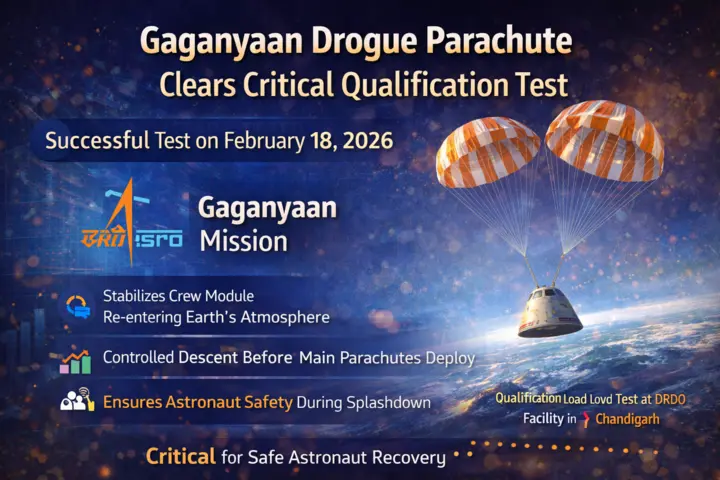
Gaganyaan Drogue Parachute Clears Critical Qualification Test
What’s the News?
India's human spaceflight programme achieved a major milestone on February 18, 2026, with the successful qualification-level load test of the Drogue Parachute for the Gaganyaan mission, conducted at DRDO's specialized testing facility in Chandigarh.
Drogue Parachute System
- Functionality:
- Deploys after the Crew Module re-enters the Earth's atmosphere.
- Stabilizes the module and reduces initial velocity before Main Parachutes deploy.
- Prevents oscillation and ensures a controlled descent.
- Testing Parameters:
- Qualification Load Test: Verifies the parachute's ability to withstand maximum expected forces.
- Simulates high-altitude and high-speed conditions encountered during spaceflight.
- Strategic Importance:
- Critical component of the Crew Module Recovery System.
- Failure in this system could jeopardize astronaut safety during splashdown.
Gaganyaan Mission Overview
- Objective:
- Demonstrate India's capability for Human Spaceflight.
- Launch astronauts into Low Earth Orbit (LEO).
- Mission Profile:
- Orbit: Approximately 400 km above Earth.
- Duration: 3 days for the crewed mission.
- Crew: 3 Indian Air Force pilots (selected as Gagannauts).
- Recovery Mechanism:
- Crew Module splashes down in the Indian Ocean.
- Involves a sequence of parachutes: Drogue, Pilot, and Main Parachutes.
- Supported by Indian Navy and Indian Coast Guard for retrieval.
Components:
- Crew Module (CM): Pressurized habitat for astronauts.
- Service Module (SM): Contains propulsion and support systems.
- Crew Escape System (CES): To pull the crew to safety in case of a launch pad or ascent phase emergency.
Complete Deceleration System Architecture:
| Stage | Component | Quantity | Function |
|---|---|---|---|
| 1 | Apex Cover Separation Parachutes | 2 | Remove protective cover |
| 2 | Drogue Parachutes | 2 | Stabilize & reduce velocity at high altitude |
| 3 | Pilot Parachutes | 3 | Extract main parachutes |
| 4 | Main Parachutes | 3 | Final deceleration for safe landing |
Sequence of Recovery:
- Step 1: Deployment of two Drogue Parachutes to stabilize the module.
- Step 2: Deployment of Pilot Parachutes.
- Step 3: Deployment of three Main Parachutes to ensure a safe splashdown speed of less than 8.5 meters/second.