
Study OAS ·
BRICS Tourism Ministers Adopt Jaipur Declaration
What’s the News?
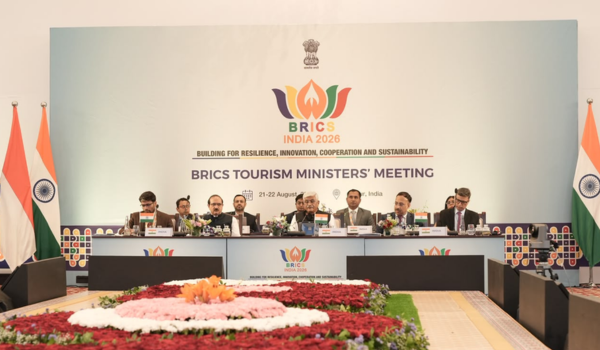
- The BRICS Tourism Ministers’ Meeting, held under India’s BRICS Chairship 2026, concluded in Jaipur, Rajasthan, with the unanimous adoption of the Jaipur Declaration.
- The declaration, formally the BRICS Tourism Ministers’ Communiqué 2026, provides a framework for practical tourism cooperation among BRICS countries.
- The meeting was chaired by Gajendra Singh Shekhawat, Union Minister for Culture and Tourism.
- It marked the culmination of the BRICS Tourism Track 2026, conducted under the theme “Building for Resilience, Innovation, Cooperation and Sustainability.”
Jaipur Declaration
The declaration identifies four priority areas for tourism cooperation:
- Artificial Intelligence and Tourism
- Sustainability and Responsible Tourism
- Tourism Skilling and Capacity Building
- Tourism Exchanges and Seamless Travel Facilitation
Artificial Intelligence & Tourism
- Promotes responsible, safe and human-centred AI and digital technologies.
- Cooperation will focus on:
- Tourism planning
- Destination management
- Visitor services
- Multilingual communication
- Travel facilitation
- It aims to use technology while maintaining human-centric and responsible tourism practices.
Sustainable & Responsible Tourism
- Focuses on tourism that protects:
- Local communities
- Environment
- Natural resources
- Cultural heritage
- Addresses concerns associated with over-tourism at major destinations.
- Encourages community-centred tourism so that economic benefits reach local populations.
- India is strengthening its Destination Management Organisation (DMO) model, drawing on experience from Ekta Nagar, Gujarat.
Skilling & Capacity Building
- BRICS countries will strengthen cooperation in training:
- Tourism professionals
- Youth
- Guides and hospitality workers
- Other tourism-sector stakeholders
- Training will focus on evolving technology, traveller expectations and new tourism services.
- The objective is to create a skilled workforce capable of supporting a competitive and sustainable tourism industry.
Seamless Travel Facilitation
- Seeks to make travel among BRICS countries easier and more convenient.
- Cooperation may involve:
- Improved connectivity
- Digital travel services
- Simplified travel processes
- Greater tourism exchanges
- Visa policies remain the sovereign responsibility of individual member countries; the declaration does not create a common BRICS visa.
- India's e-Visa system was highlighted as an example of technology-based travel facilitation.
Other Areas of Cooperation
The Jaipur Declaration also seeks greater BRICS collaboration in:
- Tourism investment
- Development of diversified tourism products
- Exchange of tourism data and best practices
- Cultural cooperation
- Exchange of artists and cultural groups
- Preservation of shared cultural heritage
- Strengthening people-to-people contacts.
BRICS Tourism Working Group
- The ministerial declaration was preceded by the 2nd BRICS 2026 Tourism Working Group (TWG) Meeting in Jaipur.
- The TWG was chaired by Bhuvnesh Kumar, Secretary, Ministry of Tourism.
- The 1st Tourism Working Group Meeting had been held virtually.
- The Working Group developed the four thematic priorities that formed the basis of the Jaipur Declaration.
India & BRICS Tourism
- India emphasised tourism as a contributor to Viksit Bharat @2047.
- Tourism can spread economic activity beyond major cities to towns, villages and remote regions.
- It supports livelihoods across sectors such as:
- Hotels and homestays
- Taxi services
- Tourist guides
- Artisans and weavers
- Farmers
- Local entrepreneurs
- India's domestic tourist visits have more than tripled over the past decade.
- India also held bilateral tourism discussions with Brazil, Iran, South Africa and the UAE on the sidelines of the meeting.
Additional Info
- BRICS
- Originally formed by Brazil, Russia, India and China (BRIC).
- South Africa joined in 2011, leading to the name BRICS.
- Current full membership comprises 11 countries:
- Brazil
- Russia
- India
- China
- South Africa
- Egypt
- Ethiopia
- Iran
- United Arab Emirates
- Saudi Arabia
- Indonesia.
- Indonesia became the newest full member after its entry was formally announced in 2025.
- BRICS is an informal intergovernmental grouping; it has no constitutive treaty, permanent secretariat or own budget.
- Cooperation broadly rests on three pillars:
- Political and security cooperation
- Economic and financial cooperation
- Cultural and people-to-people cooperation.
- India’s Chairship
- India holds the BRICS Chairship in 2026.
- The Jaipur meeting formed part of India's sectoral agenda for deepening cooperation among BRICS economies.