
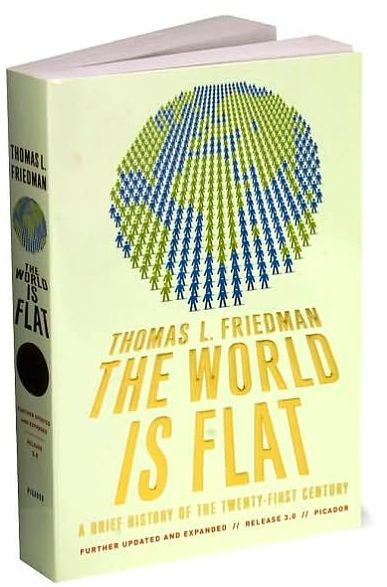
The World Is Flat – Thomas L. Friedman
Book Summary

Detailed Description of the Book
The World Is Flat explains how globalization, technology, and connectivity have reshaped the world into a more competitive and interlinked space. Thomas Friedman argues that due to advances in information technology, communication, supply chains, outsourcing, offshoring, automation, and digital platforms, the global economic playing field has become more level—allowing individuals, firms, and even small countries to compete globally.
Friedman identifies three eras of globalization:
-
Globalization 1.0 (countries globalising)
-
Globalization 2.0 (companies globalising)
-
Globalization 3.0 (individuals globalising)
He introduces the idea of “flatteners”—forces such as the internet, software, fibre-optic cables, global supply chains, and digital collaboration—that compress distance and time. However, the book is not blindly celebratory. Friedman repeatedly warns that a flat world also produces:
-
Job insecurity
-
Skill-based inequality
-
Race between education and technology
-
Pressure on states to reform governance and education systems
The following extracts may be used in OPSC answer writing:
“The world is flat.”→ Essay / GS-3: Core metaphor for globalisation and competitive equality
“Globalization has accidentally made Beijing, Bangalore, and Bethesda next-door neighbors.”→ GS-3 / Essay: Digital connectivity, outsourcing, IT-led integration
“The playing field is being leveled.”→ GS-3 Economy / Essay: Opportunities for developing countries, SMEs, individuals
“In a flat world, the most important attribute you can have is the ability to learn how to learn.”→ GS-3 / GS-4: Skill development, lifelong learning, education reform
“Globalization 3.0 is shrinking the world from a size small to a size tiny.”→ Essay / GS-3: Individual-level globalisation, digital platforms
“There are winners and losers in globalization.”→ GS-3 / Essay: Inequality, job displacement, need for social protection
“Countries that don’t invest in education will fall behind.”→ GS-3 / GS-2: Human capital, education policy, demographic dividend
“The invisible hand of the market will never work without a hidden fist.”→ GS-2 / GS-3 / Essay: Role of state, security, institutions behind markets
“Globalization is not a choice; it is a reality.”→ GS-3 / Essay: Inevitability of integration, adaptive governance
“Compassionate capitalism is essential in a flat world.”→ GS-4 Ethics / Essay: Inclusive growth, ethical globalisation
“The race is between education and technology.”→ GS-3 Economy / Essay: Skill gap, automation, future of work
“The challenge is not to stop globalization, but to manage it.”→ GS-2 Governance / GS-3: Regulation, labour laws, welfare state
Book Summary PDF:
No PDF available
← Back to Book Summaries